



Kerrison Rongeur | NJ Medical Instruments
SKU:
NJM-46461
Original price was: $ 59.$ 50Current price is: $ 50.Kerrison Rongeurs for Sale - Neurosurgical, Spine and ENT Bone Rongeurs
The Kerrison rongeur is one of the most consistently used instruments in neurosurgery and spine surgery, and it has been for the better part of a century. The design has remained fundamentally stable because it does what it was intended to do very well - removing bone from confined surgical fields in a controlled, incremental fashion without the uncontrolled force application of a chisel or the thermal spread of a drill. When the working anatomy is the posterior lamina of a vertebra adjacent to the spinal cord, or the bony wall of the internal auditory canal, or the orbital roof in a cranio-orbital approach, the ability to take precise bites of bone without collateral movement is not a convenience feature - it is a basic safety requirement.
This category at NJ Medical Instruments covers Kerrison rongeurs for general surgical, neurosurgical, ENT, and spine applications. CE-certified, manufactured from surgical-grade stainless steel at the company's Sialkot facility.
How Kerrison Rongeurs Work and Why Specifications Matter
The Kerrison rongeur operates on a punch-cut mechanism: a sliding footplate is advanced under the bone edge, and a sharp upper jaw is then pressed down against it by squeezing the handles, punching out the bone segment between the two surfaces. The surgeon advances the footplate, takes the bite, and removes the instrument to clear the bone fragment - then repeats as required until the decompression or opening is achieved.
Several specifications determine which rongeur is appropriate for a given application.
Bite Width - Matching the Rongeur to the Anatomy
Kerrison rongeurs are specified by the width of the footplate and cutting jaw - typically in 1 mm, 2 mm, 3 mm, 4 mm, and 5 mm sizes. The bite width determines how much bone is removed with each punch and how precisely the decompression can be controlled. Smaller bite widths (1-2 mm) are used in delicate anatomy - the posterior wall of the internal auditory canal, the lateral canal wall in cochlear implant surgery, or tight interlaminar spaces in the cervical spine. Larger bite widths (3-5 mm) are more efficient for removing larger bone volumes in lumbar laminectomy or posterior fossa decompression where speed matters more than precision.
Using a larger bite than the anatomy accommodates safely is one of the more common errors in Kerrison use - advancing the footplate of a 4 mm rongeur into a space that does not have adequate room risks driving the footplate into the dura or cord before the bite is taken.
Footplate Angle - Upward vs Downward Cutting
The footplate can be angled upward (toward the surgeon) or downward (away from the surgeon), and this determines the direction from which the bone is approached. Upward-cutting rongeurs are used when bone needs to be removed from a surface that is approached from below - the posterior face of the vertebral body in anterior approaches, the undersurface of the lamina. Downward-cutting rongeurs are used when the bone to be removed is above the footplate - the standard configuration for posterior laminectomy and laminar thinning.
The angle is also quoted as degrees: 40-degree and 90-degree footplate angles address the most acute access requirements, where the bone being removed is at a sharp angle to the instrument's approach axis. ENT applications in particular - lateral temporal bone work, cochlear surgery - frequently require 90-degree Kerrison rongeurs to reach around corners that upright-cutting instruments cannot approach.
Instrument Length - Standard vs Extended Shaft
Standard-length Kerrison rongeurs of around 18 cm work for most lumbar, posterior fossa, and ENT applications. Longer-shafted versions (23 cm, 26 cm) are needed for deep spinal approaches where the working distance from skin to lamina is significantly greater - obese patients, combined anterior-posterior approaches, and thoracic spine surgery where the rib cage adds distance between skin and spine.
Featured Kerrison Rongeur at NJ Medical Instruments
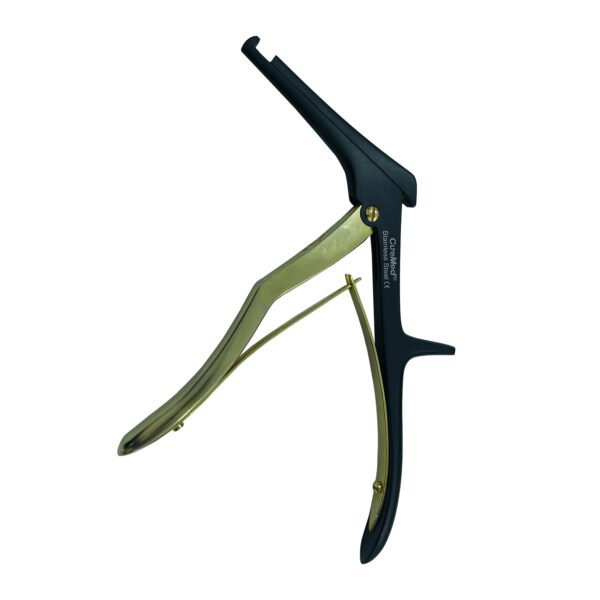
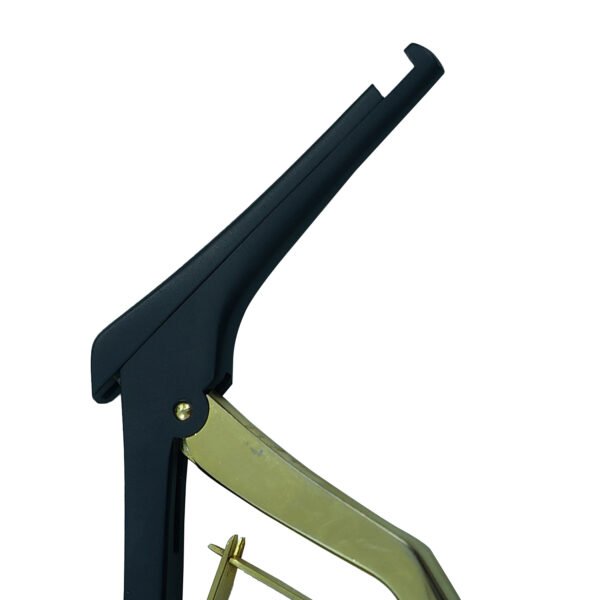
The Kerrison Rongeur here is manufactured from surgical-grade stainless steel with a sharp cutting jaw and properly hardened footplate - the two components that wear fastest and most affect clinical performance. The footplate has to retain its edge over repeated sterilisation cycles; a footplate that dulls quickly requires more force to advance under bone and increases the risk of inadvertent dural contact. The jaw-to-footplate alignment is precise, so the punch cut removes a clean bone fragment rather than fracturing or crushing it. CE-certified, available in multiple bite width specifications.
Ordering and Supply
NJ Medical Instruments ships Kerrison rongeurs worldwide, with bulk pricing available for neurosurgical units, spine surgery centres, ENT departments, and distributors. For wholesale enquiries or specific bite width and footplate angle specifications, contact info@njmedicalinstruments.com.