


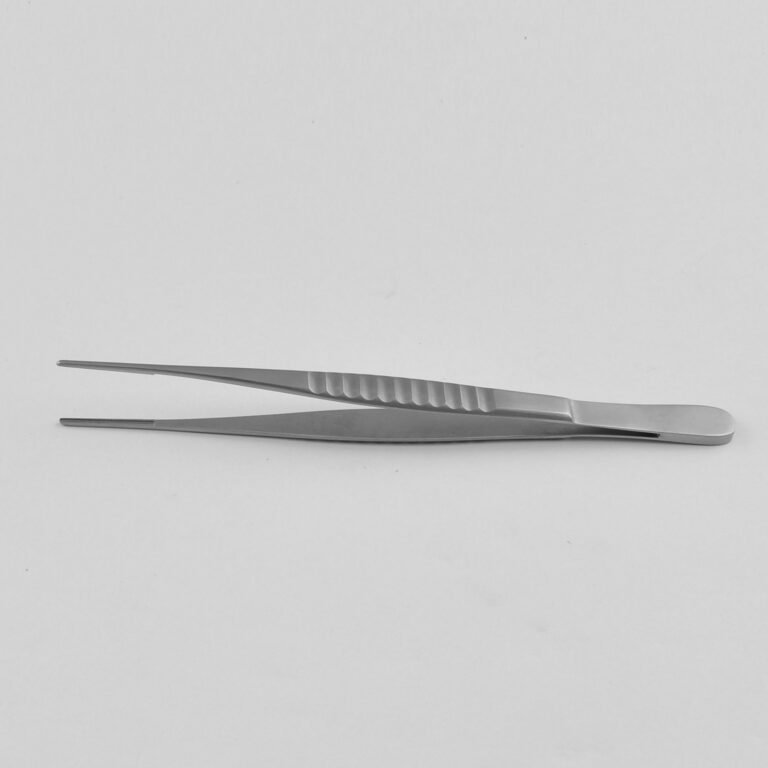
Tissue Forceps DeBakey | NJ Medical Instruments
In stock
Forceps: An Extension of the Fingers, Chosen by What the Tip Does
Forceps are the instrument a surgeon reaches for most often and thinks about least, which is precisely why the wrong pattern causes so much avoidable damage. Every design in this family answers the same question differently: how do you hold tissue securely without injuring it? The answer always involves a trade — the features that improve grip are the same ones that concentrate pressure. Understanding where a given pattern sits on that trade is the whole of choosing well.
Toothed, non-toothed and the grip-versus-trauma trade
Toothed forceps have interlocking teeth that engage tissue positively, holding tough or slippery structures with far less squeezing force than a smooth pattern requires. Because the grip comes from mechanical engagement rather than from pressure, they can be gentler on robust tissue than a smooth pattern gripped hard. Non-toothed forceps have serrated or smooth faces that grip by pressure across a broad area, and they are the right choice on delicate structures where a tooth would perforate. The mistake is not choosing one over the other, but using a smooth pattern with excessive force because it is nominally the atraumatic one.
Tip width and where the pressure actually goes
Force applied at the handle is concentrated into the contact area of the tips. A fine tip generates high local pressure for very little effort, which is what makes it precise and what makes it capable of crushing a delicate structure without the surgeon noticing. Broader tips spread the same force. Matching tip width to the tissue is a more important decision than the overall size of the instrument.
Spring tension and the effort of holding
Forceps are held closed for long periods, and the spring resists the whole time. Tension that is too high causes hand fatigue that degrades fine control over a long procedure; too low and the instrument gives no feedback about how much it is closed. Well-judged tension is why one pattern feels controllable and another feels like work, and it is not visible on inspection — it is felt.
Length, and where the hand has to be
Length is set by the depth of the field, but longer forceps also multiply small hand movements into larger tip movements and reduce the fidelity of what the fingers feel. Choosing the shortest instrument that reaches comfortably is generally better than choosing the longest available. Angled and bayonet forms exist to keep the hand out of the sightline when working straight down into a field.
Which forceps do you need?
| Tissue or task | Tip | Typical length | Chosen for |
|---|---|---|---|
| Tough or slippery tissue | Toothed, 1x2 or multi-tooth | 12–18 cm | Positive grip with less squeezing force |
| Delicate structures | Non-toothed, fine serration | 12–16 cm | Pressure spread, no perforation |
| Fine precise handling | Very fine tips | 10–14 cm | Accuracy — with care, as local pressure is high |
| Deep field | Any tip, long shanks | 20–25 cm | Reach, accepting reduced tactile fidelity |
| Straight-down approach | Bayonet or angled | 16–20 cm | Keeping the hand out of the line of sight |
Related instruments in this range
- General Surgery — the full range this category sits within
- Needle Holders — needle control during suturing
- Artery Forceps and Ligature Clamps — haemostatic control
- Scissors — cutting and dividing
- Surgical Instruments — the wider instrument catalogue
Wholesale, OEM and private-label supply
NJ Medical Instruments manufactures surgical forceps in Sialkot, Pakistan, supplying single instruments through this shop and bulk quantities direct to hospitals, surgical centres, dental practices and distributors. As the manufacturer we produce to specification — tip pattern and width, tooth configuration, serration, spring tension, length, handle finish, marking and private-label packaging. For volume pricing or an OEM quotation, email info@njmedicalinstruments.com or message +92-333-8733922.
Frequently asked questions
Are toothed forceps more traumatic than non-toothed?
Not necessarily. Teeth grip by mechanical engagement, so they need far less squeezing force to hold tough tissue securely — often making them gentler in practice than a smooth pattern being gripped hard to stop it slipping. Non-toothed patterns are the right choice on delicate structures a tooth would perforate. The real error is over-squeezing a smooth pattern because it is assumed to be the safe one.
Why do fine-tipped forceps damage tissue so easily?
Because the force applied at the handle is concentrated into a very small contact area, so local pressure is high for very little effort. Fine tips are precise, but they will crush a delicate structure without the hand registering much resistance. Matching tip width to the tissue matters more than the overall size of the instrument.
Does spring tension matter?
More than most buyers expect. Forceps are held closed for long stretches, so tension that is too high causes fatigue that erodes fine control over a long procedure, while tension that is too low gives no feedback about how far the instrument is closed. It cannot be judged by looking — it is felt in use.
Should I buy longer forceps to cover more situations?
Generally no. Longer instruments reach further but amplify small hand movements at the tip and transmit less of what the tissue feels like. The shortest pattern that reaches the field comfortably usually gives better control than a longer one used at close range.
What are your forceps made from?
They are manufactured from surgical-grade stainless steel, with tips aligned, spring tension set and the instrument inspected before dispatch. Both reusable and single-use options are available across our range — specify which you need when ordering, or ask for the material specification of a particular pattern.
Can I order in bulk or to our own specification?
Yes. As an OEM manufacturer we supply retail quantities through this shop and bulk orders direct from the factory. Custom tip patterns, tooth configurations, spring tensions, lengths, handle finishes, laser marking and private-label packaging are available. Send your specification and quantity for a quotation.