


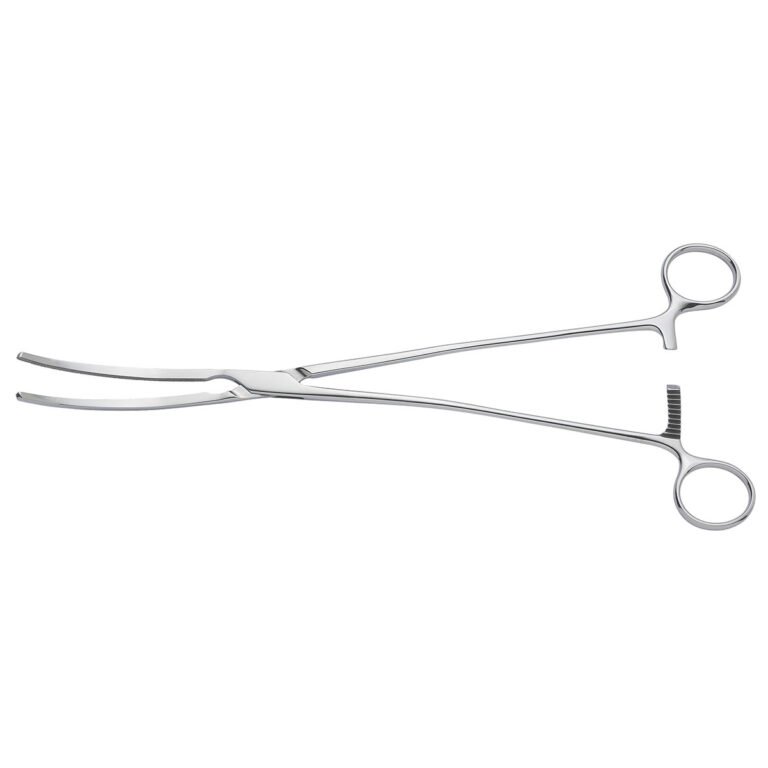
Debakey Aortic-aneurysm Clamp | NJ Medical Instruments
In stock
Aortic-Aneurysm Clamps: Spreading Load Across a Large-Diameter Vessel
Everything about clamping the aorta is a scale problem. The vessel is wide, the wall is thick and often abnormal, the pressure behind it is systemic, and the clamp has to hold all of that without concentrating force into any single line of tissue. A clamp that works perfectly on a 4 mm vessel does not simply scale up — the jaw has to get longer, the closing pressure has to be distributed differently, and the way the two blades meet becomes more important than how hard they close.
Jaw length and the distribution of closing force
Occluding a large vessel means flattening a wide cross-section into a sealed line. If the jaws are too short for the diameter, the vessel bunches at the ends of the blades and the seal depends on crushing the middle. Aortic patterns therefore use long jaws relative to the target vessel, so the flattened wall is supported across its whole width and the closing pressure per unit of tissue stays low even though the total force is high.
Blade profile: why the jaws are shaped, not flat
Aortic clamps rarely present two straight parallel blades. Angled, curved and compound-curve jaws exist so the clamp can be applied across a vessel that is fixed in position, approached from one side, and surrounded by structures that must not enter the jaws. The shape also governs where the clamp sits once locked: a well-chosen curve holds its position against arterial pressure instead of being pushed off the vessel.
Atraumatic jaw inserts and multi-row serration
The jaw face is what actually contacts the wall. Fine multi-row serrations, opposed at an angle so the rows interlock rather than meet point to point, grip the adventitia and hold against pressure while spreading contact over many small areas instead of a few sharp ones. This matters most in vessels whose walls are already abnormal, where the aim is to hold without initiating damage in the wall itself.
Ratchet control and the value of a light first setting
A long-jawed clamp generates considerable force at the tip for a small movement at the handle. A fine-graduated ratchet gives the surgeon settings between open and fully closed, so occlusion can be achieved at the least force that stops flow. On large clamps the difference between the first and second ratchet tooth can be the difference between controlled occlusion and unnecessary wall trauma, which is why ratchet quality is a genuine specification point here rather than a detail.
Which aortic clamp do you need?
| Application | Jaw form | Typical length | Selected for |
|---|---|---|---|
| Cross-clamping a large vessel | Long angled jaws, multi-row atraumatic serration | 24–28 cm | Full occlusion with load spread across the diameter |
| Deep or fixed-position access | Compound curve, offset shank | 26–30 cm | Reaching a vessel that cannot be mobilised toward the clamp |
| Side or partial application | Curved jaws with a controlled bite line | 24–26 cm | Isolating part of the circumference |
| Smaller-calibre branches | Shorter jaws, finer serration | 18–22 cm | Branch vessels where a full-size jaw is disproportionate |
| Restricted or shallow field | Slim shank, lower profile | 20–24 cm | Keeping the handle clear of the working space |
Related clamps in this range
- All Clamps — the full clamp range
- Carotid Clamps — low-profile occlusion in a shallow field
- Peripheral Vascular Clamps — jaws matched to smaller calibres
- Tangential Occlusion Clamps — partial occlusion with flow maintained
- Anastomosis Clamps — paired control across a join
Wholesale, OEM and private-label supply
NJ Medical Instruments manufactures aortic and vascular clamps in Sialkot, Pakistan, supplying single instruments through this shop and bulk quantities direct to hospitals, cardiac and vascular centres, and distributors. As the manufacturer we produce to specification — jaw length and curvature, serration pattern, ratchet graduation, shank profile, marking and private-label packaging. For volume pricing or an OEM quotation, email info@njmedicalinstruments.com or message +92-333-8733922.
Frequently asked questions
Why do aortic clamps have such long jaws?
Because occluding a wide vessel means flattening a wide cross-section. Long jaws support the whole flattened width, keeping the pressure on any given area of wall low. Short jaws on a large vessel force the tissue to bunch at the blade ends and concentrate the closing force in the middle.
What do multi-row atraumatic serrations do?
They grip the outer vessel wall across many small contact points instead of a few sharp ones. The rows are set so they interlock rather than meeting point to point, which holds the vessel against pressure while distributing the contact load over the jaw face.
How do I choose between straight, angled and compound-curve jaws?
Match the shape to the approach, not to preference. Angled jaws suit a vessel approached from one side; compound curves are for vessels fixed in position that cannot be brought toward the clamp; straighter jaws suit accessible, mobilised segments. The correct curve holds its own position once locked instead of being displaced by arterial pressure.
Why does the ratchet matter more on large clamps?
Long jaws multiply handle force at the tip, so each ratchet tooth represents a large jump in applied pressure. A finely graduated ratchet gives usable settings between open and fully closed, letting occlusion be achieved at the lowest force that works.
What are your aortic clamps made from?
They are manufactured from surgical-grade stainless steel with the jaw faces and ratchet finished and inspected before dispatch. Both reusable and single-use options are available across our vascular clamp range — specify which you need, or request the material specification for a particular pattern.
Can I order in bulk or with custom specifications?
Yes. We are an OEM manufacturer supplying retail quantities through this shop and bulk orders direct from the factory. Custom jaw geometry, lengths, serration patterns, laser marking and private-label packaging are available. Send us your specification and quantity for a quotation.