


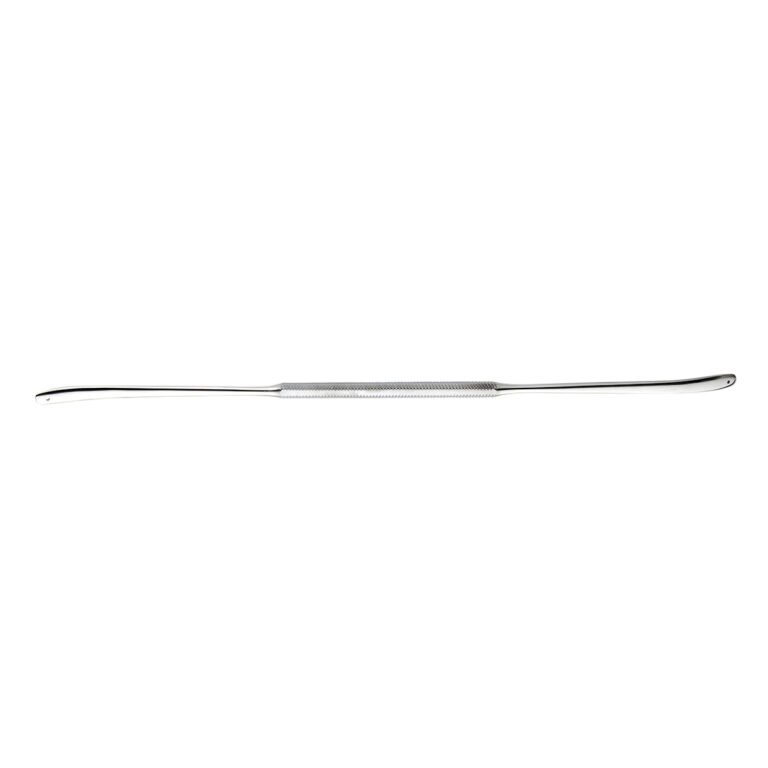
Dissector | NJ Medical Instruments
In stock
Dissectors: Finding the Plane Rather Than Making One
A dissector is a blunt instrument by design, and that is the entire idea: it separates structures along the planes that already exist between them instead of creating a new division through tissue. Anatomy provides these natural boundaries, and a blunt working end follows them because it will not pass through what it cannot separate. Where a blade divides whatever it meets, a dissector finds where the tissue is already willing to come apart — which is why it is often the safer instrument in exactly the places where structures must be preserved.
Blunt by design, not by compromise
The rounded or flattened end of a dissector is not a dulled blade. It is shaped so that force applied along the plane spreads the tissue apart, while force applied across the plane simply meets resistance rather than cutting. That asymmetry is the safety feature: the instrument advances readily where a plane exists and stops where one does not, giving the surgeon information about the anatomy through the resistance it returns.
Working end shapes and what each is for
A spatulate end sweeps a broad plane open across its width. A rounded or olive tip probes and opens a plane gently at a point, feeling its way. A hooked or right-angled end passes behind a structure so it can be lifted, encircled or slung. Many patterns are double-ended, pairing two of these so one instrument covers both the finding and the opening of a plane without an exchange.
Shaft length, rigidity and transmitted feel
The shaft carries information as much as force. A rigid shaft transmits resistance faithfully to the hand, which is what makes the plane detectable; a shaft that flexes absorbs that signal and the surgeon feels less than the tip encounters. Length is chosen for the depth of the field, but every extra centimetre of unsupported shaft costs some fidelity, which is why depth should be matched rather than over-specified.
Where dissectors sit relative to elevators and raspatories
These families are adjacent and often confused. A dissector separates soft tissue along a plane between structures. An elevator lifts tissue away from bone, working against a hard surface. A raspatory strips periosteum by scraping along bone. The distinction is what the instrument works against — soft tissue on both sides for a dissector, bone on one side for the other two — and it determines which instrument belongs in the hand at a given moment.
Which dissector do you need?
| Task | Working end | Shaft | Chosen for |
|---|---|---|---|
| Opening a broad plane | Spatulate | Rigid, medium length | Sweeping a plane open across its width |
| Finding a plane | Rounded or olive tip | Rigid, fine | Probing gently with good transmitted feel |
| Passing behind a structure | Right-angle or hooked | Medium | Encircling, lifting or slinging |
| Deep field | Any, on a long shaft | Long, rigid | Reach with the handle clear of the wound |
| Fine or superficial work | Small paired ends | Short, light | Control where a heavy instrument masks feel |
Related instruments in this range
- Curettes, Raspatories & Elevators — the full range this category sits within
- Bone Curettes — scraping with tactile feedback
- Elevators — lifting tissue from bone
- Surgical Instruments — the wider instrument catalogue
- General Surgery — general operating instruments
Wholesale, OEM and private-label supply
NJ Medical Instruments manufactures dissectors in Sialkot, Pakistan, supplying single instruments through this shop and bulk quantities direct to hospitals, surgical units and distributors. As the manufacturer we build to specification — working-end profile, single or double-ended configuration, shaft length and rigidity, handle form, marking and private-label packaging. For volume pricing or an OEM quotation, email info@njmedicalinstruments.com or message +92-333-8733922.
Frequently asked questions
What is the difference between a dissector, an elevator and a raspatory?
What each works against. A dissector separates soft tissue along a plane that lies between two structures. An elevator lifts tissue away from bone. A raspatory strips periosteum by scraping along a bone surface. They look related and are often stored together, but they are not substitutes for one another.
Why is a blunt instrument safer here than a sharp one?
Because a blunt end advances where a natural plane exists and meets resistance where one does not. It separates rather than divides, so it will not pass through a structure that has not yielded — and the resistance it returns tells the surgeon something about the anatomy ahead.
Which working-end shape should I choose?
A rounded or olive tip for finding and gently opening a plane, a spatulate end for sweeping that plane open across its width, and a right-angle or hooked end for passing behind a structure to lift or encircle it. Double-ended patterns pair two of these so one instrument covers more of the sequence.
Does shaft rigidity really matter?
Yes. The shaft transmits resistance back to the hand, and a flexing shaft absorbs that signal, so the surgeon feels less than the tip encounters. Since detecting the plane is the whole purpose, rigidity is worth more than reach — choose the length the field needs rather than the longest available.
What are your dissectors made from?
They are manufactured from surgical-grade stainless steel, with working ends finished and inspected before dispatch. Both reusable and single-use options exist across our range — specify which you need when ordering, or ask for the material specification of a particular pattern.
Can I order in bulk or to our own specification?
Yes. As an OEM manufacturer we supply retail quantities through this shop and bulk orders direct from the factory. Custom working-end profiles, double-ended pairings, shaft lengths, handle forms, laser marking and private-label packaging are available. Send your specification and quantity for a quotation.