


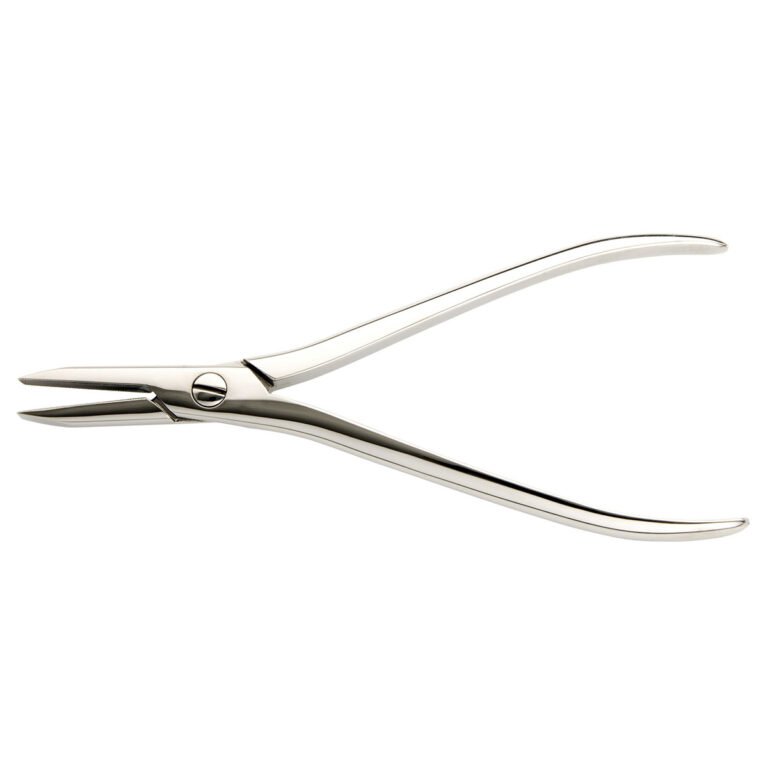
Stille Flat Pliers | NJ Medical Instruments
In stock
Flat Pliers: Gripping and Shaping With Parallel Faces
Flat pliers exist because some jobs need a face rather than a point — a flat, parallel surface that can hold wire, sheet or a small component without marking it or letting it twist. Where cutting instruments concentrate force onto an edge and holding forceps bite into a surface, flat pliers spread contact evenly across two opposed planes. That even contact is what allows controlled bending, because material bent against a flat face bends along a predictable line rather than deforming around a point.
Parallel closure and why it matters more than it sounds
On a simple pivoted plier the jaws close at an angle, so the tips meet before the heels do and a workpiece is gripped along a line at the tip. That is enough for holding, but not for bending sheet or forming a clean angle in wire. Patterns designed for shaping use geometry that keeps the working faces closer to parallel through the closing range, so the workpiece is held across the whole face and the bend forms where it is intended to.
Face finish: smooth, serrated and what each costs you
Smooth faces grip less but leave the workpiece unmarked, which matters for wire and components whose surface must stay intact. Serrated faces grip far better and mark accordingly. The choice is a straightforward trade and there is no pattern that avoids it — which is why workshops and clinics that both hold and form material generally stock both face types rather than compromising with a medium serration.
Tip width, jaw length and the leverage behind them
A wide flat tip spreads force and suits broader material and larger bends. A narrow tip reaches into confined spaces and forms tighter radii but concentrates force, so it deforms thin material more easily. Jaw length sets the leverage available: a short jaw delivers more force at the tip for the same handle effort, a long jaw trades force for reach and finer control. These three dimensions are chosen together, not separately.
Where flat pliers sit alongside cutting and holding instruments
Flat pliers are the forming and handling instrument in a set whose other members cut and grip aggressively. They are commonly used for adjusting and shaping wire components, handling small parts that must not be scored, and making controlled bends where a toothed instrument would leave a stress-raising mark at exactly the point of highest strain.
Which flat pliers do you need?
| Task | Face and tip | Jaw length | Chosen for |
|---|---|---|---|
| Forming clean bends | Smooth parallel faces, wide tip | Short to medium | Bending along a defined line without marking |
| Firm holding | Serrated faces | Short | Maximum grip where surface marking is acceptable |
| Confined access | Narrow tip | Long | Reach and tight radii in restricted space |
| Delicate components | Smooth fine faces | Medium | Handling parts whose surface must stay intact |
| Heavier material | Wide serrated faces | Short, heavy build | Force at the tip for the effort applied |
Related instruments in this range
- Bone Cutters & Rongeurs — the full range this category sits within
- Extraction Pliers — anatomically contoured beaks
- Bone Cutting Forceps — dividing with a closing edge
- Orthodontic Pliers — wire forming in orthodontics
- Surgical Instruments — the wider instrument catalogue
Wholesale, OEM and private-label supply
NJ Medical Instruments manufactures flat pliers in Sialkot, Pakistan, supplying single instruments through this shop and bulk quantities direct to hospitals, dental practices, laboratories and distributors. As the manufacturer we build to specification — face finish, tip width, jaw length, joint type, handle form, marking and private-label packaging. For volume pricing or an OEM quotation, email info@njmedicalinstruments.com or message +92-333-8733922.
Frequently asked questions
Should I choose smooth or serrated faces?
Smooth faces if the workpiece must not be marked — wire, finished components, anything where a scored surface matters. Serrated faces if grip is the priority and marking is acceptable. It is a direct trade with no pattern that gives both, so most users stock one of each rather than settling on a medium serration.
What does parallel closure actually do?
It keeps the working faces closer to parallel through the closing range, so the workpiece is held across the whole face rather than pinched at the tips. For holding, this matters little; for forming, it is what makes a bend occur along the intended line instead of deforming around a point.
How do I choose tip width?
Wide tips spread force and suit broader material and larger bends; narrow tips reach into confined spaces and form tighter radii but concentrate force and will deform thin material more readily. Choose tip width together with jaw length, since the two together determine how much force actually arrives at the workpiece.
Does jaw length change how much force I get?
Yes. A shorter jaw delivers more force at the tip for the same effort at the handle; a longer jaw trades force for reach and finer control. If an instrument feels like it needs too much effort, the jaw may simply be longer than the task warrants.
What are your flat pliers made from?
They are manufactured from surgical-grade stainless steel, with faces finished and joints fitted and inspected before dispatch. Both reusable and single-use options exist across our range — specify which you need when ordering, or ask for the material specification of a particular pattern.
Can I order in bulk or to our own specification?
Yes. As an OEM manufacturer we supply retail quantities through this shop and bulk orders direct from the factory. Custom face finishes, tip widths, jaw lengths, handle forms, laser marking and private-label packaging are available. Send your specification and quantity for a quotation.