


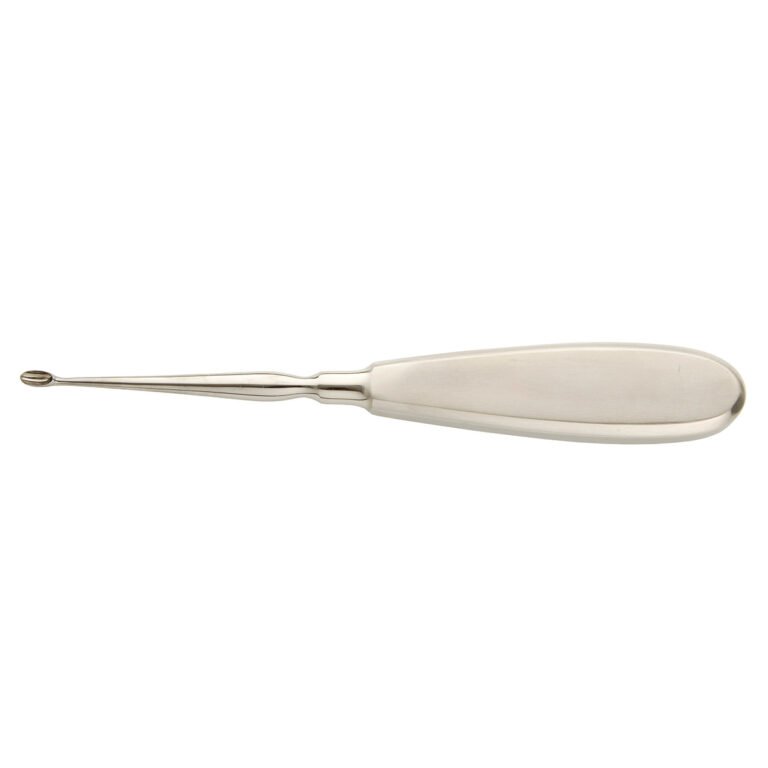
Bone Curette | NJ Medical Instruments
In stock
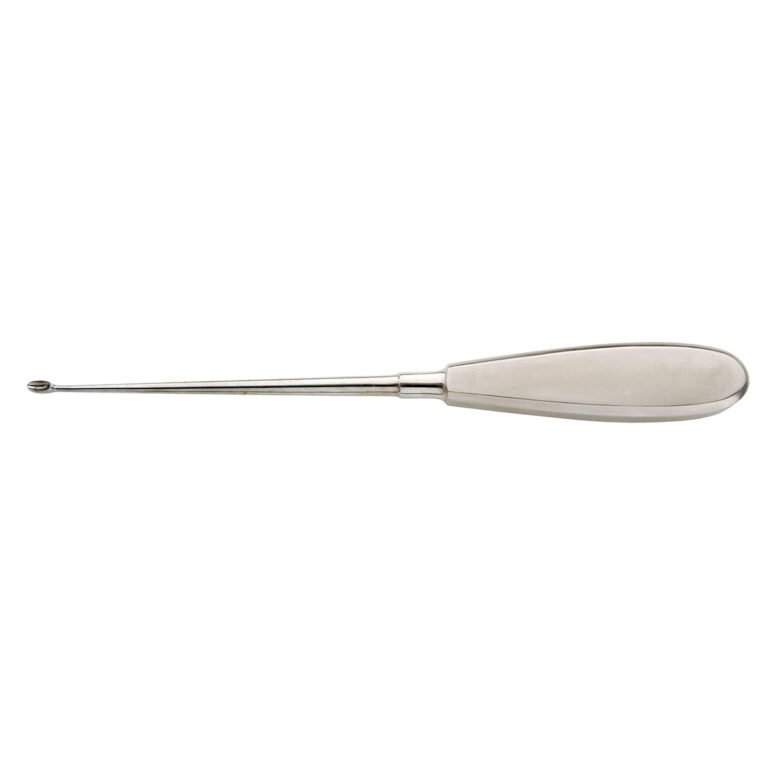
Bone Curette Long Model | NJ Medical Instruments
In stock
Bone Curettes: Scraping to a Surface You Can Feel
A curette does not cut its way through bone — it scrapes, and the surgeon judges the endpoint by the change in resistance the instrument transmits back to the hand. That feedback is the whole point of the design. A curette that is too large, too blunt or too stiffly handled removes material without reporting what it is removing, and the surgeon loses the one signal that says when soft diseased material has given way to sound bone underneath.
The cup edge and the scraping action
The working end is a cup with a sharpened rim. Drawn across a surface, the rim shears material away and the cup collects it, so the removal happens along the leading edge rather than at a point. A well-formed rim removes at a steady rate under light pressure; a dulled one requires force, and force is exactly what destroys the tactile feedback the instrument exists to provide. Rim condition matters more here than on almost any other bone instrument.
Cup size governs both rate and feel
A large cup clears volume quickly and is right for the bulk of a cavity. A small cup removes less per stroke but transmits much finer information about what it is passing over, which is what makes it the instrument for finishing at the margins. Curettes are therefore supplied in graded sizes, and the usual working pattern is to move down through the sizes rather than to complete the job with whatever was started.
Straight, angled and reverse-angle shafts
A cavity is rarely oriented conveniently to the approach. Straight shafts suit surfaces the instrument can meet head-on. Angled shafts let the cup be presented flat against a wall that lies oblique to the entry. Reverse-angle patterns reach back toward the operator to clear the undersurface of a rim — a surface that cannot be addressed at all with a straight instrument. Sets pair the same cup sizes across several shaft angles for this reason.
Double-ended patterns and handle balance
Many curettes carry a different size or angle at each end, halving the number of instruments in a set and the number of exchanges during a procedure. What makes a double-ended instrument work is balance: the handle has to sit in the hand so that light, controlled pressure is natural to apply and the working end is felt rather than pushed. A poorly balanced curette encourages exactly the heavy pressure that removes feedback.
Which bone curette do you need?
| Task | Cup and shaft | Typical form | Chosen for |
|---|---|---|---|
| Clearing a cavity | Large cup, straight shaft | Single or double-ended | Volume removal at a steady rate |
| Finishing at margins | Small cup, straight or angled | Graded set | Fine feedback where judgement matters most |
| Oblique walls | Angled shaft | Matched cup sizes | Presenting the cup flat to the surface |
| Undersurfaces and rims | Reverse angle | Paired with straight patterns | Reaching back toward the operator |
| Confined access | Long shaft, small cup | Slim profile | Depth without obstructing the view |
Related instruments in this range
- Curettes, Raspatories & Elevators — the full range this category sits within
- Dissectors — separating tissue planes
- Laminectomy Punches — biting removal in confined access
- Rongeurs — piecemeal bone removal
- Surgical Instruments — the wider instrument catalogue
Wholesale, OEM and private-label supply
NJ Medical Instruments manufactures bone curettes in Sialkot, Pakistan, supplying single instruments through this shop and graded sets in bulk to hospitals, orthopedic and dental units, and distributors. As the manufacturer we produce to specification — cup size and rim profile, shaft angle and length, single or double-ended configuration, handle form and balance, marking and private-label packaging. Because curettes are used as a graded family, we can quote for a complete size range. Email info@njmedicalinstruments.com or message +92-333-8733922.
Frequently asked questions
What size curette should I order?
More than one. Large cups clear volume quickly; small cups transmit finer information about the surface being passed over, which is what makes them the instruments for finishing. The normal working pattern is to start large and step down through the sizes, so curettes are bought as a graded set rather than singly.
Why does a dull curette matter so much?
Because a dull rim needs force, and force destroys the tactile feedback the instrument exists to give. A sharp rim removes at a steady rate under light pressure, so the change in resistance is felt clearly. Rim condition affects the usefulness of a curette more than it affects the speed of removal.
What is a reverse-angle curette for?
Reaching back toward the operator to clear an undersurface — for example the underside of a rim — which cannot be addressed with a straight instrument at all. Angled patterns present the cup flat against oblique walls; reverse-angle patterns address surfaces that face away from the entry.
Are double-ended curettes worth choosing?
They reduce the number of instruments on the tray and the number of exchanges during a procedure, which is a real advantage. The thing to check is handle balance — a double-ended instrument that does not sit well in the hand encourages heavy pressure, which is the opposite of what a curette needs.
What are your bone curettes made from?
They are manufactured from surgical-grade stainless steel, with cup rims ground and handles finished and inspected before dispatch. Both reusable and single-use options exist across our range — specify which you need when ordering, or ask for the material specification of a particular pattern.
Can I order a graded set or custom specification?
Yes. As an OEM manufacturer we supply retail quantities through this shop and bulk orders direct from the factory, including graded sets spanning cup sizes and shaft angles. Custom cup profiles, angles, shaft lengths, handle forms, laser marking and private-label packaging are available. Send your specification and quantity for a quotation.