


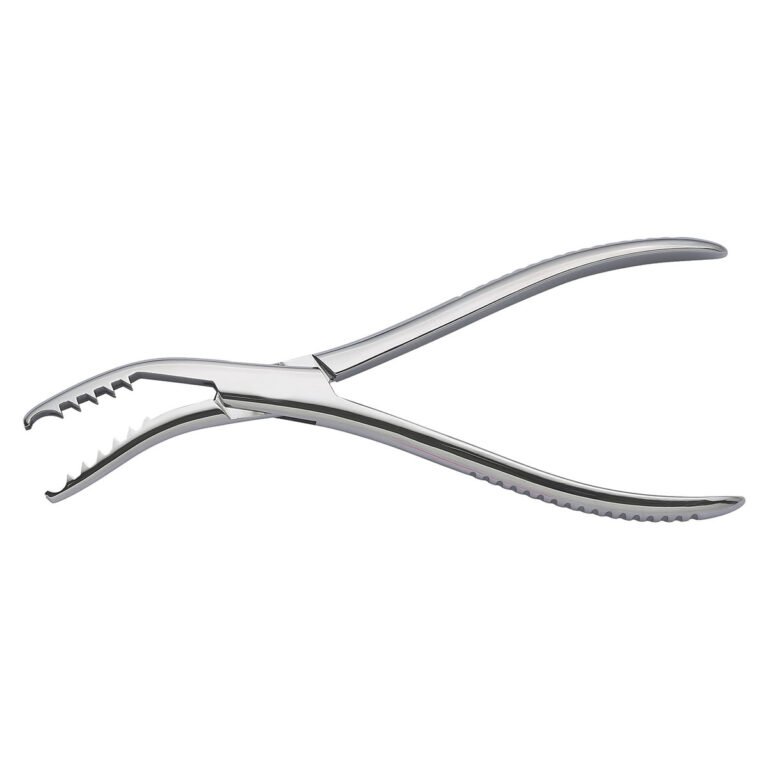
Semb Bone Holding Forceps | NJ Medical Instruments
In stock
Bone Holding Forceps: Holding a Fragment Still Against the Work Being Done to It
A bone holding forceps is judged by what happens while something else is happening — while a fragment is being reduced, drilled, cut or fixed. It has to keep bone in a chosen position against forces that are actively trying to move it, and it has to do that without the surgeon's hand maintaining the pressure. That makes the locking mechanism, not the jaw, the part that most often decides whether a given pattern is right for the job.
The lock is the instrument
Holding forceps use ratchets, speed locks or threaded closures, and they behave differently. A ratchet gives fixed increments and is fast, but the available grip is whatever the nearest tooth provides. A threaded or screw closure lets grip be dialled continuously and does not release under vibration, which is why it suits holding through drilling. Speed locks trade fine adjustment for rapid application and release. Choosing the closure is choosing how the instrument will behave over the minutes it stays clamped.
Jaw form has to match the cross-section of the bone
Bone is not flat, and a jaw that only touches at two points will rotate around them. Serrated flat jaws suit broad surfaces; pointed or spiked jaws engage a curved cortex and resist rotation by biting into it; cupped and toothed jaws wrap a round shaft. The test is whether the jaw makes contact at three separated points or more — anything less and the fragment can pivot inside the grip no matter how hard the instrument is closed.
Holding against rotation versus holding against distraction
These are different demands and they favour different patterns. Resisting rotation is about points of engagement and how far apart they sit around the circumference. Resisting distraction — a fragment being pulled along the axis — is about total grip force and the depth to which the jaw engages. A forceps that excels at one can be mediocre at the other, which is why reduction sets carry several patterns rather than multiples of one.
Self-retaining designs and the surgeon's hands
The reason this category exists at all is to free hands. A self-retaining forceps holds the reduction so both of the surgeon's hands, and the assistant's, are available for the fixation itself. That places a premium on stability of the lock under vibration and on a profile that does not obstruct the drill, plate or screw that has to reach the bone next.
Which bone holding forceps do you need?
| Task | Jaw and closure | Typical length | Chosen for |
|---|---|---|---|
| Holding through drilling | Threaded/screw closure, spiked jaws | 18–26 cm | Grip that will not loosen under vibration |
| Rapid reduction and release | Speed lock, serrated jaws | 16–22 cm | Fast application where fine adjustment is not needed |
| Round shafts | Cupped or toothed wrap-around jaws | 20–27 cm | Engaging a curved cortex at several points |
| Broad flat surfaces | Flat serrated jaws, ratchet | 16–24 cm | Contact spread over a wide area |
| Small fragments | Fine pointed jaws, light ratchet | 12–18 cm | Control without over-gripping a small piece |
Related instruments in this range
- Bone Cutters & Rongeurs — the full range this category sits within
- Bone Cutting Forceps — dividing the bone being held
- Extraction Pliers — gripping for removal
- Laminectomy Punches — biting removal in confined access
- Surgical Instruments — the wider instrument catalogue
Wholesale, OEM and private-label supply
NJ Medical Instruments manufactures bone holding and reduction forceps in Sialkot, Pakistan, supplying single instruments through this shop and complete reduction sets in bulk to hospitals, orthopedic and trauma units, and distributors. As the manufacturer we build to specification — jaw form and engagement points, closure type, shank length and profile, marking and private-label packaging. For volume pricing or an OEM quotation, email info@njmedicalinstruments.com or message +92-333-8733922.
Frequently asked questions
Which closure should I choose — ratchet, speed lock or threaded?
Choose a threaded or screw closure when the hold has to survive drilling or sustained vibration, because grip is continuously adjustable and does not step or release. Choose a ratchet for quick fixed-increment holding, and a speed lock where rapid application and release matter more than fine adjustment. The closure governs how the instrument behaves over time, so it is the first decision, not the last.
Why does the fragment still rotate inside the jaws?
Almost always because the jaw is contacting at only two points, so the bone can pivot between them. Closing harder does not fix it. A jaw form that engages at three or more separated points around the circumference — spiked, cupped or wrap-around depending on the shaft — is what resists rotation.
What jaw form suits a round shaft?
Cupped or toothed wrap-around jaws, which follow the curve and engage the cortex at several points. Flat serrated jaws are designed for broad flat surfaces and will contact a round shaft at only two points, which is the usual cause of unwanted rotation.
What length should I order?
Longer patterns of 20–27 cm suit deep exposure and larger bones and give more leverage at the jaw; 12–18 cm suits small fragments and shallow access, where a heavy instrument makes control harder rather than easier. Reduction sets normally carry a spread of lengths and jaw forms.
What are your bone holding forceps made from?
They are manufactured from surgical-grade stainless steel, with jaws and closures fitted and inspected before dispatch. Both reusable and single-use options exist across our range — specify which you need when ordering, or ask for the material specification of a particular pattern.
Can I order a complete reduction set or a custom specification?
Yes. As an OEM manufacturer we supply retail quantities through this shop and bulk orders direct from the factory, including complete reduction sets spanning several jaw forms and lengths. Custom jaws, closures, lengths, laser marking and private-label packaging are available. Send your specification and quantity for a quotation.