


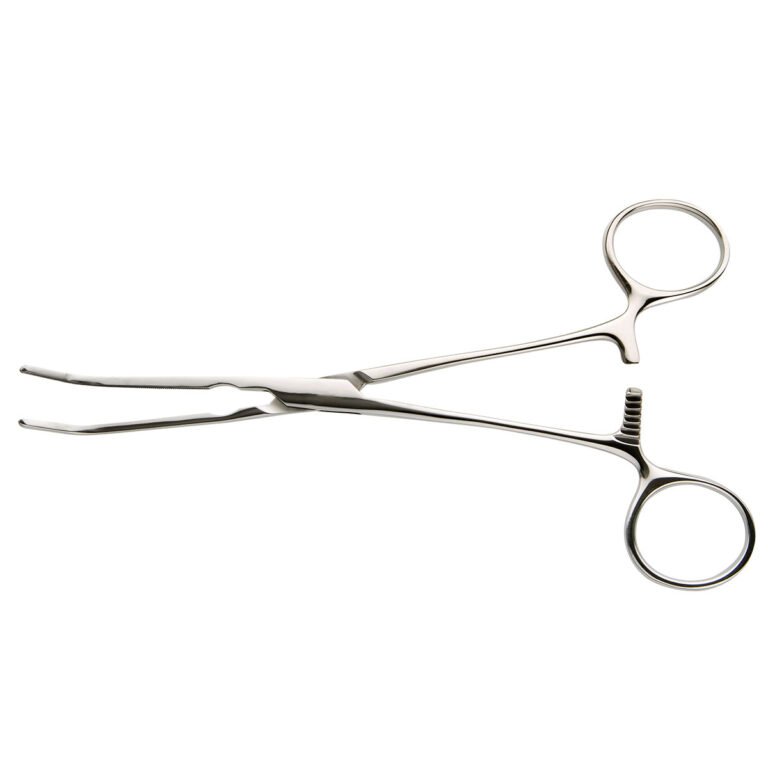
Ericsson Carotid Clamp | NJ Medical Instruments
In stock
Carotid Clamps: Occlusion in a Shallow Field With No Room to Spare
The carotid field is the opposite problem to the aorta: not depth, but congestion. The vessel sits close to the surface in a narrow exposure shared with nerves, veins and retractors, and the surgeon is working within a few centimetres of everything at once. What limits the instrument here is not reach or closing force — it is how much space the clamp occupies after it is applied. A clamp that seals perfectly but stands up in the wound has failed at the thing this category is for.
Profile is the primary specification
In a shallow exposure the whole instrument stays inside the surgeon's working volume, not just its tip. Carotid patterns are therefore built low and slim: shallower jaw depth, thinner shanks, flatter box joints and handles that lie down rather than rising out of the wound. Two clamps are often in place simultaneously, above and below the working segment, so each one has to leave room for the other and for the instruments passing between them.
Short jaws matched to a moderate calibre
Jaw length is scaled to the vessel, and an oversized jaw is a liability in a crowded field — the excess protrudes past the vessel into tissue that should not be in the clamp. Patterns in this category use short jaws with fine, closely spaced atraumatic serration, giving a controlled bite line across a moderate-calibre vessel without the long blade span that larger vascular clamps need.
Angled and bayonet shanks: seeing past your own hand
Because the field is shallow, the surgeon looks almost straight down into it, and a straight shank puts the hand directly over the point of interest. Angled and bayonet-form shanks step the handle sideways or downward so the line of sight to the jaws stays open. In this category the shank geometry does the job that jaw curvature does in deep work.
Ring-handled clamps and spring bulldogs
Two mechanisms coexist here. Ring-handled ratchet clamps give graduated, adjustable closing pressure and stay where they are put. Spring bulldog patterns apply a fixed preset pressure, are placed and removed in one movement, and occupy far less space once applied — but the closing force is built into the instrument rather than chosen at the time, so the clamp itself must be selected to suit the vessel. Most sets carry both, using bulldogs where space is tightest and ratchet clamps where control needs to be adjustable.
Which carotid clamp do you need?
| Requirement | Form | Typical length | Chosen for |
|---|---|---|---|
| Adjustable occlusion | Ring handle, fine ratchet, short atraumatic jaws | 16–20 cm | Control that can be varied after application |
| Minimum footprint | Spring bulldog, preset closing force | 4–7 cm | Tight fields where a handled clamp cannot be accommodated |
| Clear sightline | Angled or bayonet shank | 18–22 cm | Keeping the hand out of a near-vertical line of view |
| Paired proximal and distal control | Matched low-profile pair | 16–20 cm | Two clamps working in the same small exposure |
| Fine branch vessels | Micro jaws, light spring | 3–5 cm | Small-calibre branches within the exposure |
Related clamps in this range
- All Clamps — the full clamp range
- Aortic-Aneurysm Clamps — large-diameter occlusion
- Peripheral Vascular Clamps — jaws matched to calibre
- Tangential Occlusion Clamps — partial occlusion with flow maintained
- Anastomosis Clamps — paired control across a join
Wholesale, OEM and private-label supply
NJ Medical Instruments manufactures carotid and vascular clamps in Sialkot, Pakistan, supplying single instruments through this shop and bulk quantities direct to hospitals, vascular units and distributors. As the manufacturer we build to specification — jaw length and serration, shank angle and profile, spring tension on bulldog patterns, ratchet graduation, marking and private-label packaging. For volume pricing or an OEM quotation, email info@njmedicalinstruments.com or message +92-333-8733922.
Frequently asked questions
What makes a clamp specifically a carotid pattern?
Low profile and short jaws. The defining constraint is a shallow, crowded exposure in which two clamps and several other instruments share a small space, so the design priority is how little room the clamp occupies once applied — not reach, and not maximum closing force.
Should I choose a ring-handled clamp or a spring bulldog?
Choose a ring-handled ratchet clamp when you need to vary closing pressure after application. Choose a bulldog when space is the binding constraint and a preset closing force is acceptable — but then select the bulldog to match the vessel, because its force cannot be adjusted in use. Most sets stock both.
Why are the shanks angled or bayonet-shaped?
In a shallow field the surgeon looks almost straight down, so a straight shank places the hand over the very thing being watched. Stepping the handle sideways or downward keeps the sightline to the jaws open. It performs the same function that jaw curvature performs in deep-cavity instruments.
What jaw length should I order?
Short — matched to a moderate-calibre vessel. An oversized jaw protrudes beyond the vessel into surrounding tissue, which in this exposure is exactly what you are trying to avoid. Handled patterns commonly run 16 cm to 20 cm overall; bulldog patterns are far shorter.
What are your carotid clamps made from?
They are manufactured from surgical-grade stainless steel, with spring temper controlled on bulldog patterns so closing force stays consistent in use. Both reusable and single-use options are available across our vascular range — specify which you need, or request the material specification for a given pattern.
Can I order in bulk or to our own specification?
Yes. We are an OEM manufacturer supplying retail quantities through this shop and bulk orders direct from the factory. Custom jaw lengths, serration patterns, shank angles, spring tensions, laser marking and private-label packaging are all available. Send your specification and quantity for a quotation.