


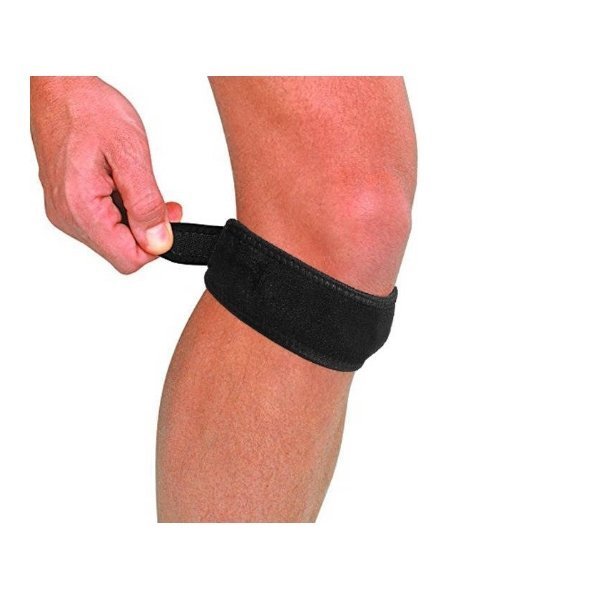
Adjustable Patella Jumper’s Knee Brace Support Strap Tendonitis Pain Running
In stock

Neoprene Knee Patella Support Brace Strap Sport Injury Arthritis Tendon
In stock

Neoprene Patella Stabilising Brace Knee Support Belt Universal Size Adjustable Strap
In stock
Knee Supports and Braces: Controlling a Hinge That Also Rotates
The knee looks like a simple hinge and behaves like anything but, which is why knee bracing is the most varied category in orthopedic supports. The joint bends and straightens, but it also rotates slightly, shifts under load, and depends on a kneecap tracking correctly through the movement. A brace can address any one of those and largely ignore the others — so the useful question is not how much support a brace gives, but which of the knee's several behaviours it is built to influence.
Three different jobs, three different designs
Compression sleeves apply even pressure and improve the wearer's sense of joint position, without meaningfully restricting movement. Patellar supports use a buttress, ring or strap positioned around or below the kneecap to influence how it tracks, and their effect depends almost entirely on that component sitting in the right place. Hinged braces use rigid uprights with a mechanical joint to resist side-to-side movement while allowing bend and extension. These are three genuinely different products, and a buyer who describes their need in terms of what the knee is doing will choose far better than one who asks for "more support".
Why hinge type matters more than upright stiffness
Because the knee does not pivot around one fixed point — the contact between the surfaces moves as the joint bends — a simple single-pivot hinge cannot follow it exactly. Polycentric hinges use a linked mechanism that shifts the pivot through the range of movement, tracking the joint more closely and staying better aligned during use. Rigid uprights matter, but a well-designed hinge on moderate uprights usually stays in position better than a stiff brace with a hinge that does not track.
Migration: the problem specific to the knee
Knee braces slide down. The thigh is conical, the calf tapers, and the whole assembly is being pulled by gravity while the muscles underneath change shape with every step. Silicone gripping bands, contoured straps and correct strap-tension order all exist to address this. A brace that migrates does not simply become less comfortable — its hinges and buttress end up in the wrong place, so it stops doing the job it was chosen for, which is why anti-migration features deserve real attention when comparing models.
Open and closed patella designs
A closed sleeve covers the kneecap and applies pressure across it. An open-patella design leaves an aperture, relieving direct pressure and letting the kneecap sit in the opening. Neither is universally better: the opening reduces pressure but can concentrate the sleeve's edge around the rim, while a closed design spreads pressure more evenly but puts some of it directly over the front of the joint. Fit and comfort during actual movement decide this more reliably than the specification does.
Which knee support do you need?
| What you want addressed | Type | Restraint level | Notes |
|---|---|---|---|
| General compression, joint awareness | Elastic sleeve | Low | Thin, wearable under clothing, little mechanical effect |
| Kneecap tracking | Patellar buttress, ring or strap | Low to medium | Depends entirely on correct positioning |
| Side-to-side stability | Hinged brace | High | Look at hinge design, not just upright stiffness |
| Adjustable through the day | Wrap-around with straps | Medium | Easier to put on than a pull-on sleeve |
| Staying in position | Any, with silicone grip bands | Varies | Anti-migration features matter more than they appear to |
Related supports in this range
- Orthopedic Supports & Braces — the full range this category sits within
- Ankle Supports — side-to-side ankle restraint
- Calf Supports — compression for the lower leg
- Thumb Supports — small-joint bracing
- Lumbar & Back Supports — trunk and lower-back bracing
Wholesale, OEM and private-label supply
NJ Medical Instruments supplies knee supports and braces to individual customers through this shop and in bulk to clinics, pharmacies, sports facilities and distributors. As a manufacturer we produce to specification — material and weave, compression level, hinge type, patellar configuration, strap layout, anti-migration features, size range, colourways and private-label packaging. For volume pricing, size-range planning or an OEM quotation, email info@njmedicalinstruments.com or message +92-333-8733922.
Frequently asked questions
What is the difference between a knee sleeve and a hinged brace?
A sleeve applies compression and improves awareness of joint position without meaningfully restricting movement. A hinged brace uses rigid uprights and a mechanical joint to resist side-to-side movement while allowing the knee to bend and straighten. They do different jobs — the sleeve is a garment, the brace is a structure.
Why does my knee brace slide down?
Because the thigh is conical, the calf tapers, and the muscles change shape with every step while gravity pulls the brace down. Silicone gripping bands, contoured straps and tightening the straps in the correct order all help. Migration matters beyond comfort: once the brace moves, its hinges and buttress are no longer in the right place.
Should I choose open or closed patella?
Neither is universally better. An open design relieves direct pressure over the kneecap but can concentrate the sleeve edge around the aperture; a closed design spreads pressure more evenly but applies some of it across the front of the joint. Comfort during actual movement is a more reliable guide here than the specification.
What is a polycentric hinge and does it matter?
It is a linked hinge whose pivot point shifts as the joint bends, which follows the knee more closely than a single fixed pivot can. It matters — a well-tracking hinge on moderate uprights usually stays aligned better in use than a very stiff brace whose hinge does not follow the joint.
How do I choose a size?
Knee sizing is normally based on a measured circumference taken at a specified point relative to the kneecap, not on clothing or shoe size. Measure rather than estimate, and use the chart for the specific model — charts differ between designs and are not interchangeable.
Can I order these in bulk or with our own branding?
Yes. We supply retail quantities through this shop and bulk orders direct from the factory, including full size ranges for clinics, pharmacies and distributors. Custom materials, hinge and patellar configurations, strap layouts, sizing, colourways and private-label packaging are available. Send your specification and quantities for a quotation.
Product information only. For advice on whether a brace is appropriate for your situation, and on fitting and wear, consult a qualified healthcare professional.