
Filter by price
Showing the single result
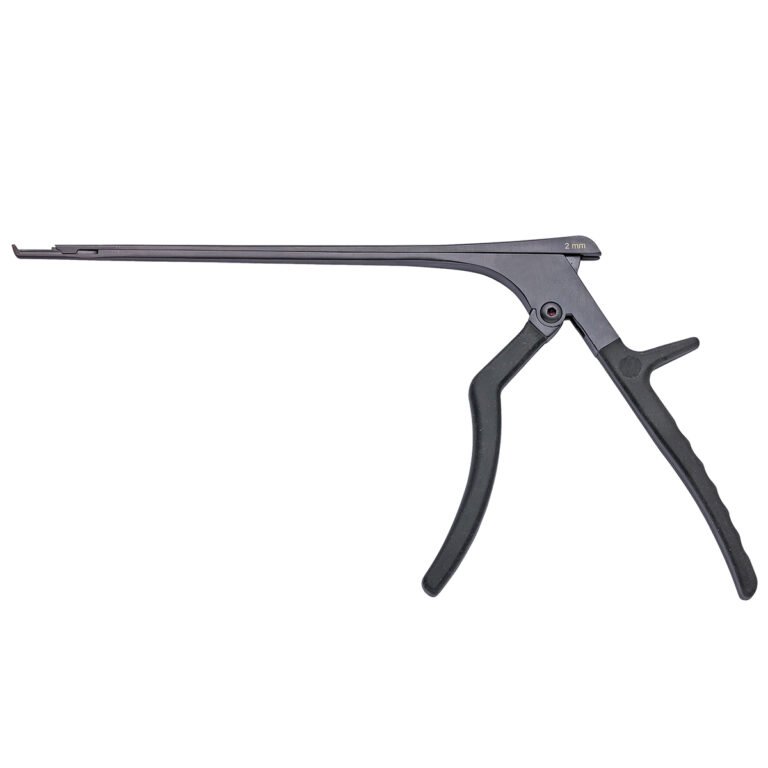
Kerrison Laminectomy Punch | NJ Medical Instruments
Kerrison Laminectomy Punches for Sale - Spinal and Neurosurgical Instruments for Bone and Ligament Removal
The Kerrison punch is the instrument that defines bone removal at the spinal canal level. Its design - a footplate that slides under the lamina while a cup above removes a controlled bite with each closure - solves a mechanical problem that straightforward bone cutting instruments cannot handle in this anatomical context. In spinal surgery, the surgeon is removing bone immediately adjacent to the dural sac and nerve roots, in a corridor where anything unpredictable creates potential neurological injury. The Kerrison's footplate protects the dura by interposing itself between the cutting cup and the neural structures below, while the cup takes the bone bite above. Every spinal decompression surgeon understands this instrument and uses it in volumes measured by the hundreds per year.
What is less often discussed outside specialist circles is how much the specific configuration - footplate angle, cup size, and shaft length - matters for matching the instrument to the anatomical level and the approach. The same Kerrison punch that works well for an L4-5 laminotomy from a posterior approach is not the right instrument for a cervical posterior foraminotomy or a thoracic extradural approach. Getting the configuration right is part of the technical knowledge of spinal surgery.
The Kerrison Laminectomy Punch at NJ Medical Instruments is manufactured from CE-certified surgical-grade stainless steel at the company's Sialkot facility, and is autoclavable.
Understanding Kerrison Punch Configurations - Footplate Angle and Cup Size
Footplate Angle - How It Determines Access Geometry
The footplate angle is the angle between the footplate (the part that slides under the bone or ligament) and the shaft of the instrument. Standard configurations include 40-degree and 90-degree footplate angles, with variations at other angles depending on the manufacturer and the specific approach being accommodated.
A 40-degree footplate suits the angled approach to the lateral recess and foramen from a posterior midline approach - the shaft angles away from the midline while the footplate engages the lateral laminar edge at the correct orientation. A 90-degree upbiting footplate is used when the instrument is inserted parallel to the spinal canal and the bite is directed straight upward or sideways into the overhanging bone. The choice between these is not aesthetic; it determines whether the footplate seats correctly under the bone and whether the cup closes on the intended target.
Cup Size - How It Affects Bone Removal Rate and Precision
Cup size - typically expressed in millimetres of cutting width (2 mm, 3 mm, 4 mm, 5 mm) - determines how much bone is removed per closure. Smaller cups (2 - 3 mm) give more precise, controlled removal and are appropriate for tight spaces, foraminotomy work, and any site where accuracy takes priority over speed. Larger cups (4 - 5 mm) take bigger bites, reduce the number of closures needed for a given volume of bone removal, and suit wide laminectomy decompression where the priority is efficient bone clearance across a larger area.
Surgical Applications Beyond Standard Laminectomy
Posterior Cervical Foraminotomy
In cervical radiculopathy managed surgically without fusion, keyhole foraminotomy removes just enough bone from the posterior rim of the foramen to decompress the exiting nerve root. The Kerrison handles the delicate bone removal at the foraminal edge, where the proximity of the vertebral artery medially and the nerve root in the foramen demands controlled, small-cup work.
Skull Base Surgery
Kerrison punches appear in neurosurgical skull base approaches - retrosigmoid craniotomy, translabyrinthine approaches, and petroclival approaches - where temporal bone and posterior fossa bone is removed to approach deep lesions. The footplate-and-cup mechanism remains the safest way to remove bone incrementally adjacent to the dura in these critically sensitive anatomical sites.
Thoracic Spinal Surgery
Thoracic laminectomy for decompression of thoracic myelopathy or tumour resection uses Kerrison punches alongside other bone instruments - the thoracic lamina is typically thicker and harder than lumbar, which influences cup size selection and the number of passes needed.
The Kerrison Laminectomy Punch at NJ Medical Instruments
The Kerrison Laminectomy Punch available here is the standard clinical pattern in CE-certified surgical-grade stainless steel. The footplate mechanism provides the neural protection that makes this instrument appropriate for bone removal adjacent to the dura, and the cup geometry removes bone cleanly without requiring excessive handle force. Autoclavable, reusable, and available for bulk procurement by spinal surgery units and neurosurgery departments.
Ordering and Supply
NJ Medical Instruments ships Kerrison punches and spinal instruments worldwide with ISO and CE certification. Bulk pricing is available for neurosurgical and spinal surgery departments. Contact info@njmedicalinstruments.com or WhatsApp +92-333-8733922.