


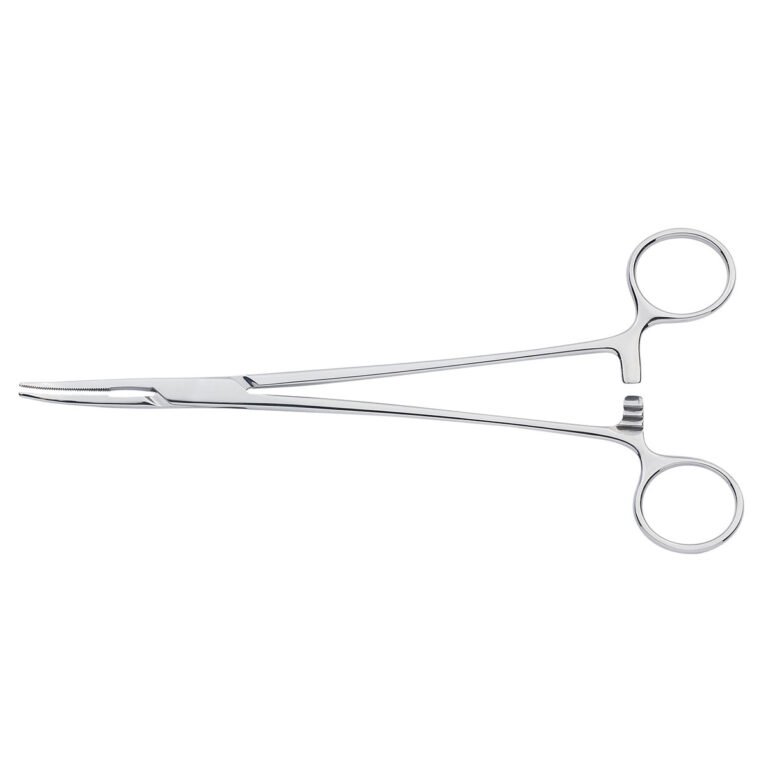
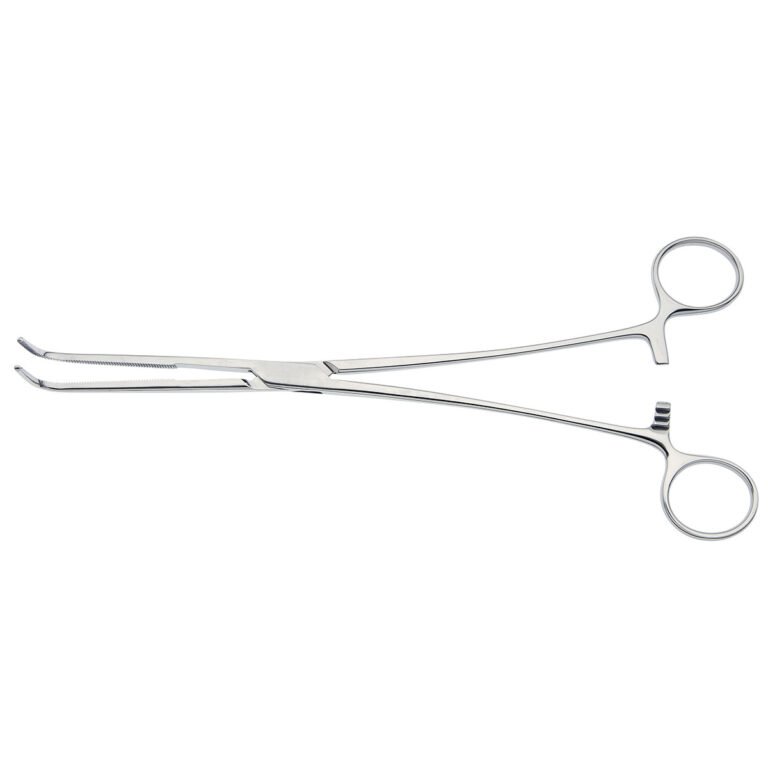
Wikström Gall Duct Clamp | NJ Medical Instruments
In stock
Gall Duct Clamps: Reaching a Deep, Narrow Field Without Blocking the View
The biliary field punishes bulky instruments: the working space sits deep under the liver edge, the structures are small-calibre and thin-walled, and the surgeon has to see past whatever is holding them. Gall duct clamps are shaped around that problem. Angulation, slender jaws and a low-profile lock exist so the clamp can occlude or hold a duct while the hand and shank stay out of the sightline. Length gets the tip there; the angle is what makes the tip usable once it arrives.
Why the jaws are angled rather than straight
A straight clamp applied deep in the subhepatic space forces the handles up into the line of vision and against the wound edge. Angled and right-angle patterns move the shank out of that plane, so the jaws sit across the duct while the handles fall away to the side. The same geometry lets the tip pass behind a structure and come back around it — which is how a clamp is placed on a duct that cannot be lifted forward without tension.
Fine jaws for small-calibre, thin-walled structures
Ducts do not tolerate the closing force that a vessel or a bowel loop absorbs. Jaws in this category are correspondingly narrow and finely finished, with light serrations or an atraumatic face that holds without cutting into the wall. The ratchet range matters as much as the jaw: a clamp whose first tooth already applies more pressure than the tissue needs gives the surgeon no usable setting at all.
Occluding, holding and retrieving are different tasks
Clamps in the biliary tray divide by intent. Occlusion clamps close the lumen. Holding clamps stabilise a duct or the gallbladder without sealing it, so dissection can proceed around a fixed point. Stone-retrieval patterns have cupped or fenestrated jaws designed to capture a calculus rather than compress tissue, and are not occlusion instruments at all despite sitting alongside them. Ordering by intent rather than by name avoids the most common mismatch in this category.
Length, profile and the depth of the field
Patterns here commonly run from around 18 cm to 26 cm. Deep exposure or a heavier body habitus needs the longer shanks; shallow or paediatric work is better served by shorter instruments, where a long clamp becomes unwieldy and its extra leverage works against fine control. Slim shanks matter for the same reason the angle does — every millimetre of metal in the field is a millimetre the surgeon cannot see through.
Which gall duct clamp do you need?
| Task | Jaw and shape | Typical length | Chosen for |
|---|---|---|---|
| Deep duct occlusion | Right-angle or strongly curved fine jaws | 22–26 cm | Reaching under the liver edge with handles clear of the sightline |
| General biliary occlusion | Gently curved atraumatic jaws | 20–23 cm | Routine control at moderate depth |
| Holding and stabilising | Broader non-occlusive jaw face | 20–24 cm | Fixing a structure for dissection rather than sealing it |
| Stone retrieval | Cupped or fenestrated jaws | 20–26 cm | Capturing a calculus without crushing it |
| Shallow or paediatric field | Short, slim, fine-tipped | 18–20 cm | Fine control where a long shank is unwieldy |
Related clamps in this range
- All Clamps — the full clamp range
- Colon Clamps — long atraumatic blades for bowel
- Anastomosis Clamps — paired control across a join
- Peripheral Vascular Clamps — calibre-matched vessel occlusion
- Artery Forceps and Ligature Clamps — haemostatic control
Wholesale, OEM and private-label supply
NJ Medical Instruments manufactures biliary and gall duct clamps in Sialkot, Pakistan, supplying single instruments through this shop and bulk quantities direct to hospitals, surgical centres and distributors. As the manufacturer we build to specification — jaw angle, jaw face, shank length and profile, ratchet characteristics, marking and private-label packaging. For volume pricing or an OEM quotation, email info@njmedicalinstruments.com or message +92-333-8733922.
Frequently asked questions
Why are gall duct clamps angled instead of straight?
Because the biliary field is deep and the surgeon has to see into it. An angled or right-angle jaw sits across the duct while the shank and handles fall away from the line of vision, instead of standing up in it as a straight clamp does. The angle also lets the tip pass behind a structure and return around it.
What length should I order?
For most adult open biliary work, 20 cm to 24 cm covers the majority of applications. Choose 26 cm for deep exposure, and 18 cm to 20 cm for shallow or paediatric fields where a long shank costs more in control than it gains in reach.
What is the difference between a gall duct clamp and stone-retrieval forceps?
A clamp occludes or holds tissue; retrieval forceps capture a calculus. Retrieval patterns have cupped or fenestrated jaws shaped to hold a stone intact, and they are not designed to seal a lumen. Both are stocked in biliary sets and the two are frequently confused when ordering by name alone.
How do I avoid damaging the duct wall?
Match the instrument to the calibre of the structure and use the lightest ratchet setting that achieves control. Ducts are thin-walled and take far less closing force than vessels or bowel, so a fine-jawed clamp with a usable first ratchet position is more important here than in almost any other clamp category.
What are your gall duct clamps made from?
They are manufactured from surgical-grade stainless steel, with jaw faces finished and inspected before dispatch. Both reusable and single-use options exist across our clamp range — tell us which you need when ordering, or ask for the material specification of a particular pattern.
Can I order in bulk or to our own specification?
Yes. We are an OEM manufacturer supplying retail quantities through this shop and bulk orders direct from the factory. Custom jaw angles, lengths, finishes, laser marking and private-label packaging are all available. Send your specification and quantity for a quotation.