


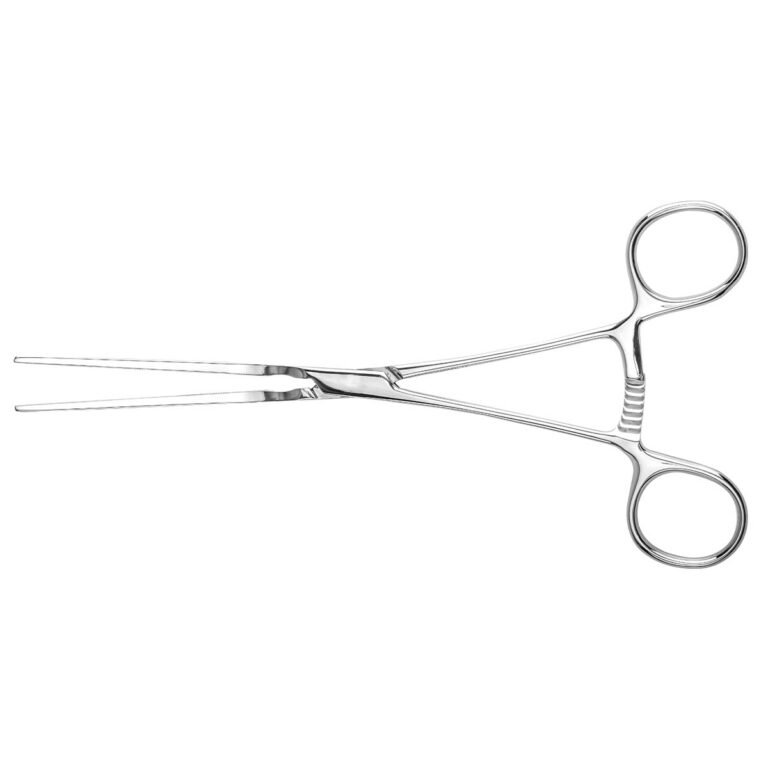
Peripheral Vascular Clamp | NJ Medical Instruments
In stock
Peripheral Vascular Clamps: Matching the Jaw to the Calibre
This is the one vascular category defined by range rather than by a single anatomical site. Peripheral vessels run from the femoral artery down to vessels a few millimetres across, and a single clamp cannot serve that span. The organising principle here is proportion: jaw length, serration pitch and closing force all have to scale with the diameter of the vessel in front of you. Nearly every avoidable problem in this category comes from using a clamp designed for a different calibre.
What goes wrong when the jaw is too large
An oversized jaw does not simply grip a small vessel more gently. The vessel occupies only part of the blade, so the closing force concentrates at whichever point contacts first, and the unused length of jaw extends into surrounding tissue that was never meant to be in the clamp. The seal becomes dependent on one narrow line of contact — the precise failure mode the atraumatic design was intended to prevent.
What goes wrong when the jaw is too small
Undersized jaws cannot flatten the full width of the vessel, so the wall bunches at the ends of the blades. Flow past the clamp is not reliably stopped, and the surgeon's instinct is to close the ratchet further, which raises pressure on the tissue that is engaged rather than recruiting the tissue that is not. More force does not fix a jaw that is too short.
Serration pitch scales with the vessel too
Fine, closely spaced serrations suit small vessels: they distribute grip over many contact points on a thin wall. Coarser pitch suits larger vessels, where a fine pattern would not develop enough purchase against the pressure behind the occlusion. Pitch is not a quality grade — a fine pattern is not inherently gentler on a large vessel — it is a matching decision, made together with jaw length.
Ring handles, bulldogs and the question of adjustability
Ring-handled ratchet clamps let closing pressure be varied and readjusted, and stay put once set. Spring bulldogs apply a fixed force determined when the instrument was made, and are chosen rather than adjusted — which means a peripheral set needs bulldogs in several tensions to cover its calibre range. Handled clamps offer control; bulldogs offer speed and a much smaller footprint. Sets that do varied peripheral work generally hold both, graded across sizes.
Which peripheral vascular clamp do you need?
| Vessel calibre | Jaw and serration | Typical form | Notes on selection |
|---|---|---|---|
| Large peripheral (e.g. femoral) | Longer jaws, medium-pitch serration | Ring-handled, angled or curved | Needs enough blade span to flatten the full width |
| Medium peripheral | Medium jaws, fine serration | Ring-handled or larger bulldog | The most commonly used size band |
| Small peripheral | Short jaws, fine close-pitch serration | Bulldog, light spring | Force must be low; jaw must not overhang the vessel |
| Branch and micro vessels | Micro jaws, very fine pitch | Micro bulldog | Chosen by tension, since it cannot be adjusted in use |
| Restricted access | Angled or bayonet shank | Ring-handled, low profile | Shank geometry keeps the hand out of the sightline |
Related clamps in this range
- All Clamps — the full clamp range
- Profunda Femoral Artery Clamps — deep groin exposure
- Carotid Clamps — low-profile occlusion in shallow fields
- Aortic-Aneurysm Clamps — large-diameter occlusion
- Anastomosis Clamps — paired control across a join
Wholesale, OEM and private-label supply
NJ Medical Instruments manufactures peripheral vascular clamps in Sialkot, Pakistan, supplying single instruments through this shop and graded sets in bulk to hospitals, vascular units and distributors. As the manufacturer we produce to specification — jaw length and serration pitch, spring tension across a size range, shank angle, ratchet graduation, marking and private-label packaging. Because this category is bought as a graded range rather than a single item, we can quote for a complete calibre set. Email info@njmedicalinstruments.com or message +92-333-8733922.
Frequently asked questions
How do I choose the right size of peripheral vascular clamp?
Match the jaw length to the width of the vessel so the blades flatten its full diameter without extending far beyond it, then match the serration pitch to the wall — finer for small vessels, coarser for large ones. Size selection matters more here than in any other clamp category, because the calibre range this category covers is so wide.
Can I use a larger clamp gently on a small vessel?
No — that is the most common mistake in this category. An oversized jaw concentrates the closing force at whichever point contacts first and puts unused blade length into surrounding tissue. Reducing the ratchet setting does not compensate, because the problem is contact geometry rather than total force.
Why won't a small clamp seal a large vessel even at full ratchet?
Because the wall bunches at the ends of the blades instead of flattening across the full width. Extra force raises pressure on the tissue already engaged without bringing in the tissue that is not, so the seal does not improve — but the trauma does.
Do I need bulldogs as well as ring-handled clamps?
If your work spans a range of calibres, yes. Bulldogs are fast and take up very little room but apply a fixed force, so covering a calibre range means holding several tensions. Ring-handled clamps allow closing pressure to be adjusted after application. Most peripheral sets hold both, graded across sizes.
What are your peripheral vascular clamps made from?
They are manufactured from surgical-grade stainless steel, with spring temper controlled on bulldog patterns so the closing force stays consistent across repeated use. Both reusable and single-use options are available in this range — specify which you need, or request the material specification for a particular pattern.
Can I order a graded set or custom specification?
Yes. As an OEM manufacturer we supply retail quantities through this shop and bulk orders direct from the factory, including complete graded sets covering a calibre range. Custom jaw lengths, serration pitches, spring tensions, laser marking and private-label packaging are available. Send your specification and quantity for a quotation.