


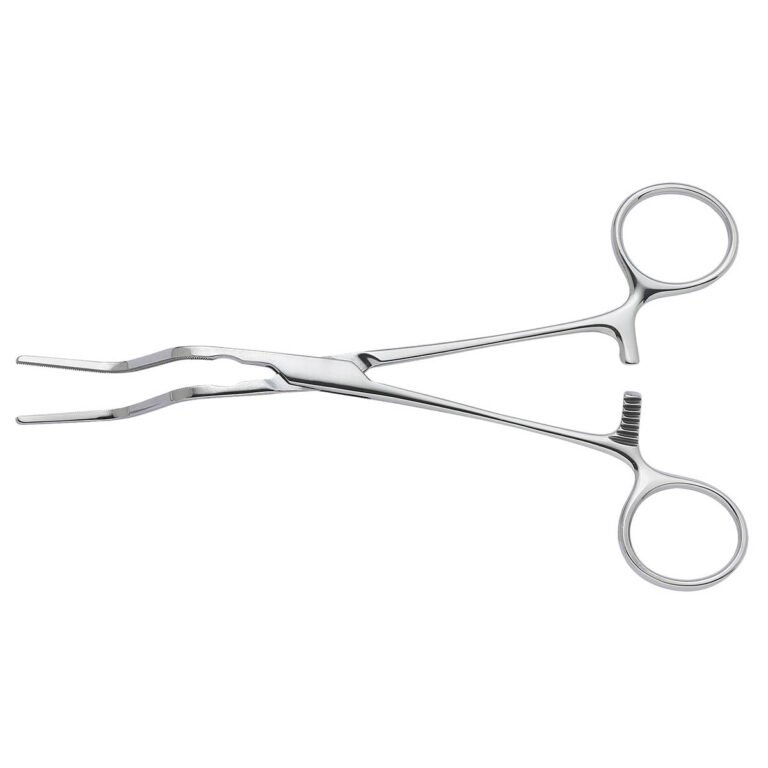
Ericsson Profunda Femoral Artery Clamp | NJ Medical Instruments
In stock
Profunda Femoral Artery Clamps: Working on One Limb of a Branch
What makes this clamp its own category is not the vessel size but the geometry around it — a branch running deep and posterior from a larger trunk, in a field where the clamp has to occlude one limb of the division while leaving the others alone. Reach and selectivity have to be delivered at the same time. A general vascular clamp of the right calibre will often physically fit, and still be the wrong instrument, because its jaw cannot be placed across one branch without catching the vessel next to it.
Selectivity: the jaw has to fit between structures, not just around one
Near a bifurcation, the space available to the clamp is bounded on more than one side. The blades must close across a single limb without their tips or their heel encroaching on the adjacent branch, which sets a maximum usable jaw length independent of how wide the target vessel is. This is the reverse of the usual sizing logic — here the limit is set by the neighbouring anatomy rather than by the vessel being clamped.
Reach into a deep, obliquely angled field
The profunda passes deep and posteriorly, so the working point sits well below the skin surface and is approached at an angle rather than face-on. Instruments in this category are built with longer shanks than their jaw size alone would suggest, and with the jaw set at an angle to the shank so the blades can lie across a vessel that the shank approaches obliquely. Jaw and shank are designed as one geometry, which is why substituting a straight clamp of similar jaw size rarely works.
Why the handle has to sit outside a deep wound
In a deep exposure the tissue above the clamp closes back over the instrument. Angled and offset shanks lift the ring handles clear of the wound edge so the clamp can be locked, adjusted and released without the surgeon working blind against overlying tissue — and so that retractors and a second clamp still fit in the same exposure.
Jaw face and holding position against pulsatile pressure
A clamp applied obliquely to a deep branch is more prone to being displaced than one applied face-on in a shallow field, because pulsatile pressure acts across the jaw rather than straight into it. Fine multi-row atraumatic serration provides grip on the adventitia that resists that shear without needing extra closing force, and the curve of the blade is chosen so the clamp seats into position rather than riding out of it.
Which profunda clamp do you need?
| Requirement | Geometry | Typical length | Selected for |
|---|---|---|---|
| Selective branch occlusion | Short jaw, angled to the shank | 18–22 cm | Clamping one limb without catching the adjacent branch |
| Deep oblique approach | Long shank, compound-curve jaw | 22–26 cm | Blades lying across a vessel approached at an angle |
| Crowded exposure | Offset shank, low-profile handle | 20–24 cm | Leaving room for retractors and a second clamp |
| Trunk control alongside | Longer jaw, medium serration | 22–26 cm | Proximal control on the parent vessel |
| Small distal branches | Micro jaw, light spring bulldog | 4–7 cm | Fine branches where a handled clamp will not fit |
Related clamps in this range
- All Clamps — the full clamp range
- Peripheral Vascular Clamps — jaws graded by calibre
- Aortic-Aneurysm Clamps — large-diameter occlusion
- Carotid Clamps — low-profile occlusion in shallow fields
- Tangential Occlusion Clamps — partial occlusion with flow maintained
Wholesale, OEM and private-label supply
NJ Medical Instruments manufactures profunda and deep peripheral vascular clamps in Sialkot, Pakistan, supplying single instruments through this shop and bulk quantities direct to hospitals, vascular units and distributors. As the manufacturer we build to specification — jaw length and angle, shank length and offset, serration pattern, ratchet graduation, marking and private-label packaging. For volume pricing or an OEM quotation, email info@njmedicalinstruments.com or message +92-333-8733922.
Frequently asked questions
Why not just use a standard peripheral vascular clamp?
Because sizing here is set by the surrounding anatomy, not by the target vessel. Near a bifurcation the jaw must close across one limb without its tips or heel reaching the adjacent branch, and the shank must approach obliquely into a deep field. A straight clamp with a correctly sized jaw will often fit physically and still fail on both counts.
What jaw length should I choose?
Short enough to sit on a single branch without encroaching on its neighbour — usually shorter than the vessel calibre alone would suggest. Longer jaws are appropriate for proximal control on the parent trunk, which is a different task usually performed with a second, larger clamp.
Why are the shanks longer than the jaw size implies?
The working point is deep, and the handles must stay clear of the wound edge so the clamp can be locked, adjusted and released under direct vision. Extra shank length buys that clearance, and the offset keeps the handle from crowding retractors and any second clamp in the same exposure.
How is the clamp kept from being displaced?
By jaw geometry and grip rather than extra force. Applied obliquely, a clamp experiences pulsatile pressure as shear across the blade, so fine multi-row atraumatic serration is used to hold the adventitia, and the blade curve is chosen so the clamp seats into position instead of riding out of it.
What are your profunda clamps made from?
They are manufactured from surgical-grade stainless steel, with jaw faces and ratchets finished and inspected before dispatch. Both reusable and single-use options are available across our vascular range — specify which you need, or request the material specification for a particular pattern.
Can I order in bulk or to our own specification?
Yes. As an OEM manufacturer we supply retail quantities through this shop and bulk orders direct from the factory. Custom jaw angles and lengths, shank offsets, serration patterns, laser marking and private-label packaging are all available. Send your specification and quantity for a quotation.