


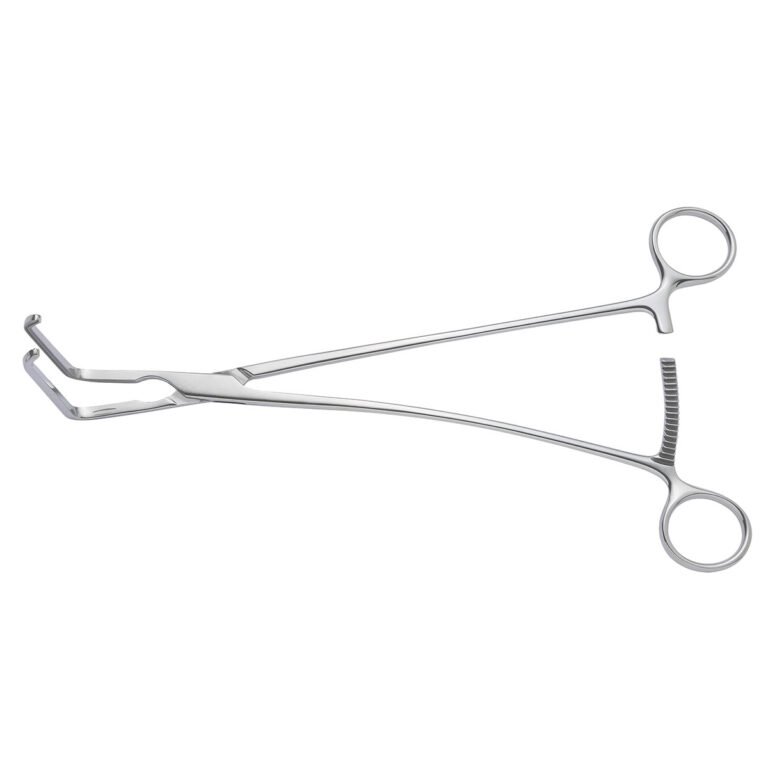
Colon Clamp | NJ Medical Instruments
In stock
Colon Clamps: Occluding Bowel Without Crushing the Wall
A colon clamp has to close a hollow, compressible organ completely enough to stop contents passing, while leaving the bowel wall able to recover once the clamp comes off. Those two demands pull in opposite directions, and every design decision in this category — jaw length, serration direction, blade flexibility, ratchet range — is a compromise between them. Choosing the wrong clamp does not usually fail in theatre; it fails afterwards, in the condition of the tissue that was held.
Why colon clamps are long and flexible
Bowel is wide and thin-walled. A short, rigid jaw concentrates its closing force along a narrow line, which is exactly how a crush injury is produced. Colon clamps are therefore built with long blades — typically 20 cm to 26 cm overall — that spread the same occlusive pressure across a much greater length of wall. Many patterns use blades with a degree of spring in them, so the jaws bow slightly under load and distribute pressure rather than pinching at the hinge end where leverage is highest.
Longitudinal serrations and why direction matters
Atraumatic colon clamps carry fine serrations running lengthways along the blade, parallel to the bowel rather than across it. Longitudinal ridges grip the wall enough to stop it sliding out of the jaws while allowing the tissue between the ridges to stay perfused. Transverse serrations, of the kind found on crushing clamps, bite across the wall and are used deliberately where the segment is going to be resected and the tissue held does not need to survive. Both types exist in this category and they are not interchangeable.
Occluding versus crushing: two jobs, two instruments
An occluding clamp is placed on bowel that stays in the patient — proximal and distal control during resection, protection of an anastomosis, preventing spillage while the lumen is open. A crushing clamp is placed on the specimen side of the division line, where its job is to seal the segment being removed. In a standard resection both appear on the same field within minutes of each other, which is why they are usually ordered together and why clear differentiation on the tray matters.
Straight and curved blades
Straight blades are the default for transverse application across a mobilised loop. Curved blades follow the natural line of the bowel where it sits against the abdominal wall or in the pelvis, allowing the clamp to be applied without first pulling the segment into an unnatural position. In deep pelvic work the curve is often what makes application possible at all.
Which colon clamp do you need?
| Requirement | Jaw characteristics | Typical length | Applied to |
|---|---|---|---|
| Atraumatic occlusion | Long flexible blades, longitudinal serrations | 22–26 cm | Bowel that remains in the patient |
| Crushing division | Rigid blades, transverse serrations | 20–24 cm | The specimen side of the division line |
| Deep or pelvic application | Curved blades | 24–26 cm | Segments that cannot be brought up into the wound |
| Shallow or mobilised loop | Straight blades | 20–23 cm | Bowel delivered into the operative field |
| Narrow working space | Slim profile, lighter blade | 20–22 cm | Confined access where a broad clamp obstructs the view |
Related clamps in this range
- All Clamps — the full clamp range
- Anastomosis Clamps — paired control across a join
- Gall Duct Clamps — angled jaws for the biliary field
- Tangential Occlusion Clamps — partial occlusion with flow maintained
- Artery Forceps and Ligature Clamps — haemostatic control
Wholesale, OEM and private-label supply
NJ Medical Instruments manufactures colon and intestinal clamps at our facility in Sialkot, Pakistan, supplying individual instruments through this shop and bulk quantities direct to hospitals, surgical centres and distributors. As the manufacturer we can build to your specification — blade length, curvature, serration pattern, spring characteristics, marking and private-label packaging. For volume pricing or an OEM quotation, email info@njmedicalinstruments.com or message +92-333-8733922.
Frequently asked questions
What is the difference between an atraumatic and a crushing colon clamp?
An atraumatic clamp has longitudinal serrations and flexible blades that occlude the lumen while preserving the bowel wall, and is used on tissue that stays in the patient. A crushing clamp has rigid blades with transverse serrations that deliberately compress the wall, and is used on the segment being removed. They look similar on a tray and should be clearly distinguished before use.
What length of colon clamp should I order?
Most general colorectal work is covered by 22 cm to 26 cm. Shorter clamps around 20 cm suit shallow fields and mobilised loops; longer curved patterns are needed for deep pelvic application where the segment cannot be lifted into the wound. Departments commonly hold two lengths and both blade shapes.
Why are colon clamp blades made flexible?
Flexibility lets the blades bow slightly under load so occlusive pressure is spread along the whole jaw rather than concentrated near the hinge, where mechanical leverage is greatest. On a wide, thin-walled organ that difference is what separates occlusion from injury.
Should I choose straight or curved blades?
Straight blades are the general-purpose choice for bowel that can be brought into the field. Curved blades follow the anatomical line of the bowel and allow application in the pelvis or against the abdominal wall without dragging the segment into position first. If you are ordering a single pattern, straight is the more versatile; if you do pelvic work regularly, add curved.
What are your colon clamps made from?
They are manufactured from surgical-grade stainless steel, with blade temper controlled so that spring patterns retain their flexibility in use. Both reusable and single-use options are available across our clamp range — specify which you require when ordering, or ask us for the material specification of a particular pattern.
Can I order colon clamps in bulk or to our own specification?
Yes. We are an OEM manufacturer supplying both retail quantities through this shop and bulk orders direct from the factory. Custom blade lengths, curvature, serration patterns, laser marking and private-label packaging are all available. Send us your specification and required quantity for a quotation.