


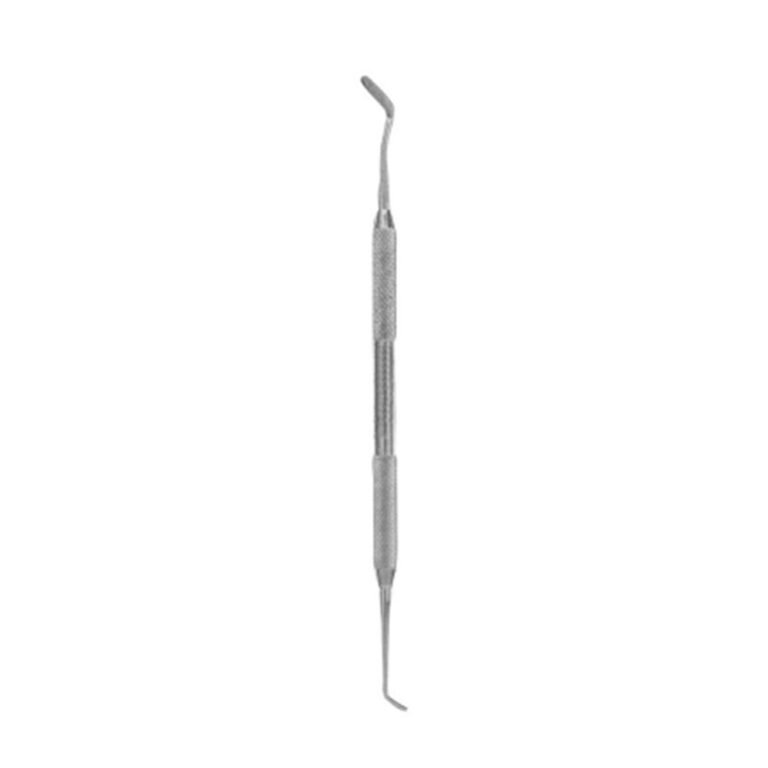
Composite Placement Instrument G-Type 1
In stock
Composite Placement & Plastic Filling Instruments: Shaping Before It Sets
Composite placement instruments exist because of one property of the material: it sticks to metal. Unlike amalgam, which is condensed and carved, composite is a sticky resin that must be placed, adapted to the cavity walls, and sculpted to anatomical form — all before curing. If the instrument pulls the material away as it lifts, the operator is fighting the restoration rather than shaping it. That is why these instruments are made with non-stick surfaces, typically titanium-nitride coated or anodised, and why the working ends are polished smooth rather than serrated. NJ Medical Instruments manufactures the range in surgical-grade stainless steel with non-stick options, supplied worldwide direct from the factory for individual purchase and for bulk, wholesale, and OEM/private-label supply.
Placement, adaptation and sculpting
Placement instruments carry composite from the compule or pad into the cavity, usually with a small flat or slightly cupped end.
Condensers and pluggers press the material into the cavity floor and against the walls. Adaptation matters more than force here — a void left at the cavity margin becomes a site for staining and recurrent caries, and no amount of surface polishing corrects it later.
Carvers and sculpting ends shape the occlusal anatomy before cure. Getting the form right at this stage saves finishing time afterwards, since composite is far easier to shape while soft than to grind back once hard.
Why non-stick coatings matter
An uncoated stainless instrument lifts composite with it on withdrawal, dragging material out of the cavity and pulling the surface into peaks. Titanium-nitride and anodised coatings reduce that adhesion so the instrument releases cleanly. The coating is a surface treatment, though, and it is damaged by abrasive cleaning — wire brushes and abrasive pads strip it, after which the instrument sticks again. Ultrasonic cleaning and soft cloths preserve it.
Composite versus amalgam instruments
They are not interchangeable. Amalgam condensers have serrated faces that grip the alloy for condensation; composite instruments have smooth polished faces that release the resin. Using an amalgam condenser on composite is one of the more common reasons a placement feels unmanageable.
Which instrument do you need?
| Instrument | Working end | Stage |
|---|---|---|
| Composite placement instrument | Flat or cupped, non-stick | Carrying material into the cavity |
| Composite condenser | Smooth round or flat face | Adapting to walls and floor |
| Anatomical carver | Shaped sculpting end | Forming occlusal anatomy |
| Interproximal instrument | Thin blade end | Contouring between teeth |
| Double-ended plastic instrument | Two working ends | Fewer instrument changes |
| Titanium-nitride coated | Gold-coloured surface | Maximum release from resin |
Explore related dental instruments
- Amalgam Pluggers, Condensers & Burnishers
- Mouth Mirrors, Scalers, Explorers & Probes
- Wax Knives and Spatulas
- All Dental Instruments
All manufactured in surgical-grade stainless steel to international standards, reusable and autoclavable, with worldwide shipping.
Bulk, wholesale & OEM supply
As a direct manufacturer, NJ Medical Instruments supplies composite placement and plastic filling instruments in bulk and wholesale quantities to dental clinics, hospitals, dental schools, and distributors, and produces OEM / private-label instruments with coated or uncoated working ends and custom laser marking. Contact us by email at info@njmedicalinstruments.com or by WhatsApp for volume pricing — no minimum-order barriers, no middlemen.
Frequently asked questions
Why do composite instruments have non-stick coatings?
Composite resin adheres to bare stainless steel, so an uncoated instrument lifts material out of the cavity as it withdraws and pulls the surface into peaks. Titanium-nitride and anodised coatings let the instrument release cleanly.
Can amalgam condensers be used for composite?
They should not be. Amalgam condensers have serrated faces designed to grip the alloy during condensation, while composite instruments have smooth polished faces designed to release resin. Using the wrong one makes placement far harder than it needs to be.
How should coated composite instruments be cleaned?
Ultrasonically and with soft cloths. Wire brushes and abrasive pads strip the coating, after which the instrument sticks to composite again. The coating is a surface treatment, not a bulk property of the metal.
Why does adaptation matter more than force?
A void left at the cavity margin becomes a site for staining and recurrent caries, and it cannot be corrected by polishing afterwards. Pressing the material properly against the walls and floor is what prevents that.
Why sculpt anatomy before curing?
Composite is far easier to shape while soft than to grind back once cured. Getting the occlusal form close to final before curing reduces finishing time and preserves the surface layer.
Do you supply composite instruments in bulk or for OEM / private label?
Yes. As a direct manufacturer we supply composite placement and plastic filling instruments in bulk and wholesale quantities, with coated or uncoated working ends, and offer OEM / private-label production. Contact us by email or WhatsApp for volume pricing.