


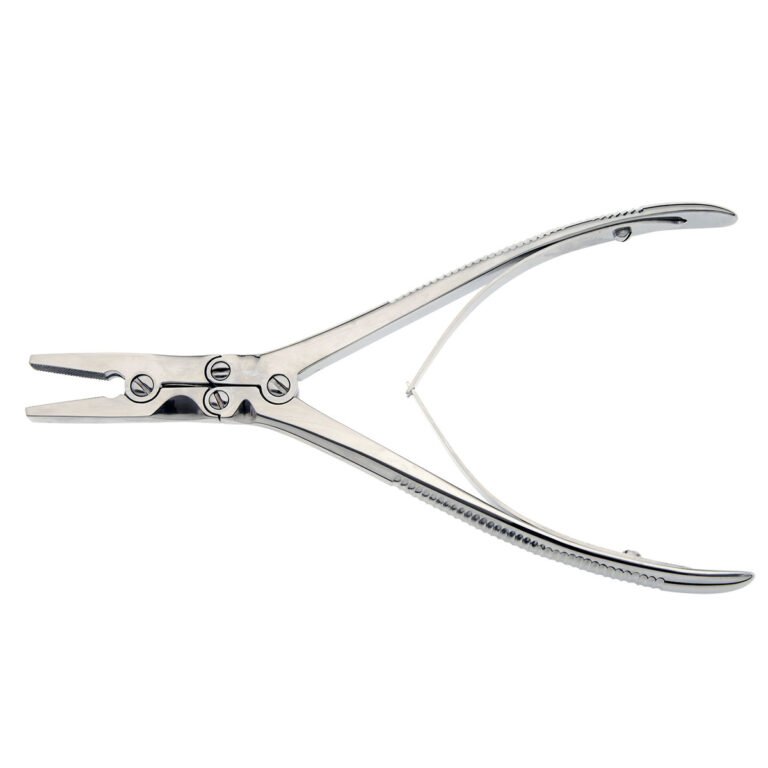
Extraction Pliers | NJ Medical Instruments
In stock
Extraction Pliers: Beaks That Fit the Anatomy They Grip
Extraction pliers are one of the few instrument families where the beak is designed around a specific anatomical shape rather than a general task. The grip has to seat on the tooth or fragment along its natural contour, transmit force along the correct axis, and stay engaged while that force is applied. A pattern that fits its intended site is controllable; the same instrument used elsewhere slips, and slipping under load is how the surrounding structures get damaged.
Beak shape is site-specific, not a preference
Beaks are ground to match a particular crown or root profile, and the pattern number on the instrument encodes which. The two beaks are often not mirror images: many patterns have one beak shaped for the buccal surface and one for the lingual or palatal, so the pliers only seat correctly in one orientation. Ordering by pattern number rather than by general description is what keeps a set coherent.
Force travels along the handle axis
The handle, joint and beak are aligned so that force applied at the handles arrives at the beak along a predictable line. Straight patterns deliver force along the shaft, suited to anterior sites approached directly. Angled and bayonet forms redirect the working axis so the beak can be seated correctly at posterior sites while the hand stays in a workable position outside the mouth. The angle exists to preserve the line of force, not merely to reach.
Serration, knurling and grip under wet conditions
The inner face of the beak carries serration or a fine cross-hatched pattern that provides purchase on a hard, smooth, wet surface. Too coarse and the contact concentrates into a few points; too fine and it fills and glazes, losing grip in use. Handle knurling matters for the same reason at the other end — the surgeon's control depends on the instrument not rotating in a gloved hand while force is applied.
Joint strength and why these fail where they do
Extraction pliers see high force with a significant rotational component. The joint carries that load in shear, and play developing there lets the beaks separate and splay under pressure, so the grip point shifts from the whole beak face to its tips. That is the common failure mode in this category, and it shows up as slipping long before the beak faces themselves are worn.
Which extraction pliers do you need?
| Site or task | Form | Beak character | Chosen for |
|---|---|---|---|
| Anterior, direct access | Straight | Matched pair, symmetrical | Force delivered along the shaft axis |
| Posterior access | Angled or bayonet | Asymmetric beaks, site-specific | Correct seating with the hand outside the working line |
| Root fragments | Fine narrow beaks | Close-pitch serration | Purchase on a small remaining surface |
| Broad crowns | Wide beaks | Contoured to the surface | Contact spread across the crown |
| Paediatric | Reduced-scale patterns | Proportionate beaks | Fit and force appropriate to smaller anatomy |
Related instruments in this range
- Bone Cutters & Rongeurs — the full range this category sits within
- Flat Pliers — flat-faced gripping and bending
- Bone Holding Forceps — self-retaining fragment control
- Dental Instruments — the wider dental range
- Surgical Instruments — the wider instrument catalogue
Wholesale, OEM and private-label supply
NJ Medical Instruments manufactures extraction pliers in Sialkot, Pakistan, supplying single instruments through this shop and full pattern sets in bulk to hospitals, dental practices, dental schools and distributors. As the manufacturer we produce to specification — beak profile and pattern number, angle, serration pitch, handle knurling, joint type, marking and private-label packaging. Because this category is normally bought as a matched set of patterns, we can quote for a complete range. Email info@njmedicalinstruments.com or message +92-333-8733922.
Frequently asked questions
Why are extraction pliers sold by pattern number?
Because the beak is ground to fit a specific anatomical profile, and the number identifies which. Two patterns that look similar can seat quite differently. Ordering by number rather than by a general description is what keeps a set consistent and replacements interchangeable.
Why are the two beaks sometimes different shapes?
Many patterns are designed with one beak contoured for one surface and the other for the opposing surface, so the instrument is intended to be seated in a particular orientation. They are not manufacturing mismatches — using such a pattern the wrong way round is a common cause of poor seating.
What do angled and bayonet forms achieve?
They redirect the working axis so the beak can seat correctly at sites that cannot be approached in a straight line, while keeping the hand in a position where force can still be applied along the intended axis. The purpose is preserving the line of force, not simply gaining reach.
Why do my pliers slip even though the beaks look fine?
Usually joint wear. High force with a rotational component loads the joint in shear, and once play develops the beaks splay under pressure so contact shifts to the tips. Slipping from this cause appears well before the beak faces show visible wear.
What are your extraction pliers made from?
They are manufactured from surgical-grade stainless steel, with beak faces ground and joints fitted and inspected before dispatch. Both reusable and single-use options exist across our range — specify which you need when ordering, or ask for the material specification of a particular pattern.
Can I order a full set of patterns or a custom specification?
Yes. As an OEM manufacturer we supply retail quantities through this shop and bulk orders direct from the factory, including complete pattern sets. Custom beak profiles, angles, serration pitches, handle finishes, laser marking and private-label packaging are available. Send your specification and quantity for a quotation.