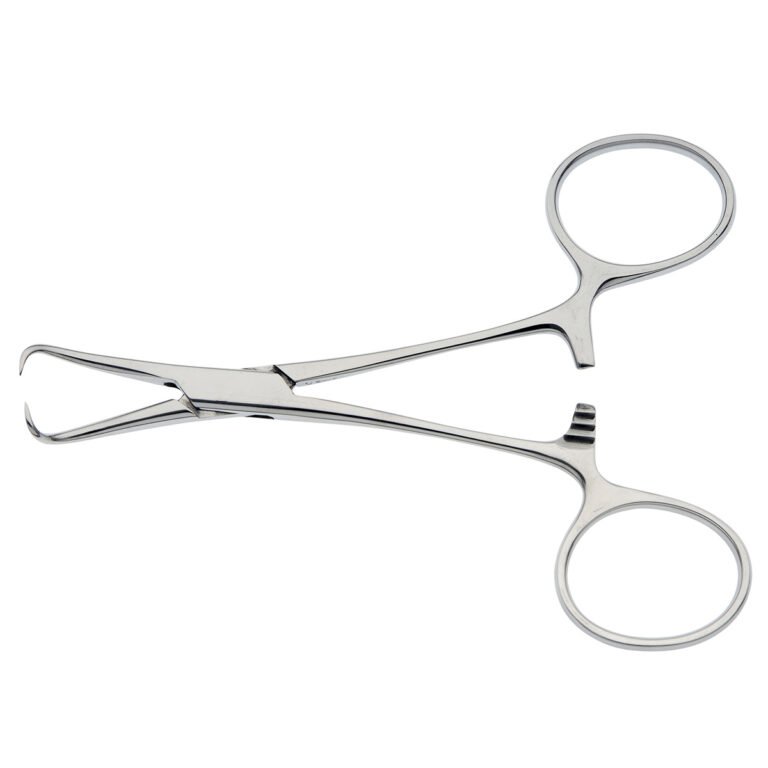
Towel Clamps: Holding the Drape Exactly Where It Was Placed
A towel clamp has one job — keep the drapes fixed for the whole procedure — and the shape of its tips decides what that fixation costs. Perforating points bite through layered fabric and hold under lateral pull, but they pass through whatever lies beneath them. Non-perforating jaws grip by pressure alone, so a clamp can be released and re-sited without leaving a track. Most set-ups carry both patterns, and the choice is made drape by drape rather than once for the whole tray.
Perforating points and what they pass through
The classic Backhaus tip is a pair of curved points that meet like pincers. Closing the ratchet drives them through the drape layers and locks them against each other, producing a hold that resists the lateral drag of instruments, tubing and the surgeon's forearm. That security comes from penetration, which is also the limitation: anything the points reach is penetrated as well. Perforating clamps therefore belong over bony landmarks and at drape-to-drape junctions where nothing but fabric sits underneath, and they are moved as little as possible once set.
Non-perforating jaws and repositionable fixation
Lorna and Edna patterns replace the points with ball-ended or flattened jaws that trap fabric between two opposing surfaces. Nothing is pierced, so the clamp can be opened and moved during set-up without leaving a hole behind. This matters most with modern single-use drape materials, where a perforation is a breach in the barrier rather than a repairable hole in reusable linen. The same non-perforating jaws are widely used to anchor suction tubing and diathermy cable to the drape edge, where a perforating tip would cut the insulation.
Ratchet position, not overall length, sets the grip
Towel clamps are commonly supplied between 9 cm and 16 cm. Length governs reach and how far the ring handles project into the working space — shorter clamps sit flatter and interfere less near the incision, longer clamps are easier to find and release at the periphery. Grip strength, however, is set by which ratchet tooth is engaged, not by the size of the instrument. A single lightweight drape needs only the first tooth; heavy layered linen may take the second or third. Driving a non-perforating clamp to full ratchet on thin disposable material tears the fabric it was chosen to protect.
Cross-action and clip patterns
Cross-action clamps such as the Jones pattern close under spring tension and open when the handles are squeezed, which reverses the usual action and allows single-handed placement while the other hand holds the drape. Clip-style patterns dispense with a full ratchet altogether for fast, light fixation. Both are quicker to apply than a ring-handled ratchet clamp and correspondingly easier to dislodge, so they suit set-up fixation rather than load-bearing points.
Which towel clamp do you need?
| Pattern | Tip or jaw | Common lengths | Best suited to |
|---|---|---|---|
| Backhaus | Curved perforating points, ring handles, ratchet | 9, 11, 13, 16 cm | General drape fixation over bony landmarks — the default pattern on most trays |
| Backhaus with bead | Perforating points with a bead stop | 13, 16 cm | Set-ups where penetration depth needs to be limited mechanically |
| Jones (cross-action) | Light perforating points, spring cross-action | 9, 13 cm | Fast one-handed placement on light drapes during set-up |
| Lorna / Edna | Ball-ended non-perforating jaws | 11, 13 cm | Single-use drapes, and anchoring tubing or cable without piercing |
| Doyen | Broad non-perforating serrated jaws | 13 cm | Heavy or multi-layered drapes where grip is spread over a wider jaw |
| Schaedel clip | Clip-style, ratchet-free | 11 cm | Quick temporary fixation where a locking ratchet is unnecessary |
Related clamps in this range
- All Clamps — the full clamp range this category sits within
- Anastomosis Clamps — paired occlusion for vessel and bowel joins
- Colon Clamps — long atraumatic jaws for bowel
- Gall Duct Clamps — angled jaws for the biliary field
- Peripheral Vascular Clamps — calibre-matched vessel occlusion
- Artery Forceps and Ligature Clamps — haemostatic clamping
Wholesale, OEM and private-label supply
NJ Medical Instruments manufactures towel clamps in Sialkot, Pakistan and supplies them both as single items to individual practitioners and in bulk to hospitals, surgical centres, dental schools and distributors. As a direct manufacturer we produce to customer specification — pattern, length, jaw finish, marking and private-label branding — with no intermediary between the workshop and your order. For volume pricing, custom specifications or OEM enquiries, email info@njmedicalinstruments.com or message +92-333-8733922.
Frequently asked questions
What is the difference between perforating and non-perforating towel clamps?
Perforating clamps such as the Backhaus close sharp points through the drape, locking it in place with a hold that resists pulling. Non-perforating clamps such as the Lorna use blunt ball or flat jaws that grip the fabric by pressure without piercing it. Perforating patterns hold more firmly; non-perforating patterns can be repositioned and leave the drape material intact.
What length towel clamp should I order?
For most general set-ups 11 cm and 13 cm cover the majority of fixation points. Choose 9 cm where the clamp sits close to the incision and a projecting handle would obstruct the field, and 16 cm where the clamp is placed at the periphery and needs to be easy to locate and release. Many departments stock two lengths rather than one.
Do non-perforating towel clamps hold securely enough?
They hold well when the jaw is matched to the material and the ratchet is set correctly. Because grip comes from surface pressure rather than penetration, they are more sensitive to fabric thickness — a broad-jawed pattern such as the Doyen grips heavy layered drapes better than a fine ball-tipped one. For high-load points that take repeated lateral pull, a perforating pattern remains the more secure choice.
How many towel clamps are typically used?
Four is the common baseline, one at each corner of the fenestration, with additional clamps added wherever two drape sheets meet or where tubing and cables cross the drape edge. Longer procedures with more equipment at the field usually need more, which is why towel clamps are ordered in sets rather than singly.
What are your towel clamps made from?
They are manufactured from surgical-grade stainless steel, finished and inspected before dispatch. Both reusable and single-use options are available across our clamp range; specify which you need when ordering, or ask us for the material specification for a particular pattern.
Can I order towel clamps in bulk or with our own branding?
Yes. We are an OEM manufacturer and supply both retail quantities through this shop and bulk orders direct from the factory. Custom lengths, jaw patterns, finishes, laser marking and private-label packaging are all available. Contact us with your specification and required quantity for a quotation.