


- Plastic Surgery Instruments
- Electrosurgical Instruments
- Surgical Instruments
- Dental Instruments
- Adenoid Curettes
- Aspirating and Irrigating Instruments
- Blepharoplasty Sets
- Breast Surgery Sets
- Chisels
- Dental Instruments
- Amalgam Pluggers Condensers, Burnishers
- Artery Forceps
- COMPSITE PLACEMENT, PLASTIC FILLING INSTRUMENTS
- ELEVATORS
- Ear Catheters and Excavators
- Ear Forceps
- Ear Hooks
- Ear Scissors and Ear Snares
- Ear Specula & Tuning Forks
- Electrosurgical Instruments
- Bipolar Artery Sealer
- Bipolar Cables
- Bipolar Electrodes
- Conization Electrodes
- Diathermy Instruments
- Electrodes (2.4 mm)
- Electrodes (4.0 mm)
- Electrosurgical Instruments for Gynecology
- ENT Diagnostic
- Conventional Laryngoscopes
- Ear Instruments
- ENT Complete Sets
- ENT Instruments
- Anastomosis Clamps
- Aortic-Aneurysm Clamps
- Carotid Clamps
- Colon Clamps
- Artery and Ligature Clamps
- Artery Forceps
- Artery Forceps and Ligature Clamps
- Bone Cutters & Rongeurs
- Curettes, Raspatories, Elevators etc.
- Blepharoplasty Scissors
- Dissecting Scissors
- Bone Curettes
- Dissectors
- Elevators
- Bone Cutting Forceps
- Bone Holding Forceps
- Bone Rongeurs
- Chisels
- Clamps
- Dissectors & Elevators
- Endoscopic Face & Forehead Lift
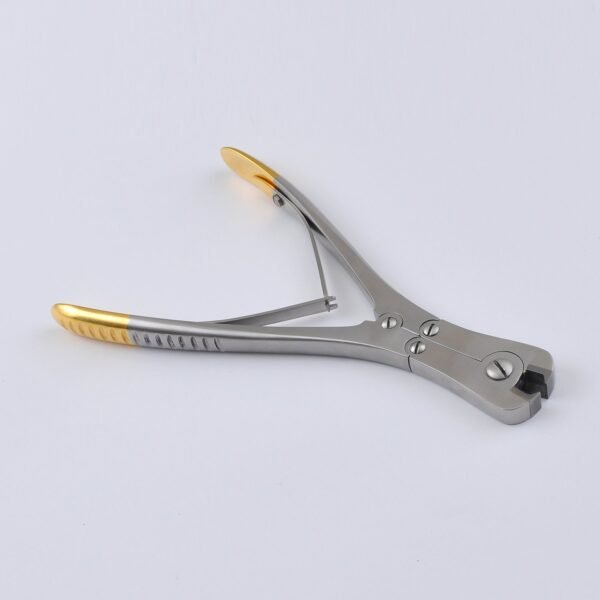
L Wire Cutter 17cm | NJ Medical Instruments
SKU:
NJM-26094
Original price was: $ 51.$ 39Current price is: $ 39.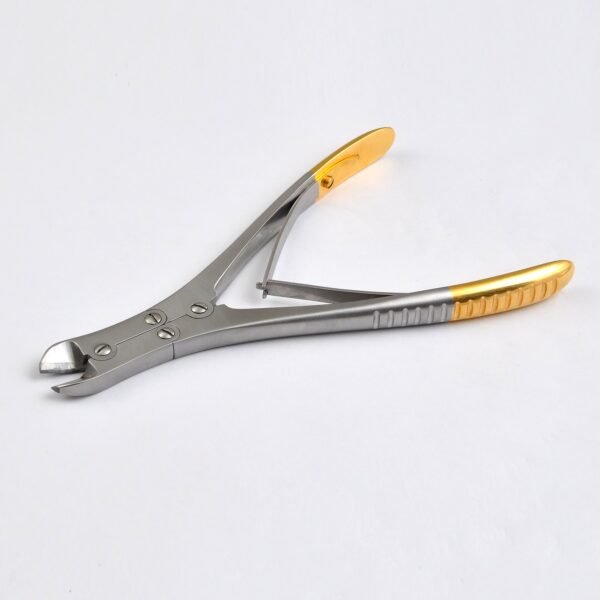
TC Wire Cutter 16.5cm | NJ Medical Instruments
SKU:
NJM-26095
Original price was: $ 51.$ 39Current price is: $ 39.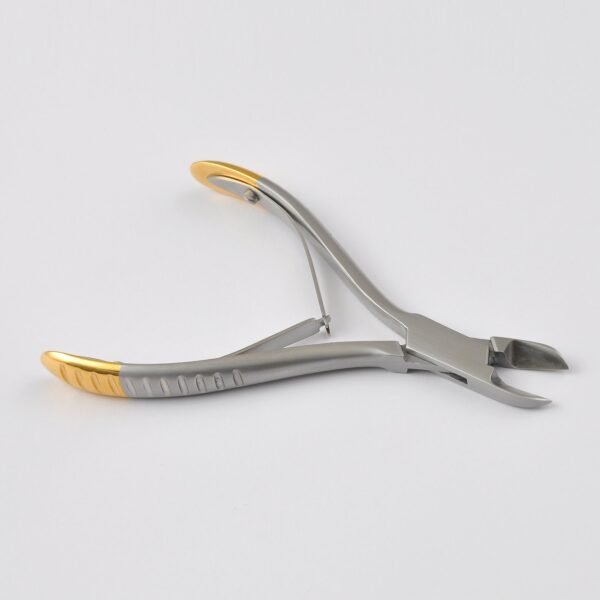
Wire Cutter – 12.4 cm | NJ Medical Instruments
SKU:
NJM-26096
Original price was: $ 51.$ 39Current price is: $ 39.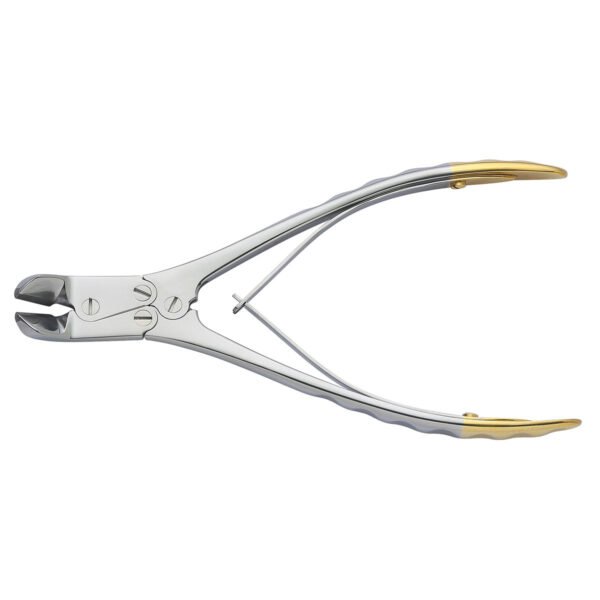
NJ Medical Instruments Double-Action Joint Wire Cutter | NJ Medical Instruments
SKU:
NJM-26523
Original price was: $ 51.$ 39Current price is: $ 39.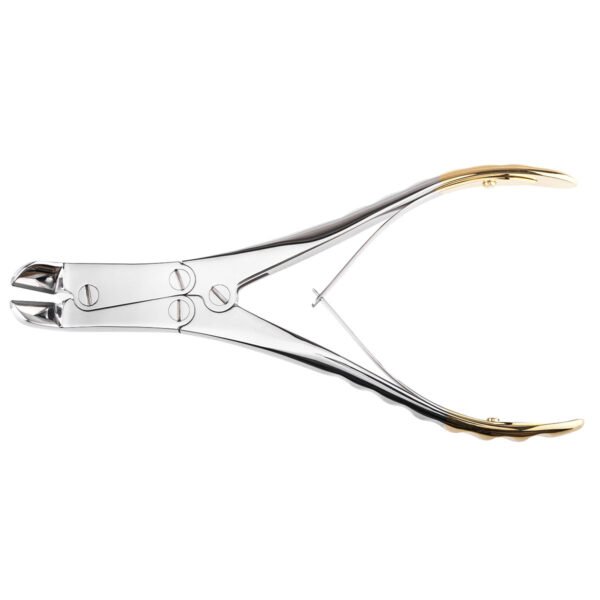
Extra Strong Double-action Joint Wire Cutter | NJ Medical Instruments
SKU:
NJM-26524
Original price was: $ 51.$ 39Current price is: $ 39.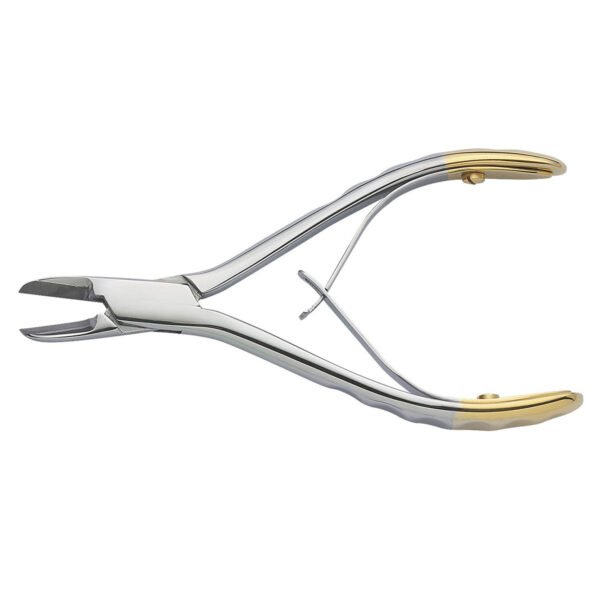
Single-action Joint Wire Cutter | NJ Medical Instruments
SKU:
NJM-26525
Original price was: $ 51.$ 39Current price is: $ 39.Surgical Wire Cutters for Sale - Single Action, Double Action and L-Type Instruments
Wire fixation is routine across orthopaedic trauma, cardiac surgery, jaw wiring, and maxillofacial practice, and removing or modifying that wire at some point in the patient's clinical course requires instruments that can handle hardened surgical stainless steel wire reliably. This sounds straightforward until you actually try to cut an 18-gauge stainless cerclage wire in a post-operative wound with an instrument that lacks adequate jaw force - the wire deforms and slips rather than cutting cleanly, the manoeuvre requires multiple attempts, and the surrounding soft tissue gets progressively more traumatised with each failed bite.
A surgical wire cutter is not a hardware tool. The blades have to be hardened to cut through work-hardened stainless steel wire, the mechanism has to generate enough jaw force in the confined space available in a wound, and the geometry has to allow the jaws to reach the wire in the specific access angle the anatomy provides. These requirements vary by application - jaw wiring removal is a different mechanical problem from sternal wire cutting, and both differ from Kirschner wire trimming at a fracture site.
The wire cutters in this category at NJ Medical Instruments cover three distinct joint mechanism types designed for different cutting force requirements and access geometries. All CE-certified and manufactured from surgical-grade stainless steel at the company's Sialkot facility.
Understanding Surgical Wire Cutter Mechanisms
The cutting performance of a surgical wire cutter is primarily determined by its joint mechanism - the relationship between handle movement and jaw force at the cutting edge. Three main configurations address different force and access requirements.
Single-Action vs Double-Action Joints
A single-action joint wire cutter operates on the same mechanical principle as standard scissors - the pivot point is between the handle force application points and the cutting jaws. The cutting force at the jaw is a direct function of the hand force applied to the handles, reduced by the mechanical disadvantage of the lever arm ratio. For light-gauge wire in accessible positions, this is entirely adequate and the mechanism is simple, reliable, and easy to maintain.
A double-action joint mechanism introduces a compound linkage between the handles and the cutting jaws. The double hinge multiplies the force applied at the handles into significantly higher jaw closure force. The same hand squeeze that would generate 50 N of jaw force in a single-action cutter generates 150 N or more in a well-designed double-action instrument. This matters for heavy-gauge wire - 16-gauge or 18-gauge stainless cerclage wire, and particularly the heavy stainless wires used for sternal closure in cardiac surgery, which are designed to resist deformation under mechanical stress.
L-Type and Angled Access Cutters
Standard straight-jaw wire cutters require the operator to approach the wire from an axis roughly parallel to the instrument's length. In many surgical access situations, the wire is oriented perpendicular to the practical approach axis - behind a bony prominence, at an angle in a wound corner, or in a location where a straight jaw cannot reach the wire without obstructing the view entirely. L-type wire cutters redirect the cutting jaw at a right angle to the shaft, allowing the wire to be approached from an access corridor that would not accommodate a straight jaw instrument.
Featured Surgical Wire Cutters at NJ Medical Instruments
Single-Action Joint Wire Cutter
The Single-Action Joint Wire Cutter is the standard configuration for light and medium-gauge wire cutting in accessible surgical sites. The straightforward single-pivot mechanism is reliable over many sterilisation cycles without the additional joint components that double-action cutters require. CE-certified. Well suited for Kirschner wire trimming, light cerclage work, and suture wire in maxillofacial and orthopaedic settings.
Extra Strong Double-Action Joint Wire Cutter
The Extra Strong Double-Action Joint Wire Cutter provides compound leverage for heavy-gauge wire - the double-action hinge multiplies handle force into significantly higher jaw closure force. CE-certified. The instrument of choice for sternal wire cutting, heavy cerclage removal, and any situation where single-action jaw force is insufficient for a clean single-bite cut through the wire.
L Wire Cutter 17 cm
The L Wire Cutter 17 cm is the angled-access variant - the cutting jaw is oriented at an angle to the shaft, allowing the instrument to reach wire in locations where a straight jaw cannot achieve the correct approach geometry. At 17 cm overall length the instrument provides adequate reach for most wound depths. CE-certified. Particularly useful in jaw wiring removal, posterior wound wire access, and fracture sites where the wire lies behind or below a bony structure.
Ordering and Supply
NJ Medical Instruments ships surgical wire cutters worldwide, with bulk pricing available for orthopaedic units, cardiac surgery departments, and distributors. Contact info@njmedicalinstruments.com for wholesale enquiries.