



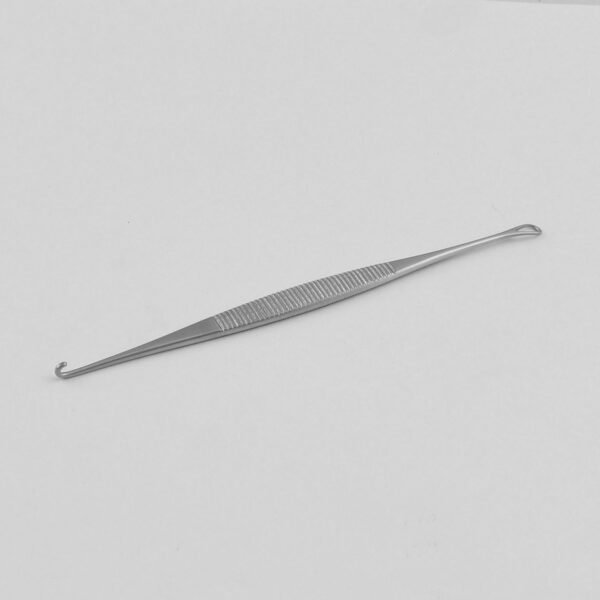
Roser Loops Blunt 14cm | NJ Medical Instruments
SKU:
NJM-26073
Original price was: $ 30.$ 20Current price is: $ 20.
Gross Loops 12cm | NJ Medical Instruments
SKU:
NJM-26072
Original price was: $ 30.$ 20Current price is: $ 20.
Gross Loops 12cm | NJ Medical Instruments
SKU:
NJM-26071
Original price was: $ 30.$ 20Current price is: $ 20.Surgical Loops for Sale - Gross, Roser and Tissue Retraction Loops for General Surgery and ENT
Surgical loops sit in a category that does not get much attention in instrument catalogues, which is partly a reflection of how unassuming they look. A loop - a wire or formed metal shaft with a loop at the working end - does not look like a precision instrument. But the specific loop pattern, tip width, shaft length, and tip finish determine how useful the instrument is in the specific task it was designed for. A loop that slips off tissue, tears when tension is applied, or is too short to reach the operating site adds real friction to procedures that should be straightforward.
The loops category at NJ Medical Instruments covers the standard patterns used in general surgery and ENT practice - Gross loops and Roser loops in appropriate shaft lengths and tip configurations. All CE-certified, surgical stainless steel, manufactured at the company's Sialkot facility.
What Surgical Loops Are Used For
The term "loop" covers several related instrument types with overlapping but distinct applications across surgical practice.
Tonsil Dissection and ENT Applications
In tonsillectomy by dissection technique, loops are used to develop the plane between the tonsillar capsule and the superior constrictor muscle. The loop is passed around the superior pole of the tonsil or around the tonsillar tissue during the dissection to provide controlled traction that maintains the correct tissue plane while the surgeon divides the attachments. The appropriate loop keeps steady, distributed tension on the tonsil without tearing through the capsule - a common failure mode when the loop is too narrow, too sharp, or applied with excessive force.
Roser loops are specifically associated with tonsil surgery in the European surgical tradition. Wilhelm Roser's contribution to standardising tonsillectomy technique included the loop design that carries his name - a blunt-tipped instrument that applies traction to tonsillar tissue without creating the laceration risk associated with sharper loop geometries. The blunt tip matters because the tonsillar capsule and the superior constrictor muscle are not far apart, and a sharp tip under traction can break through the capsule into the muscle, creating bleeding and making the dissection plane harder to maintain.
General Tissue Retraction and Handling
Outside of ENT, loops are used for holding tissue aside during dissection without the bulk of a retractor - particularly in confined fields where a rigid retractor would obstruct access. A loop passed around a vessel, duct, or fascial band allows it to be held out of the surgical field by gentle traction on the loop shaft, keeping the working area clear without requiring an additional retractor and hand. This is a common manoeuvre in thyroid surgery, where recurrent laryngeal nerve identification and protection often involves passing a fine loop around the nerve or adjacent structures to hold them gently aside while the surgeon works in the surrounding tissue.
The Gross loop pattern is associated with this type of general tissue handling and retraction use - the geometry suits pulling tissue rather than pushing through a dissection plane.
Instrument Length and Tip Configuration
Loop length determines how far into a surgical field the instrument can reach while keeping the operator's hand outside the sterile field. A 12 cm loop provides adequate reach for tonsillar and shallow pharyngeal work with good tactile control. A 14 cm shaft gives more reach for deeper field access or patients with restricted mouth opening in ENT procedures. The shaft length also affects the mechanical advantage available for applying traction - a longer shaft amplifies small movements at the handle into larger motion at the working end, which requires more care in delicate tissue applications.
The blunt vs sharp distinction at the loop tip is clinically significant: blunt tips distribute the contact force over the tip surface, reducing the risk of the loop cutting through tissue under traction, while sharp loop tips are used where the intent is to pass through tissue planes rather than simply apply surface traction.
Featured Surgical Loops at NJ Medical Instruments
Gross Loops 12 cm
The Gross Loops 12 cm is a 12 cm shaft general surgical loop instrument in the Gross pattern - suited for tissue retraction, vessel and nerve loop placement, and shallow field dissection support work. Surgical stainless steel, CE-certified, autoclavable. The 12 cm length provides standard reach for general ENT and surgical applications without the excess shaft that reduces tactile control in confined fields.
Roser Loops Blunt 14 cm
The Roser Loops Blunt 14 cm is the tonsil surgery configuration - blunt tip for safe tonsillar traction without capsule penetration, 14 cm shaft for the deeper reach needed in the oropharynx compared to more superficial ENT approaches. Surgical stainless steel, CE-certified, autoclavable. For ENT units that perform tonsillectomy by dissection, having the correctly configured Roser loop rather than improvising with a general loop reduces the procedure time and the risk of capsule tear during the superior pole dissection step.
Ordering and Supply
NJ Medical Instruments ships surgical loops worldwide, with bulk pricing for ENT departments, general surgery units, and distributors. Contact info@njmedicalinstruments.com for wholesale enquiries.