


Electrosurgical Insulation Failure: How Many Instruments Are Defective, and How to Actually Find Them

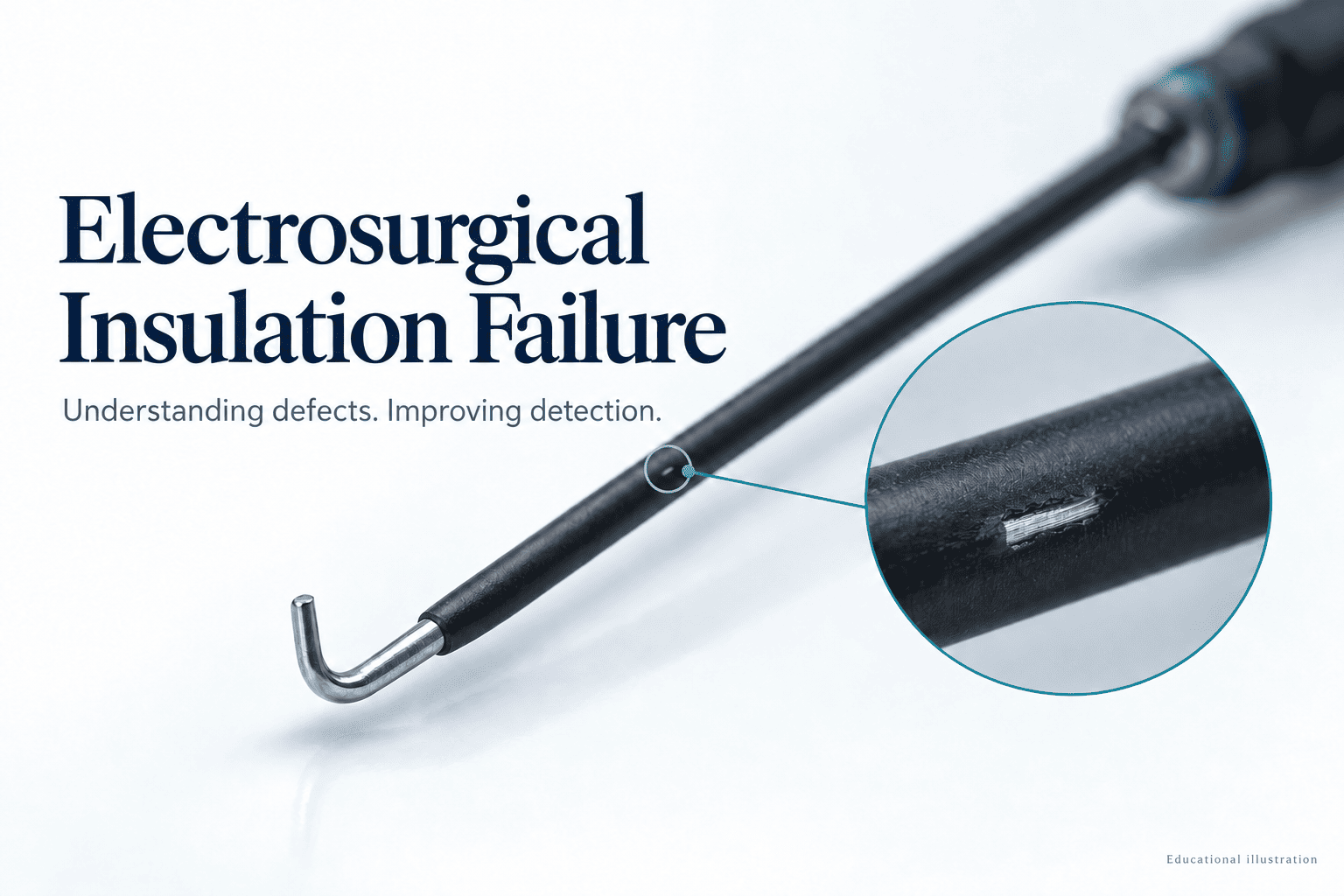
A laparoscopic hook comes out of the washer looking perfect. It is inspected, wrapped, sterilised and opened onto the field. Three centimetres up the shaft there is a break in the insulation roughly the width of a pinhead. During the case, current leaves through that hole instead of the tip, into whatever the shaft happens to be touching. Nobody sees it. The surgeon is looking at the tip, and the burn is outside the visual field.
Two weeks later the patient is readmitted with peritonitis.
That is the mechanism behind stray electrosurgical energy, and the uncomfortable part is not that it happens. It is how many instruments in ordinary circulation carry the defect that allows it, and how poorly the two methods we use to find those defects actually perform.
Electrosurgical insulation failure is a break in the insulating coat of an instrument that lets current escape somewhere other than the active tip. This guide gives you the measured prevalence across five studies, what a 2026 multisite study changed about detection, what does and does not predict failure, an honestly costed testing protocol, and what the 2026 AORN guideline revision means if you are the person buying the instruments, cables and return electrodes.
The short answer
- How common is it? Between 11.6% and 37.2% of insulated electrosurgical instruments across published studies. The most recent multisite study, April 2026, found defects on 13.1% of instruments and at least one defective instrument in 58.6% of trays.
- Can you see it? Only partly. In the 2026 study, 38.2% of defects were found only by visual inspection and 35.3% only by electrical testing. Neither method alone is adequate.
- Where are the defects? The 2026 data put handles (31.3%) well ahead of shafts (8.3%). Earlier studies pointed to the distal or mid shaft. The findings disagree, so inspect the whole device.
- Does age or cycle count predict failure? No. A 2023 study found no significant difference in years of service or number of cleanings between failed and intact instruments.
- Does having a testing policy fix it? Not on its own. Prevalence was statistically indistinguishable between hospitals that routinely checked and those that did not.
- What does appear to help? How instruments are packed and cleaned. Fixed packaging cut new defects from 14 per 100 to 2 per 100.
- What does it cost in time? About 11 seconds per instrument for visual inspection and 36 seconds for insulation testing.
On this page
- What insulation failure is, and the three ways energy escapes
- How common is it? Five studies, one picture
- What the 2026 multisite study changed
- What does not predict failure
- What does seem to matter
- Building a testing protocol that reflects the evidence
- The workload question, costed honestly
- Cables and return electrodes: the parts nobody tests
- What the 2026 AORN guideline revision changes for buyers
- Active electrode monitoring: what the evidence supports
- What to do with an instrument that fails
- Numbers you will see quoted that we could not verify
- Frequently asked questions
- Sources
What insulation failure is, and the three ways energy escapes
An insulated electrosurgical instrument is a conductor wrapped in a dielectric coat. The coat is there so that current leaves at the tip, where the surgeon is looking, and nowhere else. Insulation failure is any break in that coat — a pinhole, a crack, an abrasion, a split at a joint — that gives current a second exit.
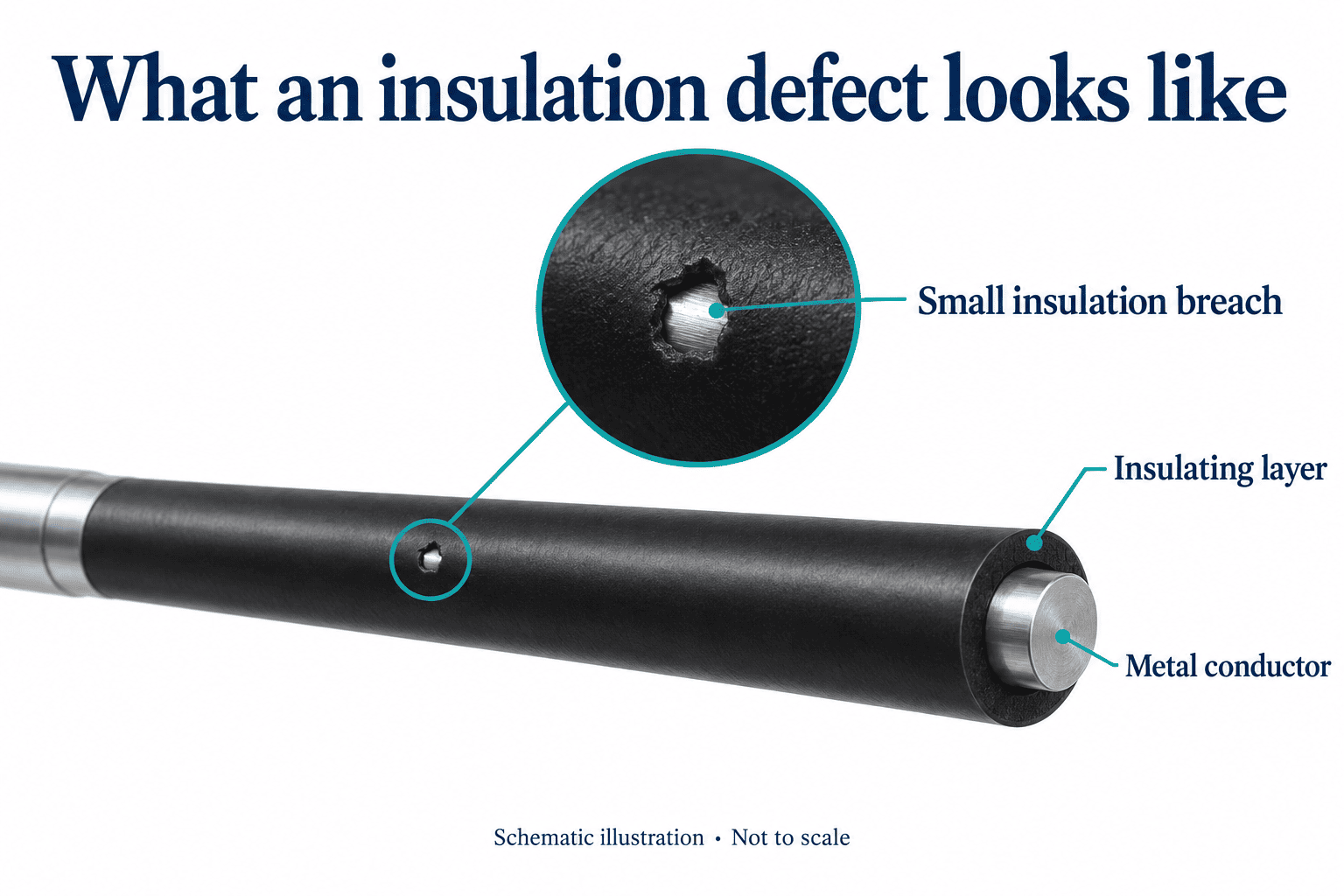
There are three recognised ways energy reaches tissue it was not meant to reach, and they are routinely confused with each other.
| Mechanism | What happens | Why it is dangerous |
|---|---|---|
| Insulation failure | A defect in the insulating coat lets current exit through the shaft or handle instead of the tip | The exit point is usually outside the surgeon’s field of view, so the burn is unwitnessed |
| Direct coupling | The activated electrode touches another conductive instrument, which then carries current to tissue | Energy is delivered wherever that second instrument is resting |
| Capacitive coupling | Current is induced through intact insulation into a nearby conductor, with no physical contact and no defect at all | No inspection or test will find it, because nothing is broken. It is a physics problem, not a maintenance problem |
Swipe the table sideways to see all columns →
That last row matters for how you think about the whole subject. Testing programmes address insulation failure. They do not address capacitive coupling, which is why guidance treats technique and equipment selection as separate controls rather than substitutes.
Capacitive coupling was once thought to be the dominant cause of laparoscopic electrosurgical injury, largely because of hybrid metal-and-plastic trocars. Montero and colleagues noted in Surgical Endoscopy that modern laparoscopy has reduced capacitive coupling and that insulation failure is now thought to be the main cause of electrosurgical complications. That shift is why the rest of this article concentrates on the defect you can actually find.
How common is it? Five studies, one picture
The honest answer to “how many of our instruments are defective” is that published prevalence runs from about one in nine to more than one in three, and the spread is mostly explained by method rather than by real differences between hospitals.
| Study | Setting and sample | Detection method | Prevalence found |
|---|---|---|---|
| Smart, Ofstead, Lamb & Daniels, Biomedical Instrumentation & Technology, April 2026 | 259 laparoscopic instruments in 29 trays, across a tertiary centre, a paediatric hospital and an ambulatory surgery centre | Visual inspection plus insulation integrity tester, defects photographed under microscope | 13.1% of instruments; 58.6% of trays held at least one |
| Tixier, Garçon, Rochefort & Corvaisier, Surgical Endoscopy, 2016 | 489 electrosurgical instruments, laparoscopic and non-laparoscopic | Visual, then high-voltage detector (DTU-6 and DIATEG) | 24.1% by visual alone, 37.2% with the detector |
| Montero, Robinson, Weaver & Stiegmann, Surgical Endoscopy, 2009 | 226 laparoscopic instruments (165 reusable, 61 disposable) at four urban hospitals | High-voltage porosity detector at 2.5 kV | 19% reusable vs 3% disposable; 71% of reusable sets had at least one |
| Zhang et al., Medicine, 2021 | 740 instruments at one Chinese hospital | High-voltage detector, 4 kV monopolar / 2 kV bipolar | 13.1% overall |
| Homma, Uehara & Saji, Scientific Reports, 2023 | 69 reusable endoscopic instruments | Insulation failure detector | 11.6%; by specialty, 14.3% gastrointestinal, 15.0% gynaecological, 8.3% urological, 0 of 9 thoracic |
Swipe the table sideways to see all columns →
Three things are worth pulling out of that table before you use any single number.
The method sets the number. Tixier’s study is the clearest demonstration: the same 489 instruments gave 24.1% on visual inspection and 37.2% once a detector was used. If someone quotes you a prevalence, ask how it was measured before you compare it with your own.
Reusable and disposable are not equivalent. Montero found insulation failure in 19% of reusable instruments against 3% of disposable ones. That is a genuine input to the reusable-versus-single-use decision, which we set out more fully in our comparison of reusable and disposable surgical instruments — though note the disposable sample there was a single instrument type, so treat it as directional rather than definitive.
Tray-level prevalence is the number that matters operationally. Instrument-level prevalence of 13.1% sounds manageable. The same dataset found 58.6% of trays contained at least one defective instrument, and Montero found 71% of reusable sets did. You do not open an instrument, you open a tray. For the tray-level view of your inventory generally, our guide to surgical instrument tray optimisation covers how to audit what is actually in circulation.
What the 2026 multisite study changed
Most published guidance on this subject says some version of: visual inspection is not enough, so use an insulation tester. That advice was built on studies like Tixier’s, where 13.1% of instruments were visually intact but failed the electrical test.
The April 2026 multisite study in AAMI’s Biomedical Instrumentation & Technology tested both methods head to head on the same 259 instruments and found something more awkward.
| Of the 34 instruments with defective insulation | Count | Share |
|---|---|---|
| Detected by both visual inspection and testing | 9 | 26.5% |
| Detected only by visual inspection | 13 | 38.2% |
| Detected only by insulation integrity testing | 12 | 35.3% |
Swipe the table sideways to see all columns →
Read the middle row again. More defects were found by eye alone than by the tester alone. A programme that replaced visual inspection with electrical testing would have missed 38.2% of the defective instruments in this sample.
The location finding is equally inconvenient for standard practice. Defects were found on 31.3% of handles (15 of 48) against 8.3% of shafts (20 of 240). Testing protocols and training material have historically concentrated on the shaft, which is where the older studies pointed.
And the older studies do point elsewhere. Montero found insulation failure most common in the distal third of laparoscopic instruments (54%). Tixier found the median, or mid-shaft, location most common for laparoscopic instruments (50.4%) and the distal location for non-laparoscopic ones (40.4%). The 2023 Scientific Reports study put the median defect 5 cm from the tip.
These findings genuinely disagree, and we are not going to pretend otherwise. Different instrument mixes, different detectors, different definitions of “distal third”. The defensible conclusion from the disagreement is the practical one: there is no region of an insulated instrument you can safely skip, and the handle is not the safe zone it has been treated as.
The authors’ own conclusion is that facilities should implement quality assurance protocols incorporating both systematic visual inspection and routine insulation integrity testing, and they add, plainly, that this will require additional time and resources. That honesty is worth matching, so there is a costing section below.
What does not predict failure
If you are trying to target a limited testing budget, the obvious instinct is to test the old instruments and the heavily used ones. The evidence does not support that.
Service life does not predict it. Homma and colleagues compared instruments with insulation failure against intact ones and found the period of use was 7 years in both groups (p = 0.90).
Cycle count does not predict it. The same comparison found 281 cleanings in the failed group against 261 in the intact group (p = 0.27).
Having a policy does not, by itself, change prevalence. This is the most uncomfortable finding in the literature. Montero compared hospitals that routinely checked for insulation failure against those that did not, and found 19% (25/130) against 33% (7/21), a difference that did not reach statistical significance (p = 0.16). The authors’ stated conclusion is that one in five reusable laparoscopic instruments has insulation failure, a finding that is not altered by whether the hospital routinely checks for insulation defects.
That should not be read as “testing is pointless”. The small comparison group and the wide uncertainty around those percentages mean the study cannot rule out a real benefit. What it does mean is that the existence of a testing policy is not evidence that the policy is working. A programme that tests a sample, or tests annually, or tests only what looks suspicious, can coexist with a fifth of the inventory being defective. If you want to claim your programme works, you need your own defect data over time, not a policy document.
One thing in the 2023 study did cluster, and it was the manufacturer. The eight failed devices came from three different companies, but six of the eight (75%) came from one of them. With only eight failures, that is far too small a sample to indict any manufacturer or to act on directly. It is, however, a reason to break your own defect data down by supplier and pattern rather than pooling it — if one pattern in your inventory is failing disproportionately, you will only see it if you record it that way. The same study also flagged reusable forceps used as monopolar devices as carrying higher risk and warranting regular assessment.
Keeping that data per instrument rather than per batch is the only way to see whether specific instruments or specific trays are repeat offenders. Our guide to surgical instrument traceability covers how to attach records to individual instruments, which is exactly the infrastructure an insulation programme needs.
What does seem to matter
If age and cycle count do not explain failure, something else does. The best available evidence points at handling — how instruments are packed and how they are cleaned, rather than how often.
Zhang and colleagues tested 740 instruments and then ran a controlled comparison over 10 cleaning cycles.
| Variable | Condition | New defects per 100 instruments |
|---|---|---|
| Packaging | Loose packaging | 14 |
| Packaging | Fixed packaging | 2 |
| Cleaning | Manual + automatic machine | 13 |
| Cleaning | Manual + ultrasonic | 5 |
| Cleaning | Manual + fixed + ultrasonic | 1 |
Swipe the table sideways to see all columns →
The differences reported were statistically significant (p = .0018 for packaging; p = .0009 across the cleaning conditions). The authors concluded that fixed packaging and a gentler cleaning procedure reduce damage to insulating properties.
Two caveats travel with those numbers. It is a single-centre study, and the cleaning and packaging systems are specific to that hospital, so the exact figures will not transfer. And it sits in apparent tension with the 2023 finding that cumulative cleaning count does not predict failure.
Those two findings are reconcilable, and the reconciliation is the practically useful part: it is not how many times an instrument is reprocessed, it is what happens to it during each cycle. Instruments that move loose in a basket, knock against each other and are handled roughly accumulate insulation damage. Instruments held in fixed positions do not, and they can go through hundreds of cycles without it.
That is the same conclusion, arrived at from a different direction, as the handling guidance in our article on instrument stains, rust and corrosion: mechanical contact during reprocessing is a bigger driver of instrument damage than cycle count.
Building a testing protocol that reflects the evidence
Here is what the evidence above supports, as a protocol.
| Element | What the evidence supports | Why |
|---|---|---|
| Both methods, every time | Systematic visual inspection and insulation integrity testing, not one or the other | Each method exclusively caught roughly a third of defects in the 2026 study |
| Whole device | Handle, proximal, mid and distal shaft, and any joint or articulation | Studies disagree on where defects concentrate; handles led in the most recent data |
| Test voltage | Follow the tester manufacturer’s instructions for the device type. Published work has used around 2.5 kV, and separately 4 kV monopolar with 2 kV bipolar | Too low may miss defects in monopolar devices; excessive voltage can damage bipolar instruments |
| Every reprocessing cycle | Test insulated instruments as part of the normal cycle, not as an annual campaign | Defects arise during handling and reprocessing, so an instrument intact last month tells you nothing about today |
| Record per instrument | Log the result against the individual instrument, not the tray | The only way to identify repeat offenders and to demonstrate the programme works |
| Cables too | Include monopolar and bipolar cables in the programme | Measured failure rates are non-trivial; see below |
| Quality review | Track defects found, near misses and adverse events, and review the trend | The 2026 AORN guideline adds a dedicated quality section requiring exactly this |
Swipe the table sideways to see all columns →
One point of realism. Testing every insulated instrument every cycle is what the evidence supports and what the 2026 study’s authors recommend. It is also a genuine resource commitment, which is why the next section costs it rather than waving at it.
Replacing instruments that failed the test?
We manufacture reusable and single-use bipolar forceps, electrodes, cables and return plates in Sialkot, direct and as an OEM. Send your failed-instrument list or your count-sheet lines and you get a line-by-line quote under your own numbering, with pattern and connector type confirmed per line.
To be clear about what we do not do: we do not sell insulation testers, and we have no commercial interest in which testing equipment you choose.
info@njmedicalinstruments.com · WhatsApp +92 333 8733922 · Contact form
The workload question, costed honestly
The 2026 study measured how long each method takes: a mean of 11 seconds per instrument for visual inspection and 36 seconds for insulation integrity testing.
Those two numbers let you cost a programme before you propose one. The calculation below is illustrative — the times are from the study, the volumes are assumptions you should replace with your own.
Assumptions: 400 insulated electrosurgical instruments in circulation. Each turns over 150 times a year. Both methods applied every cycle, so 47 seconds per instrument per cycle.
| Step | Calculation | Result |
|---|---|---|
| Instrument-cycles per year | 400 × 150 | 60,000 |
| Seconds per instrument-cycle | 11 + 36 | 47 |
| Total seconds per year | 60,000 × 47 | 2,820,000 |
| Total hours per year | 2,820,000 ÷ 3,600 | ~783 hours |
| Full-time equivalent, at 1,800 productive hours a year | 783 ÷ 1,800 | ~0.44 FTE |
Swipe the table sideways to see all columns →
So for this illustrative inventory, a complete two-method programme is somewhere near half a technician’s time, before training, equipment and record-keeping. That is a real number to take to a budget conversation, and it is more useful than the claim that testing is quick.
Two ways the figure moves. If you already do systematic visual inspection, the incremental cost of adding testing is the 36 seconds, not the 47 — about 600 hours in this example. And single-use instruments remove their share of the workload entirely, which is one of the less-discussed arguments in the reusable versus disposable calculation. Against that, weigh the replacement cost and the waste, which that article covers.
Run the arithmetic with your own instrument count and turnover before quoting any of it. The structure is what transfers, not the total.
Cables and return electrodes: the parts nobody tests
Insulation programmes tend to stop at the instrument. The circuit does not.
Zhang’s study tested the cables as well and reported 6.2% monopolar conduction failures and 7.7% bipolar short-circuits. A cable fault is not the same hazard as a shaft defect, but it sits in the same circuit and is subject to the same coiling, crushing and connector wear during reprocessing and storage. If your programme tests the instrument and ignores the monopolar and bipolar cables attached to it, you are inspecting part of a system.
The return path deserves the same attention, and this is where the 2026 guideline revision has the most to say.
What the 2026 AORN guideline revision changes for buyers
AORN’s guideline in this area was reissued for 2026 and renamed the Guideline for the Safe Use of Surgical Energy Devices, broadening it beyond electrosurgery. The lead author describes it as containing 67 recommendations — 12 new, 51 revised and 4 unchanged — plus two new sections, one on return electrodes and one on quality.
Four changes have direct purchasing consequences.
The terminology changed. “Grounding pad” and “neutral electrode” are out. The preferred term is return electrode, on the grounds that it accurately describes the pad’s function of returning current to the generator. If your catalogue, count sheets or tender documents still say “grounding pad”, they are now out of step with the guideline.
There is a stated product preference. The guideline recommends dual-foil conductive return electrodes or capacitive return electrodes wherever available, with single-foil pads used only when no alternative exists. That is an unusually specific procurement instruction, and it is the kind of line that shows up in a tender specification. If you are sourcing patient return plates, confirm the foil configuration with your supplier rather than assuming.
Multiple generators need deliberate setup. Where simultaneous use of more than one electrosurgical unit is unavoidable, the guidance is to verify compatibility of units and accessories beforehand, label accessories to correspond with each generator, and use one single-use conductive return electrode per generator, placed close to its own surgical site without overlapping. Alternatively, a capacitive return electrode with two cords, one per generator.
Device selection becomes a team decision. Before adopting a new energy device, the guideline asks for an interdisciplinary team to review clinical outcome data, compare effectiveness and safety across devices, weigh benefits and harms for the specific patient population, and check compatibility with equipment already in use. If you are a distributor or a supplier, expect more questions about outcome evidence and compatibility, and fewer purchases decided on price alone. Our guide to surgical instrument certifications covers what documentation is worth requesting.
One myth the revision addresses is worth repeating because it wastes theatre time. AORN reports finding no definitive evidence of alternate-site burns associated with jewellery, metal orthopaedic implants or tattoos during standard electrosurgery using modern generators. Where jewellery cannot be removed, the recommended response is to notify the team, assess risks and benefits, and consider an alternative energy source, rather than to cancel or delay.
The new quality section asks for a quality management plan that monitors adverse events and near misses, and spells out reporting, investigation and corrective action. Practically, that is where your insulation defect data belongs.
Active electrode monitoring: what the evidence supports
Active electrode monitoring, usually shortened to AEM, is a shielded monopolar instrument system. A conductive shield surrounds the primary insulation and drains stray energy back to the generator, while monitoring circuitry watches device integrity and cuts power if it detects a fault.
What it addresses that testing does not. Testing tells you an instrument was intact when you tested it. AEM acts during the case, and it is the only control in common use that addresses capacitive coupling, which no inspection can detect because nothing is broken. AORN’s 2026 material describes AEM during laparoscopic procedures as an early warning system for insulation failure and stray energy.
What the evidence actually shows. Bilello and colleagues, writing in the Journal of Surgical Research in 2025, created a deliberate insulation defect in the shaft of both a standard monopolar L-hook and an AEM L-hook, delivered 30 W in coagulation mode for three seconds, and measured the temperature change in bovine intestinal tissue with a thermal camera. The AEM device raised tissue temperature by 23.93 °C ± 0.79; the standard L-hook raised it by 148.85 °C ± 1.62 (p < 0.0001).
The number that makes those figures meaningful is in the same paper: severe tissue damage and necrosis can occur at temperatures as low as 60 °C. So the standard instrument with a defect went comfortably past the threshold for tissue destruction, and the shielded one did not approach it.
Where the evidence is thin, stated plainly. That is a bench measurement in animal tissue, not a patient outcome. The same authors note that few studies have evaluated the efficacy of AEM in reducing stray energy injuries in practice. AEM also does nothing to prevent insulation failure or capacitive coupling occurring; it manages the consequence. And the technology is closely associated with a single manufacturer, which means much of the material you will find about it is vendor-produced and should be read with that in mind.
The reasonable position, given that evidence: AEM is a credible additional control for monopolar laparoscopy with a strong mechanistic rationale and good bench data, and it is not a substitute for inspection, testing or technique. Anyone telling you it removes the need for a testing programme is going beyond what has been shown.
What to do with an instrument that fails
A failed insulation test is not a judgement call in the way a stain is.
| Finding | Action |
|---|---|
| Visible break, crack, split or abrasion in the insulation | Remove from service immediately. Do not return it to the tray |
| Failed electrical test, no visible defect | Remove from service. The 2016 data show these are real defects, not tester artefacts |
| Passed the test but the coat is lifting, bubbled or discoloured near a joint | Remove and inspect under magnification. Treat as failed until proven otherwise |
| Cable fails a conduction or short-circuit check | Remove from service. Cables are usually cheaper to replace than to investigate |
| Defect on a single-use instrument | Remove and report to the supplier with the lot number |
Swipe the table sideways to see all columns →
Repair is generally not the route for insulation. Re-coating a shaft is a specialist manufacturing operation, not a repair-bench one, and a partially re-insulated instrument is difficult to validate. For most facilities the practical options are replacement or, for high-turnover items, a move to single-use bipolar forceps, which carry no testing burden and, on Montero’s data, a substantially lower defect rate.
If the failure rate on a particular pattern is consistently higher than the rest of your inventory, that is a supplier conversation. Ask for the insulation material and coating process, whether the coat is applied as a sleeve or a bonded coating, and what the manufacturer’s own test voltage and acceptance criterion are. Our bulk buying guide covers the wider supplier checks that belong in the same conversation.
Rebuilding an electrosurgical inventory
We manufacture the electrosurgical range in Sialkot as an OEM and direct supplier, so a replacement list can be quoted and built line by line rather than bought as a catalogue set.
Reusable bipolar forceps and non-stick bipolar forceps · single-use bipolar forceps · laparoscopic electrodes · diathermy instruments · monopolar and bipolar cables · patient return plates · or browse the full electrosurgical instruments range.
Send your failed-instrument list with connector types and we will confirm pattern compatibility per line before quoting. Certification documentation on request.
info@njmedicalinstruments.com · WhatsApp +92 333 8733922 · Contact form · Browse the shop · About the factory
Numbers you will see quoted that we could not verify
Two figures circulate widely in material on this subject, and we are leaving them out of the argument above rather than repeating them.
The first is that stray electrosurgical energy causes “thousands of patient burns annually” in the United States. The second is that “25% of patients burned by stray current will die”. Both appear in vendor and trade material without a traceable primary source, and we could not trace one. They may be right. We are not going to build a safety argument on a number we cannot check, and neither should you if you are taking a business case to a committee that might check it.
One further figure deserves a date rather than exclusion. A frequently cited survey of 506 surgeons found that 18% had personally experienced a patient complication from capacitive coupling or insulation failure, and 54% knew of a colleague whose patient had. That survey was conducted at an American College of Surgeons conference in 1993. Laparoscopic practice has changed substantially since — Montero’s group note that modern laparoscopy has reduced capacitive coupling specifically. Treat the 1993 figures as evidence that the problem was recognised early, not as a current incidence rate.
Frequently asked questions
What is insulation failure in an electrosurgical instrument?
It is a break in the insulating coat of an insulated electrosurgical instrument — a pinhole, crack, abrasion or split — that lets current exit somewhere other than the active tip. Because the escape point is usually on the shaft or handle and outside the surgeon’s view, the resulting burn is typically unwitnessed and can present days or weeks later.
What percentage of electrosurgical instruments have insulation failure?
Published studies report 11.6% to 37.2%, and the figure depends heavily on the detection method used. The most recent multisite study, published in April 2026, found defects on 13.1% of 259 laparoscopic instruments, with 58.6% of trays containing at least one defective instrument. An earlier study found 19% of reusable laparoscopic instruments defective against 3% of disposable ones.
Is visual inspection enough to find insulation defects?
No, and neither is electrical testing on its own. In the 2026 multisite study, 38.2% of defects were found only by visual inspection and 35.3% only by insulation integrity testing, with just 26.5% found by both. The evidence supports running both methods rather than choosing between them.
Where on the instrument do insulation defects occur?
The studies disagree, which is itself the useful finding. The 2026 data found defects on 31.3% of handles against 8.3% of shafts. A 2009 study found failures most common in the distal third of laparoscopic instruments (54%). A 2016 study found the mid-shaft position most common for laparoscopic instruments (50.4%) and the distal position for non-laparoscopic ones (40.4%). Inspect and test the whole device, including the handle.
How often should insulated instruments be tested?
The evidence supports testing every reprocessing cycle rather than running periodic campaigns, because defects arise from handling during use and reprocessing. An instrument that passed last month tells you nothing about its condition today. The 2026 study’s authors recommend incorporating both visual inspection and insulation integrity testing into normal sterile processing cycles, and acknowledge this requires additional time and resources.
What voltage should an insulation tester use?
Follow the tester manufacturer’s instructions for the device type being tested. Published studies have used around 2.5 kV, and separately 4 kV for monopolar instruments with 2 kV for bipolar. The reasoning given is that too low a voltage may miss defects in monopolar devices, while excessive voltage can damage bipolar instruments.
Do older instruments fail more often?
The available evidence says no. A 2023 study found no significant difference in service life between failed and intact instruments (7 years in both groups, p = 0.90) or in number of cleanings (281 against 261, p = 0.27). You cannot target testing at the oldest instruments and assume the newer ones are safe.
What causes insulation to degrade?
Mechanical handling appears to matter more than cycle count. A 740-instrument study found fixed packaging reduced new defects from 14 per 100 to 2 per 100, and gentler cleaning sequences reduced them further. Repeated insertion through trocars, high-voltage settings and material defects are also cited as contributors.
Can a failed instrument be repaired?
Usually not economically. Re-coating insulation is a manufacturing process rather than a repair-bench operation, and a partially re-insulated instrument is difficult to validate. Replacement, or a move to single-use for high-turnover items, is the practical route for most facilities.
Does active electrode monitoring replace insulation testing?
No. AEM addresses stray energy during the case, including capacitive coupling that no test can detect, and bench studies show it prevents the temperature rise that an insulation defect otherwise produces. But few studies have evaluated whether it reduces actual injuries in practice, and it does not prevent insulation failure from occurring. Treat it as an additional control, not a replacement for inspection and testing.
What changed in the 2026 AORN guideline?
The guideline was renamed the Guideline for the Safe Use of Surgical Energy Devices and contains 67 recommendations — 12 new, 51 revised, 4 unchanged — with new sections on return electrodes and quality. For buyers, the notable changes are the retirement of the terms “grounding pad” and “neutral electrode” in favour of “return electrode”, a stated preference for dual-foil conductive or capacitive return electrodes over single-foil, specific setup requirements when multiple generators are used, and a requirement for interdisciplinary review before adopting new energy devices.
Are bipolar instruments safer than monopolar for stray energy?
Bipolar instruments confine current between the two poles of the instrument rather than routing it through the patient to a return electrode, which removes the return-path hazards and substantially reduces the stray energy problem that dominates monopolar laparoscopy. It does not make insulation irrelevant: bipolar instruments and their cables still fail, and one study reported 7.7% bipolar cable short-circuits. Bipolar instruments should be tested at the lower voltage their manufacturer specifies.
Sources
- Smart AG, Ofstead CL, Lamb LA, Daniels FE. Laparoscopic Instrument Defect Detection: A Prospective, Multisite Study. Biomedical Instrumentation & Technology, 7 April 2026; 60(2):9–18. DOI 10.2345/0899-8205-60.2.9. The keystone source: 13.1% instrument and 58.6% tray defect prevalence, the head-to-head comparison showing each detection method exclusively caught about a third of defects, handle versus shaft distribution, and the 11-second and 36-second timings. Europe PMC
- Montero PN, Robinson TN, Weaver JS, Stiegmann GV. Insulation failure in laparoscopic instruments. Surgical Endoscopy, 2009; 24(2):462–465. DOI 10.1007/s00464-009-0601-5. 19% reusable versus 3% disposable, 71% of reusable sets affected, distal-third concentration, and the finding that routine checking did not significantly alter prevalence. Europe PMC
- Tixier F, Garçon M, Rochefort F, Corvaisier S. Insulation failure in electrosurgery instrumentation: a prospective evaluation. Surgical Endoscopy, 2016; 30(11):4995–5001. DOI 10.1007/s00464-016-4844-7. 489 instruments, 24.1% by visual inspection against 37.2% with a detector, and 13.1% visually intact but electrically failed. Europe PMC
- Zhang Y, et al. The packaging and clean method contribute to insulation failure of electrosurgical instruments. Medicine (Baltimore), 2021; 100(42):e27492. 740 instruments, 13.1% overall; packaging and cleaning-method effects; monopolar and bipolar cable failure rates. Single-centre. PMC
- Homma T, Uehara H, Saji H. Factors affecting insulation failure in reusable surgical devices. Scientific Reports, 22 August 2023; 13(1):13719. DOI 10.1038/s41598-023-41059-8. 11.6% prevalence in 69 devices, specialty breakdown, median defect 5 cm from the tip, the absence of any significant association with service life or cleaning count, the clustering of six of eight failures in one manufacturer’s products, and the higher risk flagged for reusable forceps used as monopolar devices. nature.com
- AORN, Guideline for the Safe Use of Surgical Energy Devices (2026 revision), as described by AORN. The rename and scope change, 67 recommendations, return electrode terminology and the dual-foil preference, multiple-generator setup, the new quality section, AEM as an early warning system, and the absence of definitive evidence on jewellery, implants and tattoos. aorn.org
- Bilello J, Larsen J, Fu D, Jones T, Jones E. The Protective Shield: A Comparative Analysis of Standard Laparoscopic Techniques versus Active Electrode Monitoring Technology. Journal of Surgical Research, 2 May 2025; 310:249–256. DOI 10.1016/j.jss.2025.03.059. The bovine-tissue benchtop comparison of AEM against a standard L-hook with an induced insulation defect, the 60 °C tissue-damage threshold, and the stated limitation that few studies have evaluated AEM’s effect on actual injuries. Europe PMC
Research completed 25 September 2026. Prevalence figures are from the studies named and are not interchangeable — each depends on the detection method, test voltage and instrument mix used. Test your own inventory before assuming any of these rates apply to it.

Written by
Akif Javaid
Akif Javaid is the owner of NJ Medical Instruments, a surgical instrument manufacturer established in Sialkot, Pakistan in 1990. The company manufactures reusable surgical, dental, ENT and orthopedic instruments and now stocks them locally through inventory hubs in Pakistan, the UK, the UAE and the USA, supplying hospitals, clinics and distributors worldwide with faster regional fulfilment. It also produces private-label and OEM instrument sets to customer specification.

3 thoughts on “Electrosurgical Insulation Failure: How Many Instruments Are Defective, and How to Actually Find Them”