


Reusable vs Disposable Surgical Instruments: Cost, Safety and Waste Compared

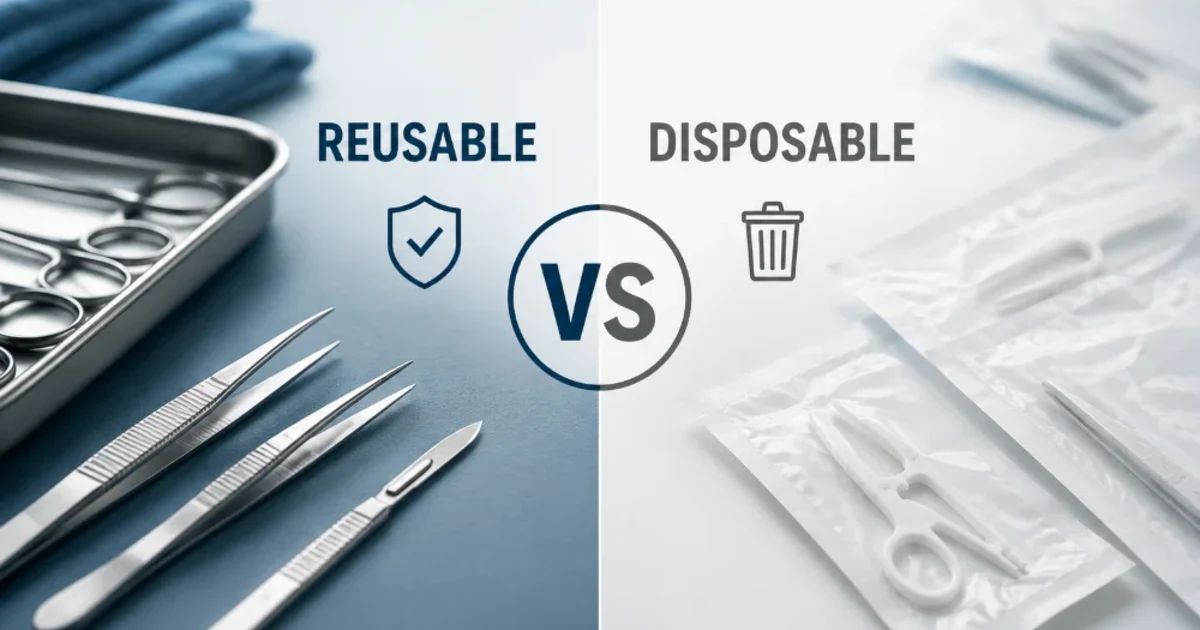
Should your next tray be reusable stainless steel or single-use disposable? The reusable vs disposable surgical instruments question looks like a small operational choice. It is not. It sets your cost per procedure, your sterile processing workload, your infection-control exposure, your waste disposal bill and — increasingly — what you have to report on emissions.
This guide puts the published numbers in one place so you can make the call on evidence instead of habit.
Key takeaways
- Reusables win on cost at volume. Reprocessing runs roughly $0.51–$0.77 per instrument per cycle, so an instrument used regularly pays back its purchase price quickly.
- Most trays are over-packed. Studies find only 13–22% of the instruments opened for a case are actually used. That is the real cost leak, not the choice of material.
- The waste gap is large. Operating rooms produce 20–30% of hospital solid waste and around 70% of regulated medical waste.
- Reusables are not zero-impact. Cleaning and sterilization account for roughly 90% of a reusable instrument’s environmental footprint — a well-run sterile processing department matters as much as the instrument choice.
- Most departments need both. Reusable as the backbone, disposable for specific hard-to-clean or high-risk items.
On this page
What you are actually comparing
Reusable (reprocessable) instruments are made from surgical-grade stainless steel — typically 420 or 440 series, against the ISO 7153-1 material standard — and are cleaned, sterilized and used again across hundreds of procedures. This is the global default for artery forceps, needle holders, scissors and general surgery instruments.
Disposable (single-use) instruments use lighter-gauge steel, coated metals or medical-grade polymer, and are discarded after one procedure. They have become standard in a few defined niches: single-use laryngoscope blades and similar ENT diagnostic items, biopsy tools, and cases with elevated cross-contamination risk.
The decision is not metal versus plastic. It is cost and risk per use across the instrument’s working life, and that is where the two genuinely separate.
Cost per use
Published reprocessing studies put instrument maintenance and sterilization at roughly $0.51–$0.77 per instrument per cycle.1 Against that, a reusable instrument bought once and correctly reprocessed drops to a small fraction of its purchase price per procedure within the first year of normal use.
The larger finding in the same literature is about trays, not instruments. Only 13–22% of the instruments opened for a case are actually used,1 and tray optimisation studies show typical trays can be cut by 30–60% without affecting the procedure.2 Before switching materials, count what is coming back unused.
| Factor | Reusable (stainless steel) | Disposable (single-use) |
|---|---|---|
| Upfront unit cost | Higher | Lower |
| Cost per use after year 1 | Very low — amortised across the working life | Fixed, identical every case |
| Sterile processing labour | Required each cycle | None |
| Reprocessing cost per instrument | ~$0.51–$0.77 per cycle | $0 — discarded |
| Waste disposal cost | Low — packaging only | Higher — regulated waste stream |
| Storage and tray management | Ongoing | Minimal |
| Best economics at | Medium-to-high case volume, standard procedures | Low volume, remote settings, high-contamination cases |
Sterilization and infection control
Departments choose disposables for one reason above all others: it removes reprocessing risk entirely. That is a fair argument for genuinely high-risk cases. For most general, orthopedic, ENT and plastic surgery work, correctly reprocessed instruments have a long and well-documented safety record.
| Consideration | What to weigh |
|---|---|
| Working life | Depends on steel grade, jaw design and reprocessing discipline. Ask the manufacturer for the validated reprocessing instructions for the specific instrument rather than accepting a headline cycle count. |
| Where failures come from | Overwhelmingly process issues — incomplete cleaning, unvalidated cycles, skipped steps — rather than the instrument itself. |
| Regulatory position | FDA and EU/UK authorities publish detailed reprocessing requirements precisely because reusable instrumentation is the norm, not the exception. |
| Disposable-specific risk | Sterile packaging damaged before use, and improvised reuse of items never designed for it in resource-limited settings. |
The safety gap between the two is narrower than most procurement conversations assume — on the condition that the instruments are well made and the sterile processing department follows validated protocols.
One device class where the reusable-versus-single-use gap has actually been measured rather than argued: insulated electrosurgical instruments. One study found insulation defects in 19% of reusable laparoscopic instruments against 3% of disposable ones. The evidence, and the testing burden that comes with reusables, is in our guide to insulation defects in reusable and single-use instruments.
Waste and emissions
This is where the two options genuinely pull apart.
| Metric | Figure | Source |
|---|---|---|
| OR share of hospital solid waste | 20–30% | Multi-centre surgeon survey3 |
| OR share of regulated / incinerated medical waste | ~70% | Multi-centre surgeon survey3 |
| OR share of total hospital costs | 30–60% | Tray optimisation review2 |
| Health care’s share of global net emissions | 4.4% — fifth-largest emitter if it were a country | Health Care Without Harm / Arup4 |
| Health care emissions from the supply chain | 71% | Health Care Without Harm / Arup4 |
| Reusable instrument footprint attributable to reprocessing | ~90% | Tray optimisation review2 |
| Reduction achievable by removing seldom-used tray instruments | 30–60% | Tray optimisation review2 |
Read the last two rows together. Reusable instruments are not zero-impact — almost all of their footprint sits in cleaning and sterilization, which means the fastest environmental win available to most departments is not switching material. It is taking the instruments nobody uses out of the tray.
A decision framework
Neither option suits every situation. Match the instrument to the procedure:
| Choose reusable when… | Choose disposable when… |
|---|---|
| Case volume is medium to high | Case volume is very low or unpredictable |
| Sterile processing is reliable and validated | Sterile processing capacity is the bottleneck |
| It is a standard general, plastic, ENT or dental instrument | The case carries elevated cross-contamination risk |
| Long-term cost and emissions reporting matter | You are mobile, remote or field-based with no reprocessing access |
| Precision over years matters — forceps, needle holders, scissors | Cleaning is genuinely hard — fine lumens, complex channels |
Most well-run departments run a hybrid: reusable stainless as the backbone of every general surgery tray, disposables reserved for specific high-risk or hard-to-reprocess items.
Sourcing checklist: reusable instruments that last
Six things to verify before ordering from any manufacturer:
| # | Verify | Why it matters |
|---|---|---|
| 1 | Steel grade (420 or 440) and ISO 7153-1 material conformity | Confirms the material meets the recognised international standard |
| 2 | The actual certificate documents your market requires — ask for numbers and scope, not a claim on a website | Requirements differ by market and product class; a general statement is not evidence |
| 3 | Written reprocessing instructions for the specific instrument | Tells you the real service life and how to protect it |
| 4 | Left/right-hand options, jaw pattern, tungsten carbide inserts | Confirms fit for your specialty |
| 5 | Compatible sterilization containers | Prevents reprocessing bottlenecks downstream |
| 6 | A sample order before bulk purchase | Lets you check alignment, ratchet tension and finish yourself |
Also useful: our guides to choosing surgical scissors by procedure and buying surgical forceps for hospitals and clinics.
What reprocessing actually costs: the full stack
One cost lever sits outside this comparison entirely: the instruments in a reusable tray that get reprocessed every cycle and never used. Right-sizing the tray cut cost per use by 55% in one measured general surgery set.
Most comparisons stop at “reusable is cheaper over time”. True, but useless when you are building a budget. Here is the cost stack a sterile processing department actually carries, layer by layer, with the published figure for each.
Per instrument, per cycle
The most widely cited figure is $0.51 to $0.77 per instrument for maintenance and sterilization, covering packaging, labour and high-level disinfection.1
The detail almost everyone misses: packaging changes the number. One analysis put reprocessing at $0.34–$0.47 for an instrument inside a tray against $0.81–$0.84 for the same instrument peel-packed on its own.5 Peel-packing roughly doubles the per-instrument cost. If your department peel-packs singles that could travel in a tray, that is a line you can cut this month without changing your instrument mix at all.
Per cycle, per case, and the capital behind it
| Cost layer | Published figure | Note |
|---|---|---|
| Instrument reprocessing, in a tray | $0.34–$0.47 | Per instrument, per cycle5 |
| Instrument reprocessing, peel-packed | $0.81–$0.84 | Roughly double the tray figure5 |
| Steam autoclave cycle | $33–$80 | Whole cycle, not per instrument6 |
| Low-temperature / plasma cycle | $81–$185 | For heat-sensitive items6 |
| Operating room time | $36–$38 per minute | Direct and indirect combined7 |
| Autoclave purchase | $5,000–$15,000 | Capital, before service contracts |
One caveat on the cycle figures: they come from a single-use instrument supplier, so treat them as the higher end of a plausible range rather than a neutral benchmark.6 We have included them because they are among the few published cycle-level numbers, not because the source is disinterested.
What the studies actually found, procedure by procedure
Vendor pages on both sides of this argument assert a conclusion. The published cost analyses give numbers, and they do not all point the same way. Here is what they found.
| Study / procedure | Reusable per case | Disposable per case | Result |
|---|---|---|---|
| Laparoscopic cholecystectomy, 4 hospitals8 | $46.92–$50.67 | $330–$460 | Reusable, by roughly 7× |
| Laparoscopy, 3-year single-set policy9 | ~$100, stable across 3 years | $600 falling to $200 | Reusable |
| Laparoscopic cholecystectomy, Belgian market10 | Baseline | 7.4–27.7× higher | Reusable |
| Laparoscopy, 623 operations over 24 months2 | Under €55 after amortisation | ~9× higher | Reusable; set paid for itself in 9 procedures |
| Endoscopic carpal tunnel release7 | $1,019 | $917 | Disposable, by $102 |
Four of the five favour reusable, several of them by a wide margin. The fifth matters more than the other four, because it shows the mechanism: in endoscopic carpal tunnel release the instrument itself is cheap, the setup is fiddly and the operating room clock is expensive. Once theatre minutes dominate the equation, reusable loses.
Where the breakeven actually sits
The carpal tunnel analysis is useful because it published its own switching points. Reusable equipment became the cheaper option when any of the following held true:7
| Variable | Reusable wins when… |
|---|---|
| Operating room time | Below $28.63 per minute |
| Setup time for the reusable set | Under 6.8 minutes |
| Cost of the disposable equivalent | Above $647 |
| Case volume | Enough to amortise — one study reached breakeven at 9 procedures2 |
This is also why the general question has no general answer. A hospital paying $38 a theatre minute and a clinic paying a fraction of that are not solving the same problem, even for the same instrument.
Where NJ Medical Instruments fits
NJ Medical Instruments has manufactured reusable, surgical-grade stainless steel instruments in Sialkot, Pakistan since 1990, supplying direct as an OEM with no middlemen. The range covers general surgery, plastic surgery, ENT, dental and orthopedics, alongside sterilization containers and complete instrument sets.
If your procurement process requires specific documentation, ask our team before you order and we will tell you exactly what applies to your market and product class. On material and origin, see our guide to what “German steel” actually means in surgical instruments.
Moving to a hybrid model, or rebuilding trays around optimised reusable instrumentation? We quote standard catalogue items and configure custom sets to match your case mix.
Get a quote for your theatre or distribution order.
Browse reusable surgical instrumentsWhatsApp +92-333-8733922
Frequently asked questions
Are reusable surgical instruments cheaper than disposable ones?
In most recurring-use scenarios, yes. Reprocessing costs roughly $0.51–$0.77 per instrument per cycle, so the higher purchase price is usually recovered within the first year of normal theatre use. Disposables win economically at low volume or genuine one-off use.
Is it safe to reuse surgical instruments after sterilization?
Yes, provided the instrument meets recognised material standards and the facility follows validated sterile processing protocols. Reprocessing failures are overwhelmingly traced to process gaps rather than to the instrument itself.
Why are hospitals moving back toward reusable instruments?
Cost and reporting. Unused single-use consumables are a documented source of waste, and emissions reporting requirements are now common across the UK, EU and large US health systems.
Which instruments are best kept single-use?
Items that are genuinely hard to clean — complex lumens or channels — plus tools used in known high-risk infectious cases and equipment for mobile or remote settings with no reliable sterile processing access.
What is the fastest way to cut instrument costs without switching to disposables?
Audit your trays. Studies consistently find only 13–22% of opened instruments are used, and removing seldom-used items typically reduces tray contents by 30–60% with no effect on the procedure.
Does NJ Medical Instruments supply both reusable and single-use instruments?
The core catalogue is reusable, surgical-grade stainless steel instrumentation, with single-use options in selected categories such as ENT diagnostics. Contact our team to discuss your tray configuration.
How much does it cost to sterilize a surgical instrument?
Published figures put maintenance and sterilization at $0.51 to $0.77 per instrument per cycle. Packaging changes it: roughly $0.34–$0.47 for an instrument inside a tray against $0.81–$0.84 for the same instrument peel-packed individually. At cycle level, a steam autoclave run costs about $33–$80 and a low-temperature or plasma cycle $81–$185.
How many procedures before a reusable instrument set pays for itself?
It depends on theatre economics, but published cases are faster than most people expect. One study of 623 laparoscopic operations found each set amortised its purchase price after nine procedures, after which instrument cost fell below €55 per case.
Is there any case where disposable instruments are genuinely cheaper?
Yes. An activity-based costing analysis of endoscopic carpal tunnel release found disposable equipment cost $917 against $1,019 for reusable — disposables cheaper by $102. The driver was operating room time, not the instrument. Where the instrument is inexpensive, setup is slow and theatre minutes are costly, disposables can win.
How much more do disposable instruments cost per procedure?
Across laparoscopic studies the multiple ranges widely. One Belgian market analysis calculated a full disposable set at 7.4 to 27.7 times the per-procedure cost of reusables. A four-hospital comparison found $330–$460 per case for disposables against $46.92–$50.67 for reusables. The spread depends on procedure, set composition and how the theatre is costed.
Sources
- Decreasing operating room costs via reduction of surgical instruments.
- Reducing surgical instrument usage: systematic review of tray optimisation, PubMed Central.
- Surgeons’ perspectives on operating room waste: multicenter survey, Surgery.
- Health care’s climate footprint, Health Care Without Harm with Arup.
- Cost of reprocessing medical devices, summarising tray versus peel-pack figures from the Journal of Hospital Administration.
- Cycle-level sterilization cost figures. Note: published by a single-use instrument supplier; treat as the upper end of the range.
- Reusable versus disposable equipment for endoscopic carpal tunnel release: activity-based costing analysis, Journal of Hand Surgery.
- Reusable instruments are more cost-effective than disposable instruments for laparoscopic cholecystectomy, Surgical Endoscopy.
- A comparison of reusable versus disposable laparoscopic instrument costs, PubMed.
- A cost comparison of disposable vs reusable instruments in laparoscopic cholecystectomy, Surgical Endoscopy.
Previously in this series: How to choose the right surgical scissors for each procedure · Surgical forceps: a complete buyer’s guide · German steel vs Sialkot surgical instruments
Whichever way that decision goes, the reusable side still has to be counted and reordered accurately. Our surgical instrument tray lists give the contents of twelve standard trays, with the alternative names that cause most wrong orders.

Written by
Akif Javaid
Akif Javaid is the owner of NJ Medical Instruments, a surgical instrument manufacturer established in Sialkot, Pakistan in 1990. The company manufactures reusable surgical, dental, ENT and orthopedic instruments and now stocks them locally through inventory hubs in Pakistan, the UK, the UAE and the USA, supplying hospitals, clinics and distributors worldwide with faster regional fulfilment. It also produces private-label and OEM instrument sets to customer specification.

6 thoughts on “Reusable vs Disposable Surgical Instruments: Cost, Safety and Waste Compared”