


Skin Graft Knife, Dermatome and Mesher: The Buyer’s Guide

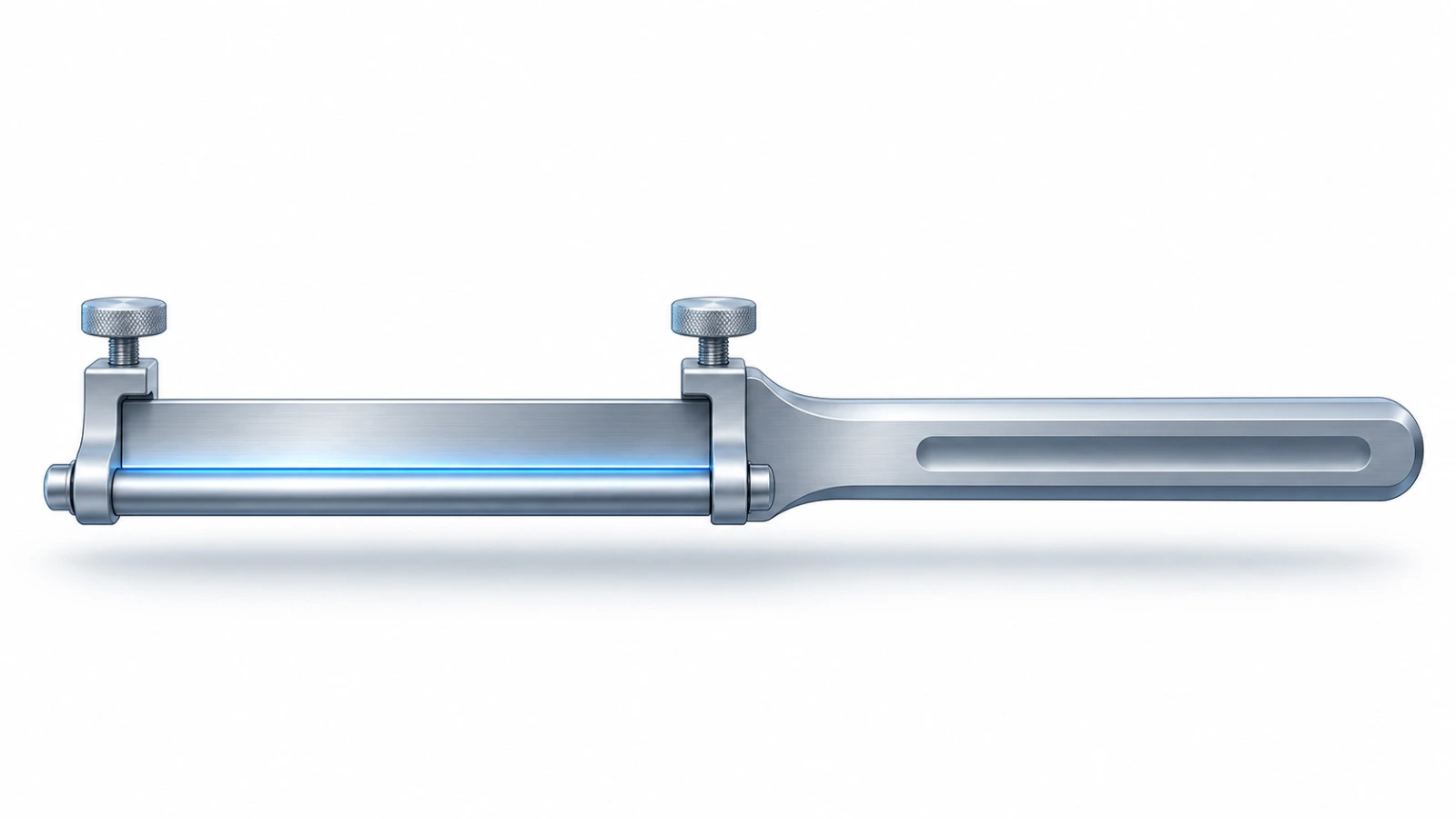
A skin graft knife is a hand-held dermatome: a guarded blade on a roller bar that shaves a sheet of skin off the donor site at a set depth. Six patterns are still in routine use, they look almost identical in a catalogue photograph, and the difference between them is not quality. It is the roller, the handedness and where the adjuster sits.
This guide is written for the person who has to raise a purchase order, not for the person holding the knife. It covers the depth band the instrument actually has to hit, how the six patterns differ mechanically, where a hand knife stops and a powered dermatome starts, why the ratio printed on a mesher carrier plate overstates what you get, which US and EU regulatory route each device type falls under, and what to put on a quotation so two suppliers can be compared on the same line.
The short version
- The clinically useful depth band for a split-thickness graft is roughly 0.2 mm to 0.75 mm. Most hand knives scale to 1.2 mm and the Schink to 2.0 mm, so you work in the bottom half of the dial and calibration matters more than range.
- Watson is the odd one out. Its roller is smooth and does not rotate or oscillate, and it is supplied right-handed only. Every other pattern here has a grooved roller that turns and is available left- or right-handed.
- A powered air dermatome tops out around 0.76 mm. That is the top of the clinical band, not a limitation — and it is why hand knives persist where there is no compressed air.
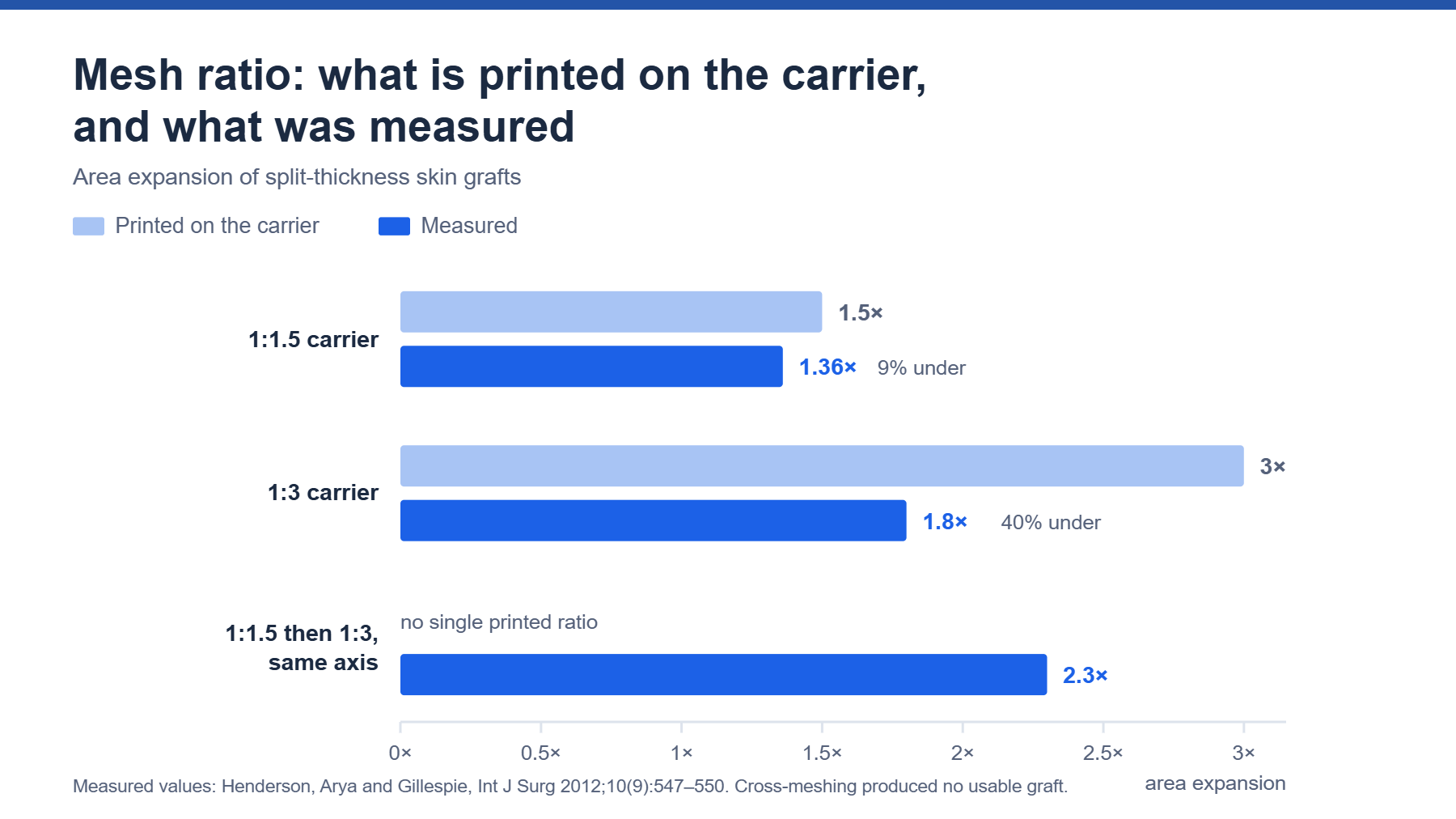
- Mesh ratios are nominal. A 1:1.5 carrier measured 1.36× and a 1:3 carrier 1.80× in porcine testing. Buy area, not ratio.
- ASTM F899 specifies chemistry only. Hardness and heat treatment are left to agreement between buyer and supplier, so “F899 420 steel” on a quotation tells you nothing about the edge.
- A manual skin graft knife, a powered dermatome and a graft mesher are all Class I in the US and all three are exempt from premarket notification — but none of them is exempt from the Quality System Regulation.
The depth a skin graft knife has to hit
Everything about choosing a graft knife follows from one number: how deep the cut has to be. A split-thickness graft takes the epidermis and part of the dermis, and the share of dermis you take decides how fast the donor site heals, how much the graft shrinks and how well it stands up to wear.
The conventional classification, with the figures as Seyhan sets them out, runs like this.
| Class | Thickness (inches) | Thickness (mm) | Primary contraction | Behaviour |
|---|---|---|---|---|
| Thin | 0.008–0.012 | 0.20–0.30 | about 10% | Revascularises fastest. Donor site heals quickest and usually scars least. Shrinks most during healing. |
| Medium | 0.012–0.018 | 0.30–0.45 | about 20% | The thickness in most common use. The average graft is cut at about 0.015 in. |
| Thick | 0.018–0.030 | 0.45–0.75 | — | Best resistance to trauma. Donor site can take several weeks and is more prone to hypertrophic scarring. |
| Full thickness | — | — | about 40% | Not a dermatome job. Excised with a blade and the donor site closed directly. |
So the instrument has to be controllable across roughly 0.20 mm to 0.75 mm, and most of the work sits around 0.30 mm to 0.45 mm. Donor sites generally re-epithelialise in about seven to fourteen days, and the shallower the cut the faster that happens.
Where each instrument’s scale actually sits
Hold that band against what the instruments are built to do, because the mismatch is the useful part.
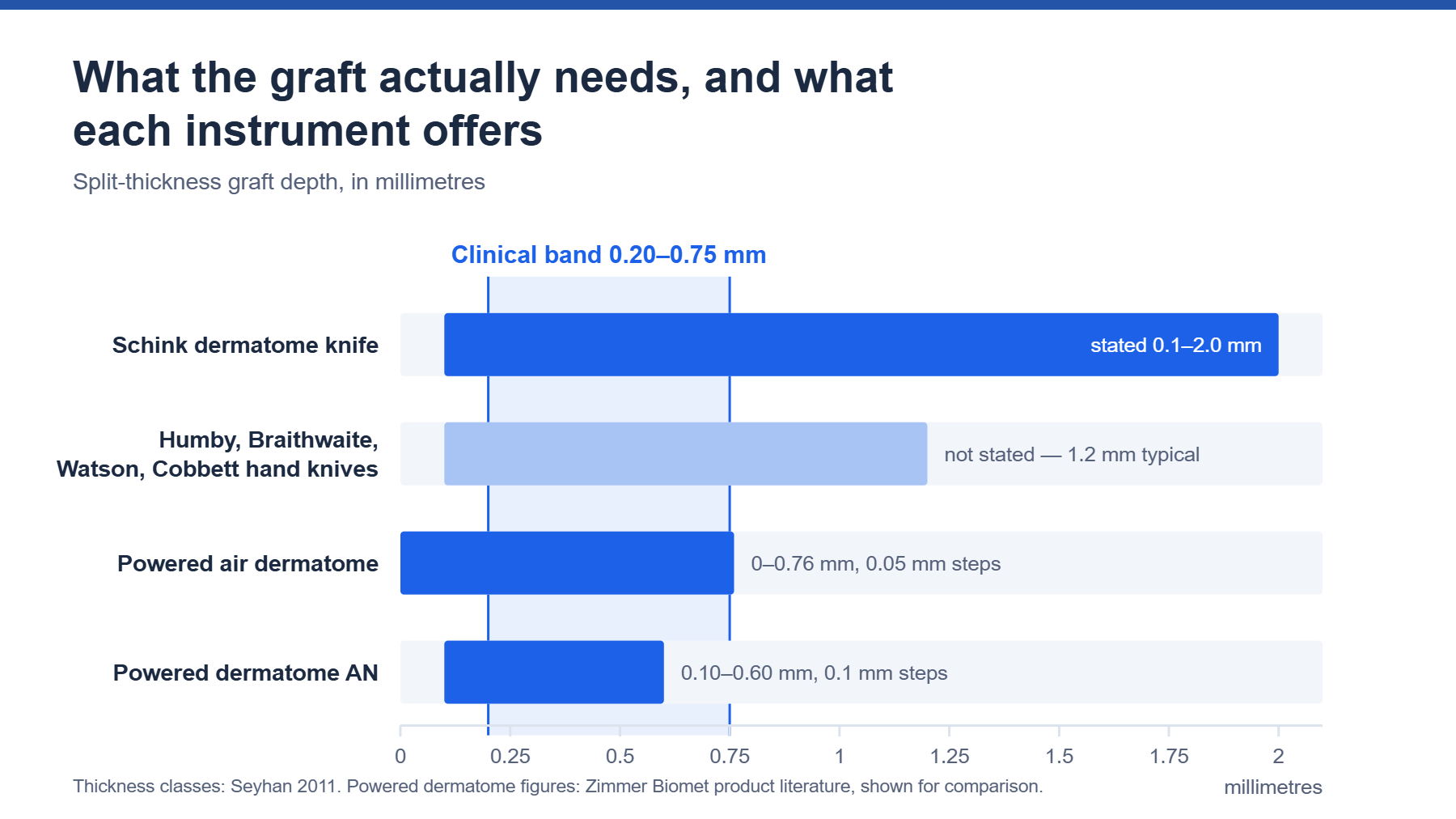
| Instrument | Stated adjustment range | Covers 0.20–0.75 mm? | Share of its own scale actually used |
|---|---|---|---|
| Schink dermatome knife | 0.1–2.0 mm | Yes, with a wide margin | About 28% |
| Humby, Braithwaite, Watson, Cobbett pattern hand knives | Not stated on these listings | Mechanically yes; confirm the figure in writing | Roughly the bottom half of a typical 1.2 mm scale |
| Powered air dermatome (industry reference) | 0.000–0.030 in / 0–0.76 mm in 0.002 in steps | Yes, almost exactly | Nearly all of it |
| Powered dermatome AN (industry reference) | 0.004–0.024 in / 0.10–0.60 mm in 0.004 in steps | Covers thin and medium, not the top of thick | Nearly all of it |
Why this matters on a purchase order
A wider range is not a better instrument. The powered dermatome whose scale stops at 0.76 mm is the one matched most precisely to the job, and it resolves in 0.05 mm steps. A hand knife that scales to 2.0 mm spends most of its dial outside split-thickness use, which puts the weight on how repeatably the guard gap can be set and held. Ask for the adjustment range and the increment, not just the maximum. Four of the six patterns in this range do not state a range on the listing at all, and that is a fair question to put to any supplier, including this one.
The six skin graft knife patterns, compared
These patterns are a family tree, not a set of competing brands. The Blair knife came first. Humby added the adjustable roller that controls thickness, which is the ancestor of everything else on this page. Braithwaite reworked it, and the Watson and Cobbett knives are both modifications of the Braithwaite. The names survive because the mechanisms differ, and the mechanical differences are the only thing a buyer needs to read.
| Pattern | Length | Handedness | Roller behaviour | Thickness adjuster | Price |
|---|---|---|---|---|---|
| Silver | 19 cm (7½ in) | Not stated | Grooved; rotates and oscillates side to side | Thumbscrews on top of the support pillars | $49 |
| Watson | 30.5 cm (12 in) | Right-handed only | Smooth; does not rotate or oscillate | Slacken the locking nut, turn the adjuster nut, retighten. Roller stays parallel. | $46 |
| Braithwaite | 30.5 cm (12 in) | Right and left | Grooved; oscillates side to side and rotates | Adjuster nuts at the end of the knife | $48 |
| Schink | 31 cm (12¼ in) | Right and left | Not stated | Adjustable 0.1–2.0 mm. Satin finish; mirror finish on request. | $99 |
| Cobbett | 36.5 cm (14¼ in) | Right and left | Grooved; rotates and oscillates side to side | Thumb screws on top of the support pillars | $47 |
| Humby | 36.5 cm (14¼ in) | Right and left | Grooved; rotates and oscillates side to side | Thumb screws on top of the support pillars | $54 |
Watson is the decision point
Of the six, Watson is the one that behaves differently. Its roller bar is smooth and fixed — it neither rotates nor oscillates during the cut — and the roller holds a parallel position through the stroke. Every other grooved-roller pattern here turns and oscillates as it is drawn across the skin.
That is a genuine trade-off rather than a defect. A fixed parallel roller gives a cut whose depth depends on the operator keeping a steady angle and a steady pull, and it rewards an experienced hand with a very even sheet. A rotating grooved roller does more of that work itself. Which you want is a preference held by the surgeon, not a specification decided in procurement — so it is the one line on the order that is worth asking the theatre about before you place it.
The second Watson consideration is harder: it is supplied right-handed only. Every other pattern in this range is available in both hands. If the set is going into a shared pool rather than to a named surgeon, that single fact can rule Watson out regardless of price.
Humby and Cobbett overlap
Read the two listings side by side and they describe the same instrument: 36.5 cm, both hands, grooved roller that rotates and oscillates, thumb screws on the support pillars. The $7 gap between them is not explained by anything stated. If you are buying one and not the other, ask what differs — blade seat, roller length, finish — and get the answer in writing. A supplier who can answer that question properly is telling you something useful about how well they know their own range.
Skin graft knife length is a working-posture decision
The range runs from 19 cm to 36.5 cm. The short Silver knife is a small-graft instrument; the 36.5 cm patterns give the long, steady, two-handed stroke that a large thigh or back donor site needs. Buying a single length for a mixed caseload is the most common avoidable mistake in this category. A short knife on a long donor site produces a graft assembled from several passes, with the join lines that implies.
Skin graft knife or powered dermatome
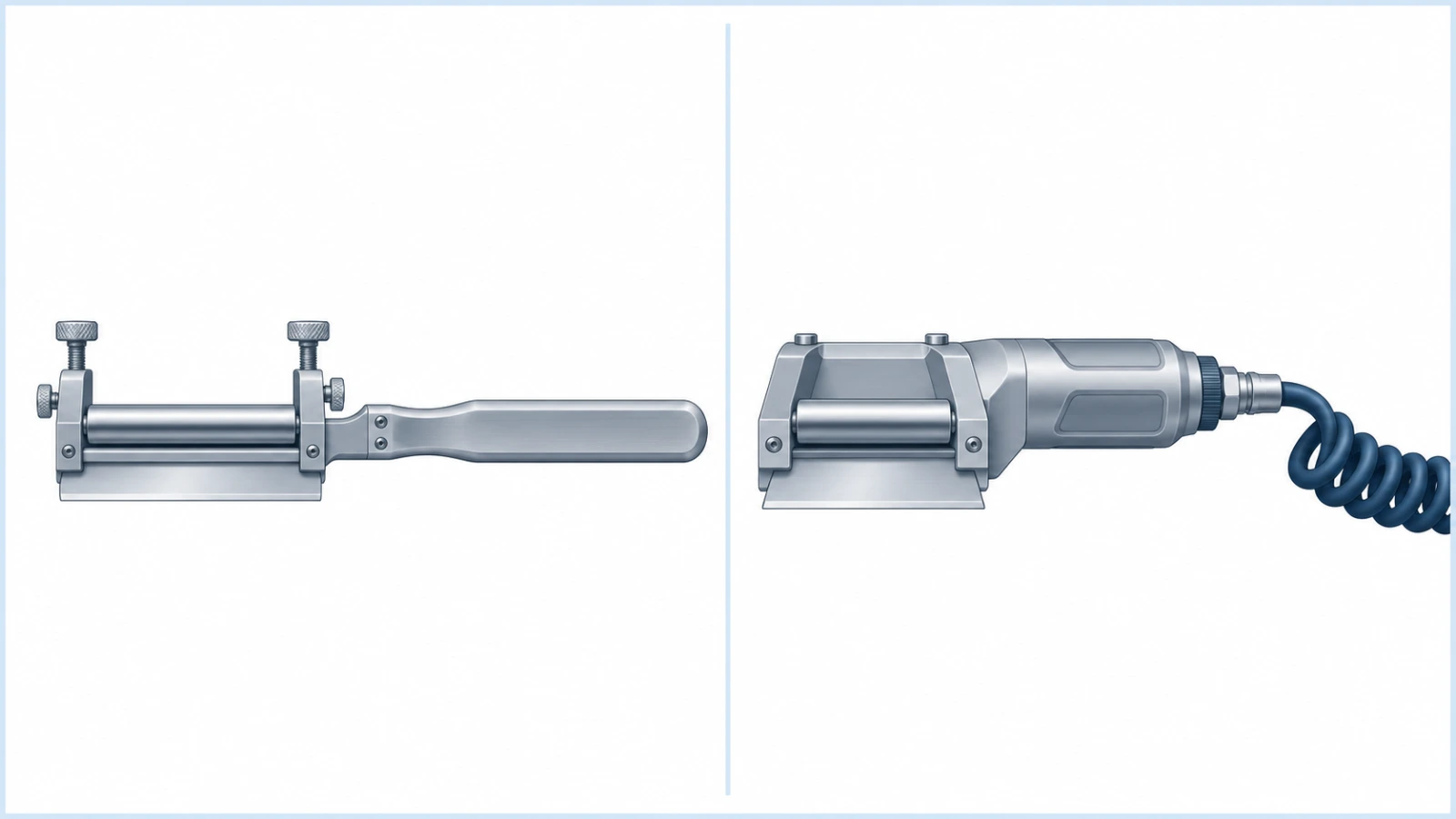
The air dermatome is the most widely used graft harvesting device in the world, and electrically driven heads give thinner, longer strips at a more uniform thickness than a hand knife will. If a unit has reliable medical air and a service contract, that is the default. The hand knife is not a legacy instrument surviving on sentiment, though, and it is worth being clear about why.
| Consideration | Hand dermatome knife | Powered dermatome |
|---|---|---|
| Depth uniformity | Depends on operator angle and pull speed | Mechanically governed; more uniform over a long strip |
| Depth ceiling | 1.2 mm typical, 2.0 mm on the Schink | About 0.76 mm on the air unit, 0.60 mm on the AN |
| Cut width | Set by the blade and guard | Fixed by width plate: 1, 1.5, 2, 3 or 4 in (2.5–10.2 cm) |
| Services needed | None | Medical air or power, plus a regulator and hose |
| Consumables per case | One sterile blade | Blade plus width plate maintenance |
| Unit cost here | $46–$99 | Capital equipment; an order of magnitude higher |
| Failure mode in theatre | Blade swap, seconds | No air, no graft — needs a manual fallback |
The ceiling, and the fallback nobody budgets for
Two conclusions follow. The first is that the ceiling difference is real: if a thick graft above 0.76 mm is ever needed, the powered unit cannot reach it and a hand knife is not optional. The second is the one that gets forgotten in capital budgeting — a theatre running a powered dermatome still needs a hand knife on the shelf, because an air failure mid-list is otherwise an abandoned procedure. At $46 to $99 the fallback is cheaper than the cancellation.
The practical answer
Buy the powered unit for volume and uniformity if the services exist. Buy a hand knife regardless, in the handedness your surgeons use, as the fallback and for grafts above the powered ceiling. In settings without reliable medical air — which includes much of the burn caseload in the regions where burn mortality is concentrated — the hand knife is not the fallback. It is the instrument.
Meshing: the ratio is not the expansion
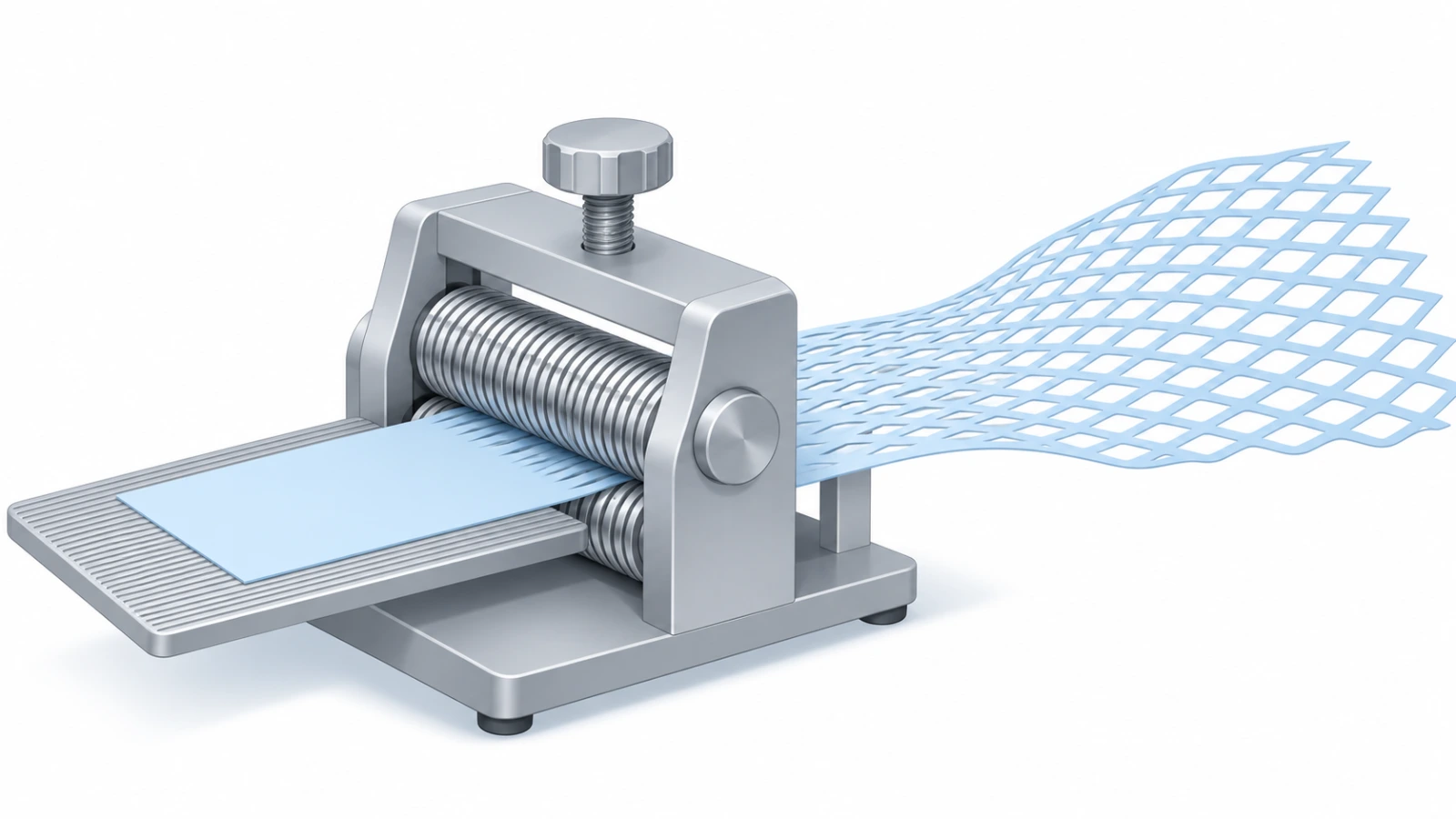
A graft mesher cuts a regular pattern of slits into a harvested sheet so it can be stretched to cover a larger area. The sheet is laid on a carrier plate whose groove pattern determines the ratio, and the ratio is printed on the plate. This is where buyers get caught, because the printed ratio is a geometric maximum, not a result.
Porcine split-thickness grafts meshed and then maximally expanded in a controlled study came out well short of the number on the carrier. The authors recorded that meshed skin “did not expand as much as suggested by the ratios displayed on dermacarriers”.
| Carrier plate ratio | Area expansion measured | Shortfall against nominal |
|---|---|---|
| 1:1.5 | 1.36× | about 9% under |
| 1:3 | 1.80× | about 40% under |
| 1:1.5 then re-meshed at 1:3, same axis | about 2.3× | Best result recorded in the study |
| Re-meshed across the first axis | No usable graft | Cross-meshing cut the skin into small pieces |
Two operational findings sit inside that table. Overmeshing works if the second pass follows the direction of the first — a 1:1.5 pass followed by a 1:3 pass reached roughly 2.3×, more than either plate alone. Cross-meshing destroys the graft. Re-meshing at right angles to the first pass cut the sheet into fragments. That is a theatre-floor fact, but it also affects what you buy: it means the value of a mesher is in having the right sequence of plates available, not the highest single ratio on the box.
What to specify on a mesher
For reference, the ratio sets offered on the established industry systems are 1:1, 1.5:1, 2:1, 3:1 and 4:1 on the cutter-determined mesher, and 1.5:1, 3:1, 6:1 and 9:1 on the carrier-determined system, with carriers in 8 in (20.3 cm) and 16 in (40.6 cm) lengths. Use that as the yardstick when you read any quotation.
The skin graft mesher machine here is supplied with ten sterile-packed graft carrier plates and is described as taking both thin and thick grafts, with predetermined expansion set by the carrier so no cutter change is needed during the procedure, and a continuous-feed design that prevents plate misloading. The listing does not say which ratios the ten plates cover. That is the first question to ask, and it should be answered as a list of ratios and the count of each.
Work backwards from area, never from ratio
- Start with the wound area you have to cover, in cm².
- Divide by the measured expansion you can rely on, not the printed ratio. On the figures above, treat a 1:3 plate as roughly 1.8× unless your own audit says otherwise.
- That gives the donor area you must harvest. Check it against what the donor site can actually give.
- Only then choose plate ratios — and order a sequence that allows a same-axis second pass if you need more area than one plate gives.
| Plate ratio | If you trust the nominal ratio | Using measured expansion | Extra donor skin you actually need |
|---|---|---|---|
| 1:1.5 | 400 cm² | 441 cm² | 41 cm² |
| 1:3 | 200 cm² | 333 cm² | 133 cm² |
| 1:1.5 then 1:3, same axis | — | 261 cm² | Best coverage per cm² harvested |
Worked from the measured expansion figures above. Planning a 1:3 mesh on the nominal ratio alone would under-harvest by about 133 cm² on a defect of this size.
Steel, hardness, and what ASTM F899 leaves out
Instrument steel is the part of a quotation most likely to be quoted confidently and specified badly. The standard everyone names is ASTM F899, Standard Specification for Wrought Stainless Steels for Surgical Instruments. It is worth knowing exactly what that standard does.
F899 is a chemistry standard
F899 covers the chemistry requirements for wrought stainless steels used to make surgical instruments. Mechanical properties, heat treatment and hardness are not set by F899 — they fall to referenced material standards or, in the standard’s own words, to agreement between buyer and supplier. The hardness and heat-treatment data in its tables are informational. So a quotation that says “ASTM F899 420 stainless” has told you the alloy and nothing about the edge. If edge retention matters, hardness has to be a line in your purchase agreement, because the standard deliberately leaves it to you.
Which grade belongs where
It is also worth knowing that there is no formal definition of the phrase “surgical stainless steel”. It gets applied loosely to any corrosion-resistant grade. That is not a reason to distrust a supplier who uses it — this site uses “surgical-grade stainless steel” in its own specification rows — but it is a reason to pin the grade down when the instrument has a cutting edge.
| Family | Example grades | Character | Used for | Why |
|---|---|---|---|---|
| Martensitic | 420, 440 | High carbon, chromium alloyed, hardenable. Can be slightly magnetic. | Cutting edges: blades, scissors, graft knives | Takes and holds hardness. Less corrosion resistant than 316. |
| Austenitic | 304, 316, 316L | Low carbon in the L grades, not hardenable by heat treatment | Implants and body-contact devices; non-cutting instrument parts | 316L is biocompatible when made to ASTM F138/F139. It is chosen for corrosion resistance, not for an edge. |
| Precipitation hardening | 17-4 PH | High strength with good corrosion resistance | General instrument components | Strength without the carbon load of a cutting grade. |
For a graft knife this splits the instrument in two. The blade wants a hardenable martensitic grade with a specified hardness. The handle, roller bar and adjuster want corrosion resistance and dimensional stability through repeated autoclave cycles, and they do not need to hold an edge. A supplier quoting one grade for the whole instrument is either simplifying or has not thought about it.
One further standard is worth naming because it is cheap to require and makes a measurable difference: ASTM A967 covers passivation, which substantially improves the corrosion resistance of any stainless grade. Instrument staining and pitting in service is frequently a passivation and water-chemistry problem rather than a steel-grade problem, which is covered in more detail in the guide to surgical instrument stains and corrosion.
Put these four lines on the purchase order
- Blade grade and condition — alloy designation plus the hardness you require, with the test method.
- Handle and roller grade — stated separately from the blade.
- Passivation — to ASTM A967, stated on the certificate.
- Material certification — a mill or batch certificate traceable to the delivered lot, not a generic statement.
Country-of-origin steel claims
A note on sourcing language, since it appears throughout this category. Several listings in this range, including this site’s own, describe the steel as German. Treat any country-of-origin steel claim the way you would treat a hardness claim: ask for the certificate that supports it. A supplier who can produce a mill certificate has answered the question. One who cannot has told you the phrase is marketing, and you can price accordingly.
Regulatory route by device type
These three device types take three different routes, and the differences are the sort of thing that surfaces at the border rather than at the quotation stage. The classifications below are drawn from the FDA product classification database and 21 CFR Part 878.
| Device | FDA product code | Regulation | Class | Premarket notification | QSR (GMP) |
|---|---|---|---|---|---|
| Dermatome | GFD | 21 CFR 878.4820 | I | Exempt, subject to § 878.9 | Applies |
| Expander, surgical, skin graft (the mesher) | FZW | 21 CFR 878.4800 | I | Exempt | Not exempt |
| Retractor, and manual instruments of general use | GAD and related | 21 CFR 878.4800 | I | Exempt | Not exempt |
Three points that matter commercially.
- 878.4820 is the powered regulation. Its scope is AC-powered, battery-powered and air-powered surgical instrument motors and their accessories, and the accessories it names include burs, chisels and osteotomes, dermabrasion brushes, dermatomes, drill bits, hammerheads, pin drivers and saw blades. A purely manual hand knife is a manual surgical instrument, which puts it with the 878.4800 family.
- Exempt from 510(k) is not exempt from the Quality System Regulation. The FDA classification records for the manual instrument family show premarket notification exempt and GMP not exempt. A supplier offering these devices into the US still has to operate a quality system, and you are entitled to see evidence of it.
- The exemption has conditions. Under § 878.9 a premarket notification is still required where the device has a different intended use from a legally marketed device of that generic type, or where it “operates using a different fundamental scientific technology”. The example the regulation itself gives for that second condition is a laser-cutting instrument against a metal-blade one — directly relevant if anyone offers you a non-mechanical graft harvesting device described as equivalent to a knife.
EU: the Class I sub-categories decide whether a Notified Body is involved
Under the EU Medical Device Regulation 2017/745, plain Class I devices are self-certified by the manufacturer with no Notified Body. Three sub-categories are different, and reusable graft knives and sterile blades both fall into them.
| Sub-class | What it covers | Relevant item here | Notified Body |
|---|---|---|---|
| Class I | Non-sterile, non-measuring, not a reusable surgical instrument | Accessories and non-sterile ancillaries | No — self-certified |
| Class Is | Supplied sterile | Single-use sterile graft blades | Yes, for a limited scope |
| Class Im | With a measuring function | — | Yes, for a limited scope |
| Class Ir | Reusable surgical instruments | Reusable graft knife handles and mesher | Yes, for a limited scope |
The practical consequence: a supplier can legitimately say a non-sterile accessory is self-certified Class I, while the reusable knife handle beside it on the same quotation sits in Class Ir and the sterile blade in Class Is, both of which require Notified Body involvement for their limited scope. One CE statement covering a mixed quotation is not a complete answer. Ask which declaration of conformity covers which line item.
Language to insist on, and language to reject
- “FDA approved” is not a claim that can be made about these instruments. Approval is a different pathway from clearance, and these device types are exempt from premarket notification altogether. Any supplier using that phrase on a Class I manual instrument is telling you they do not know the framework.
- Registration and listing are not approval. An FDA establishment registration number says a facility has registered. It is not an endorsement of any product.
- “CE certified” is loose. Ask for the declaration of conformity, the class it covers, and the Notified Body number where one applies.
- “ISO certified” is incomplete. The one that matters here is ISO 13485. Ask for the standard, the certificate number, the scope statement and the expiry date.
Applied to this supplier, for the avoidance of doubt: NJ Medical Instruments is an OEM manufacturer in Sialkot, established in 1990, supplying direct. Certification documentation is available on request, and a buyer in a regulated market should request it and read the scope statement before placing a first order. That is the correct process with any manufacturer in this category, including this one.
Reprocessing a mixed reusable and single-use set
Skin grafting is one of the few trays where reusable and single-use items are physically interlocked. The knife handle is reusable. The blade is not. The mesher body is reusable; its carrier plates are supplied sterile. This matters because a tray card or an instrument record that carries one reprocessing instruction for the whole set will be wrong for part of it.
| Item | Reusable or single-use | Reprocessing note |
|---|---|---|
| Knife handle, roller bar, adjuster | Reusable | Reprocess per the manufacturer’s instructions for use. Adjuster threads and the roller seat need attention; they trap protein and are easy to miss. |
| Graft blade | Single use, supplied sterile | Not reprocessed. Discard after one case. Packed individually. |
| Mesher body | Reusable | Reprocess per the instructions for use. |
| Graft carrier plates | Supplied sterile-packed | Treated as consumables. Ten supplied with the mesher. |
| 23-piece grafting set | Mixed | The set is described as fully reusable, but its contents include five disposable skin graft blades. The tray card has to reflect both. |
The trap in a mixed set
The 23-piece set is a good illustration. Its own description says the instruments are fully reusable and withstand repeated autoclaving — and the contents list includes disposable graft blades. Both statements are true about different parts of the same box. Writing “autoclavable: yes” against the whole set is the kind of unscoped claim that produces a reprocessing error in a sterile services department that has never handled the set before. The listing here is written as reusable instruments, graft blades are disposable, and that is the form the tray card should take too. The approach is set out in more detail in the guide to reusable against disposable surgical instruments.
What sterile services needs to know
Two further points for sterile services. First, the adjuster mechanism is the part of a graft knife most likely to fail inspection over time — threads gall, graduations wear, and a knife whose scale no longer corresponds to its gap is a patient safety issue rather than a cosmetic one. Build a periodic gap check into the instrument record. Second, these are high-value single instruments in a shared pool, which is exactly the case for item-level tracking rather than set-level tracking; the reasoning is in the guide to surgical instrument traceability.
A skin graft knife gap check you can actually run
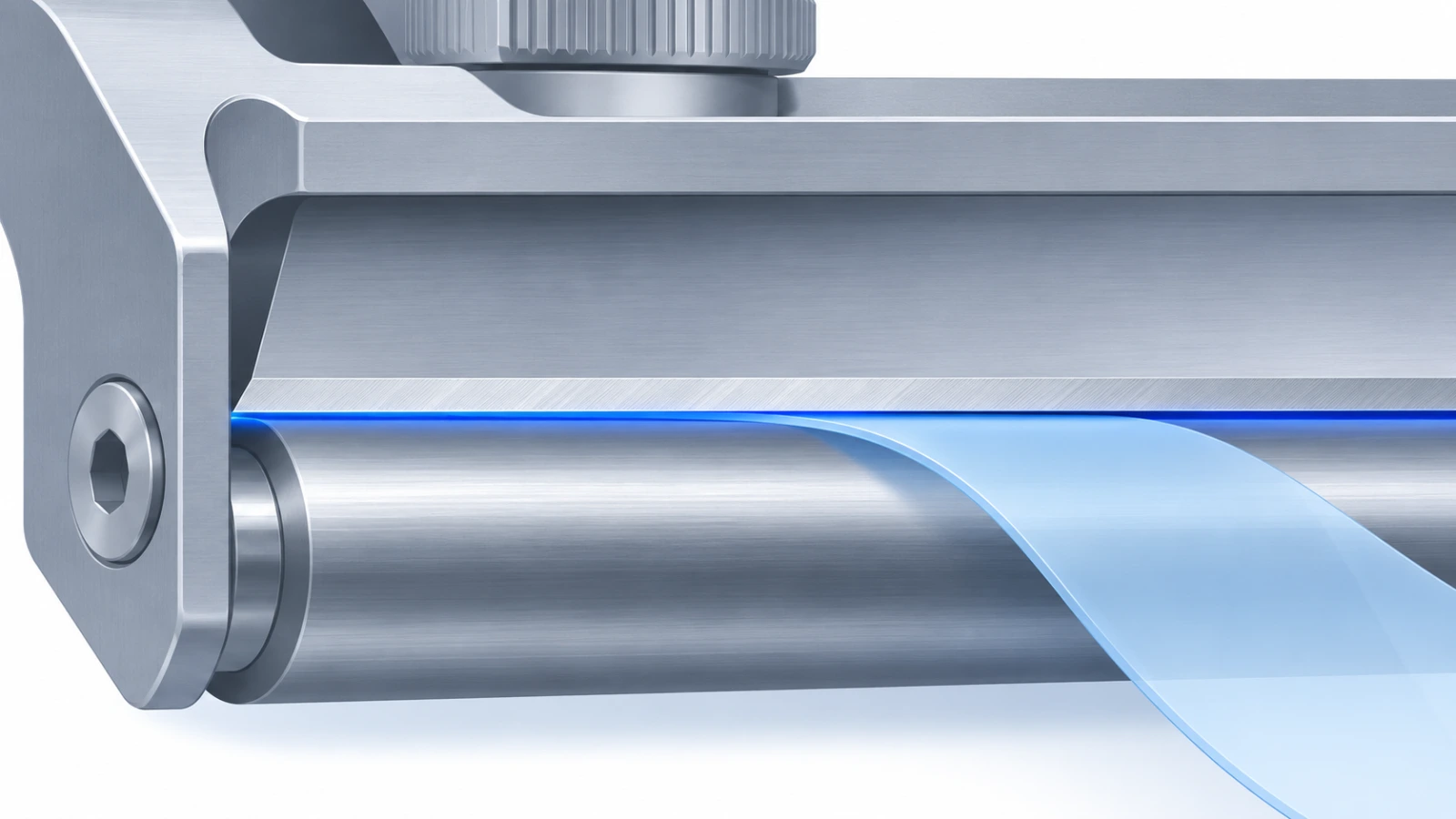
You do not need a calibration laboratory to catch a drifting knife. Set the adjuster to a known mark, close the guard on a feeler gauge or a stack of shim stock at the target thickness, and confirm the gauge is held with light drag at the same reading at both ends of the roller. Repeat at the low, middle and high end of the working band. A knife whose gap differs between the two ends of the roller will produce a wedge-shaped graft, and that is visible on this test long before it is visible on a patient. Record the readings against the instrument number.
Import, packaging and documentation
This is the section most instrument guides leave out, and it is where orders actually get delayed.
Tariff classification
Surgical instruments of this type classify in HS heading 9018. For a US import, surgical instruments from Pakistan have been ruled into subheading 9018.90.8000, described as instruments and appliances used in medical, surgical, dental or veterinary sciences; dental-specific instruments go to 9018.49.8040. Those subheadings are a reliable starting point for a classification request.
Check the rate yourself
The ruling that establishes those subheadings dates from 1995 and quotes duty of 6.3% and 3.8% respectively, with a note that Pakistani goods might enter duty-free under the Generalized System of Preferences subject to requirements. Do not budget on those figures. Rates change, and GSP eligibility in particular has not been continuous. Confirm the current rate in the tariff schedule for your date of entry, and if the value is material, request a binding ruling rather than relying on a thirty-year-old one.
What sterile packaging has to carry
For the single-use blades, the packaging is a regulatory document as much as a container. Specify and then check on receipt:
- Individual sterile barrier packaging, intact, with no channel or seal defects.
- Sterilisation method stated on the pack, with the process indicator.
- Lot or batch number, legible, and traceable back to a certificate.
- Expiry or use-by date, with enough remaining shelf life for your turnover. Ask what minimum remaining life the supplier guarantees on despatch — this is negotiable and frequently not offered.
- Single-use symbol and the manufacturer identification.
- Instructions for use supplied in the language required by the destination market.
Documents to request with the first shipment
| Document | What to check | Why it matters |
|---|---|---|
| Quality system certificate | Standard, number, scope, expiry | ISO 13485 scope has to cover the device type you are buying, not just the company |
| Declaration of conformity (EU) | Which class, which line items, Notified Body number if applicable | A mixed quotation may need more than one |
| Material or mill certificate | Traceable to the delivered lot | Supports the grade and any country-of-origin claim |
| Sterilisation certificate (blades) | Method, lot, release | Links the pack in your hand to a validated process |
| Instructions for use | Reprocessing parameters, cycle limits | Sterile services cannot validate a cycle without it |
| Commercial invoice and packing list | HS code, country of origin, values | Customs classification and valuation |
A manufacturer that supplies this pack without being chased is a materially lower-risk supplier than one that assembles it on request, independent of unit price. That difference is worth more than a few per cent on the line.
Build a skin graft knife quotation you can compare
Two quotations for “skin graft knife” are not comparable until the same fields are filled in on both. Send this as a table and ask for it back completed.
| Field | Why it decides the order |
|---|---|
| Pattern name | Humby, Braithwaite, Watson, Cobbett, Schink or Silver. Not “dermatome knife”. |
| Overall length | 19 to 36.5 cm in this range. Decides whether a long donor site needs one pass or several. |
| Handedness | Right, left, or both available. Watson is right-hand only; a shared pool usually needs both. |
| Roller type | Grooved and rotating, or smooth and fixed. The single biggest difference in feel. |
| Adjustment range and increment | The band it covers and the smallest reliable step. Four of six listings in this range do not state it. |
| Adjuster location | Pillar thumbscrews or end nuts. Affects whether it can be reset mid-case. |
| Blade grade and hardness | Alloy plus hardness and test method. F899 alone is not enough. |
| Handle and roller grade | Quoted separately from the blade. |
| Passivation | To ASTM A967, stated on the certificate. |
| Blade compatibility | Which blade part number fits, confirmed in writing, with the price per blade. |
| Mesher plate ratios | The list of ratios supplied and the count of each, not just the plate count. |
| Regulatory route | US product code and class; EU sub-class and declaration of conformity per line item. |
| Sterile pack shelf life on despatch | Minimum remaining life guaranteed. Negotiable; rarely offered unasked. |
| Unit price and price break quantities | Per unit, and the quantity at which it steps down. |
| HS code and country of origin | For your own classification and valuation. |
| Lead time and MOQ | Separately for stock lines and OEM or private-label lines. |
Cost per case, not cost per instrument
The knife is bought once and the blades are bought forever, so the unit price is the smaller half of the decision. Worked on the published prices here:
| Line | Calculation | Five-year cost |
|---|---|---|
| Watson knife at $46, one per set, two sets | 2 × $46 | $92 |
| Sterile single-use blades at $20, one per case | 200 × 5 × $20 | $20,000 |
| Total | $20,092 | |
| Knife as a share of the total | 0.5% |
Where the negotiation actually is
On this profile the instrument is half a per cent of five-year spend and the consumable is essentially all of it. A 10% reduction on the blade price saves $2,000 over the period; getting the knife for free saves $92. So negotiate the blade, confirm its part number and fit in writing, and treat the knife as a specification decision rather than a price decision. The one case where that reverses is a low-volume unit buying a $684 mesher — there the capital item dominates and the question becomes whether the caseload justifies it at all.
If you are assembling a full tray rather than replacing a single instrument, the composition logic is covered in the surgical instrument tray lists guide, and the cost side in tray optimisation. For instruments arriving on loan rather than purchased, the receiving checks are in the loaner tray checklist.
The NJ Medical Instruments skin grafting range
Every item below is a live listing with a published price. Prices are shown as listed at the time of writing and are per unit unless stated.
| Item | Key specification | Price |
|---|---|---|
| Skin Graft Mesher Machine | Supplied with 10 sterile graft carrier plates. Predetermined expansion by carrier, no cutter change mid-procedure. Continuous feed. Takes thin and thick grafts. | $684 |
| Skin Grafting Instruments Set, 23 pieces | Harvesting, site preparation and graft transfer in one set. Reusable instruments; graft blades disposable. | $200 |
| Schink Dermatome Skin Graft Knife | 31 cm. Right and left handed. Adjustable 0.1–2.0 mm — the only stated range in the hand range. Satin finish, mirror on request. Wooden box. | $99 |
| Humby Dermatome Skin Graft Knife | 36.5 cm. Right and left handed. Grooved roller, rotates and oscillates. Pillar thumbscrews. | $54 |
| Silver Dermatome Skin Graft Knife | 19 cm. Grooved roller, rotates and oscillates. Pillar thumbscrews. Supplied with 10 sterile blades in a wooden box. | $49 |
| Braithwaite Skin Graft Knife | 30.5 cm. Right and left handed. Grooved roller, oscillates and rotates. Adjuster nuts at the end of the knife. | $48 |
| Cobbett Skin Graft Knife | 36.5 cm. Right and left handed. Grooved roller, rotates and oscillates. Pillar thumbscrews. | $47 |
| Watson Skin Graft Knife | 30.5 cm. Right-handed. Smooth roller that does not rotate or oscillate, holds parallel. Locking nut and adjuster nut. | $46 |
| Sterile Skin Grafting Blade, single use | Individually packed, sterile, disposable. Stated as compatible with standard dermatome knives — confirm the fit for your handle. | $20 |
| Humby Swivel Skin Hook, 11.5 cm | Two sharp swivel-mounted prongs. The swivel lets the prongs follow the direction of traction, so one placement holds through a dissection instead of repeated re-seating. | $20 |
The full category is at skin graft knife handles, within plastic surgery instruments. Related procedure-specific guides on this site cover rhinoplasty osteotomes and maxillofacial and orthognathic instrument sets.
Buyer FAQs
What is the difference between a Humby knife and a dermatome?
A Humby knife is a dermatome. “Dermatome” is the general term for any instrument that cuts a skin graft to a set thickness, and it covers both hand-held knives and powered units. The Humby is the hand-held pattern that introduced the adjustable roller controlling graft thickness, and it is the ancestor of the Braithwaite, Watson and Cobbett knives. When people contrast “Humby knife” with “dermatome” they usually mean hand knife against powered dermatome: the powered unit gives more uniform thickness over a long strip, while the hand knife needs no air or power and reaches thicker grafts.
Which skin graft knife should I buy if I can only buy one?
For a shared instrument pool, a 30.5 cm or 36.5 cm pattern available in both hands — Braithwaite, Cobbett or Humby. They cover long donor sites in a single pass and do not restrict which surgeon can use them. Choose Watson only where a named right-handed surgeon prefers a fixed parallel roller, because it is supplied right-handed only. Choose the Schink where you need a stated adjustment range on the quotation, since at 0.1 to 2.0 mm it is the only pattern in this range that publishes one.
Is the Watson knife better or worse than the Humby?
Neither. They do the same job with different mechanics. The Watson roller is smooth and fixed, holding a parallel position so depth depends on the operator keeping a steady angle and pull; the Humby roller is grooved and rotates and oscillates, doing more of that work itself. Experienced surgeons hold strong preferences in both directions. The decisive practical difference is handedness: the Watson here is right-handed only, the Humby is available in both.
What thickness should a split-thickness graft be?
Conventionally, thin is 0.20 to 0.30 mm, medium 0.30 to 0.45 mm and thick 0.45 to 0.75 mm. Medium is the most commonly used and the average graft is cut at about 0.015 in. Thinner grafts revascularise faster and the donor site heals quicker, but they contract more during healing. Thicker grafts resist trauma better at the cost of a slower, more scar-prone donor site. The choice is clinical; the purchasing consequence is that the instrument must be controllable across roughly 0.2 to 0.75 mm.
Does a 1:3 mesher carrier really give three times the area?
No. Measured expansion falls short of the printed ratio. In controlled porcine testing a 1:1.5 carrier produced 1.36× area expansion and a 1:3 carrier produced 1.80×, and the authors recorded that meshed skin did not expand as much as the ratios displayed on the carriers suggest. Plan donor harvest from measured expansion rather than the nominal ratio, or you will under-harvest.
Can a meshed graft be meshed a second time?
Yes, if the second pass follows the direction of the first. A 1:1.5 pass followed by a 1:3 pass in the same axis reached roughly 2.3× expansion, more than either carrier alone. Re-meshing at right angles to the first pass — cross-meshing — cut the graft into small pieces and produced nothing usable. For purchasing, that means ordering a sequence of carrier ratios matters more than buying the highest single ratio.
Are skin graft knives and meshers FDA approved?
No, and they cannot be. “Approved” describes a different FDA pathway that does not apply to these devices. A dermatome is Class I under 21 CFR 878.4820, product code GFD, and a surgical skin graft expander is Class I under 21 CFR 878.4800, product code FZW. Both are exempt from premarket notification. Neither is exempt from the Quality System Regulation, so a supplier still has to run a quality system. Treat “FDA approved” on any Class I manual instrument as a sign the supplier does not know the framework.
Does a reusable skin graft knife need a Notified Body in the EU?
A reusable surgical instrument falls into Class Ir under EU MDR 2017/745, which requires Notified Body involvement for a limited scope, unlike plain Class I which the manufacturer self-certifies. Sterile single-use blades are Class Is, which also requires Notified Body involvement for a limited scope. A quotation containing a reusable handle, a sterile blade and a non-sterile accessory may need more than one declaration of conformity, so ask which document covers which line item.
What steel should a graft knife be made of?
Split the question between the blade and the body. A cutting edge wants a hardenable martensitic grade such as 420 or 440, specified with a hardness value and a test method. The handle, roller bar and adjuster want corrosion resistance and dimensional stability through repeated autoclaving and do not need to hold an edge. Note that ASTM F899 specifies chemistry only — hardness and heat treatment are left to agreement between buyer and supplier — so naming F899 on a quotation does not tell you anything about edge retention.
Are the single-use blades compatible with any dermatome knife?
The blades here are described as compatible with standard dermatome knives, which is the normal wording in this category, but blade seats do vary between patterns and makers. Confirm the blade part number against your specific handle in writing before committing to a volume order, and ideally test-fit one before the first full delivery. Getting this wrong is the single most expensive mistake available in this category, because the blade is almost all of the lifetime cost.
How much does a skin graft mesher cost?
The mesher machine here is $684 and includes ten sterile graft carrier plates. Hand knives in the same range run from $46 to $99 and single-use sterile blades are $20. Whether a mesher earns its place depends on caseload: at low volume the capital cost dominates and sheet grafting may be the better answer, while at higher volume the donor skin it saves on large defects pays for it quickly.
What HS code do skin graft instruments use?
Surgical instruments of this type sit in HS heading 9018. For US entry, surgical instruments from Pakistan have been ruled into subheading 9018.90.8000, with dental-specific instruments under 9018.49.8040. Use those as a starting point, confirm the current duty rate in the tariff schedule for your date of entry, and request a binding ruling if the shipment value makes the classification material.
Can I order skin graft instruments as OEM or private label?
Yes. NJ Medical Instruments manufactures in Sialkot and supplies both single units through the online shop and bulk, wholesale and OEM orders built to custom specifications. For an OEM enquiry, send the pattern, length, handedness, adjustment range, blade compatibility, marking and packaging requirements, and the annual volume, and ask for the minimum order quantity and lead time on each line separately.
References
- Seyhan T. Split-Thickness Skin Grafts. In: Spear M, ed. Skin Grafts – Indications, Applications and Current Research. IntechOpen, 2011. doi:10.5772/23658. intechopen.com — graft thickness classification and primary contraction figures.
- Henderson J, Arya R, Gillespie P. Skin graft meshing, over-meshing and cross-meshing. Int J Surg. 2012;10(9):547–550. doi:10.1016/j.ijsu.2012.08.013. PubMed 22960468 — measured expansion of 1.36× and 1.80× against nominal ratios, overmeshing to 2.3×, and the cross-meshing failure.
- US Food and Drug Administration. Product Classification: Dermatome (product code GFD, 21 CFR 878.4820) and Expander, Surgical, Skin Graft (product code FZW, 21 CFR 878.4800). FDA CDRH classification database. accessdata.fda.gov
- 21 CFR Part 878 — General and Plastic Surgery Devices, including § 878.9 limitations of exemptions and § 878.4820 surgical instrument motors and accessories. govinfo.gov
- ASTM F899, Standard Specification for Wrought Stainless Steels for Surgical Instruments — chemistry requirements; mechanical properties, heat treatment and hardness by referenced standards or buyer–supplier agreement. ANSI webstore
- Zimmer Biomet. Skin Grafting Family brochure — dermatome cutting ranges and increments, width plate sizes, and mesher and MeshGraft II expansion ratio sets. zimmerbiomet.com (PDF) — used here as an industry reference for comparison, not as a description of NJ Medical Instruments products.
- European Commission / EU MDR 2017/745 Class I sub-categories (I, Is, Im, Ir) and Notified Body involvement. Emergo by UL summary of the Commission factsheet
- US Customs and Border Protection ruling NY 810140, 17 May 1995 — classification of stainless steel surgical instruments from Pakistan under HTSUS 9018.90.8000 and 9018.49.8040. Rates quoted in that ruling are historical; confirm current rates before budgeting.
- World Health Organization. Burns fact sheet, 21 October 2026 — approximately 163,000 deaths worldwide in 2023 from exposure to fire, heat and hot substances, with the African and South-East Asia Regions together accounting for about 66% of them. who.int
- ASTM A967, Standard Specification for Chemical Passivation Treatments for Stainless Steel Parts.
Scope note. This guide is procurement and specification information for buyers of surgical instruments. It is not clinical guidance and not a substitute for the instructions for use supplied with any device. Regulatory classifications are stated as published by the relevant authority at the time of writing and should be confirmed for your market and device before import. Prices are as listed at the time of writing. NJ Medical Instruments makes no certification claim in this article; certification documentation is available on request.

Written by
Akif Javaid
Akif Javaid is the owner of NJ Medical Instruments, a surgical instrument manufacturer established in Sialkot, Pakistan in 1990. The company manufactures reusable surgical, dental, ENT and orthopedic instruments and now stocks them locally through inventory hubs in Pakistan, the UK, the UAE and the USA, supplying hospitals, clinics and distributors worldwide with faster regional fulfilment. It also produces private-label and OEM instrument sets to customer specification.
