


Maxillofacial Retractors and Orthognathic Instrument Sets: A Buyer’s Guide

For hospital buyers, distributors and procurement teams · Updated 21 October 2026
Ordering a maxillofacial retractor by name alone can leave an important detail undecided. Two instruments described as “Obwegeser” may have different widths, lengths or blade profiles. A useful order identifies the exact pattern, dimensions and quantity, then checks them against the surgical team’s approved tray list.
This guide explains what to compare when buying maxillofacial retractors and orthognathic instrument sets, where catalogue descriptions need clarification, and what to include in a quotation request.
Before you compare prices
- Confirm the procedure. A mandibular osteotomy set, a midface set and a TMJ set can have different requirements.
- Specify measurements clearly. Overall length, working length, blade width and channel width are separate dimensions.
- Check the item list. Piece count alone will not tell you whether the required patterns and left/right instruments are included.
- Ask for supporting documents. Include reprocessing instructions, product identification, delivery terms and any documentation required by your purchasing team.
Start with the procedure and tray list
“Maxillofacial set” is a broad description. Before asking for a price, establish whether the order is for bilateral sagittal split osteotomy (BSSO), another mandibular procedure, midface surgery, or condylar/TMJ work. Use the operating team’s approved list as the starting point.
The groups below help organise a buying discussion. They are not a universal surgical set list, and instruments for every group are not automatically needed in every case.
| Scope | Examples | What to confirm |
|---|---|---|
| Mandibular ramus and body | Ramus, sigmoid-notch, channel and body retractors | Required patterns, blade profiles, dimensions and left/right quantities. |
| Splitting and bone manipulation | Separators, spreaders, osteotomes and clamps | The exact instruments on the approved tray list, including blade widths. |
| Midface work, when required | Maxillary mobilisation instruments and appropriate elevators/retractors | Whether the quotation includes the intended midface procedure. |
| Condylar or TMJ work, when required | Condylar-neck and glenoid retractors | Specific access requirements and any illumination fittings. Do not assume these belong in every BSSO set. |
A longer item list is not necessarily a better match. Ask the supplier to show what is included, what is optional and where a proposed substitute differs from your specification.
Compare dimensions and retractor patterns
For a channel retractor, record the channel measurement and the instrument’s overall length separately. If working reach matters to your team, request that measurement too. A listed overall length of 23 cm does not mean a 23 cm working length.
These examples come from NJ Medical Instruments’ current product descriptions. They show why the measurement label matters as much as the number. Confirm the selected configuration in the written quotation.
| Pattern | Listed dimensions | Ordering detail |
|---|---|---|
| Mandibular channel retractor | 8 mm channel; 17 cm overall length | Specify the 8 mm channel explicitly. |
| Bremerich channel retractor | 10 mm channel; 18 cm or 22.5 cm length | State which length and how many of each. |
| Obwegeser channel retractor | 17.5 cm length; 8 mm and 10 mm blade options | The description calls these blade sizes. Confirm the exact measurement shown on a drawing. |
| Hargis mandibular body retractor | 17 cm overall length; 13 mm width | The listing states width, not internal channel width. Do not treat those as equivalent. |
| Dumbach channel retractor | 23 cm length | Request the channel and blade dimensions; these are not specified in the listing. |
| Obwegeser-type malleable retractor | 15.9 cm overall length; malleable pattern | Confirm width and the manufacturer’s instructions on permitted shaping. |
A rigid and a malleable instrument should not be substituted without the surgical team’s approval. For a replacement, send the product reference and clear photographs, preferably with a dimensioned drawing. A photograph alone may not show the channel profile or distinguish similar sizes.
A 2008 technical note described a modified inferior-border channel retractor designed to improve access. It is useful background on why geometry matters, but it does not demonstrate that every channel retractor has the same performance. [4]
Check splitting and fixation instruments
Have the surgeon confirm the required separators, spreaders and osteotomes. A buying guide should not choose the operative technique or recommend changing it to suit a standard set.
Where wire instruments are required, ask for the manufacturer’s maximum cutting capacity for the intended wire material and diameter. “Double action” or “tungsten carbide” alone does not establish that capacity. For plate and screw instrumentation, confirm compatibility with the chosen fixation system.
Check whether trays, inserts and accessories are included in the stated piece count. Record left and right instruments as separate order lines when applicable.
Build a quotation you can compare
An itemised quotation makes missing information easier to spot. Use the same specification sheet for each supplier and ask for substitutions to be identified against the original line item.
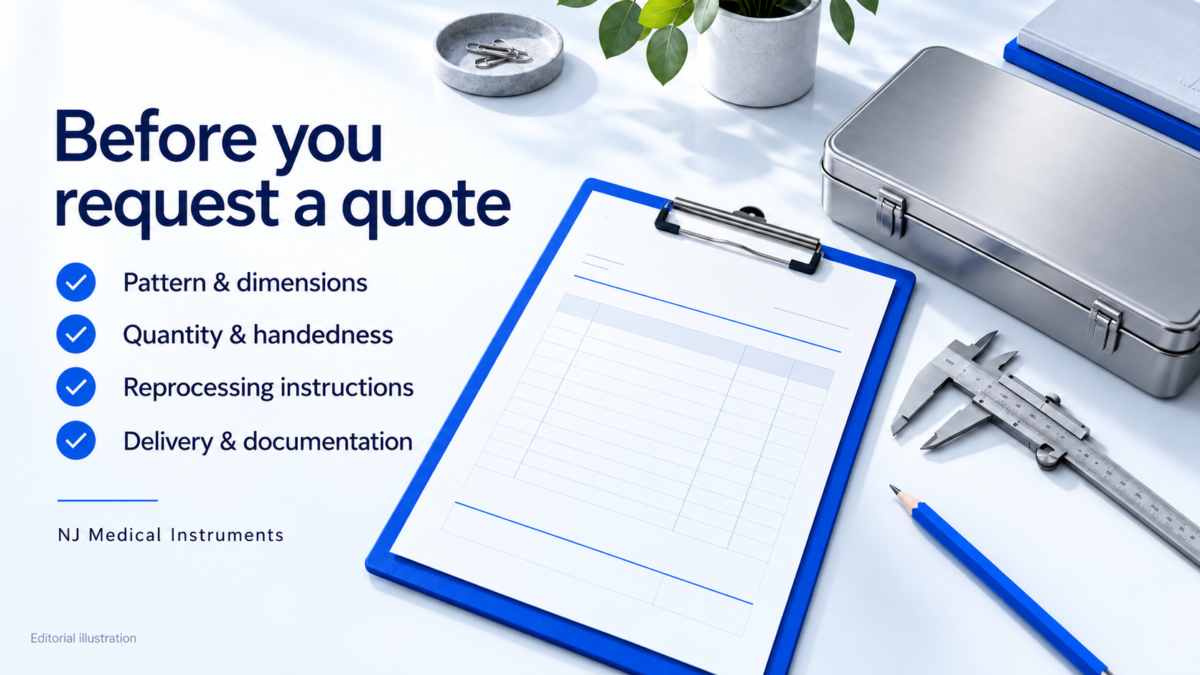
| Field | What to request |
|---|---|
| Product reference and purpose | Catalogue code or drawing reference, instrument pattern and approved tray-list item. |
| Dimensions | Overall length, required working length, blade dimensions and channel dimensions, with units and measurement points. |
| Configuration and quantity | Rigid or malleable; straight, angled or curved; left/right pattern; quantity per configuration. |
| Material and finish | The stated material specification and required finish, supported by relevant documentation. |
| Compatibility | Fixation-system interface, wire material and cutting capacity, or light-carrier connection as applicable. |
| Reprocessing and supply condition | Manufacturer’s instructions for use; whether supplied sterile or non-sterile; cleaning and sterilisation requirements. |
| Identification and documents | Product and batch identification, agreed marking, and documentation required for your destination and procurement process. |
| Tray and packing | Itemised contents, case and insert details, and whether accessories count towards the total. |
| Commercial terms | Unit and set prices, currency, minimum order, lead time, shipping costs, warranty terms and replacement arrangements. |
Example order line
Bremerich mandibular channel retractor; 10 mm channel; 18 cm overall length; quantity 2. Please confirm the catalogue reference, dimensions, supply condition and instructions for use, and identify any proposed substitution.
This is an ordering example, not a recommendation for a particular procedure.
Confirm reprocessing and documentation
Ask your sterile-services team to review the manufacturer’s instructions before purchase. FDA guidance explains that reusable devices require device-specific reprocessing, including thorough cleaning before the appropriate disinfection or sterilisation stage. [5]
A catalogue label such as “reusable” or “autoclavable” is not a complete processing instruction. Confirm that the instrument, any illumination components and the proposed tray can be processed as instructed using your facility’s equipment. Avoid assuming one cycle applies to every component.
For product documentation, ask what applies to the exact item and destination. Check the product identity, manufacturer and scope of the documents supplied rather than relying on general promotional claims.
Read the clinical evidence in context
Research on surgical complications can inform a discussion with the clinical team. It should not be used to promise that buying one instrument will produce a particular patient outcome.
Splitting technique and nerve disturbance
Mensink and colleagues’ 2014 review included 14 studies. Reported neurosensory disturbance per operated site was 4.1% in the no-chisel group, 18.4% where chisel use was undefined, and 37.3% where buccal-cortex chisel use was explicitly described. The authors reported substantial differences between studies and limited technical detail. These figures are not a controlled product comparison or a prediction of an individual patient’s risk. [1]
Bad splits: keep the findings tied to their source
A separate 2016 review by Steenen and Becking covered 33 studies and reported 458 unfavourable fractures among 19,527 sagittal ramus osteotomies, approximately 2.3% per osteotomy. That is an aggregate from those studies, not a universal present-day rate. [2]
Another 2016 review, by Steenen, van Wijk and Becking, examined 30 studies of reported risk factors. It found no comparative studies assessing bad-split incidence between splitting techniques. Its seven-cohort analysis did not find a statistically significant difference between third-molar removal during surgery and removal at least six months earlier. This does not prove the approaches are equivalent or settle the decision for an individual patient. [3]
For procurement, the practical step is to match the approved technique and tray specification. These papers do not establish that an NJ Medical Instruments product reduces nerve injury or unfavourable fractures.
Explore the NJ Medical Instruments range
Use the product links in the comparison table to review individual retractors. For a broader starting point, review the maxillofacial surgery instruments set and compare its itemised contents with your approved tray list. Confirm the final contents and quantities before ordering.
Buyer FAQs
Is there one standard orthognathic instrument set?
There is no single catalogue list to assume will fit every order. The required contents depend on the procedure, surgeon’s technique and facility’s approved tray list. Confirm the contents line by line.
Which retractor width should I buy?
Use the dimension approved by the surgical team. Confirm whether the supplier’s number refers to blade width, tip width or internal channel width. Those measurements should not be used interchangeably.
Does a BSSO set always need condylar or TMJ retractors?
Do not assume so from the “maxillofacial” label. Ask the operating team to specify any condylar or TMJ instruments required for the planned work.
Can I match an instrument from a photograph?
A photograph helps identify the general pattern, but may not establish dimensions, handedness or material. Include a catalogue reference or drawing and request written confirmation of the proposed match.
Can a malleable retractor be reshaped repeatedly?
Do not assume unlimited reshaping is permitted. Follow the manufacturer’s instructions on shaping, inspection and replacement, and obtain those instructions before choosing the pattern.
What should an OEM or private-label enquiry include?
Include the proposed drawing or reference pattern, dimensions, material, finish, marking, packaging, quantities and documentation needs. Ask which requirements can be met and how samples will be approved before placing a production order.
References
Selected background sources and catalogue information checked on 21 October 2026. This is a procurement guide, not a comprehensive review of current surgical practice.
- Mensink et al. (2014). BSSO technique and inferior alveolar nerve hypoesthesia. Journal of Cranio-Maxillofacial Surgery, 42(6), 976–982. View source.
- Steenen & Becking (2016). Bad splits in BSSO: fracture patterns. International Journal of Oral and Maxillofacial Surgery, 45(7), 887–897. View source.
- Steenen, van Wijk & Becking (2016). Bad splits in BSSO: reported risk factors. International Journal of Oral and Maxillofacial Surgery, 45(8), 971–979. View source.
- Markiewicz & Margarone (2008). Modified channel retractor: a technical note. Journal of Cranio-Maxillofacial Surgery, 36(5), 269–272. View source.
- US FDA. How are Reusable Medical Devices Reprocessed? View source.
Instrument selection and operative decisions belong to the qualified clinical team. This article supports purchasing and specification discussions; it does not provide surgical instructions.

Written by
Akif Javaid
Akif Javaid is the owner of NJ Medical Instruments, a surgical instrument manufacturer established in Sialkot, Pakistan in 1990. The company manufactures reusable surgical, dental, ENT and orthopedic instruments and now stocks them locally through inventory hubs in Pakistan, the UK, the UAE and the USA, supplying hospitals, clinics and distributors worldwide with faster regional fulfilment. It also produces private-label and OEM instrument sets to customer specification.
