


Amalgam Condensers, Pluggers and Burnishers: How Nib Diameter Decides the Restoration

The short answer
- A condenser (plugger) packs. A burnisher smooths. They are not interchangeable, and the difference is the shape of the working face: flat and often serrated on a condenser, smooth and rounded on a burnisher.
- Nib diameter is the specification that matters most. Condensation pressure is force divided by nib area, and area rises with the square of the diameter. A 2.0 mm nib needs four times the hand force of a 1.0 mm nib to reach the same pressure.
- Most dentists never reach the textbook figure. In a study of 42 practitioners, only one reached the 15 MPa condensation pressure recommended in the literature.
- Buy condensers in a size ladder — roughly 1.0–1.5 mm for the first increments and line angles, 1.8–2.5 mm for the bulk — not as a single mid-size instrument.
- Composite instruments are a different tool. A condenser is designed to grip material; a composite placement instrument is coated to release it.
- If you supply the EU, check the calendar. General use of dental amalgam has been banned there since 1 January 2025, and manufacture and import into the EU since 1 July 2026.
Restorative hand instruments look simple enough that most practices buy them by picture. A kit arrives, the nibs are somewhere between 1 mm and 2 mm, the burnishers are whichever shapes the supplier had, and nobody thinks about it again until an increment slips off a nib or a margin opens up.
The instruments are simple. The physics is not, and it is the part no catalogue explains. This guide sets out what a condenser, a plugger and a burnisher each do, what the published clinical measurements say about the pressures actually achieved in practice, how to read a nib size, and how to write a specification if you are ordering a set made to your own pattern rather than buying off a shelf.
On this page
- Condenser, plugger, burnisher, carver: what each one does
- The number that decides everything: nib diameter
- What dentists actually achieve: published measurements
- Choosing sizes: a working sequence
- Smooth or serrated?
- Burnishers: the shape is the specification
- What the evidence actually says about burnishing
- Composite instruments are a different tool
- Where amalgam stands in 2026
- Buying: stock set or made to your specification
- Frequently asked questions
- Sources
Condenser, plugger, burnisher, carver: what each one does
Four instrument families handle a direct restoration between placement and finishing. They are frequently sold together, frequently confused, and each is defined by the shape of its working end rather than by its name.
Condenser and plugger are the same instrument. The terms are used interchangeably across textbooks, catalogues and clinical dictionaries — a plugger is defined as a hand or machine tool for condensing amalgam or gold foil into a cavity preparation. If a supplier lists both, expect the same product under two headings, and check the nib diameters rather than the label.
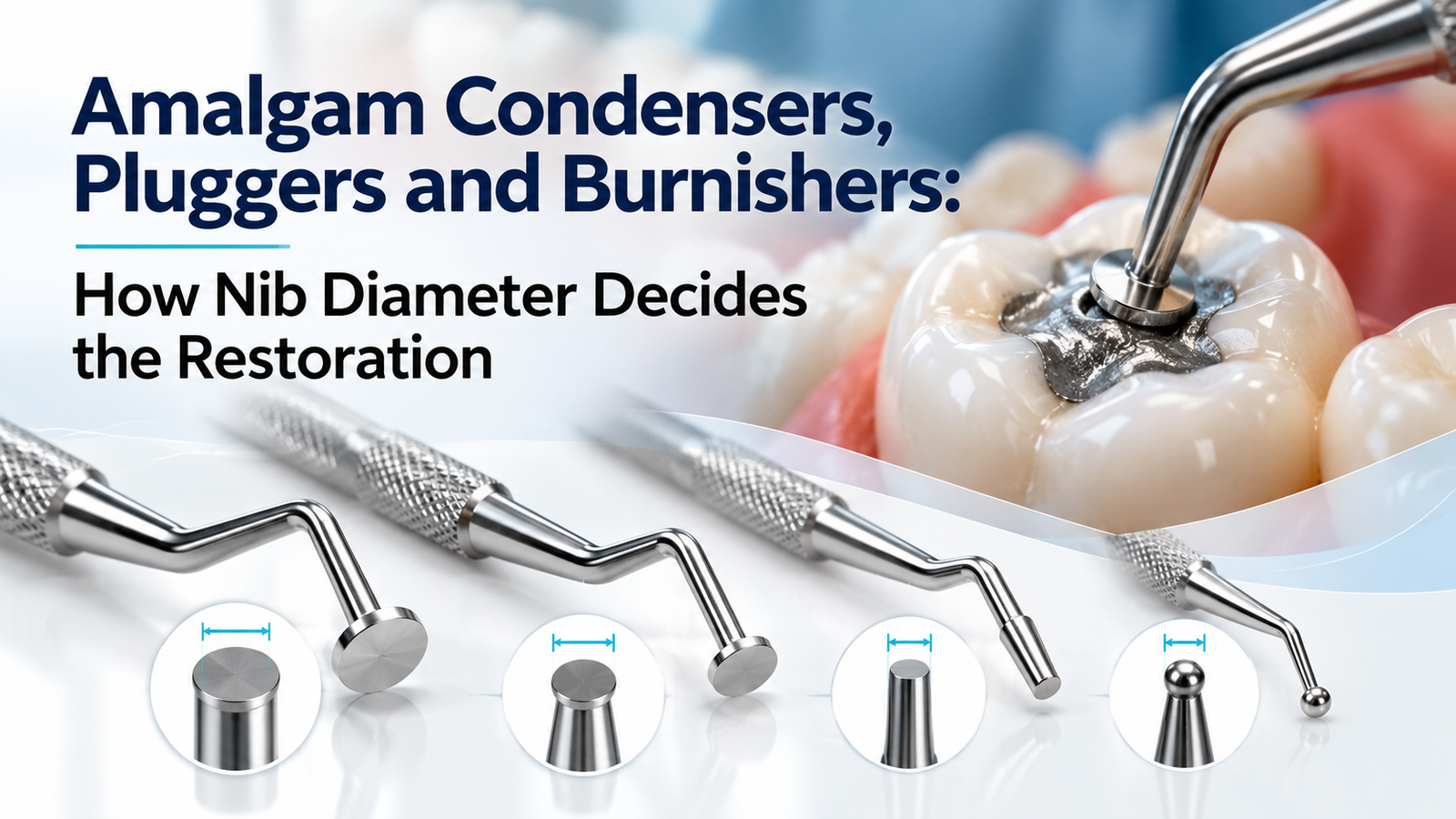
The working end is a flat nib, round or occasionally diamond-shaped, on an angled shank. The angle exists so the operator can bring the nib square onto the material at the floor of a proximal box without the handle fouling the opposing arch. The nib face may be smooth or serrated.
Burnishers have a smooth, rounded working end. Nothing on a burnisher is designed to bite. It is dragged across a surface under light load to compress and smooth it, to adapt a matrix band, or to begin shaping anatomy before a carver is used.
Carvers — discoid-cleoid, Hollenback and similar patterns — have a blade. They remove material to re-establish occlusal and interproximal form. A carver is a cutting instrument; a burnisher is not.
Composite placement instruments (also sold as plastic filling instruments) carry and shape resin. They are covered separately below, because the design problem is the opposite of a condenser’s.
A naming note worth knowing before you order. “Plastic filling instrument” does not mean an instrument made of plastic. It means an instrument for handling a material while it is in a plastic — that is, mouldable — state. Almost every instrument sold under that name is stainless steel.
The number that decides everything: nib diameter
Condensation pressure is force divided by the area of the nib face. That is the whole mechanism, and it has one consequence that changes how you should buy these instruments:
Nib area rises with the square of the diameter. Double the diameter and you quarter the pressure for the same hand force. This is why a practitioner who feels they are pushing hard can still be under-condensing — the effort is real, but it is spread over four times the area.
The table below works the arithmetic for the nib sizes normally offered. The 15 MPa column uses the condensation pressure recommended in the dental materials literature; the final column shows what a moderate 10 newton push (about 1 kgf) actually delivers at each size.
| Nib diameter | Nib face area | Force needed for 15 MPa | In kgf | Pressure from a 10 N push |
|---|---|---|---|---|
| 0.8 mm | 0.50 mm² | 7.5 N | 0.77 kgf | 19.9 MPa |
| 1.0 mm | 0.79 mm² | 11.8 N | 1.20 kgf | 12.7 MPa |
| 1.2 mm | 1.13 mm² | 17.0 N | 1.73 kgf | 8.8 MPa |
| 1.5 mm | 1.77 mm² | 26.5 N | 2.70 kgf | 5.7 MPa |
| 1.8 mm | 2.54 mm² | 38.2 N | 3.89 kgf | 3.9 MPa |
| 2.0 mm | 3.14 mm² | 47.1 N | 4.80 kgf | 3.2 MPa |
| 2.5 mm | 4.91 mm² | 73.6 N | 7.51 kgf | 2.0 MPa |
| 3.0 mm | 7.07 mm² | 106.0 N | 10.81 kgf | 1.4 MPa |
Read the last column first. The same push that produces nearly 13 MPa through a 1.0 mm nib produces about 2 MPa through a 2.5 mm nib. Nothing about the operator has changed. Only the instrument has.
The practical conclusion is the opposite of what most buyers assume. A larger condenser is not a stronger condenser. It is a faster one, bought at the cost of pressure, and it belongs at the stage of the restoration where speed matters more than density — the bulk, not the floor.
What dentists actually achieve: published measurements
Condensation pressure has been measured directly, with strain-gauged pluggers, in mannequin studies and on real patients. The results are consistent across four decades and they are worth knowing before you choose a size ladder.
| Study | Setting | Small plugger | Large plugger | Notable finding |
|---|---|---|---|---|
| Jørgensen, 1977 (cited as the benchmark) | Recommendation | 15 MPa recommended | The figure most later studies test against | |
| Lussi & Buergin, 1987, J Dent Res | 42 general practitioners, standard Class II in a mannequin head | 9.17 ± 3.04 MPa (1.15 mm nib) | 4.09 ± 1.41 MPa (1.8 mm nib) | Only one of the 42 reached 15 MPa |
| Brown, Maiolo & Miller, 1993, Am J Dent | Specialist prosthodontist, two pinned Class II restorations, video plus strain gauge | 12.6 ± 1.9 MPa at the base of the proximal box | 2.2 ± 0.7 MPa on the final increment | Pressure fell sharply moving from a 1.5 mm to a 2.5 mm plugger |
| Lussi et al., 1995, Eur J Oral Sci | 44 practitioners, real patients, force-measuring plugger | Max 8.9 ± 2.4 MPa; average 3.7 ± 1.3 MPa | Max 5.5 ± 1.8 MPa; average 2.2 ± 0.9 MPa | 131 s total working time, of which 44 s was actual condensation |
| Roggenkamp et al., 2010 (amalgam repair) | Laboratory, spring-loaded calibrated carrier, 1 mm tip | 22.5 MPa applied (4 lb over 0.79 mm²) | At 5.6 and 14 MPa, bond reached about 40% of the control | |
Three things follow from this table.
The gap between recommendation and practice is structural, not a skill problem. Across two studies, 86 practitioners produced average pressures in the 2–4 MPa range with routine instruments. Asking clinicians to push harder does not close a fourfold gap. Choosing a smaller nib for the increments that matter does.
The same operator varies enormously within one restoration. In the 1993 measurements, the same prosthodontist applied 12.6 MPa at the base of the box and 2.2 MPa on the final increment. That is appropriate — the last increment is about to be burnished and carved — but it tells you that a set needs a range of sizes, because the stages need different pressures.
Condensation time is short. Of 131 seconds of working time, only 44 were spent condensing. Anything about the instrument that wastes those 44 seconds — a nib that slips, a shank that will not reach square, a handle that is hard to hold under load — costs a disproportionate amount.
Choosing sizes: a working sequence
The sensible way to specify a set is by stage, not by count. Here is what each stage asks of the instrument.
| Stage | Instrument | Working end | Typical size | What actually decides the choice |
|---|---|---|---|---|
| 1. Delivery | Amalgam carrier | Hollow barrel with plunger | Small and large barrel | Barrel volume against the increment you want to place |
| 2. First increments | Small condenser | Flat nib, smooth or serrated | 1.0–1.5 mm | Must reach the box floor, line angles and retention grooves and still deliver pressure |
| 3. Interproximal | Interproximal condenser | Offset nib shaped to the box | ≈1.0–1.2 mm | Mesial or distal box geometry; the nib must sit square, not skewed |
| 4. Bulk and occlusal | Large condenser | Flat nib | 1.8–2.5 mm | Covers area quickly; accept that pressure falls and plan for it |
| 5. Pre-carve burnish | Large ball, ovoid or anatomical burnisher | Smooth, broad contact | Large | Broad surface contact; worked from centre outwards to the margins under light force |
| 6. Carve | Discoid-cleoid or Hollenback carver | Blade | — | Occlusal versus interproximal anatomy; timing against the set of the material |
| 7. Post-carve burnish | Football, acorn or T-ball burnisher | Smooth, shaped | Small to mid | The shape has to match the anatomy you have just carved |
A set built this way has at least two condenser diameters, one interproximal pattern, and burnishers in more than one shape. A set built by price has one condenser and one ball burnisher, and the operator compensates with force at exactly the stage where force does not help.
Already know the nib sizes you need?
We manufacture restorative hand instruments to specification in Sialkot, direct from the factory floor — nib diameter, face pattern, shank angle, handle profile and laser marking to your drawing or sample. Send us your specification and we will quote against it, or WhatsApp +92-333-8733922 with a photo of the instrument you want matched.
Smooth or serrated?
Condenser faces come plain or with a cross-cut serration, and the distinction is not decorative.
Serrated faces grip. The serration prevents the nib skating sideways off a freshly placed increment, which is what allows the operator to angle the instrument into a line angle and still deliver force along the intended axis rather than shearing the increment away. On amalgam this is a genuine advantage.
Smooth faces release. The same serration that grips amalgam holds resin, and a serrated face used on composite tends to lift material back out of the preparation on withdrawal. The consequence is the effect clinicians call tug-back or pull-back. It is also the reason a serrated face collects material and takes longer to clean.
A double-ended condenser with one smooth end and one serrated end, in two diameters, covers most of what a general practice does. A tray that runs both amalgam and composite is better served by keeping the two instrument groups separate, for reasons set out in the composite section below.
Burnishers: the shape is the specification
Condensers are specified by a number — the nib diameter. Burnishers are specified by a shape, and the shape determines which surface the instrument can actually reach and sit against. A ball burnisher cannot follow a carved fissure; an acorn can. That is the entire selection logic.
| Shape | Profile | Primary use | Where it struggles |
|---|---|---|---|
| Ball | Spherical head on a shank | Pre-carve burnishing, adapting a matrix band, general smoothing | Cannot reproduce anatomy; a sphere only makes a sphere |
| Football | Ellipsoid, flattened sphere | Smoothing broad occlusal surfaces; lingual surfaces of anterior teeth | Too broad for narrow fissures and tight embrasures |
| Acorn | Acorn or anatomical profile | Smoothing while forming occlusal anatomy in one pass | The shape dictates the anatomy, so it suits some cusp forms better than others |
| T-ball | Ball set transverse to the shank | Contouring a matrix band, initiating carving, reaching around a cusp | The transverse head limits access in a narrow box |
| Beavertail | Flat, broad, leaf-shaped blade | Inverting a dental dam, broad-surface burnishing | No use where a defined radius is needed |
| Cone | Tapered cone | Forming grooves and defining anatomy before carving | Concentrates load on a small area; easy to over-work a surface |
Pattern numbers vary between manufacturers and are not a standard. A number that means a ball burnisher in one catalogue can mean something else in the next, so when you order by number, confirm the head shape and head dimension as well. Our burnisher range lists each figure number with its own page — Fig. 25, Fig. 27 double-ended, Fig. 28, Fig. 29, Fig. 31 and Fig. 33.
What the evidence actually says about burnishing
Most instrument pages state that burnishing improves marginal seal and leave it there. The literature is more divided than that, and a buyer is better off knowing it.
| Study | What was tested | Finding |
|---|---|---|
| Ben-Amar et al., 1987, Dental Materials | Class V restorations, admixed and spherical high-copper amalgams, pre- and post-carve burnishing combinations | Admixed amalgam leaked less after burnishing; with spherical amalgam no statistically significant difference was found. Best adaptation came from admixed amalgam burnished both before and after carving |
| Kamel, 1995, Egypt Dent J | 80 extracted molars, Class I cavities, five finishing groups, thermally stressed, assessed by SEM | The pre- plus post-carve burnish group showed the highest proportion of margins rated excellent |
| Study reported in J Prosthet Dent, 1978 | Microleakage after single and double burnishing | No significant increase or decrease in microleakage from either |
| Bryant, 1992, Aust Dent J | 228 high-copper amalgam restorations in 56 patients, assessed clinically to three years | Marginal integrity was similar across finishing techniques. Polished restorations had substantially better surface texture and less discoloration. No support was found for immediate finishing |
Taken together: burnishing reliably improves surface quality, and its effect on marginal integrity depends on the material and is not consistent across studies. The honest buying conclusion is that you should choose burnishers for access and shape — can this head sit flat on the surface you need to work — and not on the strength of a promised clinical outcome. Any supplier telling you that a particular burnisher seals margins is going further than the evidence does.
Technique note, because it affects what size you buy. Pre-carve burnishing is described as a large burnisher worked for around fifteen seconds under light force, from the centre of the restoration outwards towards the margins, before the matrix is removed. That “large” is the reason a set needs a big head as well as a small one — a small burnisher cannot make broad, even contact, and broad contact is the point of the step.
Composite instruments are a different tool
It is common to see a condenser used on composite because it is the instrument already on the tray. It works, up to a point, and then it does not — because the two instruments are engineered against opposite failure modes.
A condenser is designed so material does not slide off it. A composite placement instrument is designed so material lets go of it. One grips; the other releases.
| Property | Amalgam condenser / plugger | Composite placement instrument |
|---|---|---|
| Working face | Flat nib, often cross-cut serrated | Smooth polished blades and paddles, no serration |
| Surface | Uncoated stainless steel | Coated — titanium nitride (TiN) is the common option; aluminium titanium nitride (AlTiN) is offered as a harder, smoother alternative |
| Failure you are buying against | The increment skating off the nib | Tug-back — resin lifting out of the preparation on withdrawal |
| Typical working dimension | 1.0–2.5 mm round nib | Blades roughly 1.3–1.9 mm wide, plus paddle and condensing ends |
| How it is sized | Nib diameter in millimetres | By pattern name or number (Woodson, 8A, and similar), which is not standardised between makers |
| What limits service life | Wear and surface condition of the steel | Integrity of the coating — once it is worn through, the non-stick behaviour goes with it |
| Set composition | A ladder of diameters | A range of blade shapes, typically split into anterior and posterior patterns |
Two buying consequences.
Judge a coated instrument on the coating, not the colour. A gold or black finish signals that a coating has been applied; it says nothing about hardness, thickness or adhesion. Ask what coating, applied by what process, and inspect the working ends of your existing instruments for wear-through before reordering — a coated instrument that has lost its coating at the tip is behaving like an uncoated one.
Keep the two families separate on the tray. A serrated condenser dragged through resin holds material in its serrations and is slower to clean; a coated composite instrument used to condense amalgam is having its coating worked against a hard, abrasive material for no benefit. Our composite placement and plastic filling instruments sit in their own category for that reason.
Where amalgam stands in 2026
If you are a distributor, a group practice or a procurement buyer planning a purchase cycle, the regulatory calendar now matters more than the instrument specification. The position as of September 2026:
| Date | What applies | Who it affects |
|---|---|---|
| 1 January 2025 | General ban on the use of dental amalgam in the EU, except where a practitioner deems it strictly necessary for a patient’s specific medical needs. Export of dental amalgam from the EU also prohibited | All EU practices and EU exporters |
| 30 June 2026 | End of the derogation available to member states where amalgam was effectively the only reimbursed material and reimbursement of alternatives was not yet in place | The member states that used the derogation |
| 1 July 2026 | Manufacture of dental amalgam in, and import of dental amalgam into, the EU prohibited, other than for the specific medical-needs exemption | EU manufacturers, importers and distributors |
| 2034 | Global phase-out date agreed at the sixth Conference of the Parties to the Minamata Convention in November 2025, after which manufacture, import and export of dental amalgam are not permitted | Worldwide |
What this means for an instrument order depends entirely on the market you serve.
EU and UK-facing buyers: new amalgam condenser stock is a shrinking line. Existing restorations still need repair, replacement and finishing, so burnishers and carvers keep their place on the tray for years, but a set weighted towards composite placement instruments matches where the work is going.
US, GCC, South Asian and African markets: amalgam remains in routine use and the 2034 date is the horizon, not 2026. Condensers and pluggers are a normal ongoing purchase.
Distributors supplying more than one region: the two ranges now diverge, and a single catalogue line will not serve both. This is a reason to specify rather than to stock-buy.
Buying: stock set or made to your specification
There are two ways to buy restorative hand instruments, and the right one depends on whether you are equipping a surgery or supplying a market.
A stock set is right for a single practice or a teaching clinic. Check that it contains at least two condenser diameters and more than one burnisher shape, and that the nib sizes are actually stated in millimetres rather than described as “small” and “large”. If a listing will not give you a number, it is not a specification.
A specified order is right for distributors, dental schools, group practices standardising across sites, and anyone putting their own name on the instrument. As an OEM manufacturer we make to drawing, to sample or to a written specification. The fields below are what we need from you to quote accurately; copy the table into an email and fill in the right-hand column.
| Specification field | What to state | Example |
|---|---|---|
| Instrument and pattern | Type, and pattern name or figure number if you have one | Amalgam condenser, round nib |
| Nib diameter | In mm, to one decimal place, per end | 1.2 mm / 1.8 mm |
| Nib face | Smooth or serrated; serration pattern if specific | Serrated, cross-cut |
| Shank | Straight, angled, bin-angle; state the angle if it matters | Bin-angle |
| Ends | Single or double ended | Double ended |
| Overall length | In mm | 165 mm |
| Handle | Solid or hollow, diameter, knurl or flute pattern | Hollow, 8 mm, octagonal knurl |
| Material | Stainless steel grade or “surgical-grade stainless steel” | Surgical-grade stainless steel |
| Finish | Satin or mirror | Satin |
| Coating | Only for composite instruments — state the coating required | TiN, working ends only |
| Marking | Text, position and method | Laser mark, practice name, on shank |
| Packing | Loose, set, or set in a tray; and set composition | Set of 6, foam insert |
| Quantity and schedule | First order quantity and expected repeat interval | 500 sets, quarterly |
Two fields are worth extra attention. Nib diameter per end is the one buyers most often leave out, and it is the one that determines whether the instrument works — see the pressure table above. Handle diameter and knurl decide whether the operator can hold the instrument steadily under load; the measurement studies show condensation is only about 44 seconds of work per restoration, and a handle that slips wastes a meaningful share of it.
Get restorative instruments quoted to your specification
NJ Medical Instruments has manufactured surgical, dental and ENT instruments in Sialkot since 1990, supplying direct with no middlemen. Send your drawing, sample or filled-in table above to info@njmedicalinstruments.com, or WhatsApp +92-333-8733922. If you are not sure what to specify, send a photo of the instrument you are replacing — we will match it and come back with sizes and pricing. Contact us here.
Related dental instrument categories
- Amalgam pluggers, condensers and burnishers — the range covered in this guide
- Composite placement and plastic filling instruments — for resin work
- Mouth mirrors, scalers, explorers and probes — the diagnostic instruments that share the tray
- Dental extracting forceps and dental elevators
- Wax knives and spatulas — laboratory and chairside material handling
- All dental instruments
Further reading on this site: our dental extraction forceps guide covers the selection logic for the surgical side of the practice; tray optimisation and tray lists deal with what a set should actually contain; and stains and corrosion explains what shortens instrument life after purchase.
Frequently asked questions
What is the difference between an amalgam condenser and a plugger?
There is none. Condenser and plugger are two names for the same instrument, used interchangeably in textbooks, dictionaries and catalogues. Both describe a hand instrument with a flat nib used to pack restorative material into a cavity preparation. When a supplier lists both, compare the nib diameters rather than the headings.
What is the difference between a condenser and a burnisher?
A condenser packs material in, using a flat nib and vertical pressure. A burnisher smooths material that has already been packed, using a rounded head and light lateral strokes. A condenser has a defined edge to its working face; a burnisher is smooth all over. They are used at different stages and cannot substitute for one another.
What size amalgam condenser do I need?
You need more than one. Roughly 1.0–1.5 mm for the first increments, the floor of a box, line angles and retention grooves; roughly 1.8–2.5 mm for condensing the bulk and the occlusal portion. The reason is pressure: nib area rises with the square of the diameter, so a 2.0 mm nib needs about four times the hand force of a 1.0 mm nib to reach the same condensation pressure.
What condensation pressure should be applied to amalgam?
The figure recommended in the dental materials literature is 15 MPa. Measured practice falls well short of it: in a study of 42 general practitioners, maximum pressures averaged 9.17 MPa with a 1.15 mm plugger and 4.09 MPa with a 1.8 mm one, and only one practitioner reached 15 MPa. A later study of 44 practitioners treating real patients recorded average pressures of 3.7 MPa and 2.2 MPa for small and large instruments.
Why should a condenser be smaller than the area being condensed?
Because pressure is force divided by area. A nib smaller than the surface concentrates the available force into a smaller footprint and therefore delivers higher pressure. This is also why, in amalgam repair work, the recommendation is to use a condenser smaller than the repair site so that maximum pressure reaches the surface being bonded to.
Should an amalgam condenser be smooth or serrated?
Serrated for amalgam, smooth for composite. A serrated face grips the increment and stops the nib skating sideways, which is what lets the operator angle into a line angle and still deliver force along the intended axis. On resin the same serration holds material and lifts it back out of the preparation on withdrawal.
What are the types of dental burnisher?
The common shapes are ball, football, acorn, T-ball, beavertail and cone. Ball burnishers are used for pre-carve burnishing and adapting a matrix band; footballs for broad occlusal and lingual surfaces; acorns for smoothing while forming anatomy; T-balls for contouring a band and reaching around a cusp; beavertails for inverting a dental dam and broad-surface work; cones for defining grooves before carving.
Does burnishing improve the marginal seal of an amalgam restoration?
The evidence is mixed and depends on the material. One in vitro study found less marginal leakage in admixed amalgam after burnishing but no significant difference in spherical amalgam. A study of 80 extracted molars found the best margins in the group burnished both before and after carving. A separate microleakage study found no significant change from single or double burnishing, and a three-year clinical assessment of 228 restorations found marginal integrity similar across finishing techniques, with polished restorations showing better surface texture. Burnishing reliably improves surface quality; its effect on marginal integrity is not consistent.
Can I use an amalgam condenser for composite fillings?
You can, but the instrument is working against you. A condenser — especially a serrated one — is designed so material does not release from it, which is exactly the property that causes resin to lift out of the preparation when you withdraw. Composite placement instruments are made with smooth, coated working ends, usually titanium nitride or aluminium titanium nitride, specifically to release the material.
What does “plastic filling instrument” mean?
It refers to the state of the material, not the material of the instrument. A plastic filling instrument handles a restorative material while it is still mouldable. Nearly every instrument sold under that name is stainless steel, usually with a coated working end.
Is dental amalgam banned?
In the EU, general use has been banned since 1 January 2025, with a narrow exemption where a practitioner judges it strictly necessary for a patient’s specific medical needs. A derogation for certain member states ran to 30 June 2026, and manufacture and import into the EU have been prohibited since 1 July 2026. Globally, the sixth Conference of the Parties to the Minamata Convention agreed in November 2025 on a phase-out date of 2034. Amalgam remains in routine use in the United States, the GCC, South Asia and much of Africa.
Do I still need burnishers if my practice has moved to composite?
Yes, for two reasons. Existing amalgam restorations still require repair, replacement and finishing for many years after new placements stop. And burnishers are used on other materials as well — adapting a matrix band, inverting a dental dam and burnishing temporary restorative material are all standard uses independent of amalgam.
How do I specify a custom set for OEM or private-label supply?
State the instrument and pattern, the nib diameter for each end in millimetres, whether the face is smooth or serrated, the shank type, single or double ended, overall length, handle profile and diameter, material, finish, any coating, the marking you want and the packing format, along with quantity and expected repeat interval. A drawing or a physical sample removes most of the ambiguity. Send it to info@njmedicalinstruments.com or WhatsApp +92-333-8733922.
Sources
- Lussi AS, Buergin WB. A new method to measure the condensation pressure of amalgam under in vivo conditions. Journal of Dental Research, 1987;66(3):737–9.
- Lussi A, Brunner M, Portmann P, Buergin W. Condensation pressure during amalgam placement in patients. European Journal of Oral Sciences, 1995;103(6):388–93.
- Brown IH, Maiolo C, Miller DR. Variation in condensation pressure during clinical packing of amalgam restorations. American Journal of Dentistry, 1993;6:255–9.
- Roggenkamp C et al. In vitro bond strengths of amalgam added to existing amalgams. PubMed ID 20533632.
- Ben-Amar A, Serebro L, Gorfil C, Soroka E, Liberman R. The effect of burnishing on the marginal leakage of high copper amalgam restorations: an in vitro study. Dental Materials, 1987.
- Kamel FM. Effect of surface treatment on marginal integrity of amalgam restorations (in vitro study). Egyptian Dental Journal, 1995;41(3):1313–20.
- Bryant RW. Finishing techniques for amalgam restorations: clinical assessment at three years. Australian Dental Journal, 1992.
- Regulation (EU) 2024/1849 amending Regulation (EU) 2017/852 on mercury as regards dental amalgam. European Parliament and Council, 13 June 2024.
- European Parliament, Legislative Observatory — procedure summary on the revision of the EU Mercury Regulation.
- Sixth Conference of the Parties to the Minamata Convention on Mercury, November 2025 — agreed global dental amalgam phase-out date.
- Taber’s Medical Dictionary, 25th edition — definition of “plugger”.
Pressure and force figures in the nib diameter table are calculated from the geometry of a circular nib face (area = πd²/4) and are provided to illustrate the relationship between tip size and condensation pressure. They are not clinical recommendations.

Written by
Akif Javaid
Akif Javaid is the owner of NJ Medical Instruments, a surgical instrument manufacturer established in Sialkot, Pakistan in 1990. The company manufactures reusable surgical, dental, ENT and orthopedic instruments and now stocks them locally through inventory hubs in Pakistan, the UK, the UAE and the USA, supplying hospitals, clinics and distributors worldwide with faster regional fulfilment. It also produces private-label and OEM instrument sets to customer specification.
