


Surgical Instrument Tray Lists: What’s in 12 Sets and What Each Instrument Is Really Called

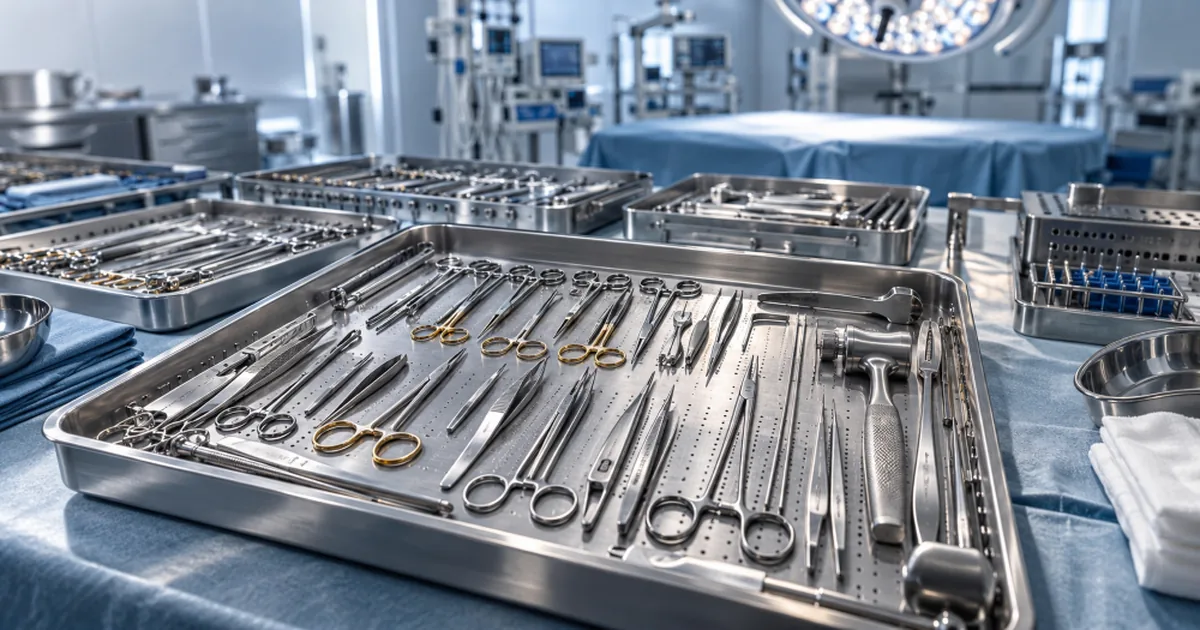
A quarter of surgical cases hit an instrument problem, and the commonest one is an instrument that is not there. In fact, some of those instruments were never lost. They were ordered under a name the factory does not use.
In 2021 a research team put twenty-four trained observers into seven operating rooms and asked them to record every instrument fault they saw, rather than waiting for staff to file a report. They logged 236 errors across 147 cases. Notably, missing instruments were the largest category by a wide margin. More than half of the affected cases were delayed, by an average of ten minutes each, and the team put the annual cost in lost chargeable theatre minutes at that one two-hospital campus at somewhere between $6.75 million and $9.42 million.
The finding that matters most for anyone buying instruments is the breakdown. Nearly nine in ten of those errors traced back to what the authors call visualisation tasks: inspecting an instrument, identifying it, confirming that the right things are in the right tray. Not sterilisation failures. Not breakages. Recognition.
A naming problem that was never standardised
Certainly, recognition is partly a looking problem. It is also a naming problem, and naming in this trade was never standardised. The instrument a British theatre calls a Spencer Wells, an American theatre calls a Rochester-Pean. Kocher and Ochsner are the same forceps. Doyen is both a retractor and a bowel clamp, depending on who is holding it. A scrub nurse who asks for “a Doyen” in the wrong theatre gets the wrong instrument, and a procurement officer who types “Doyen” into a supplier’s search box gets whichever one that supplier happened to list first.
This page is the surgical instrument tray list we kept being asked for. It does two things. The decoder below lays out what is actually inside twelve standard trays, item by item, with a tick box against each line so it works as a count sheet. Hover or tap any line and it shows you every other name that instrument answers to. Further down is the full name-collision table, which is the part that costs people money.
The tray decoder
Pick a tray. Each list is grouped the way a scrub nurse lays a back table — exposure first, then dissection, haemostasis, closure — rather than alphabetically, because that is the order things get reached for.
Dressing set
- Dissecting forceps, non-toothed, 13 cmAlso called: thumb forceps · pick-ups · plain forceps · smooth forceps×1
- Dissecting forceps, toothed, 13 cmAlso called: rat-tooth forceps · 1×2 teeth · toothed pick-ups×1
- Halstead mosquito artery forceps, curvedAlso called: mosquito · haemostat · hemostatic forceps · small clip×2
- Mayo dressing scissors, straight, 14 cmAlso called: dressing scissors · Mayo straight · suture scissors×1
- Rampley sponge-holding forcepsAlso called: sponge holder · ring forceps · swab holder · Foerster (different pattern)×1
- Gallipot, 60 mlAlso called: medicine cup · lotion bowl · small pot×1
Lines counted: Full set: 7 pieces (with kidney dish)
Minor / basic surgical set
- Scalpel handle No. 3Also called: BP handle · Bard-Parker handle · knife handle · blade holder×1
- Adson dissecting forceps, toothedAlso called: Adson pick-ups · rat-tooth Adson · fine toothed forceps×1
- Adson dissecting forceps, non-toothedAlso called: plain Adson · smooth Adson · dressing Adson×1
- Halstead mosquito artery forceps, curvedAlso called: mosquito · haemostat · small clip×4
- Allis tissue forceps, 15 cmAlso called: Allis clamp · tissue holding forceps · Allis forceps×2
- Metzenbaum scissors, curved, 14 cmAlso called: Metz · dissecting scissors · tissue scissors×1
- Mayo scissors, straight, 14 cmAlso called: suture scissors · Mayo straight · stitch scissors×1
- Mayo-Hegar needle holder, 15 cmAlso called: needle driver (US) · needle holder · Mayo-Hegar×1
- Gillies skin hook / Senn retractor, double-endedAlso called: skin hook · cat’s paw (Senn) · rake retractor×2
- Backhaus towel clipAlso called: towel clamp · drape clip · Backhaus · Jones (spring pattern)×4
Lines counted: Full set: 15–20 pieces depending on hospital policy
IV cut-down set (venesection)
- Scalpel handle No. 3 (takes 10–15 blades)Also called: BP handle · Bard-Parker No. 3 · knife handle×1
- Adson dissecting forceps, fine toothedAlso called: fine pick-ups · Adson toothed · 1×2 teeth×1
- Dissecting forceps, non-toothed, 12 cmAlso called: plain forceps · smooth pick-ups×1
- Halstead mosquito artery forceps, curvedAlso called: mosquito · small haemostat · fine clip×4
- Iris / tenotomy scissors, curved, 11 cmAlso called: iris scissors · fine scissors · tenotomy×1
- Suture scissors, straightAlso called: stitch scissors · Mayo straight×1
- Mayo-Hegar needle holder, 13 cmAlso called: needle driver · small needle holder×1
- Weitlaner self-retaining retractor, smallAlso called: self-retainer · Weitlaner · spreader · Gelpi (different pattern)×1
- Aneurysm needle / vein dilatorAlso called: vein hook · ligature carrier · aneurysm hook×1
- Backhaus towel clipAlso called: towel clamp · drape clip×4
Lines counted: Full set: 12–16 pieces
Hydrocele and hernia set
- Incision and dissection
- Scalpel handle No. 3 and No. 4Also called: BP handles · the number is the HANDLE, not the blade×2
- Mayo scissors, curved and straight, 17 cmAlso called: Mayo · heavy scissors · fascia scissors×2
- Metzenbaum scissors, curved, 18 cmAlso called: Metz · delicate dissecting scissors×1
- Grasping and holding
- Dissecting forceps, toothed and non-toothed, 15 cmAlso called: pick-ups · thumb forceps · rat-tooth×4
- DeBakey atraumatic forceps, 20 cmAlso called: DeBakey · vascular forceps · atraumatic pick-ups×1
- Allis tissue forceps, 15 cmAlso called: Allis clamp · tissue forceps×4
- Babcock forceps, 16 cmAlso called: Babcock · fenestrated atraumatic forceps · bowel forceps×2
- Haemostasis
- Halstead mosquito artery forceps, curvedAlso called: mosquito · small haemostat×6
- Crile artery forceps, curved, 14 cmAlso called: Crile · haemostat · Rochester-Pean (US, similar)×6
- Kocher artery forceps, 1×2 teeth, 16 cmAlso called: Ochsner (US) · Kocher-Ochsner · toothed clamp×4
- Exposure and closure
- Langenbeck retractor, pairAlso called: Langenbeck · L-retractor · right-angle retractor×2
- Czerny double-ended retractorAlso called: Army-Navy (US) · US Army retractor · double-ended retractor×2
- Mayo-Hegar needle holder, 16 cmAlso called: needle driver · Crile-Wood (finer pattern)×2
- Rampley sponge-holding forcepsAlso called: sponge holder · ring forceps · swab holder×2
- Backhaus towel clipAlso called: towel clamp · drape clip×6
- Yankauer suction tip and tubing connectorAlso called: sucker · suction tip · Yankauer×1
Lines counted: Full set: 40–44 pieces
Circumcision set
- Scalpel handle No. 3Also called: BP handle · knife handle×1
- Straight artery forceps, fineAlso called: crushing forceps · straight mosquito · haemostat×2
- Curved artery forceps, fineAlso called: mosquito · curved haemostat×2
- Probe / dissector, bluntAlso called: sinus probe · blunt dissector · separator×1
- Iris scissors, straightAlso called: fine scissors · small operating scissors×1
- Mayo scissors, straightAlso called: suture scissors · stitch scissors×1
- Adson dissecting forceps, toothedAlso called: fine pick-ups · toothed Adson×1
- Needle holder, 13 cmAlso called: needle driver · Mayo-Hegar small×1
- Gallipot and kidney dishAlso called: medicine cup · emesis basin (US) · K-basin×2
Lines counted: Full set: 10–14 pieces
Major laparotomy set
- Incision and dissection
- Scalpel handles No. 3, No. 4, No. 7Also called: BP handles · long No. 7 for deep work×3
- Mayo scissors, curved and straight, 17–23 cmAlso called: Mayo · fascia scissors×4
- Metzenbaum scissors, 18 and 23 cmAlso called: Metz · long Metz for pelvic work×3
- Haemostasis and clamping
- Mosquito, Crile and Rochester-Pean artery forcepsAlso called: haemostats · clips · artery forceps×24
- Kocher (Ochsner) artery forceps, 1×2 teethAlso called: Ochsner · toothed clamp · Kocher×6
- Mixter right-angle forceps, 20 cmAlso called: right angle · Mixter · Lahey (similar) · ‘the right angle’×2
- Doyen intestinal clamp, atraumaticAlso called: bowel clamp · Doyen clamp · NOT the Doyen retractor×2
- Grasping
- Allis and Babcock tissue forcepsAlso called: Allis clamp · Babcock · bowel forceps×12
- DeBakey and toothed dissecting forceps, 20–25 cmAlso called: long pick-ups · DeBakey · rat-tooth×6
- Exposure
- Deaver retractor, 25 and 50 mm bladeAlso called: Deaver · deep retractor×2
- Morris / Kelly abdominal retractorAlso called: Morris · Kelly retractor · hand-held abdominal×2
- Balfour or Bookwalter self-retaining retractorAlso called: self-retainer · abdominal spreader · Balfour×1
- Closure
- Mayo-Hegar and Crile-Wood needle holders, 18–24 cmAlso called: needle drivers · long needle holders×4
- Backhaus towel clipsAlso called: towel clamps · drape clips×8
- Yankauer and Poole suction tipsAlso called: sucker · Poole (abdominal, fenestrated shroud)×2
Lines counted: Full set: 60–90 pieces depending on the hospital’s own count sheet
Laparoscopic cholecystectomy (lap chole)
- Access
- Veress insufflation needle, 120 mmAlso called: Veress · Verres (common misspelling) · pneumoperitoneum needle×1
- Trocar and cannula, 10 mmAlso called: port · 10 mm port · camera port×2
- Trocar and cannula, 5 mmAlso called: port · working port · 5 mm port×2
- Vision
- Laparoscope, 30°, 10 mm, with light leadAlso called: scope · telescope · angled scope · the 30×1
- Dissection and grasping
- Maryland dissecting forceps, 5 mmAlso called: Maryland · dissector · curved dissector×1
- Fenestrated atraumatic grasper, 5 mmAlso called: fundus grasper · bowel grasper · atraumatic grasper×2
- L-hook monopolar electrode, 5 mmAlso called: hook · diathermy hook · the Bovie hook (brand name used generically)×1
- Laparoscopic scissors, 5 mmAlso called: Metz tip · laparoscopic Metzenbaum×1
- Clip applier and clips, 10 mmAlso called: clipper · clip gun · ligation clip applier×1
- Finishing
- Suction and irrigation cannula, 5 mmAlso called: sucker · irrigator · suction-irrigation×1
- Specimen retrieval bagAlso called: endobag · retrieval pouch · specimen bag×1
- Open conversion set, wrapped and unopenedAlso called: the open tray · conversion set · standby laparotomy set×1
Lines counted: Full set: Laparoscopic stack plus a full open set held in reserve
Caesarean section set
- Scalpel handle No. 4Also called: BP handle No. 4 · takes 20–25 blades×2
- Mayo scissors, curved and straightAlso called: Mayo · heavy scissors×2
- Metzenbaum scissors, curvedAlso called: Metz · dissecting scissors×1
- Doyen retractor, bladderAlso called: bladder retractor · Doyen · NOT the Doyen bowel clamp×1
- Green-Armytage haemostatic forcepsAlso called: Green-Armytage · uterine angle forceps · GA clamps×4
- Kocher (Ochsner) artery forcepsAlso called: Ochsner · toothed clamp×4
- Rochester-Pean / Crile artery forceps, curvedAlso called: haemostats · artery forceps · Spencer Wells (UK, similar)×8
- Allis tissue forcepsAlso called: Allis clamp×4
- Sponge-holding forcepsAlso called: ring forceps · swab holder · Rampley×2
- Mayo-Hegar needle holder, 18 cmAlso called: needle driver · long needle holder×2
- Backhaus towel clipsAlso called: towel clamps · drape clips×6
- Suction tip and cord clampsAlso called: sucker · cord clamp · umbilical clamp×2
Lines counted: Full set: 28–35 pieces
Thyroidectomy set
- Incision and exposure
- Scalpel handle No. 3Also called: BP handle · knife handle×2
- Joll thyroid retractor, self-retainingAlso called: Joll’s retractor · thyroid self-retainer×1
- Langenbeck retractor, small pairAlso called: L-retractor · Langenbeck×2
- Cushing vein retractorAlso called: vein retractor · nerve retractor×2
- Dissection
- Metzenbaum scissors, curved, 18 cmAlso called: Metz · fine dissecting scissors×2
- Mayo scissors, curvedAlso called: Mayo · heavy scissors×2
- Lahey thyroid tenaculum forcepsAlso called: Lahey · thyroid tenaculum · grasping tenaculum×2
- Haemostasis
- Halstead mosquito artery forceps, curvedAlso called: mosquito · fine haemostat×12
- Crile artery forceps, curvedAlso called: Crile · haemostat×8
- Lahey right-angle forcepsAlso called: right angle · Mixter (similar) · Lahey×2
- Grasping and closure
- Adson and DeBakey dissecting forcepsAlso called: pick-ups · fine forceps · atraumatic forceps×4
- Allis tissue forcepsAlso called: Allis clamp×4
- Crile-Wood needle holder, 15 cmAlso called: needle driver · fine needle holder×2
- Backhaus towel clipsAlso called: towel clamps×6
Lines counted: Full set: Around 53 pieces
Tracheostomy set
- Scalpel handle No. 3Also called: BP handle · knife handle×1
- Trousseau tracheal dilatorAlso called: tracheal dilator · Trousseau · Laborde (different pattern)×1
- Tracheal hook, sharp, single prongAlso called: cricoid hook · tracheal hook×1
- Langenbeck retractor, small pairAlso called: L-retractor · Langenbeck×2
- Metzenbaum scissors, curved, 14 cmAlso called: Metz · dissecting scissors×1
- Mayo scissors, straightAlso called: suture scissors×1
- Halstead mosquito artery forceps, curvedAlso called: mosquito · fine haemostat×6
- Crile artery forceps, curvedAlso called: Crile · haemostat×4
- Adson dissecting forceps, toothedAlso called: fine pick-ups · toothed Adson×1
- Needle holder, 15 cmAlso called: needle driver · Mayo-Hegar×1
- Suction tip, fineAlso called: sucker · suction cannula×1
- Backhaus towel clipsAlso called: towel clamps×4
Lines counted: Full set: 18–24 pieces
Tonsillectomy and adenoidectomy set
- Access
- Boyle-Davis mouth gag with tongue bladesAlso called: mouth gag · Boyle-Davis · gag and blade×1
- Draffin bipod suspension rodsAlso called: Draffin bipods · suspension rods · the bipods×2
- Dissection and removal
- Tonsil dissector and pillar retractorAlso called: Hurd dissector · pillar retractor · tonsil elevator×1
- Tonsil snare with wireAlso called: Eve’s snare · snare · tonsil snare×1
- Adenoid curette, St Clair Thomson patternAlso called: adenoid curette · St Clair Thomson · Barnhill (US pattern)×2
- Luc’s / Tilley nasal forcepsAlso called: Luc’s forceps · Tilley · nasal dressing forceps×1
- Haemostasis
- Negus tonsil artery forcepsAlso called: tonsil artery forceps · Negus · Denis Browne (similar)×4
- Birkett or Wilson tonsil holding forcepsAlso called: tonsil holding forceps · Birkett · Wilson×2
- Curved artery forceps, longAlso called: haemostats · artery forceps×6
- Tonsil needle holder, curved, longAlso called: tonsil needle holder · Negus needle holder×1
- Tonsil suction tipAlso called: sucker · Yankauer · tonsil sucker×1
Lines counted: Full set: Around 35 pieces
Myringotomy and ear set
- Aural speculum set, graduated sizesAlso called: ear speculum · aural speculum · Hartmann speculum×4
- Myringotomy knife, angledAlso called: myringotome · para-centesis knife · myringotomy blade×1
- Hartmann ear alligator forceps, serrated jawAlso called: alligator forceps · crocodile forceps · Hartmann forceps×1
- Ear suction tube, 1.0 / 1.5 / 2.0 mmAlso called: Zoellner sucker · ear sucker · fine suction×3
- Ear hook, blunt and sharpAlso called: wax hook · ring curette · ear hook×2
- Grommet / ventilation tube inserterAlso called: grommet inserter · T-tube inserter · vent tube forceps×1
- Jobson-Horne probe with ring curetteAlso called: Jobson-Horne · wax curette · ring probe×1
Lines counted: Full set: 10–14 pieces
Prefer email? Send your marked-up list to info@njmedicalinstruments.com. The WhatsApp button on each tray already carries that tray’s name.
A note on how to use these lists
These are representative compositions, not a standard. There is no international specification that fixes what goes in a named tray. Composition varies by hospital, by surgeon and by country, and it changes when a technique changes. The lists above are drawn from commonly supplied set contents and published theatre set lists, and they are useful for learning a tray, briefing a new supplier or sanity-checking a quotation.
Your own facility’s approved count sheet is the authority for what belongs in your tray. Nothing on this page replaces it, and nothing here is clinical guidance.
The names that collide, and what they cost
Below is the part of this page we would print and stick above the phone if we were running a purchasing desk. Every row is a name collision we have seen produce a wrong order, a wrong tray or an argument between a theatre and a store.
Read the last column first, because the pattern is almost always the same: a word that feels like a specification is actually a category, and the specification everyone forgot to give is length, curve or jaw.
Seventeen collisions that cost real money
| What theatre says | Other names for the same thing | What to write on the order | Where it goes wrong |
|---|---|---|---|
| Kocher | Ochsner, Kocher-Ochsner, toothed clamp | Kocher-Ochsner artery forceps, 1×2 teeth, straight or curved, 16 cm | Kocher and Ochsner are the same instrument under a European and an American name. Buyers who think they are different order both, then find two identical trays’ worth on the shelf. |
| Spencer Wells | Rochester-Pean, Pean, artery forceps | Spencer Wells artery forceps, curved, 18 cm — or name Rochester-Pean explicitly | Close cousins, not identical. Jaw serration and box joint differ by pattern. If a theatre is used to one, substituting the other is noticed on the first case. |
| Doyen | Doyen retractor; Doyen intestinal clamp | State which: “Doyen bladder retractor” or “Doyen intestinal clamp, atraumatic, curved” | Two completely different instruments share the surname. The obstetric retractor and the bowel clamp are not interchangeable and are not even in the same tray. |
| BP handle, No. 3 / No. 4 | Bard-Parker handle, scalpel handle, knife handle | Scalpel handle No. 4, fits blades 20–25 | The number is the handle, not the blade. No. 3 takes 10–15 blades; No. 4 takes 20–25. Ordering “No. 15 handles” produces a handle that no blade will fit. |
| Pick-ups | Thumb forceps, dissecting forceps, tissue forceps, plain or rat-tooth | Adson dissecting forceps, 1×2 teeth, 12 cm | “Forceps” alone covers ring-handled clamps and non-locking thumb forceps, which are unrelated tools. Always state the pattern name. |
| Artery forceps | Haemostat, hemostatic forceps, clip, clamp | Halstead mosquito artery forceps, curved, 12.5 cm | A category, not a product. Mosquito, Crile, Kelly, Rochester-Pean and Kocher are all artery forceps and none is a substitute for another. |
Names that change between catalogues and countries
| What theatre says | Other names for the same thing | What to write on the order | Where it goes wrong |
|---|---|---|---|
| Sponge holder | Ring forceps, swab holder, sponge-holding forceps | Rampley sponge-holding forceps, 24 cm — or Foerster, serrated or smooth | Rampley and Foerster are different patterns with different jaws. “Ring forceps” also gets used for cervical and uterine instruments in gynaecology. |
| Needle holder | Needle driver (US), Mayo-Hegar, Crile-Wood, Hegar, Olsen-Hegar | Mayo-Hegar needle holder, 18 cm, tungsten carbide jaws | Olsen-Hegar has a suture-cutting scissor built into the jaw. Order it by accident and the surgeon cuts the suture they meant to hold. |
Slang, slips and brand names used as generics
| What theatre says | Other names for the same thing | What to write on the order | Where it goes wrong |
|---|---|---|---|
| Metz | Metzenbaum scissors, dissecting scissors, tissue scissors | Metzenbaum dissecting scissors, curved, 18 cm | Length is the whole specification here. A 14 cm and a 23 cm Metzenbaum do different jobs and cost different money. |
| The right angle | Mixter, Lahey, right-angle forceps, gall duct forceps | Mixter right-angle dissecting forceps, 20 cm | Mixter and Lahey are similar but not identical in tip length and curve. Cardiothoracic and biliary teams are particular about which. |
| Army-Navy | US Army retractor, Czerny (UK), double-ended retractor | Army-Navy retractor, double-ended, 21.5 cm | The UK Czerny and the US Army-Navy are used for the same job in the same slot of the tray, but blade dimensions differ. Substituting silently annoys the surgeon, not the store. |
| Bovie | Diathermy, cautery, electrosurgical pencil, ESU handpiece | Monopolar handpiece with hand control, plus electrode type and shaft length | Bovie is a brand name used generically, like Hoover. Ordering “a Bovie” tells the supplier nothing about connector, shaft length or electrode. |
Hollowware, consumables and brand names
| What theatre says | Other names for the same thing | What to write on the order | Where it goes wrong |
|---|---|---|---|
| Towel clip | Towel clamp, drape clip, Backhaus, Jones, Lorna | Backhaus towel clip, 13 cm, penetrating | Penetrating and non-penetrating are different products. Facilities moving to non-penetrating clips often reorder the old ones by habit. |
| Kidney dish | Emesis basin (US), kidney tray, K-basin, receiver | Kidney dish, stainless steel, 825 ml | Hollowware is priced and shipped by capacity, not by name. Give millilitres or a length in millimetres. |
| Gallipot | Medicine cup, lotion bowl, small pot | Gallipot, stainless steel, 60 ml | “Gallipot” is barely used in North America; “medicine cup” is barely used in South Asia. Same object, two hemispheres. |
| Sucker | Yankauer, Poole, suction tip, suction cannula | Yankauer suction tip, with or without vent hole | Poole has a fenestrated outer shroud for abdominal fluid; Yankauer does not. They are not alternatives to each other. |
| Rongeur | Bone nibbler, bone punch, Kerrison, Leksell, Luer | Kerrison laminectomy punch, 40° up-cutting, 3 mm bite | Bite size and cutting direction are the specification. “Rongeur” alone spans hand instruments that differ by a factor of ten in price. |
| Alligator | Crocodile forceps, Hartmann forceps, ear alligator | Hartmann ear alligator forceps, serrated jaw, 8 cm shaft | Shaft length is what distinguishes ear, nose and laryngeal versions. The jaw looks the same in every photograph. |
Why the naming was never fixed
It is tempting to treat this as sloppiness. It is not. What we have instead is history that never got tidied up, and three separate reasons the mess persists.
Eponyms outlived the people who earned them
Most hand instruments are named after the surgeon who first published a design. Geeky Medics makes the point plainly in its list of eponymous instruments: generic descriptions exist, but they are not always usable, some generic names cover more than one instrument, and some instruments carry several eponyms at once. Nineteenth-century surgeons and their manufacturers had a commercial reason to attach a new name to a barely modified design, and the names stuck long after the reason disappeared.
Rhinoplasty osteotomes are the clearest example of the problem: Parkes, Neivert, Rubin, Cinelli and Tebbetts all appear on instruments doing broadly the same job, while the specification that actually decides the outcome \u2014 blade width \u2014 goes unmentioned. We unpick that in the rhinoplasty osteotome guide.
Maxillofacial retractors have the same problem under different names: Obwegeser, Dumbach, Bremerich, Hargis and Awty all sit in the catalogue while the channel width that decides the fit is often left off the title. The maxillofacial and orthognathic sets guide covers that.
Two manufacturing traditions named the same things separately
Hand instruments were codified in parallel in Europe and North America before either side had much visibility of the other’s catalogues. That is how Kocher and Ochsner ended up describing one instrument, and why Czerny and Army-Navy occupy the same slot in a tray on opposite sides of the Atlantic. Once both names were printed in both continents’ catalogues, neither could be retired.
Theatre slang is faster than catalogue language
In practice, nobody in a live case says “Metzenbaum dissecting scissors, curved, eighteen centimetre”. They say “Metz”. Slang is efficient and correct inside the room. It becomes expensive at the moment it leaves the room and lands in an email to a supplier, because the supplier’s catalogue does not contain the word “Metz”.
That handover point — theatre language to catalogue language — is the gap this page exists to close. It is also the only part of the problem a manufacturer can see clearly, because we receive the same instrument requested under a different name from Karachi, Manchester, Lagos, Dubai and Ohio in the same week.
How to write an instrument order that cannot be misread
Every wrong delivery we have ever had to correct came from an order line that was missing one of five things. Give all five and the ambiguity disappears.
| Element | Why it matters | Weak line | Line that works |
|---|---|---|---|
| Pattern name | Fixes the design, not the category | Artery forceps | Halstead mosquito artery forceps |
| Length | The single biggest driver of price within a pattern | Metzenbaum scissors | Metzenbaum scissors, 18 cm |
| Curve or profile | Straight and curved are separate products, never substitutes | Mayo scissors | Mayo scissors, curved |
| Jaw, teeth or bite | Decides what the instrument can hold or cut | Dissecting forceps | Dissecting forceps, 1×2 teeth |
| Material or insert | Tungsten carbide inserts change both performance and cost | Needle holder | Mayo-Hegar needle holder, tungsten carbide jaws |
One more practical habit, and it is the cheapest insurance available: send a photograph. A picture of the instrument on the tray, next to a ruler, resolves in ten seconds what three emails will not. Every serious manufacturer would rather receive a photo than a paragraph.
If you are choosing between suppliers rather than reordering from a known one, two companion pieces cover that: how to verify a surgical instrument supplier and the surgical instruments price guide.
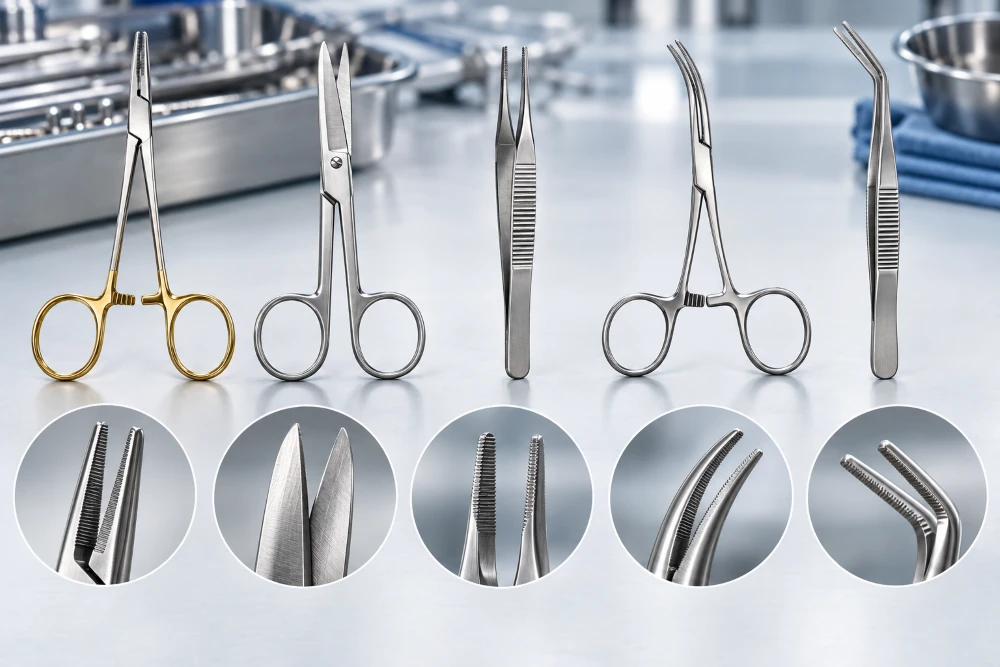
On gold and black handles. Colour on a ring handle is a specification, not decoration. Gold rings conventionally indicate tungsten carbide inserts in the jaw or blade. A black handle conventionally indicates a micro-serrated cutting edge, the pattern most catalogues sell as super-cut. One gold ring and one black handle together means both. If a quotation is unexpectedly cheap, check whether the carbide went missing from the specification.
What the count sheet is really for
A count sheet is also the document you change when you decide a tray is carrying too much. Published audits put instrument use as low as 10.7% of what gets opened, so it is worth knowing how many instruments a tray actually needs before you re-issue the sheet.
The tick boxes in the decoder are not a gimmick. Counting is the control that catches everything else, and the published data on how often it catches something is worth knowing.
In the observational study described at the top of this page, just over 26% of observed cases carried at least one instrument error. A separate work-systems study of tray assembly found 3,900 tray defects across 41,799 cases, with missing instruments accounting for 17.6% of reported assembly defects. In ophthalmic surgery, a 2022 survey of cataract surgeons put instrument-related delay at 18% of cases.
Although those three figures were produced by three different methods, they land in the same range. Something goes wrong with the instruments in roughly one case in five, and it is usually a counting or identification problem rather than a manufacturing one.
There is a further finding that should change how anyone reads their own incident data. The same research group compared what trained observers saw against what staff reported through the hospital’s own system, and found the observed rate to be 38 times higher than the reported rate, with 79.6% of staff reports left incomplete. If your own numbers look reassuring, that is the first thing to check.
Counting is only half of tray integrity. The other half is condition: an instrument that is present but blunt, stiff or pitted fails the case as surely as one that is missing. That ground is covered in our guide to instrument maintenance and in the notes on sterilization of medical instruments.
Three habits that reduce the count problem
- Count against a printed sheet, not from memory. The decoder above prints cleanly — use your browser’s print function and it will drop the tabs, the buttons and the colour, and give you the tick list.
- Write the pattern name on the sheet, not the slang. “Metz 18” is fine in theatre and useless in the store. A sheet that carries the catalogue name is a sheet that can be reordered from.
- Photograph the assembled tray once and keep the photo with the sheet. It settles arguments about what the tray is supposed to look like faster than any list.
- Keep the tray in one container from decontamination to theatre. Loose instruments moved between baskets are the ones that go astray; a fitted sterilization container keeps the contents and the count sheet together.
Buying a set rather than a list of instruments
In most facilities the naming problem surfaces while replacing a tray one instrument at a time. Ordering the set as a set avoids it, because the composition is agreed once and then repeated.
NJ Medical Instruments manufactures in Sialkot and supplies both individual practitioners and bulk buyers directly, without a distributor in between. The sets referenced in the decoder are ones we build and ship: the IV cut-down set, the hernia and hydrocoelectomy set, the 53-piece thyroidectomy set, the tracheostomy set, the caesarean section set and the rest of the medical instrument sets range.
If your tray does not match any standard composition — and after a few years of a surgeon’s preferences, most do not — send us the count sheet. Sets are built to a customer’s own list as a matter of routine, and a marked-up list is a better brief than a catalogue reference.
Individual replacements sit in the same catalogue: artery forceps and ligature clamps, scissors by pattern, needle holders, dissecting and tissue forceps, hooks and retractors and sterilization containers.
Questions we get asked about tray contents
Is there an official standard for what goes in a named surgical set?
No. There is no international specification that fixes the contents of a “minor set” or a “hernia set”. Composition is set by each facility and recorded on its own count sheet, which is why two hospitals in the same city can have materially different trays under the same name. Published set lists, including the ones on this page, are conventions rather than standards.
What is the difference between Kocher forceps and Ochsner forceps?
There is none. They are the same toothed artery forceps under a European and an American name, and many catalogues list them together as Kocher-Ochsner. If a quotation shows both as separate line items, ask before you approve it.
Why does the scalpel handle number not match the blade number?
Because the number describes the handle’s fitting, not the blade. A No. 3 handle takes the smaller blades numbered 10 to 15; a No. 4 handle takes the larger blades numbered 20 to 25. A No. 7 is a long, slim No. 3 fitting for deep work. Blade numbers and handle numbers are two separate series that happen to use the same digits.
What does a gold handle on an instrument mean?
By convention it indicates tungsten carbide inserts in the working surfaces — the jaw of a needle holder, the blade of a pair of scissors. Carbide holds an edge longer than the surrounding stainless steel. A black handle conventionally indicates a micro-serrated cutting edge. The colours are an industry convention rather than a regulated marking, so confirm the specification in writing rather than relying on the finish.
What are Spencer Wells forceps called in the United States?
The nearest American equivalent is the Rochester-Pean. They are close relatives rather than identical twins, and they differ in jaw serration and box joint by pattern. If a theatre has trained on one, ask before substituting the other.
Is a Doyen a retractor or a bowel clamp?
Both, which is exactly the problem. The Doyen bladder retractor appears in obstetric trays and the Doyen intestinal clamp appears in bowel surgery. They share a surname and nothing else. Always state which one on an order.
How many instruments should be in a major laparotomy set?
Commonly between 60 and 90 pieces, though sets from 44 pieces up to 150 are all sold as “major”. The piece count on its own is a poor guide to whether a set fits your theatre; the list of patterns and lengths is what matters. Compare like for like by contents, not by the number on the box.
Can a set be built to our own count sheet?
Yes, and it is the cleanest way to buy. Send the count sheet with pattern names, lengths and quantities, marked up if it is out of date. A manufacturer working from your own list removes the translation step where most ordering errors are introduced.
Related reading
- Surgical forceps: a complete buyer’s guide — the patterns behind the names in the tables above.
- How to choose the right surgical scissors for each procedure — why length and curve are the specification.
- Top 10 must-have surgical instrument sets for operating theatres — which sets to equip with, rather than what is inside them.
- Reusable vs disposable surgical instruments — the cost-per-use arithmetic behind reprocessing a tray.
- German steel vs Sialkot surgical instruments — what a country-of-origin stamp does and does not tell a buyer.
- Essential surgical instrument maintenance tips — keeping a tray serviceable once you own it.
- How to verify a surgical instrument supplier — what to ask before the first order.
- Surgical instruments price guide — what these sets and singles actually cost.
Sources
- Observed rates of surgical instrument errors point to visualization tasks as a critically vulnerable point in sterile processing. PMC11017563 — 236 errors across 147 cases; 88.6% visualisation-related; average delay 10.16 minutes; $6.75m–$9.42m estimated annual lost charges.
- Addressing sterile processing instrument errors with advanced technology and data insights. Infection Control Today — 26.16% of observed cases carried at least one instrument error.
- When pressure builds in decontamination. Pure Processing — 3,900 tray defects across 41,799 cases; missing instruments 17.6% of assembly defects.
- Patterns in staff-reported surgical instrument errors. Perioperative Care and Operating Room Management — observed error rates 38× staff-reported rates; 79.6% report incompletion.
- Best practices for minimising instrument-related surgical delays. Rumex — 2022 cataract surgeon survey, instrument issues in 18% of cases.
- Eponymous surgical instruments. Geeky Medics — on generic versus eponymous naming and instruments carrying several names.
- General surgical instruments, operating theatre basics. Geeky Medics — on hospital-to-hospital variation in instrument names and the closing count.
Written by Akif Javaid, owner of NJ Medical Instruments, Sialkot. The compositions and name collisions on this page come from the orders we receive and the sets we build, checked against the published sources listed above.

Written by
Akif Javaid
Akif Javaid is the owner of NJ Medical Instruments, a surgical instrument manufacturer established in Sialkot, Pakistan in 1990. The company manufactures reusable surgical, dental, ENT and orthopedic instruments and now stocks them locally through inventory hubs in Pakistan, the UK, the UAE and the USA, supplying hospitals, clinics and distributors worldwide with faster regional fulfilment. It also produces private-label and OEM instrument sets to customer specification.

5 thoughts on “Surgical Instrument Tray Lists: What’s in 12 Sets and What Each Instrument Is Really Called”