


ACDF and Cervical Cage Instrument Sets: What to Specify, and How to Verify the Supplier

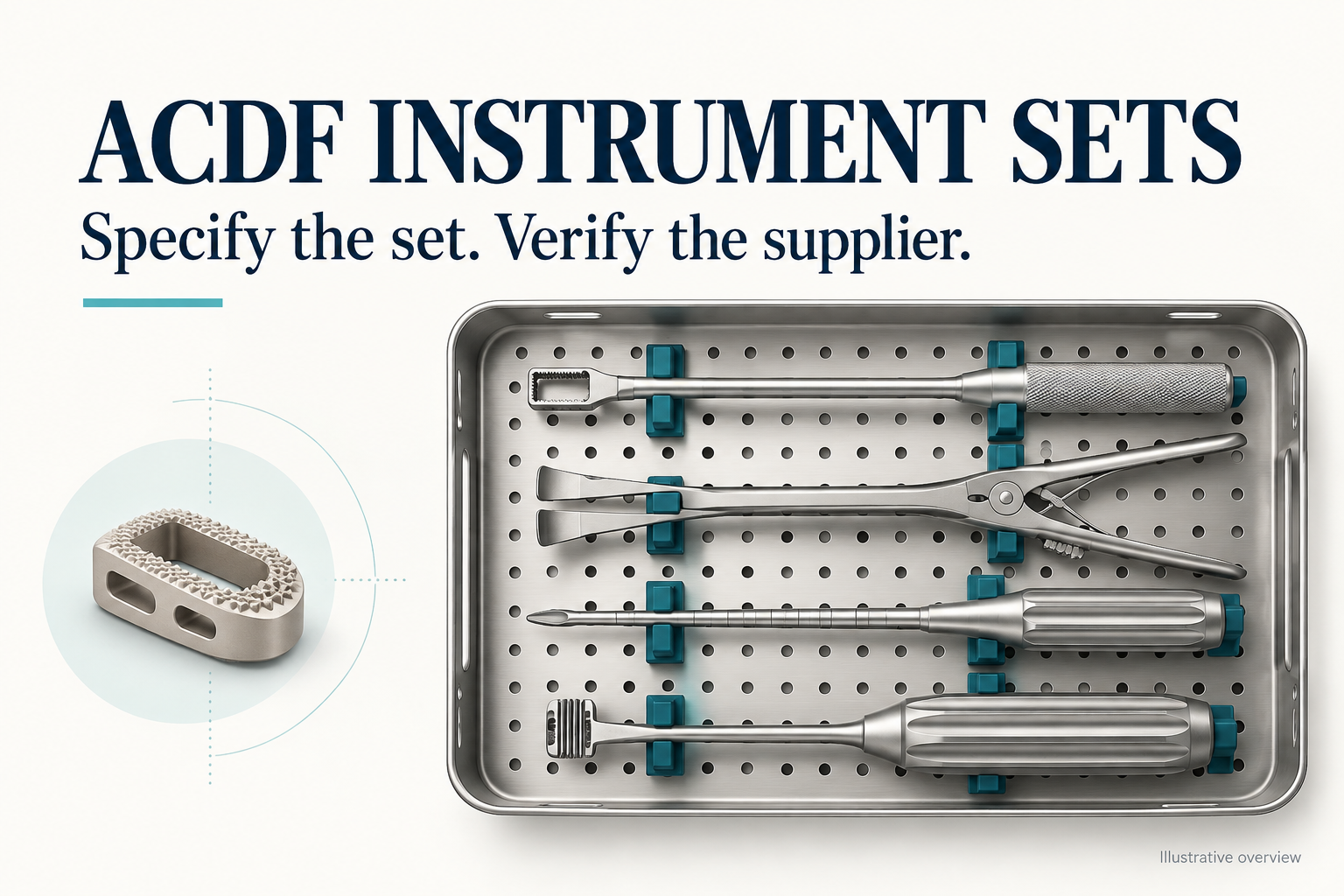
The short answer
- The cage is the implant. The instrument set is what makes it fit. Footprint, height and lordosis are all chosen intra-operatively with trial sizers, a depth gauge and a distractor, and those are instruments, not implants.
- The published subsidence research points at the instruments, not the cage material. In cyclic testing, bone density had the largest effect on subsidence, footprint size was second, and cage material had no measurable effect at all.
- An ACDF set is three layers: general soft-tissue access, a cervical retractor and distraction system, and the discectomy and site-preparation instruments. Buy them as one tray or they will not arrive matched.
- The set and the cage sit in different regulatory classes. In the US, general manual orthopaedic surgical instruments are Class I general-controls devices. A cervical intervertebral body fusion device is Class II under 21 CFR 888.3080 and needs a cleared 510(k).
- Five public databases let you verify a supplier for free before you pay a deposit: FDA Establishment Registration and Device Listing, the FDA 510(k) database, the certification body’s own ISO 13485 search, NANDO, and EUDAMED.
- FDA establishment registration is not FDA approval. Registration and listing say nothing about whether a device is cleared. Any supplier presenting a registration certificate as approval has told you something useful about the supplier.
Search “cervical cage instrument set wholesale” and you get parts lists. Page after page of quantities and product codes, 40 or 60 line items, no explanation of why any of it is on the tray or what happens if a piece is the wrong size.
That is fine if you already know what you are buying. If you are a distributor entering spine, a hospital group standardising trays across sites, or a brand putting your own name on a set, the parts list is the least useful document in the transaction. What you need is the logic: what each layer of the set does, which dimensions have to match the implant you intend it to be used with, where the regulatory line falls between the instruments and the cage, and how to check a factory’s paperwork without taking the factory’s word for it.
This guide covers all four. We manufacture these sets in Sialkot and supply them direct, so treat the commercial sections as what they are, but the technical and regulatory sections are sourced and cited and you can check every one of them.
On this page
- What an ACDF instrument set actually contains
- The sizing chain: why the instruments decide the fit
- What the subsidence research actually says
- Caspar distraction, and the 7 mm detail buyers miss
- Instrument set or implant? Two different regulatory animals
- How to verify a supplier using five public databases
- The registration-is-not-approval trap
- Specifying a set for OEM or private-label supply
- Our spine and cervical instrument sets
- Frequently asked questions
- Sources
What an ACDF instrument set actually contains
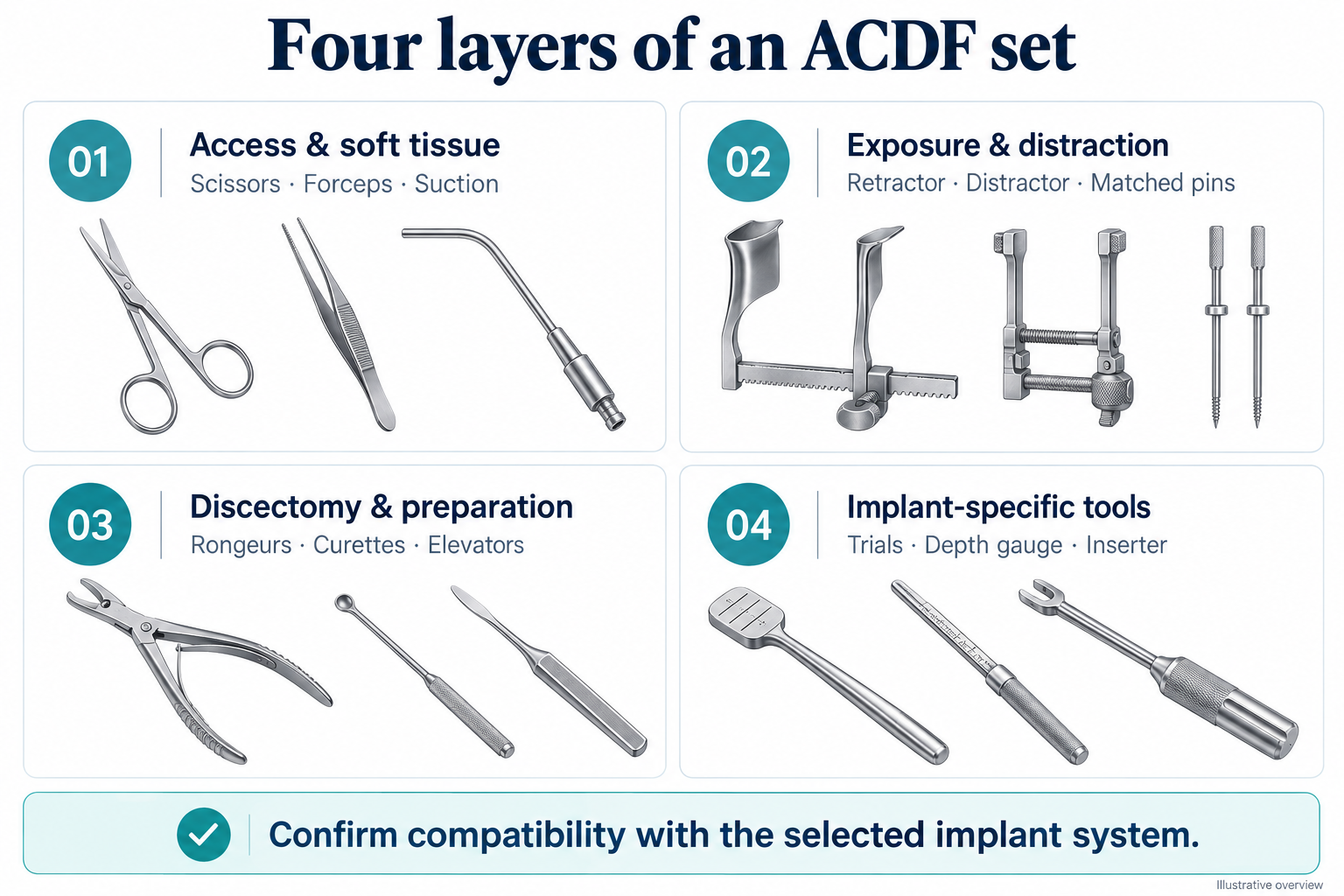
Anterior cervical discectomy and fusion has been performed since Cloward and Smith and Robinson first described it in 1958, and the instrument sequence has been stable for decades even as graft materials and implants have changed. A set is best understood as three layers stacked on one tray.
| Layer | Purpose | Typical instruments | What goes wrong if it is short |
|---|---|---|---|
| 1. Access and soft tissue | Reaching the anterior cervical spine and controlling the field | Scalpel handles long and short, Metzenbaum and Mayo scissors, toothed and non-toothed tissue forceps, mosquito and Crile forceps, Allis tissue forceps, needle holders, Langenbeck retractors, Frazier suction tubes | The surgeon substitutes from a general tray, and the tray stops being a tray |
| 2. Exposure and distraction | Holding the field open and opening the disc space under control | Self-retaining cervical retractor frame with medial and lateral blades in a range of depths, vertebral body distractor, distraction pins, pin drill and drill sleeve, screwdriver, T-handle and T-driver, cervical spreader | This is the layer that is most often mismatched. Blades, pins and distractor must come from one system |
| 3. Discectomy and site preparation | Removing disc material and preparing the endplates for the implant | Kerrison rongeurs in a range of bites and angles, pituitary and disc rongeurs, angled curettes, nerve hooks blunt and micro, Woodson and Freer elevators, Cobb spinal elevator, ball hook, foraminotomy rongeur, high-speed drill with bits and guards | Incomplete endplate preparation, which is one of the factors named in the subsidence literature |
| 4. Implant-specific | Sizing and delivering the cage or plate | Trial sizers by footprint and height, depth gauge, cage inserter or holder, impactor, mallet, plate holding and bending forceps, taps and drills to the plate system | Nothing fits. These must match the implant system, not the instrument set |
Layer four is the reason a generic “ACDF set” is a slightly misleading product name. Layers one to three are largely system-agnostic. Layer four is not, and any honest supplier will ask which implant system you are buying it to serve before quoting.
A naming note. “Cervical cage instrument set” is used in the market for two different things: a set of reusable instruments used to place a cage, and a kit that includes cages. Those are not the same purchase and they are not in the same regulatory class. Section 5 below sets out the difference, and it is worth resolving before anyone quotes you a price.
The sizing chain: why the instruments decide the fit
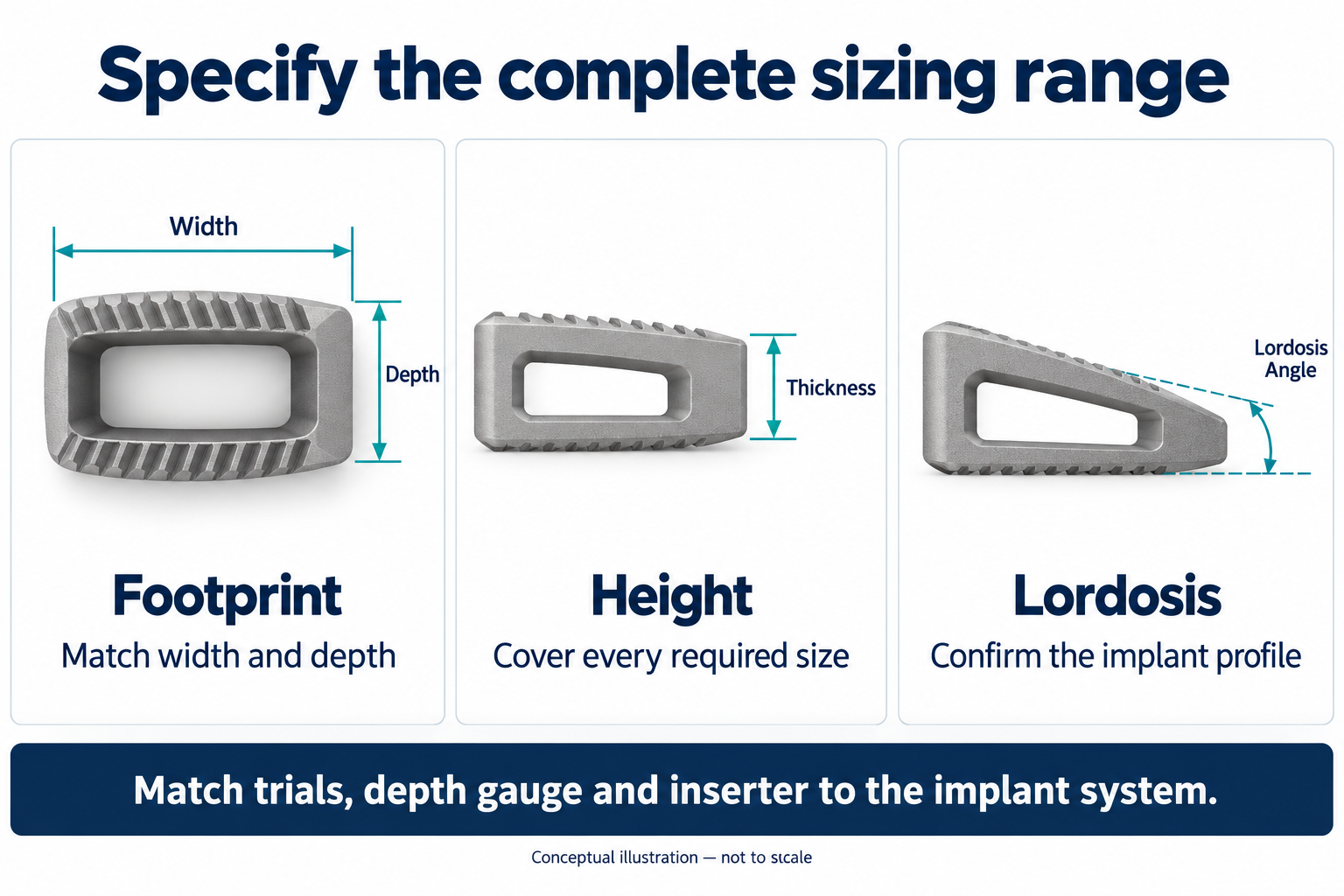
Cervical interbody implants are sold in a matrix of three dimensions, and every one of them is selected in theatre rather than ordered in advance.
| Dimension | Typical published range | How it is chosen |
|---|---|---|
| Footprint (width × depth) | Small around 11.5 × 12.5 mm, standard around 13 × 14 mm, large around 15 × 16 mm. Other systems publish 13.5 × 15.5 mm and 17.5 × 15.5 mm | Trial sizer, often colour-coded by footprint |
| Height | Commonly 5 mm to 12 mm in 1 mm increments; some systems run 4.5 mm to 10.5 mm | Trial sizer against the distracted space |
| Lordosis | Around 0° to 7° at the lower heights and 5° to 12° at the higher ones. Worked examples include implants with 6° and 7° of built-in lordosis | Implant profile choice: parallel, convex or lordotic |
| Anterior-posterior seating depth | A published technique guide targets a depth leaving about 1 mm clear of both the anterior and posterior vertebral borders | Depth gauge |
Read the right-hand column. Footprint, height, lordosis and seating depth are decided by a trial sizer, a distractor and a depth gauge. The cage is inert until those three instruments have told the surgeon which cage to open.
This has a direct purchasing consequence that gets missed constantly: a trial-sizer range that does not cover the implant range is a defective set, even though every individual instrument is perfect. If the implants come in eight heights and the trials cover five, three of the implant sizes cannot be selected safely. Match the count, not just the type.
What the subsidence research actually says
Subsidence, where the implant sinks into the adjacent vertebral bodies, causes loss of disc height, loss of lordosis and sometimes recurrent symptoms. It is the complication most often used to sell cage features. The published work is worth reading closely, because it does not support most of what is claimed.
| Study | What was tested | Result |
|---|---|---|
| Cage morphology, material and substrate density, JAAOS, 2017 | Cervical cages at 16 × 12 mm (103.2 mm² footprint) and 17 × 14 mm (125.5 mm²), three materials with elastic moduli of 296, 110 and 4 GPa, cyclically loaded between foam blocks of two densities, all cages 10 mm thick at 0° lordosis | Substrate density had the greatest influence on subsidence. Smaller footprint was second. Cage material had no effect. Measurement sensitivity was 5 µm |
| Same study, endplate texture sub-analysis | Textured versus non-textured cage endplates at 3,600 loading cycles in lower-density foam | 406 ± 91 µm versus 513 ± 2 µm. Directionally better, not statistically significant (P = 0.06) |
| Hyperlordotic versus standard lordotic spacers in ACDF | 10° hyperlordotic spacer, 16 × 15 mm footprint, against standard lordotic spacers, radiographic review | Cranial spacer subsidence 6.67% versus 28.9% (P = 0.013). For at least one spacer, 26.7% versus 42.2%, which did not reach significance (P = 0.183) |
| Duey et al., cited in the same paper | 131 patients, one to three level ACDF | Subsidence was significantly associated with loss of lordosis |
| Endplate preparation, review literature | Surgical factors in subsidence | Endplate preparation, contact area and overdistraction are named as contributing factors alongside implant choice |
Three conclusions, and they all point the same way.
Footprint beat material, and footprint is an instrument decision. Going from 103.2 mm² to 125.5 mm² of contact area, a 22% increase, mattered. Going from 4 GPa to 296 GPa of stiffness, a 74-fold increase, did not. The variable that moved the result is the one selected with a trial sizer.
Lordosis mattered, and lordosis is set by distraction and implant profile. The hyperlordotic comparison produced a statistically significant reduction in cranial subsidence. Distraction control is a distractor and a pin system.
Endplate preparation is on the named list, and it is entirely instrument-dependent. Curettes, rongeurs and elevators do that work. A set that is short on curette angles is short on the one thing the literature says the surgeon controls.
Read the non-significant results too. Textured endplates came out better but at P = 0.06, and the overall hyperlordotic subsidence difference came out at P = 0.183. Both are worth knowing and neither supports a marketing claim. If a supplier quotes you the textured-endplate number without the P value, they either have not read the paper or are counting on you not having.
Caspar distraction, and the 7 mm detail buyers miss
Vertebral body distraction using threaded pins placed into the adjacent vertebrae, commonly called Caspar distraction after the system that popularised it, is standard in anterior cervical work. A published surgical technique guide for a cervical cage with an integrated anchoring implant specifies placing the distraction pins approximately 7 mm from both endplates, specifically to avoid the pins colliding with the anchor.
That single number carries three purchasing implications.
Pin length and thread are system-specific. Protocols reference 16 mm pins. A pin that is right for one vertebral body is wrong for another, and the pin, the pilot drill and the drill sleeve are a matched trio. Buying pins loose from a different source than the distractor is how sets end up with pins that will not seat to depth.
Pin placement has to clear the implant. If the cage has integrated fixation, the pin corridor and the anchor corridor compete for the same bone. Whether the instrument set can respect a 7 mm offset is a function of the distractor geometry, not of surgeon skill.
Overdistraction is on the subsidence list. A distractor with coarse increments makes it easier to overshoot. This is a reason to care about the mechanism, not just the presence, of the distractor in a set.
Need a cervical set quoted against a specific implant system?
Tell us which cage or plate system the set has to serve and what footprint and height range the implants cover, and we will quote the trial and sizing instruments to match rather than sending a generic list. Email info@njmedicalinstruments.com or WhatsApp +92-333-8733922. Contact us here.
Instrument set or implant? Two different regulatory animals
This is the section that matters most and the one no competing page carries. In the United States the instruments and the cage are classified separately, and the gap between them is wide.
| The instrument set | The cervical cage | |
|---|---|---|
| What it is | Reusable manual instruments: retractors, rongeurs, curettes, elevators, distractors, trials | An implanted single or multiple component spinal device inserted into the intervertebral body space and intended for intervertebral body fusion |
| US classification | General manual orthopaedic surgical instruments are given as examples of Class I devices, subject to general controls | Class II with special controls under 21 CFR 888.3080 where it contains bone grafting material. Class III requiring premarket approval where it includes any therapeutic biologic such as BMP |
| Premarket route | Many Class I instruments are exempt from 510(k) | 510(k) clearance, with FDA’s Class II Special Controls Guidance Document for intervertebral body fusion devices as the special control. Not eligible for third-party review |
| Product codes | Varies by instrument type | ODP for a cervical intervertebral fusion device with bone graft. MAX for lumbar. OVD for lumbar with integrated fixation |
| Test standards you should expect to see | Material and corrosion specifications | ASTM F2077 test methods for intervertebral body fusion devices, ASTM F2267 for load-induced subsidence under static axial compression, ASTM F3292 for inspection of spinal implants undergoing testing |
| Who can supply it | A manufacturer with an appropriate quality system | Into the US, a holder of the cleared 510(k) for that device, or a party supplying under it |
What this means in practice: a Sialkot or Chinese instrument manufacturer can legitimately make, export and private-label the reusable instrument set. Supplying the cage itself into the US or the EU is a different undertaking with a different paper trail, and a quotation that treats the two as one line item should be queried rather than accepted.
It also means the phrase “cervical cage kit, CE certified” in a listing tells you almost nothing on its own. CE marking is product-level conformity, and which conformity route applies depends on what is actually in the box.
Our position, stated plainly: we manufacture and supply the reusable instrument sets. Where a buyer needs the implants as well, the implant route has to be established separately in the destination market, and we will tell you that before you place an order rather than after. If you want our current quality documentation to review, ask and we will send what we hold.
How to verify a supplier using five public databases
Every document a factory sends you is a PDF, and a PDF is a claim. All five of the checks below are free, public, and resolve the claim against the issuing authority’s own record. Do them before the deposit, not after the container ships.
| # | Check | Where it resolves | What a pass looks like |
|---|---|---|---|
| 1 | ISO 13485:2016 certificate | The issuing certification body’s own online search. Certificates are typically valid three years with annual surveillance audits | The number resolves on the issuer’s site, the expiry is in the future on the day you check, and the scope statement explicitly covers manufacture of the relevant product family. A scope covering only distribution is not a manufacturing certificate |
| 2 | FDA establishment registration and device listing | FDA’s Establishment Registration and Device Listing database, updated weekly. The legal basis is 21 CFR Part 807 Subpart C, with quality systems under 21 CFR Part 820 | The registration number resolves to the exact legal name, owner or operator, and site address you are auditing, with a current status and device listings against the correct product codes |
| 3 | 510(k) clearance, if a cleared device is claimed | FDA’s 510(k) database, searchable by applicant name or K number | The K number exists, names the applicant you are dealing with, and covers the device and indication you are being sold |
| 4 | CE marking and notified body | NANDO, the EU’s notified body database. The four-digit number beside the CE mark identifies the body | The four-digit number resolves to a real notified body whose designation covers the relevant device codes |
| 5 | EU registration | EUDAMED, which holds actor registration with an SRN, device registration and certificate information. Modules have been activating progressively, so check what is live on the date you look | The manufacturer has an actor registration, and once the relevant module is active, device and certificate records that match the paperwork |
Two extras worth adding for a spine purchase. For a US-bound device, UDI data should be findable in FDA’s GUDID through AccessGUDID. And importing a device into the US requires establishment registration of the foreign manufacturer, device listing, and a Prior Notice filing for each shipment, so a supplier who has never heard of Prior Notice has never shipped to the US.
The registration-is-not-approval trap
One sentence from the Congressional Research Service’s guide to FDA databases is worth more to a procurement team than any brochure: registration and listing do not denote approval or clearance of a firm or its devices by the FDA.
Read that again alongside what actually arrives in your inbox. FDA establishment registration is a filing. Any manufacturer that wants to ship devices into the US does it, it is largely administrative, and third-party agents sell the service. It creates a number that resolves in a public database. It certifies nothing about the device.
Yet “FDA Registered” appears on instrument listings constantly, sometimes on a certificate-styled page with a seal, positioned exactly where a buyer would expect to see clearance. The information this gives you is not about the device. It is about the supplier’s willingness to let you misunderstand something.
The same logic applies to three other common overstatements:
| What you are shown | What it actually establishes | What it does not establish |
|---|---|---|
| “FDA Registered” certificate | The site filed an establishment registration | Anything at all about clearance, approval, or the device’s safety and performance |
| “FDA Approved” | Nothing. For a Class II device the correct term is cleared, via 510(k). “Approved” refers to premarket approval of Class III devices | A supplier using “FDA approved” for an instrument set or a Class II cage is describing something that does not exist |
| ISO 13485 certificate with a distribution-only scope | A quality system covering distribution | That the factory you are auditing manufactures under that system |
| A CE mark with no notified body number | For most self-certifiable classes, a self-declaration | Independent assessment. For higher-risk classes a notified body number must be present |
None of this requires you to be a regulatory specialist. It requires you to type a number into a search box on a government website, which takes about ninety seconds per document.
Specifying a set for OEM or private-label supply
If you are buying a stock set for one theatre, a parts list is enough. If you are a distributor, a hospital group or a brand, you are specifying a product, and the fields below are what a manufacturer needs in order to quote something you can actually reorder identically in two years.
| Field | What to state | Example |
|---|---|---|
| Procedure and approach | The operation the set serves | Single and two-level ACDF, anterior approach |
| Implant system served | Make and model, or the dimension matrix if the system is yours | Footprints 13 × 14 and 15 × 16 mm, heights 5 to 11 mm in 1 mm steps, lordosis 0° and 7° |
| Trial and sizing coverage | One trial per implant size, stated as a count | 14 trials, colour-coded by footprint |
| Retractor system | Frame type, blade depths and widths, quantity per size | Frame plus medial and lateral blades at 30, 40 and 50 mm, two of each |
| Distraction | Distractor type, pin length and thread, pilot drill and sleeve | Double-joint distractor, 16 mm pins, matched pilot drill and sleeve |
| Rongeurs | Type, jaw bite in mm, angle, shaft length | Kerrison 2, 3 and 4 mm, 40° up, 8 in shaft |
| Curettes | Angles and sizes | Angled curettes 2-0 and 3-0 |
| Materials | Stainless grade or specification, and any titanium components | Surgical-grade stainless steel |
| Finish | Satin or mirror, and any coating | Satin |
| Marking | Text, position, method, and whether each piece is individually identified | Laser mark, brand plus item code, on shaft |
| Tray and layout | Case material, insert type, whether positions are labelled, count plate | Perforated case, silicone mat inserts, labelled positions, count plate on lid |
| Documentation required | Which certificates and records must ship with the order | Material certificates, ISO 13485 certificate, instructions for use |
| Quantity and schedule | First order and expected repeat interval | 25 sets, then quarterly |
Two fields do most of the work. Implant system served decides whether layer four of the set is usable at all. Tray and layout decides whether the set survives contact with a sterile processing department: labelled positions and a count plate are what make a missing instrument visible at the end of a case rather than at the start of the next one. Our note on tray optimisation covers that in more detail, and instrument traceability covers individual marking.
Our spine and cervical instrument sets
Complete sets, supplied direct from the factory:
- Cervical Cage Surgical Set
- Spinal Retractor Instrument Set, anterior cervical retractor kit
- Anterior Cervical Plate Instrument Set
- Posterior Cervical Fixation System Set
- Cervical Micro Discectomy Curette Set
- Major Spinal Surgical Instrument Set
Individual instruments from the same range:
- Cloward Cervical Spreader and the Caspar Toothed Disc Rongeur
- Thin Footplate Kerrison Laminectomy Punch, and the wider bone cutters and rongeurs range including bone rongeurs
- Cobb Spinal Elevator for endplate and soft-tissue work
- Cervical Mallet, 19 cm, 215 g
- McIndoe Chisel, mushroom head, plus the full osteotomes and chisels ranges
- Everything else in surgical instruments
Related reading: tray lists on building a set from scratch, reusable versus disposable on the cost case, and stains and corrosion on what shortens the life of a set after it arrives. About NJ Medical Instruments.
Wholesale, OEM and private-label supply
NJ Medical Instruments has manufactured surgical, dental and ENT instruments in Sialkot since 1990 and supplies direct with no middlemen. Send a parts list, a drawing, a sample set or the specification table above to info@njmedicalinstruments.com, or WhatsApp +92-333-8733922. Ask for our current quality documentation and we will send what we hold so you can run the five checks in this guide against it.
Frequently asked questions
What is in an ACDF instrument set?
Four layers. Soft-tissue access instruments such as scalpel handles, Metzenbaum and Mayo scissors, tissue forceps, mosquito and Crile forceps, needle holders and Frazier suction. Exposure and distraction: a self-retaining cervical retractor frame with medial and lateral blades, a vertebral body distractor, distraction pins, pilot drill and sleeve, screwdriver and T-handle. Discectomy and site preparation: Kerrison rongeurs, pituitary and disc rongeurs, angled curettes, nerve hooks, Woodson and Freer elevators, a Cobb elevator and a high-speed drill. And implant-specific instruments: trial sizers, a depth gauge, an inserter, an impactor and a mallet.
What is the difference between a cervical cage instrument set and a cervical cage kit?
An instrument set is reusable manual instruments used to place an implant. A kit, as the word is often used, includes the implants themselves. They are different purchases in different regulatory classes, so it is worth establishing which one a quotation covers before comparing prices.
Is a cervical cage a Class II or Class III device in the US?
Under 21 CFR 888.3080, an intervertebral body fusion device containing bone grafting material is Class II with special controls, and the special control is FDA’s Class II Special Controls Guidance Document for intervertebral body fusion devices. A device that includes any therapeutic biologic, such as bone morphogenetic protein, is Class III and requires premarket approval. The product code for a cervical intervertebral fusion device with bone graft is ODP.
What class are surgical instruments in the US?
General manual orthopaedic surgical instruments are given by FDA as examples of Class I devices, subject to general controls, and many Class I instruments are exempt from 510(k). That is a different pathway from the implant they are used to place, which is the single most useful distinction for a spine procurement buyer to understand.
Does FDA registration mean a device is FDA approved?
No. Registration and listing do not denote approval or clearance of a firm or its devices by FDA. Establishment registration is an administrative filing required of anyone shipping devices into the US and says nothing about the device. For a Class II device the correct term is cleared, through a 510(k). Approved refers to premarket approval of Class III devices, so “FDA approved” applied to an instrument set or a Class II cage describes something that does not exist.
How do I verify that a surgical instrument supplier meets US safety standards?
Resolve each document against the issuing authority rather than reading the PDF. Check the ISO 13485:2016 certificate number on the issuing certification body’s own search tool, and confirm the scope covers manufacture rather than only distribution. Check the FDA establishment registration number in FDA’s Establishment Registration and Device Listing database and confirm it matches the exact legal name and site address you are auditing. Check any claimed 510(k) by K number or applicant name in the FDA 510(k) database. For the EU, check the four-digit notified body number in NANDO and look for the manufacturer’s actor registration in EUDAMED. All five are free and public.
What quality certifications should I look for when buying surgical instruments?
ISO 13485:2016 with a scope that explicitly covers manufacture of the relevant product family, current on the date you check rather than the date on the PDF. Certificates typically run three years with annual surveillance audits. Beyond that, what you need depends on destination: CE marking with a notified body number where the class requires one for the EU, and establishment registration plus device listing, and 510(k) clearance where the device requires it, for the US.
Does cage material affect subsidence?
In one cyclic loading study of cervical cages, three materials spanning elastic moduli of 296, 110 and 4 GPa showed no effect on subsidence. Substrate bone density had the greatest influence and smaller cage footprint was second. Textured endplates performed directionally better than non-textured at 3,600 cycles, 406 ± 91 µm against 513 ± 2 µm, but the difference did not reach statistical significance at P = 0.06.
What cervical cage sizes are available?
Footprints are commonly grouped as small around 11.5 × 12.5 mm, standard around 13 × 14 mm and large around 15 × 16 mm, though published systems also use 13.5 × 15.5 mm and 17.5 × 15.5 mm. Heights commonly run 5 mm to 12 mm in 1 mm increments, with some systems from 4.5 mm to 10.5 mm. Lordosis is roughly 0° to 7° at lower heights and 5° to 12° at higher ones, and sagittal profiles are described as parallel, convex or lordotic.
How far from the endplates should Caspar distraction pins be placed?
A published surgical technique guide for a cervical cage with an integrated anchoring implant specifies approximately 7 mm from both endplates, to avoid contact between the distraction pins and the anchor. The relevant point for a buyer is that the pin, the pilot drill and the drill sleeve are a matched set, and pins sourced separately from the distractor often will not seat correctly.
Which ASTM standards apply to intervertebral body fusion devices?
ASTM F2077 covers test methods for intervertebral body fusion devices, ASTM F2267 covers measuring load-induced subsidence under static axial compression, and ASTM F3292 covers the inspection of spinal implants undergoing testing. These are recognised against the intervertebral body fusion device product codes and are reasonable things to ask a supplier about if implants are in scope.
Can a Pakistani or Chinese factory legally supply ACDF instrument sets?
The reusable instrument set and the implant are different questions. Manufacturing and exporting the instruments is ordinary international trade, subject to the destination market’s requirements for that device class and to the manufacturer holding an appropriate quality system. Supplying the cage into a regulated market is a separate undertaking with its own clearance and registration requirements, and should be established in the destination market before an order is placed rather than assumed.
Can you make an ACDF set to our own brand and pattern?
Yes. Send a parts list, a drawing or a sample set, along with the implant dimension matrix the set has to serve, the trial count, blade sizes, rongeur bites and angles, materials, finish, marking and tray layout. Quantity and expected reorder interval help with pricing. Email info@njmedicalinstruments.com or WhatsApp +92-333-8733922.
Sources
- 21 CFR 888.3080, Intervertebral body fusion device. Electronic Code of Federal Regulations, Title 21, Part 888, Subpart D.
- FDA. Class II Special Controls Guidance Document: Intervertebral Body Fusion Device — Guidance for Industry and FDA Staff.
- FDA Product Classification records for product codes ODP, MAX and OVD, including recognised consensus standards ASTM F2077, ASTM F2267 and ASTM F3292.
- FDA. Orthopaedic and Rehabilitation Devices Panel background material on device classification, including Class I and Class II examples.
- FDA. Search Registration and Listing, Establishment Registration and Device Listing database.
- Congressional Research Service, R48133. Finding Medical Device and Drug Approval Information Through the Food and Drug Administration Databases.
- 21 CFR Part 807 Subpart C, establishment registration and device listing; 21 CFR Part 820, quality system regulation.
- The Effect of Cervical Interbody Cage Morphology, Material Composition, and Substrate Density on Cage Subsidence. Journal of the American Academy of Orthopaedic Surgeons, 2017.
- Radiographic outcomes and subsidence rate in hyperlordotic versus standard lordotic interbody spacers in patients undergoing anterior cervical discectomy and fusion. PMC11888038.
- AO Foundation, anterior cervical interbody spacer — published footprint and height ranges.
- ROI-C Cervical Cage Surgical Technique Guide — distraction pin placement and seating depth.
- Anterior Cervical Discectomy and Fusion in the Ovine Model. PMC3164061 — published instrument list.
- AORN. Anterior Cervical Discectomy and Fusion (ACDF) — supplies and equipment.
- European Commission NANDO notified body database; EUDAMED actor, device and certificate modules.
This guide is written for procurement and distribution audiences. It is not clinical guidance and not regulatory advice. Classification and market requirements change, and they depend on the specific device and destination market, so verify current requirements with the relevant authority or a qualified regulatory consultant before importing or placing a device on the market.

Written by
Akif Javaid
Akif Javaid is the owner of NJ Medical Instruments, a surgical instrument manufacturer established in Sialkot, Pakistan in 1990. The company manufactures reusable surgical, dental, ENT and orthopedic instruments and now stocks them locally through inventory hubs in Pakistan, the UK, the UAE and the USA, supplying hospitals, clinics and distributors worldwide with faster regional fulfilment. It also produces private-label and OEM instrument sets to customer specification.
