


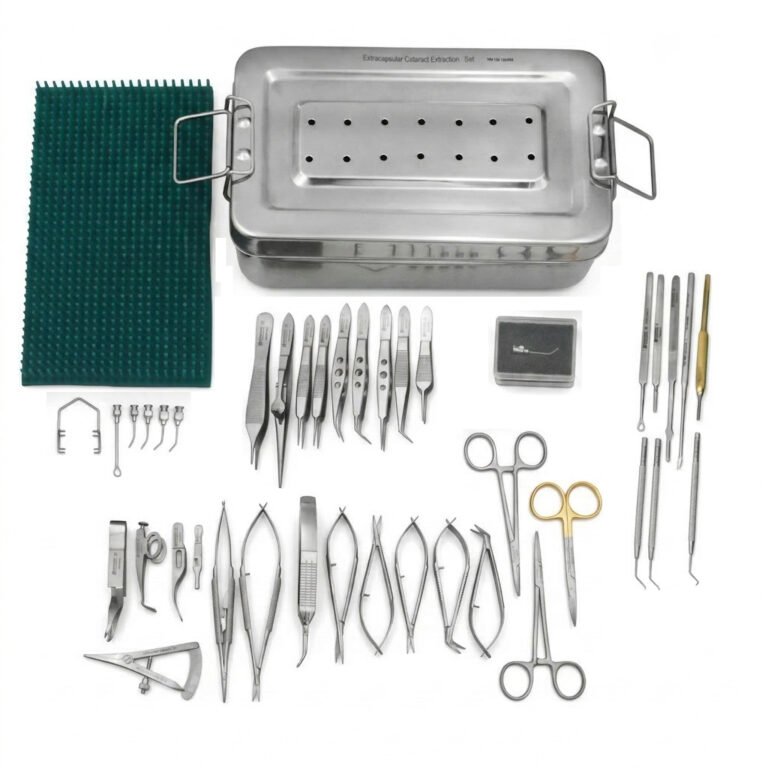
ExtraCapsular Cataract Extraction Set (ECCE) | NJ Medical Instruments
In stock
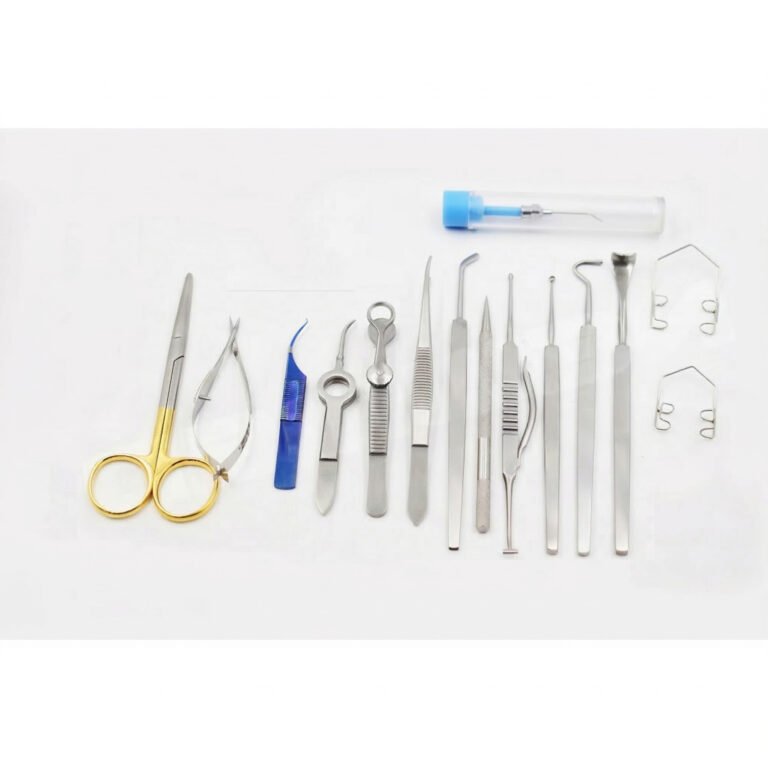
OFFICE SET (OPTOMETRIST) Standard Set Augenarztpraxis | NJ Medical Instruments
In stock
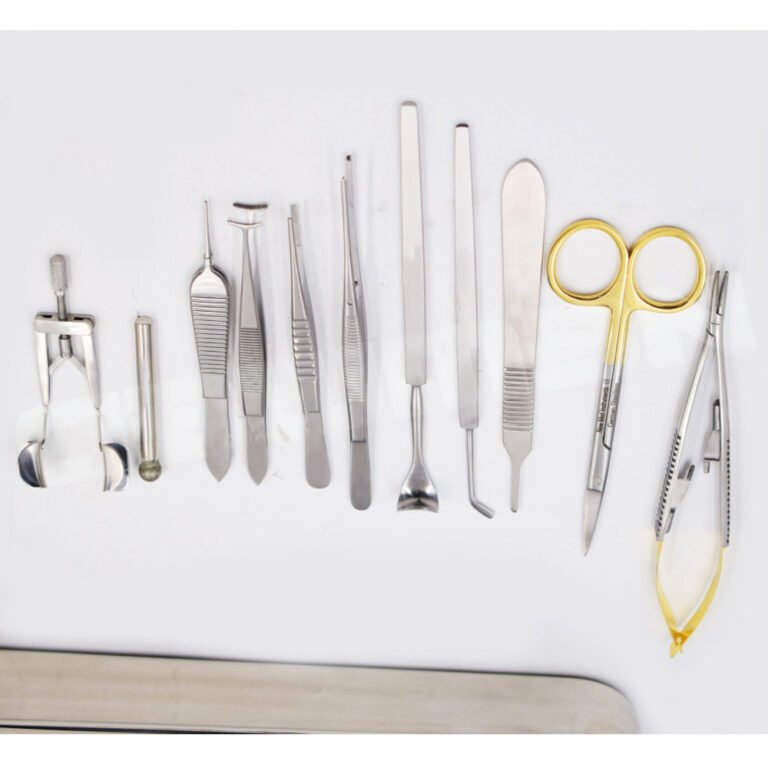
Pterygium Set | NJ Medical Instruments
In stock
Ophthalmic Surgery Sets: Instruments Scaled to the Eye
Ophthalmic surgery operates at a scale where the instruments themselves become the limiting factor. Corneal tissue is around half a millimetre thick, sutures used to close it are finer than a human hair, and the whole procedure is performed under a microscope where a tremor invisible to the naked eye is a large movement on screen. Standard surgical instruments are not merely inconvenient at that scale — they are unusable. So an ophthalmic set is built from instruments with spring handles rather than ring handles, tips measured in tenths of a millimetre, and a deliberate mass and balance that damps rather than amplifies hand movement. NJ Medical Instruments assembles ophthalmic sets in surgical-grade stainless steel, to standard configurations or to your own instrument list, supplied worldwide direct from the factory with OEM and private-label options.
Why spring handles replace ring handles
A ring-handled instrument is opened and closed by moving the fingers through a wide arc — fine for a haemostat, far too coarse when the working tips must travel a fraction of a millimetre. A spring handle is held like a pencil and squeezed, so the tips respond to pressure rather than to finger travel, and they open again on their own when pressure is released. That is why Castroviejo needle holders, Westcott scissors, and ophthalmic forceps all share the same handle form despite doing different jobs.
Holding the eye open and still
Two problems have to be solved before any surgery begins. A lid speculum holds the eyelids apart for the duration — the blink reflex is involuntary and cannot be relied upon to stay suppressed. Fixation forceps stabilise the globe itself, which otherwise rotates away from instruments as they are applied. Neither is optional, and both are on the tray before anything else.
Handling tissue that cannot be gripped conventionally
Corneal and conjunctival tissue cannot tolerate a crushing grip, so ophthalmic forceps use very fine teeth, often a single 0.12 mm tooth, which engages the tissue at one point rather than compressing it across a surface. Utrata and capsulorhexis forceps are shaped specifically to grasp and tear the lens capsule in a controlled circular path.
What an ophthalmic set contains
| Instrument | Character | Purpose |
|---|---|---|
| Lid speculum | Self-retaining wire or blade | Holding the eyelids apart |
| Fixation forceps | Fine toothed | Stabilising the globe |
| 0.12 mm toothed forceps | Single fine tooth | Holding cornea without crushing |
| Westcott scissors | Spring handle, fine blades | Conjunctival and corneal cutting |
| Castroviejo needle holder | Spring handle, locking catch | Very fine suture |
| Capsulorhexis forceps | Shaped fine tips | Controlled capsule tear |
| Muscle hook | Blunt curved tip | Engaging extraocular muscle |
| Chalazion clamp | Plate and ring | Isolating and stabilising a lesion |
Explore related instruments and sets
- Tenotomy Scissors and Eye Scissors
- Needle Holders including Castroviejo patterns
- Blepharoplasty Sets for eyelid surgery
- All Medical Instrument Sets
All instruments are manufactured in surgical-grade stainless steel to international standards, reusable and autoclavable, with worldwide shipping.
Custom, bulk & OEM set assembly
As a direct manufacturer, NJ Medical Instruments assembles ophthalmic sets to your own instrument list — your choice of forceps tooth sizes, scissor patterns, speculum type, and case — and supplies them in bulk to hospitals, eye units, and distributors. OEM and private-label sets with custom laser marking are available. Send us your list by email at info@njmedicalinstruments.com or by WhatsApp and we will quote the complete set — no minimum-order barriers, no middlemen.
Frequently asked questions
What instruments are in an ophthalmic surgery set?
An ophthalmic set contains a lid speculum, fixation forceps, very fine toothed forceps such as 0.12 mm patterns, Westcott scissors, a Castroviejo needle holder, capsulorhexis forceps, a muscle hook, and a chalazion clamp — all scaled to tissue measured in fractions of a millimetre.
Why do ophthalmic instruments have spring handles?
A ring handle opens and closes through a wide finger arc, which is far too coarse when the tips must move a fraction of a millimetre. A spring handle is held like a pencil and squeezed, so the tips respond to pressure rather than finger travel.
What is a lid speculum for?
It holds the eyelids apart for the duration of the procedure. The blink reflex is involuntary and cannot be relied on to stay suppressed, so the lids are held mechanically.
What are 0.12 mm forceps used for?
They have a single very fine tooth that engages corneal or conjunctival tissue at one point rather than compressing it across a surface, which is how tissue that cannot tolerate a crushing grip is held securely.
Why are fixation forceps needed?
The globe rotates away from instruments as they are applied. Fixation forceps stabilise it so the surgeon works on a still target rather than a moving one.
Can you build a custom ophthalmic set?
Yes. We assemble sets to your own instrument list, with your choice of forceps tooth sizes, scissor patterns, speculum type, and case, including OEM and private-label sets with custom laser marking.