


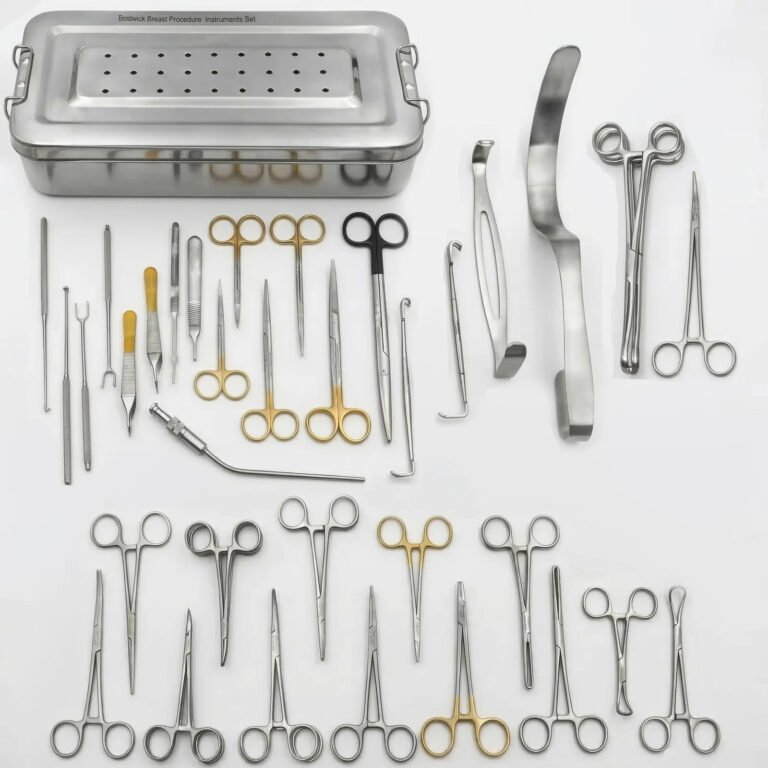
Bostwick Breast Procedure Set | NJ Medical Instruments
In stock
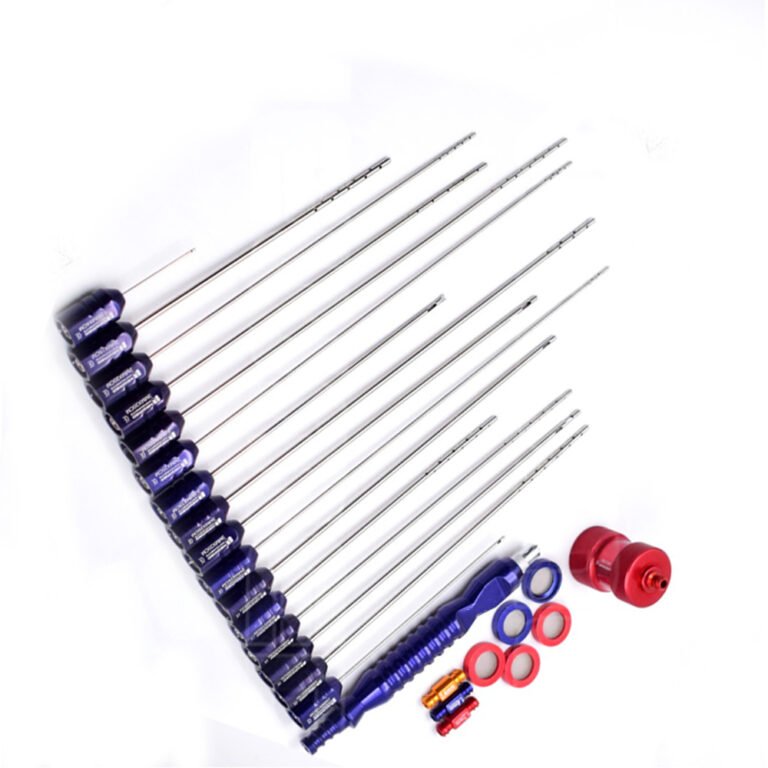
Breast Liposuction Cannula Set – Fat Injection & Harvesting Set for Breast | NJ Medical Instruments
In stock
Breast Surgery Sets: Instruments Built Around Symmetry
Breast surgery is judged by comparison — one side against the other — and that single fact shapes the instrument set more than any technical consideration. In most operations the result is assessed on its own terms. Here the patient and surgeon both evaluate the outcome by looking at two sides together, so a few millimetres of difference in areola diameter or nipple position is visible in a way the same discrepancy would never be elsewhere on the body. That is why a breast set contains measuring and marking instruments alongside the cutting ones, and why they are used before the first incision rather than as an afterthought. NJ Medical Instruments assembles breast surgery sets in surgical-grade stainless steel, to standard configurations or to your own instrument list, supplied worldwide direct from the factory with OEM and private-label options.
Planning instruments do the decisive work
Areola markers stamp a precise circular outline, and using the same marker on both sides is what makes the two areolae match — freehand marking cannot achieve that reliably. Fixed-diameter, adjustable, and set-of-four options let the surgeon select the size suited to the patient.
Calipers measure nipple position, sternal notch distances, and implant projection with accuracy a ruler cannot match on a curved surface. Flexible rulers measure along the contour rather than across it.
Marking is done with the patient upright, since breast position changes when supine — a plan drawn on a lying patient does not describe the standing result.
Access and dissection
The working space in augmentation and reconstruction is a pocket several centimetres deep reached through a small incision, so the set needs long-handled instruments and lighted retractors. A fibre-optic or lighted retractor matters here for the same reason as in facelift surgery: the surgeon is working inside a cavity that ambient theatre light does not reach, and haemostasis in a pocket depends on seeing the bleeding point.
What a breast surgery set contains
| Stage | Instrument | Purpose |
|---|---|---|
| Planning | Areola markers, fixed and adjustable | Matching areola diameter both sides |
| Planning | Calipers and flexible rulers | Nipple position and projection |
| Incision | Scalpel handles | Inframammary or periareolar access |
| Exposure | Lighted / fibre-optic retractors | Seeing inside the pocket |
| Dissection | Long dissecting scissors | Developing the implant pocket |
| Haemostasis | Long artery forceps, bipolar | Bleeding control at depth |
| Handling | Atraumatic tissue forceps | Handling flaps without crushing |
| Closure | Needle holders, fine and standard | Layered closure |
Explore related instruments and sets
- Measuring & Marking Instruments including areola markers
- Hooks & Retractors and Plastic Surgery Scissors
- Thumb Forceps and Needle Holders
- All Medical Instrument Sets and Plastic Surgery Sets
All instruments are manufactured in surgical-grade stainless steel to international standards, reusable and autoclavable, with worldwide shipping.
Custom, bulk & OEM set assembly
As a direct manufacturer, NJ Medical Instruments assembles breast surgery sets to your own instrument list — your choice of marker diameters, retractor patterns, instrument lengths, and case — and supplies them in bulk to hospitals, aesthetic and reconstructive units, and distributors. OEM and private-label sets with custom laser marking are available. Send us your list by email at info@njmedicalinstruments.com or by WhatsApp and we will quote the complete set — no minimum-order barriers, no middlemen.
Frequently asked questions
What instruments are in a breast surgery set?
A breast set contains areola markers, calipers and flexible rulers for planning, scalpel handles, lighted retractors for pocket exposure, long dissecting scissors, long artery forceps and bipolar forceps for haemostasis at depth, atraumatic tissue forceps, and needle holders for layered closure.
Why are areola markers important?
Because the result is judged by comparing one side with the other. Marking both areolae with the same instrument produces a matching diameter, which freehand marking cannot achieve reliably.
Why is marking done with the patient upright?
Breast position changes when the patient lies down, so a plan drawn on a supine patient does not describe the standing result. Marking upright captures the anatomy as it will be seen.
Why do breast sets include lighted retractors?
The implant pocket is several centimetres deep and reached through a small incision, so ambient theatre light does not reach the working area. A lighted retractor puts illumination where the dissection and haemostasis are happening.
Why are the instruments longer than in a general set?
The surgeon works at the far end of a pocket from a small access incision. Standard-length instruments place the handle and hand where they obstruct the very view being used.
Can you build a custom breast surgery set?
Yes. We assemble sets to your own instrument list, with your choice of marker diameters, retractor patterns, instrument lengths, and case, including OEM and private-label sets with custom laser marking.