


Rhinoplasty Osteotomes: Blade Widths, Guards and Buying Guide

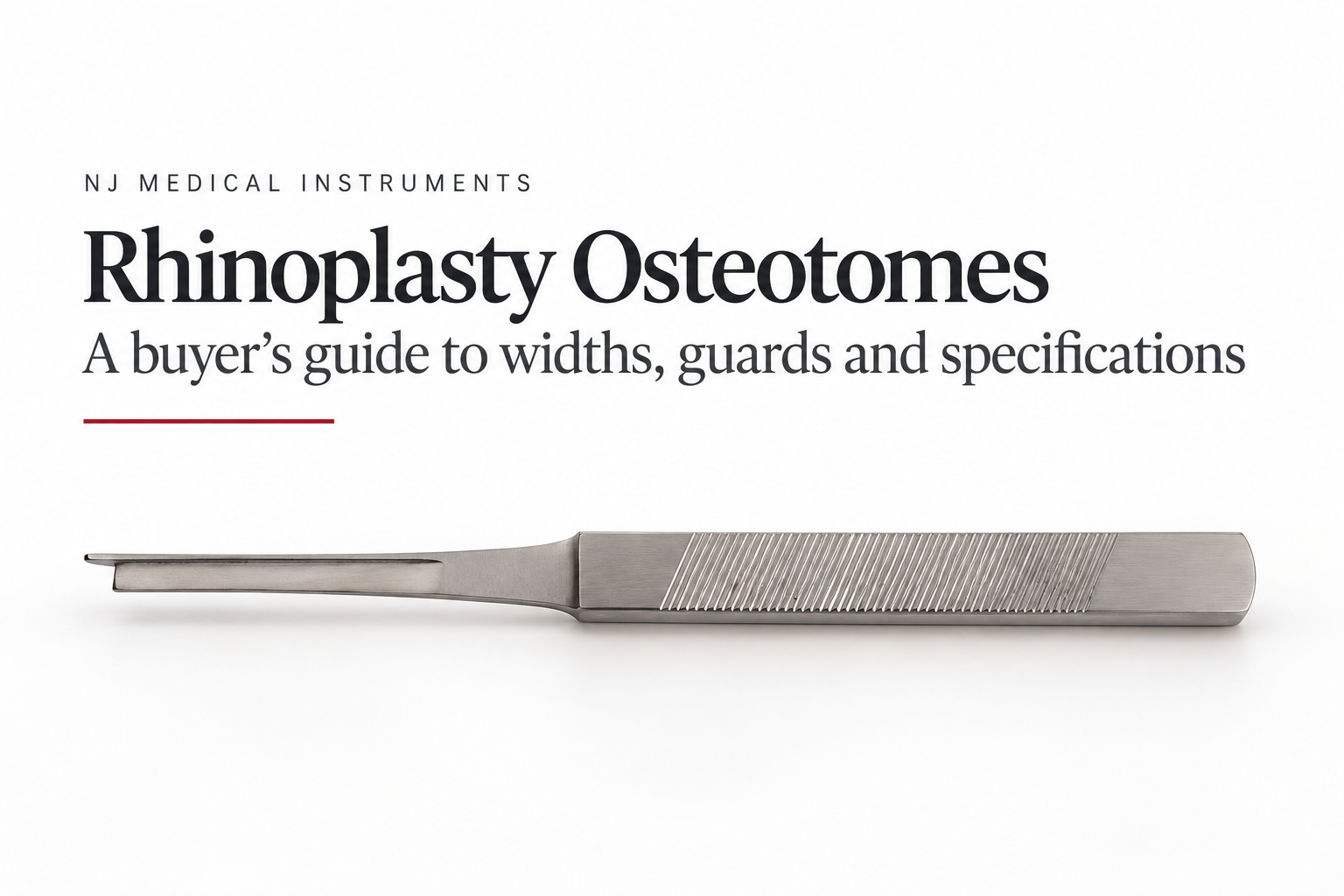
For hospital buyers, distributors and OEM teams · Evidence checked 20 October 2026
Choosing rhinoplasty osteotomes starts with the operating surgeon’s specification: blade width, tip geometry, guard configuration and overall length. Pattern names such as Parkes or Cinelli help identify an instrument, but they do not replace those details.
This guide explains what the published comparisons can tell a buyer, where their limits lie, and what to include in a quotation request. It is a procurement resource, not surgical training or patient-specific advice.
The short answer
- Specify width and pattern together. A width alone does not identify the correct instrument.
- Compare studies carefully. Technique, access and instrument design can change together, so an outcome difference cannot automatically be attributed to blade width.
- Use the surgeon-approved list. There is no universal width or set configuration for every rhinoplasty case.
- Confirm the delivered specification. Ask for dimensions, tip photographs, quantities, reprocessing instructions and destination-specific documentation before ordering.
Already have a list? Go straight to the quotation checklist or view relevant instruments.
The osteotomy names buyers encounter
A request may refer to medial, lateral, transverse or intermediate osteotomies. These describe the location or purpose of the planned bone work, rather than a complete purchasing specification. Not every procedure includes every type.
| Term on the request | What the buyer should clarify |
|---|---|
| Medial | The requested pattern, blade geometry, width and length. |
| Lateral | Whether the surgeon requires a continuous or perforating technique, and the exact guard and blade configuration. |
| Transverse | Whether a named osteotome, manual saw or powered-system accessory is specified. |
| Intermediate | The surgeon’s preferred instrument and dimensions for this additional bone work. |
Use these questions to complete the order, not to select the surgical technique on the clinician’s behalf. If a pattern name is unfamiliar, obtain a catalogue reference or a clear tip photograph before comparing suppliers.
Blade width: what the evidence actually shows
Blade width matters, but the original studies answer different questions. Keeping their results separate makes this a more useful purchasing discussion.
Narrowing results: a 60-patient photographic comparison
Zoumalan and colleagues compared 40 patients treated with intranasal microperforating osteotomies and 20 treated with continuous lateral osteotomies. They found no statistically significant difference between techniques in the amount of nasal bone narrowing. This retrospective comparison evaluated techniques, not blade width in isolation. It does not establish that every width or design will give equivalent results. [1]
Mucosal injury: a separate cadaver study
The often-quoted 11% versus 74% mucosal-tearing figures came from a different anatomical study involving 19 cadaver heads. Rohrich and colleagues’ follow-up states that both groups used 2 mm osteotomes, comparing external perforating with internal continuous osteotomy. These are not complication rates from the 60-patient study and cannot be presented as the effect of changing a blade from 2 mm to 4 mm. [2]
What to put on the order
Write the required width in millimetres alongside the pattern, guard, geometry and quantity. Avoid treating a catalogue’s “micro” label as a precise measurement. For repeat orders, include the previous approved product reference and confirm that its specification has not changed.
| Specification | Buyer action |
|---|---|
| Narrow or micro pattern | Replace the descriptive label with the exact width requested by the surgeon. |
| Multiple widths | List each width and its quantity separately; do not assume every pattern comes in the same sizes. |
| Replacement instrument | Provide the existing code, length and clear photographs of the blade and handle. |
| Unclear or conflicting listing | Request written confirmation of the supplied dimension before placing the order. |
Nasal bone thickness varies by site
Lee and colleagues measured CT scans from 100 patients in a Korean study. Their mean measurements differed between lateral, medial and intermediate tracks. The intermediate values were lower in that sample. [3]
| Measured track | Low level | Middle level | High level |
|---|---|---|---|
| Lateral | 2.61 ± 0.66 mm | 2.75 ± 0.76 mm | 2.72 ± 0.53 mm |
| Medial | 2.54 ± 0.31 mm | Not reported | 2.77 ± 0.30 mm |
| Intermediate | 1.26 ± 0.34 mm | Not reported | 1.31 ± 0.32 mm |
These are study averages, not measurements of an individual patient or a universal blade-sizing rule. Bone thickness and blade width are different dimensions. A buyer should not infer a required blade width directly from this table.
Guarded and unguarded osteotomes: specify the design
A guard changes the working-end profile. Its position and shape should be agreed with the operating surgeon, along with blade width, curvature and overall length. “Guarded” alone is too broad a specification for matching two catalogue items.
Becker and colleagues evaluated narrower, low-profile guarded designs in their clinical and radiographic work. This is a reason to inspect the actual design, rather than assume that every guarded instrument behaves the same way. [4]
- Single-guarded: confirm guard orientation and whether separate left and right patterns are required.
- Double-guarded: request an end-on photograph or drawing showing the blade and guards.
- Unguarded: confirm the tip profile and edge configuration specified by the surgeon.
A guard does not justify a blanket claim of “no tissue trauma”, and an unguarded blade is not automatically the best choice. The approved instrument, technique and clinical judgement belong together.

Osteotome, manual saw or piezo?
These are different instrument systems, and comparisons should be tied to a defined outcome and follow-up period.
A 2025 randomised trial by Eid and colleagues included 60 patients in three groups. Piezoelectric osteotomy showed better early morbidity measures, including day-one swelling and bruising. Patient-reported functional and aesthetic scores did not differ significantly between groups at six months. [5]
The study was small, with 20 patients per group and limited follow-up. Its abstract and main text also differ in how they describe some day-seven findings. It should not be reduced to a guaranteed “two-week advantage” or a promise of identical long-term outcomes.
For procurement, compare the clinician-approved setup as a whole: instruments or compatible tips, equipment availability, reprocessing requirements, training, replacement parts and total quotation. A reported clinical benefit does not by itself establish which system a particular service should buy.
Preservation rhinoplasty: name the saw and curvature
If the approved list includes preservation instruments, identify each item separately. A request for “nasal saws” leaves room for a mismatch between different shapes and patterns.
Our catalogue lists a concave radix nasal saw and a convex transverse nasal saw as distinct products. Use their full names and product references when requesting a quote. Confirm the chosen curvature and dimensions against the surgeon’s specification.
For a complete set, request an itemised contents list. A set name or headline piece count does not confirm that every required saw, elevator, rasp or osteotome is included.

What to include in a rhinoplasty instrument quotation
A useful quotation lets you compare the same specification across suppliers. Send an approved item list where possible, then ask the supplier to identify any substitution or unconfirmed detail.
| Field | What to include |
|---|---|
| Pattern and product reference | Full instrument name, catalogue code or product link; tip photographs if matching an existing item. |
| Blade width and quantity | Exact width in mm and quantity for every line item. |
| Working-end design | Straight or curved; edge configuration; unguarded, single-guarded or double-guarded; left/right orientation if applicable. |
| Overall length and handle | Required length, handle design and any agreed material or finish. |
| Set contents and tray | Itemised instrument list, quantities, case requirements and proposed layout. |
| Material and documentation | Documented material specification, intended-use information and applicable product documentation for your destination. |
| Reprocessing | Manufacturer’s cleaning, inspection, sterilisation and maintenance instructions. |
| OEM or private label | Proposed marking text, location, packaging and drawings or sample requirements, subject to feasibility confirmation. |
| Commercial details | Order quantity, delivery country/postcode and required date; request lead time, shipping cost and quotation validity. |
| Acceptance check | Agree how dimensions, finish, markings, tip condition and contents will be checked before acceptance. |
For a new pattern or supplier, consider an agreed sample review before committing to a larger order. Keep the approved specification with the purchase order so repeat orders can be checked against it.
Explore the NJ Medical Instruments range
Start with the closest catalogue item, then confirm the exact configuration. Product names below link to the corresponding listings.
- Parkes straight single-guarded lateral osteotome: a named guarded pattern for specification matching.
- Micro rhinoplasty straight double-edged osteotome: review the available variants and confirm the required width in your quotation.
- Concave radix nasal saw and convex transverse nasal saw: separately listed preservation patterns.
- Preservation rhinoplasty instruments set: request the itemised contents and confirm any additions or substitutions.
NJ Medical Instruments manufactures and supplies instruments from Sialkot, Pakistan, and accepts enquiries for standard catalogue items and customised/OEM requirements. Learn about the company or contact our team.
Related reading: surgical instrument tray lists.
Frequently asked questions
What size osteotome should I order for rhinoplasty?
Order the width, pattern, guard and length specified by the operating surgeon. There is no single size that covers every clinical requirement. List multiple sizes as separate items with individual quantities.
Does a wider blade produce more narrowing?
The cited photographic comparison did not isolate width as the only variable. It cannot establish a simple relationship between blade width and the amount of narrowing. See the evidence summary above.
Should I choose a guarded or unguarded pattern?
Match the clinician-approved design. Ask for photographs or a drawing if guard position, handedness or tip geometry is unclear. Do not substitute one solely because its length or pattern name is similar.
Can I match a replacement from a photograph?
A photograph is a useful starting point. Include an overall view, a close-up of the working end, the product code if available, and measured dimensions. Ask for written confirmation of the proposed match.
Can I request a custom or private-label set?
Yes, you can submit an OEM enquiry with your item list, drawings, quantities, branding and packaging requirements. Feasibility, sample arrangements, minimum quantities and lead time need to be agreed in the quotation.
What should I check before accepting a complete set?
Compare it with the approved itemised list. Check instrument count, dimensions, markings, visible condition, tray fit and supplied documentation. Reprocessing and suitability checks should follow the manufacturer’s instructions and your facility’s procedures.
References
- Zoumalan RA, Shah AR, Constantinides M. Quantitative comparison between microperforating osteotomies and continuous lateral osteotomies in rhinoplasty. Archives of Facial Plastic Surgery. 2010;12(2):92–96. doi:10.1001/archfaci.2010.14.
- Rohrich RJ, Janis JE, Adams WP, Krueger JK. An update on the lateral nasal osteotomy in rhinoplasty: an anatomic endoscopic comparison of the external versus the internal approach. Plastic and Reconstructive Surgery. 2003. doi:10.1097/01.PRS.0000061005.27994.E3. This follow-up explicitly describes the earlier 19-cadaver study and its use of 2 mm osteotomes in both groups.
- Lee HM, Kang HJ, Choi JH, Chae SW, Lee SH, Hwang SJ. Rationale for osteotome selection in rhinoplasty. The Journal of Laryngology & Otology. 2002;116(12):1005–1008. doi:10.1258/002221502761698739.
- Becker DG et al. The lateral osteotomy in rhinoplasty: clinical and radiographic rationale for osteotome selection. Plastic and Reconstructive Surgery. 2000. PubMed: 10809115.
- Eid AM, Shabana YK, Eldeeb AH, Abdelmeguid AS. Comparison study of conventional, magic saws and piezoelectric osteotomies techniques in rhinoplasty. The Egyptian Journal of Otolaryngology. 2025;41:166. doi:10.1186/s43163-025-00909-0.
Prepared for professional procurement and distribution audiences. Research findings describe the cited study conditions and do not establish clinical outcomes for NJ Medical Instruments products. Clinical selection remains the responsibility of the operating surgeon.

Written by
Akif Javaid
Akif Javaid is the owner of NJ Medical Instruments, a surgical instrument manufacturer established in Sialkot, Pakistan in 1990. The company manufactures reusable surgical, dental, ENT and orthopedic instruments and now stocks them locally through inventory hubs in Pakistan, the UK, the UAE and the USA, supplying hospitals, clinics and distributors worldwide with faster regional fulfilment. It also produces private-label and OEM instrument sets to customer specification.
