


Surgical Instrument Stains, Rust and Corrosion: How to Diagnose the Cause and Decide What to Do

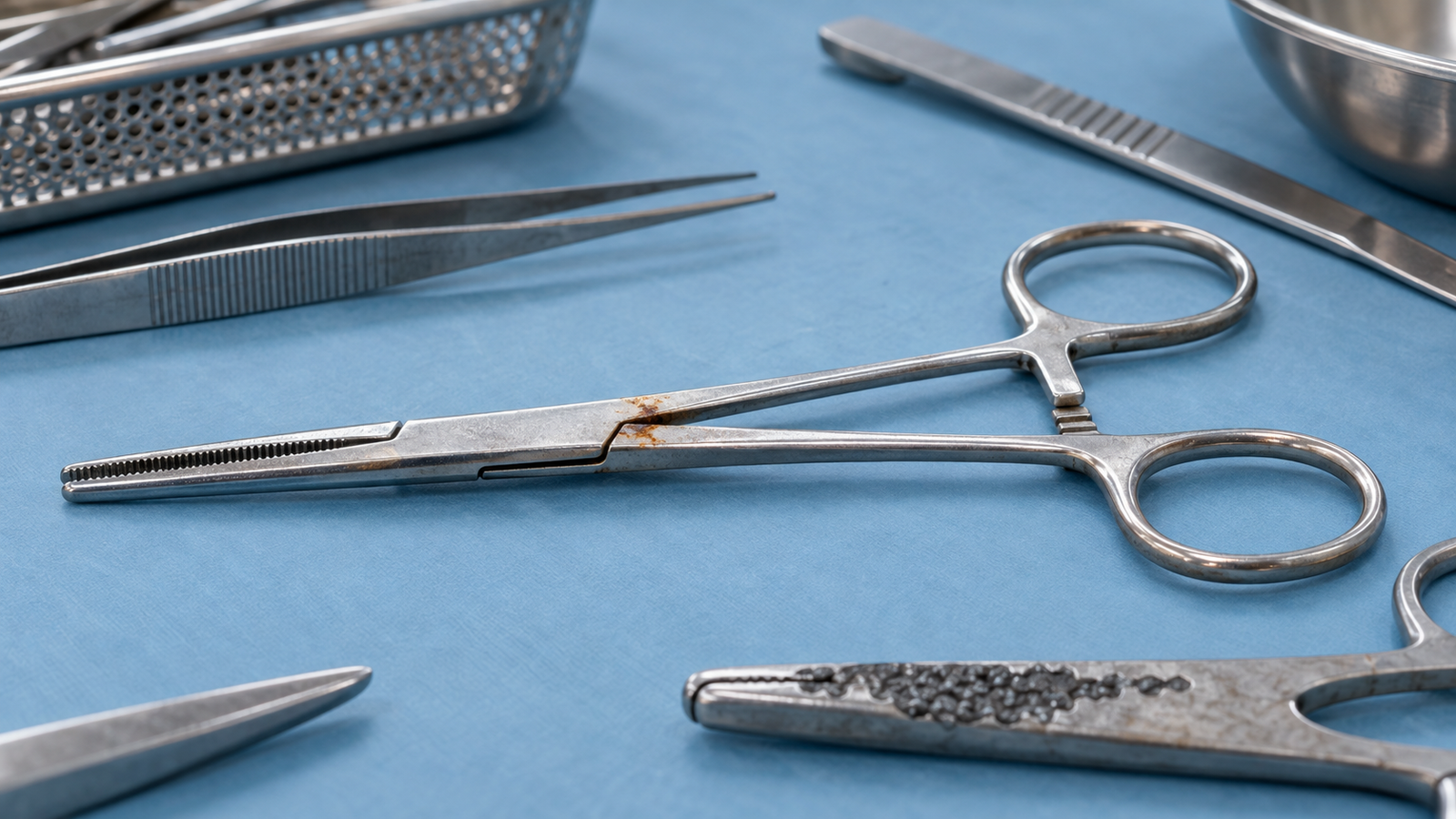
A general set comes up to theatre. A Kocher has a brown bloom across the box lock and a grey film down one shank. The scrub practitioner will not accept it. The set goes back, the case starts late, and somebody sends the supplier a photograph with one line under it: this steel is no good.
That email is usually going to the wrong address. Most marks on a surgical instrument are made after it leaves the factory, in the water, the chemistry or the timing of the facility’s own reprocessing. Some are made in the factory. A few mean the instrument has to leave service today. You cannot tell which is which from the colour, and colour is the only thing most guidance talks about.
Surgical instrument staining is a deposit that has landed on the surface and bonded to it. Corrosion is loss of the instrument’s own surface. One comes off and one does not, and that single distinction decides whether an instrument goes back into a set or out of service. This guide gives you the ion-by-ion mechanism from the one consensus standard that documents it, a three-test bench triage, a pattern-based differential that finds the cause faster than any colour chart, and the wording to use when the instrument genuinely is the problem.
The short answer
- Is it a stain or corrosion? A stain is a deposit sitting on the surface and it usually comes off. Corrosion is loss of the instrument’s own surface and it does not. Remove the stain first, then inspect what is underneath under lighted magnification.
- What causes most of it? Water and chemistry, far more often than steel. ANSI/AAMI ST108:2023 names the ions: iron gives brown rust, manganese gives black, copper gives green, chloride attacks the passive layer, and phosphates, sulfates, silicates and hardness form scale.
- Does a stain mean the cycle failed? No. A surface deposit is not evidence of a sterilisation failure. It still has to be removed, because you cannot inspect a surface you cannot see, and because scale can shield soil.
- When must an instrument leave service? When pitting, rust or corrosion is present on the instrument itself once any stain has been removed.
- What is the single highest-yield fix? Critical water for the final rinse and for steam generation: under 10 µS/cm conductivity, under 1 mg/L chloride, under 1 mg CaCO3/L hardness, against under 500, 250 and 150 for utility water.
- What is the fastest diagnostic? Pattern, not colour. Whether the mark appears on one instrument, one basket, one washer, one steriliser or everywhere narrows the cause in an afternoon.
On this page
- Stain, corrosion and rust are three different problems
- Why the colour chart is a starting point, not a diagnosis
- What the water is actually doing
- The three-test bench triage
- Pattern beats colour: the differential
- Where the passive layer goes, and how it comes back
- Does staining or corrosion actually harm patients?
- What it costs, and why it looks like a supplier problem
- A worked example: tracing a brown bloom
- The supplier conversation: what to ask and what to send
- Prevention checklist
- Frequently asked questions
- Sources
Stain, corrosion and rust are three different problems
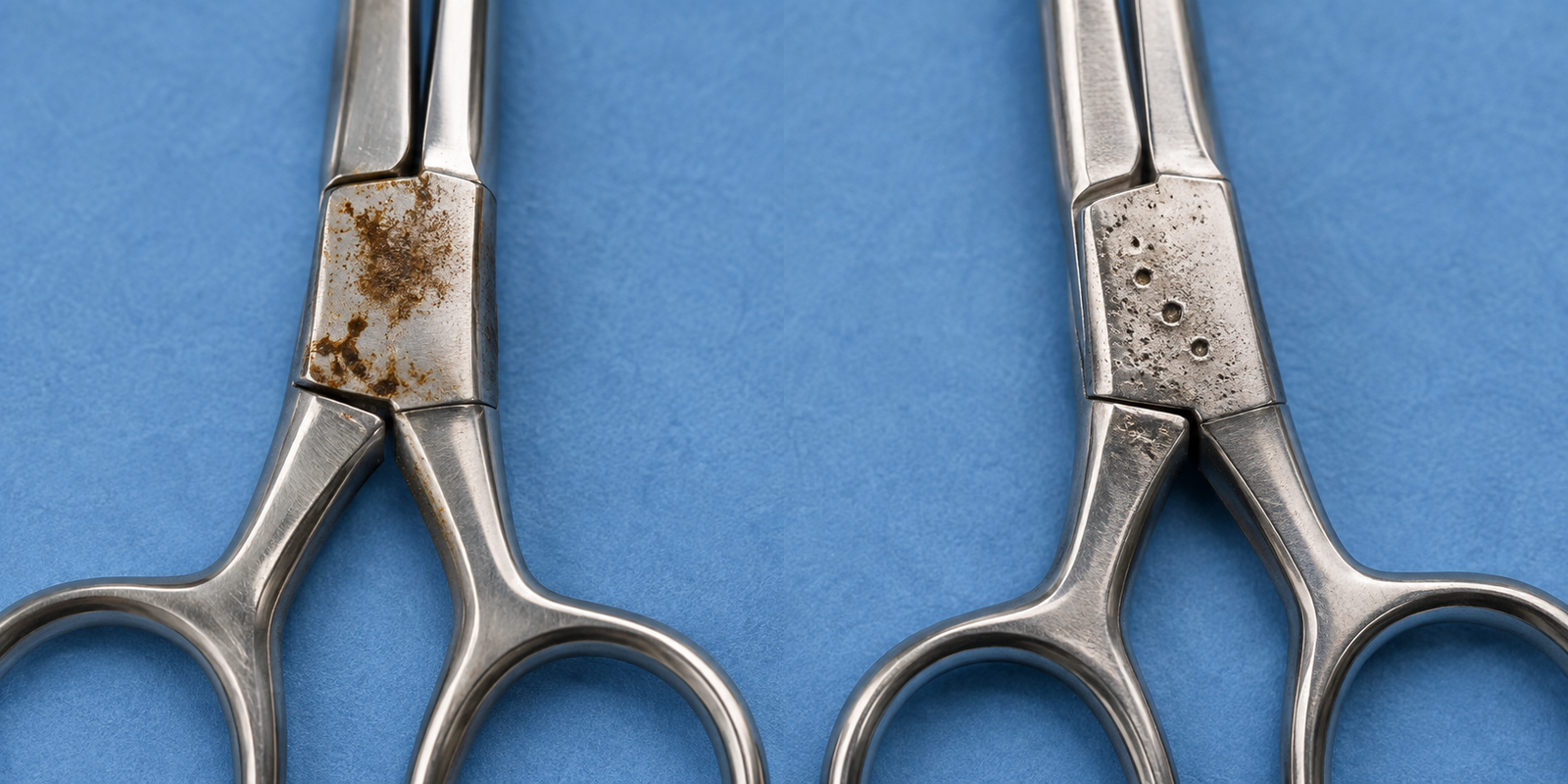
Almost every argument in a decontamination room about a discoloured instrument is really an argument about which of these three things people are looking at.
| What it is | Reversible? | The decision | |
|---|---|---|---|
| Stain, spot or deposit | Something else — minerals, detergent residue, steam additives, dried blood, plated metal — has landed on the instrument and bonded to the surface | Usually. Wipes, destains or ultrasonic-cleans off | Remove it, then inspect the surface underneath. Then find out where the deposit came from |
| Corrosion | The instrument’s own surface has been chemically or electrochemically attacked. Pitting, crevice, intergranular, galvanic and stress corrosion are the recognised forms | No. The metal is gone | Withdraw from service. Assess for repair and repassivation, or replace |
| Rust | One visible outcome of corrosion: iron oxide. It can be the instrument’s own iron oxidising, or free iron transferred onto it from water, steam piping or another instrument | Transferred rust can sometimes be removed; the corrosion site it creates cannot be undone by cleaning | Treat as corrosion until you have proved otherwise under magnification |
Swipe the table sideways to see all columns →
The reason the distinction is physical and not cosmetic is the passive layer. Surgical stainless steel does not resist corrosion because it is hard; it resists corrosion because chromium at the surface reacts with oxygen to form a chromium oxide film only about 2–3 nanometres thick. A chromium content of at least roughly 12% is what allows that film to form at all, as set out in research presented to the World Federation for Hospital Sterilisation Sciences in 2022 by Buhmann and colleagues at Borer Chemie and Empa, the Swiss Federal Laboratories for Materials Science and Technology.
A stain sits on that film. Corrosion means that film has been breached and the metal beneath it is reacting. Everything else in this guide follows from which of those two you are looking at.
One term to retire from the conversation. “Surgical grade stainless steel” is not a specification. The metals permitted for surgical instruments are specified in ISO 7153-1:2016, Surgical instruments — Materials — Part 1: Metals, with the alloys themselves designated under EN 10088-1. A material designation tells you what corrosion resistance to expect. A marketing phrase does not. We make the same argument at more length in our comparison of German-branded and Sialkot-made instruments.
Why the colour chart is a starting point, not a diagnosis
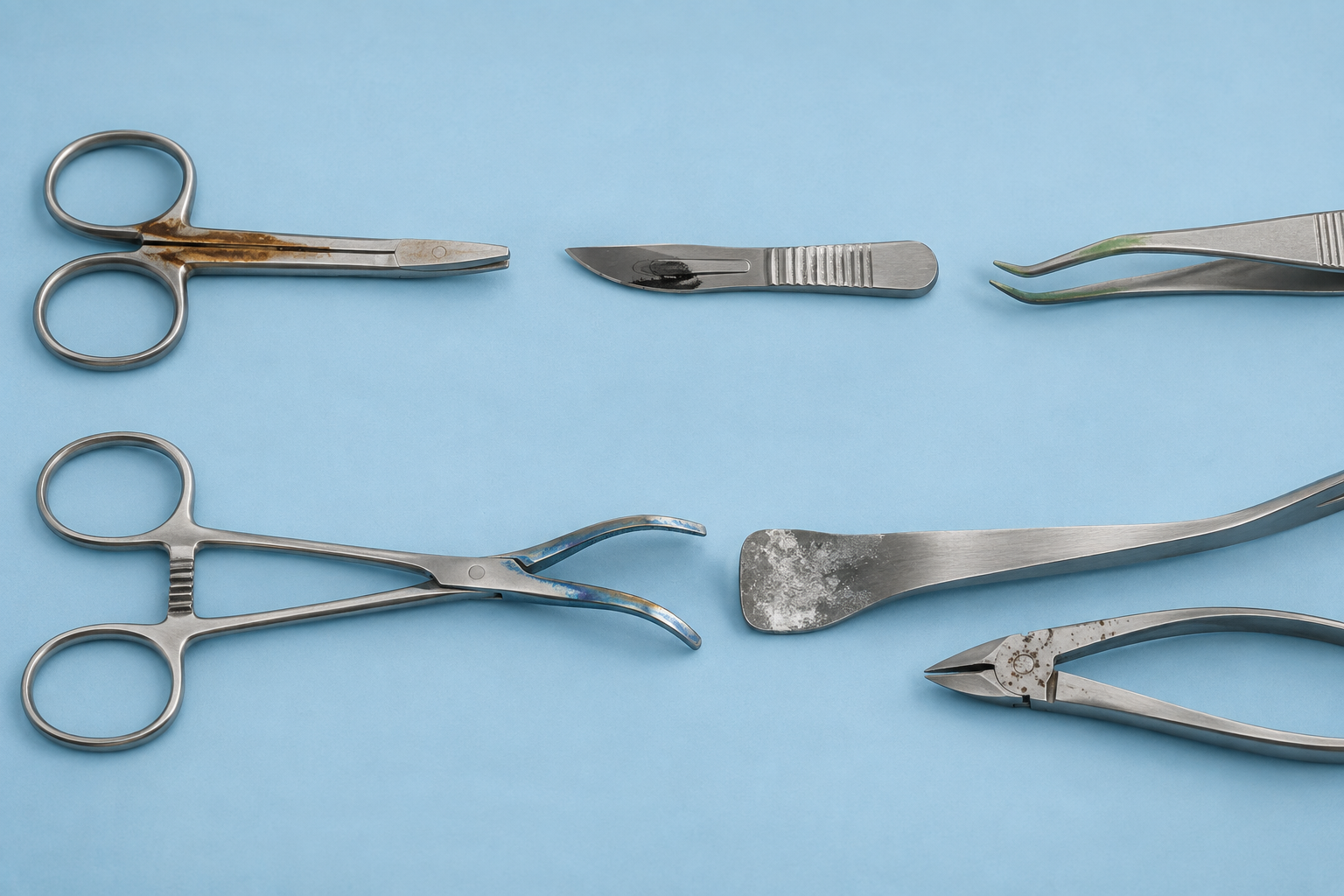
There is a colour-to-cause chart in circulation across the instrument industry, and it is genuinely useful. It is also worth knowing where it comes from. Much of it traces back to a small number of manufacturer sources, the most-cited of which is a 2000 article by three STERIS authors in Infection Control Today. It is a quarter of a century old, it cites no standards, and the versions circulating today have been recopied many times.
What has changed is that ST108 now documents the mechanism ion by ion in a consensus standard, in Annex A.3.1.1. Where a colour claim lines up with that annex, treat it as well supported. Where it does not, treat it as trade experience: often right, but not something to redesign a water system around on its own.
| Appearance | Commonly attributed to | Mechanism documented in ST108 | Where to look first |
|---|---|---|---|
| Brown or orange bloom that wipes off | Phosphate and mineral deposits, high-pH detergent residue, dried blood | Phosphates, sulfates and silicates form insoluble scale; hardness causes scaling | Detergent dose and neutralisation, final rinse water, point-of-use handling |
| Brown or orange that does not wipe off, surface feels rough | Rust; chloride attack | Iron deposits “will inevitably lead to rust formation” and create a corrosion site that grows until the instrument is serviced and repassivated. Chloride disrupts the passive layer and lets the iron in the steel oxidise | Chloride in water and steam, saline exposure, iron in the supply or steam piping |
| Black discoloration | Acid or low-pH detergent, insufficient alkalinity neutralisation, ammonia | Manganese “oxidises like iron, but the resulting discoloration will be black, not brown like rust” | Manganese in the supply; washer rinse and neutralisation step; detergent pH |
| Green | Copper contact | Copper ions deposit on surfaces and cause green staining and/or corrosion | Copper piping, dissimilar metals in the same load |
| Blue, grey or rainbow film | Excess neutralising amines in steam; reverse plating between dissimilar metals | Galvanic corrosion is named as a mechanism where metal ions deposit on instruments | Boiler treatment chemistry; mixed metals in ultrasonic or autoclave loads |
| White, chalky or matt film | Hard water scale | Hard water causes scaling that should be removed before sterilisation; silicates form hard-to-remove residues, especially if heated | Total hardness and silicate; softener performance; drying |
| Multi-coloured heat tint | Excessive heat | Not addressed | Sterilisation parameters; contact with chamber surfaces |
| Discrete light or dark spots | Water droplets dried on the surface | Water that is too acidic or too alkaline can cause pitting and staining | Final rinse quality and drying |
Swipe the table sideways to see all columns →
Two cautions before you use this table on a real instrument.
Colour is ambiguous at the box lock. Dried organic residue in a box lock can look exactly like rust, and box locks are where it is most often found. This is precisely where magnification earns its keep: current sterile processing guidance is to inspect stains and corrosion under lighted magnification specifically to tell rust from organic debris, and AAMI ST79 likewise points to enhanced visualisation tools for assessing cleanliness and device integrity.
Silicate is the trap. Silicate residues are difficult to remove, and removing them can damage the instrument surface. ST108 is explicit that silicate should be removed before any process involving heat. A white film that goes through a steam cycle is harder to deal with afterwards than the same film caught at the washer.
What the water is actually doing
This is the section to read if you only read one. ANSI/AAMI ST108:2023 is the first American National Standard on water for medical device processing; it revises and replaces the earlier technical information report AAMI TIR34. That change of status matters: a TIR is informative, a standard is the document surveyors and accreditors measure practice against.
It is worth being precise about its legal weight, because vendor marketing frequently overstates it. ST108 is a voluntary consensus standard, not a regulation. What is mandatory in the United States is having a water management programme at all: ST108 records that the Joint Commission implemented standard EC.02.05.02 on 1 January 2022, complementing a 2017 CMS requirement, and notes that other accrediting bodies have similar requirements. Outside the US, the equivalent working reference is the Instrument Reprocessing Working Group’s “Red Brochure”, which German and wider European practice has used since 1979 and which Buhmann and colleagues cite directly for corrosion prevention.
Two water qualities, two jobs
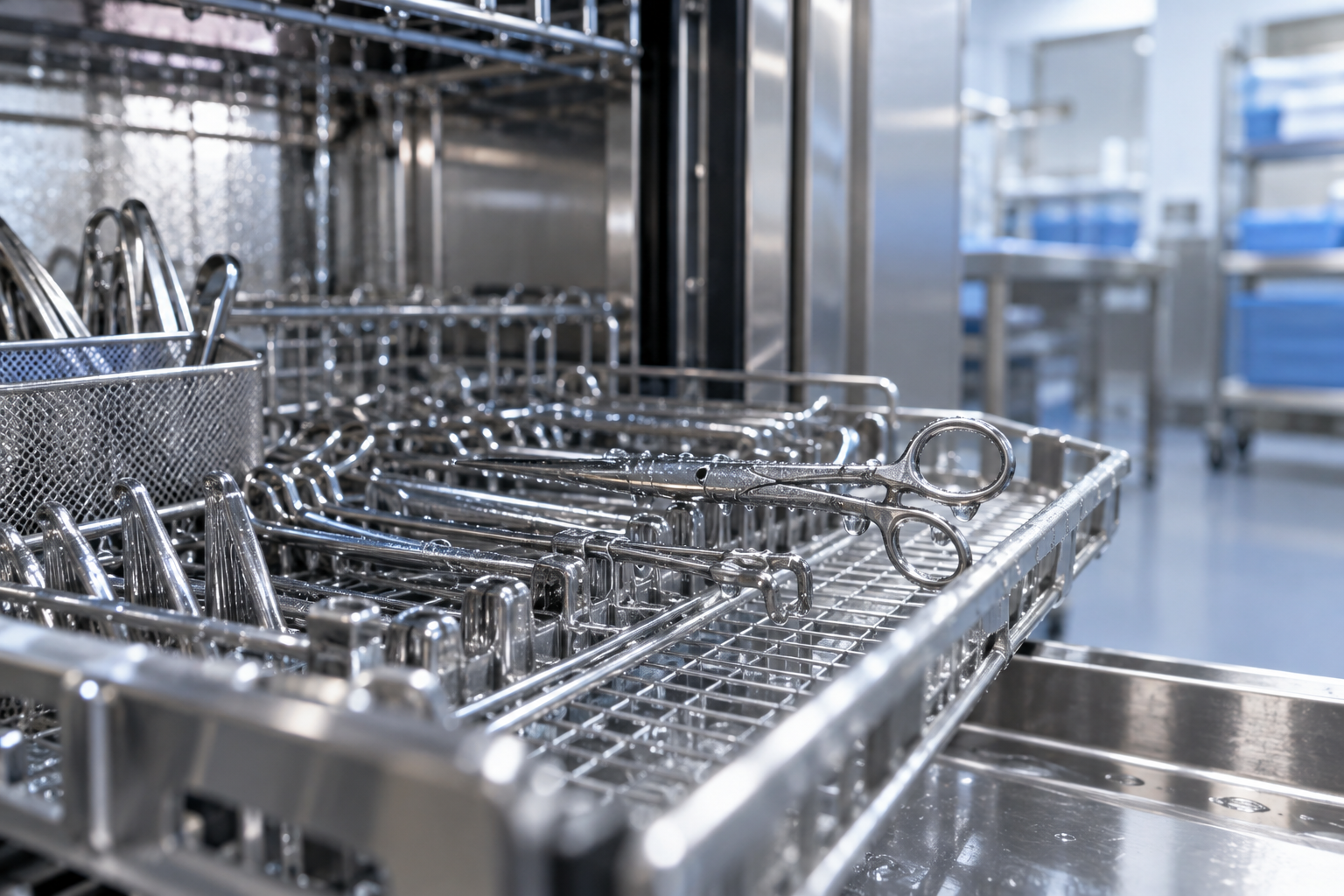
ST108 defines three categories: utility water (tap water, possibly treated, used for flushing, washing and intermediate rinsing), critical water (extensively treated, typically by reverse osmosis and/or deionisation, used for the final rinse and for steam generation) and steam, monitored as condensate.
The operating rule is short: utility water does most of the work; critical water is for the final rinse. The standard also warns the other way, that using critical water at every stage can be unnecessary, costly and itself damaging.
The limits that matter for staining and corrosion
These are the performance qualification levels from ST108’s Table 2, for the parameters that show up as marks on instruments. The full table also covers bacteria, endotoxin, total organic carbon, nitrate, colour and turbidity, and carries a separate column for steam monitored as condensate; consult the standard itself for those.
| Measurement | Units | Utility water | Critical water |
|---|---|---|---|
| pH at 25 °C | pH | 6.5 – 9.5 | 5.0 – 7.5 |
| Conductivity | µS/cm | < 500 | < 10 |
| Total hardness | mg CaCO3/L | < 150 | < 1 |
| Chloride | mg/L | < 250 | < 1 |
| Iron | mg/L | < 0.1 | < 0.1 |
| Copper | mg/L | < 0.1 | < 0.1 |
| Manganese | mg/L | < 0.1 | < 0.1 |
| Zinc | mg/L | < 0.1 | < 0.1 |
| Aluminium | mg/L | < 0.1 | < 0.1 |
| Silicate | mg/L | < 50 | < 1 |
| Phosphate | mg/L | < 5 | < 1 |
| Sulfate | mg/L | < 150 | < 1 |
| Total alkalinity | mg CaCO3/L | < 400 | < 8 |
Swipe the table sideways to see all columns →
Note that iron, copper, manganese, zinc and aluminium carry the same limit in both categories. Those are the five staining metals, and the standard does not give utility water any latitude on them.
The standard adds that if hardness exceeds 150 mg/L, a softener is recommended unless the water is being used for washing with a cleaning chemistry able to handle higher hardness — a useful piece of practical latitude for facilities in hard-water regions.
How chloride and iron actually do the damage
Two mechanisms are worth understanding rather than memorising, because they explain almost every stubborn case.
Chloride. It corrodes stainless steel by disrupting the passive external layer, which leaves the iron in the steel free to oxidise. Chloride-induced corrosion gets worse as concentration and temperature rise, which is why the chloride limit in steam matters more than the chloride limit anywhere else in the plant. It is also why instruments should be wiped with sterile water and never saline during a case, and why blood left to dry is a chloride problem as well as a soil problem.
Iron and manganese. Deposited iron leads to rust, and ST108 is blunt about the consequence: it forms a corrosion site that will keep growing until the instrument is serviced and repassivated. Iron and manganese ions can slip into imperfections in the steel and disrupt the passive layer from inside. The standard’s recommendation is the simplest sentence in the whole document: these ions should not be left on the instrument, and a critical-water final rinse is the way to remove them.
Monitoring you can actually defend
ST108 sets minimum monitoring frequencies at the generation system. Quarterly for utility water. For critical water: pH and conductivity daily, total alkalinity and total hardness monthly, bacteria and endotoxin monthly. The standard is explicit that these are minimums and that frequency should increase while a problem is unresolved. It also recommends testing across a full calendar year after commissioning a treatment system, specifically to catch seasonal variation in the incoming supply — which is the single most common explanation for staining that appears out of nowhere in a department that changed nothing.
The three-test bench triage
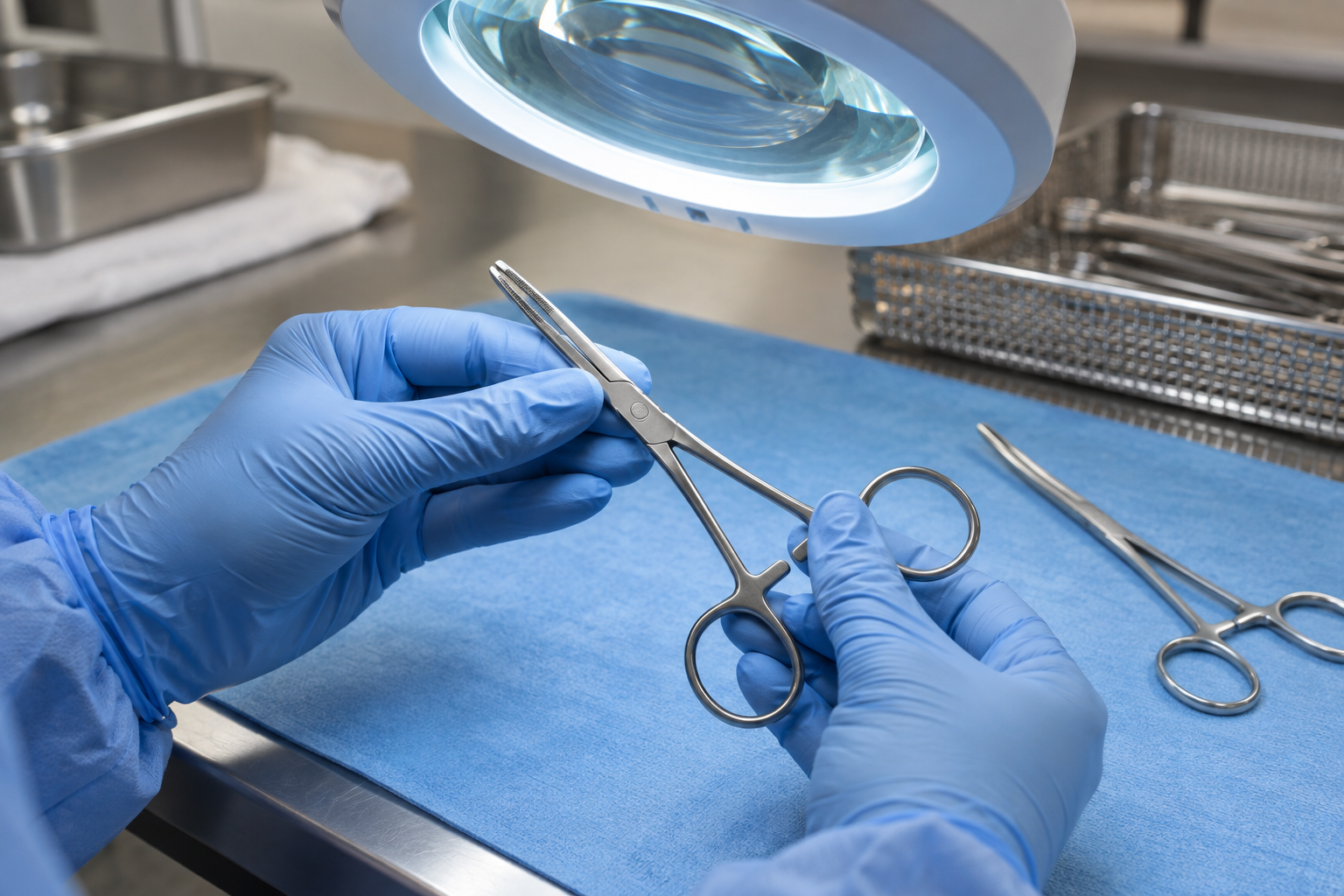
You do not need a laboratory to make the first decision. You need three tests, in this order, at the inspection bench.
Test 1 — Does it come off? Attempt removal with the wipe, cloth or instrument-care product your department already uses; then, if needed, a single destaining cycle. Use a non-metallic brush on stubborn areas. Never use steel wool, wire brushes or abrasive powders on instrument surfaces: they damage the fine finish and actively promote corrosion. Comes off cleanly with nothing underneath: it was a stain. Does not come off: treat as corrosion until Test 2 says otherwise.
Test 2 — What is underneath? Inspect under lighted magnification, and look at the box lock, the serrations, the ratchet and the hinge before the shank. This is the whole point of removing the stain: you cannot assess a surface you cannot see. You are looking for pitting, roughness, a matt patch where the finish used to be, or a dark line following a crevice.
Test 3 — Who else has it? Look at the instrument’s neighbours in the same basket, then at the rest of the load. One instrument with a unique mark is an instrument problem. Several instruments in one basket sharing a mark is a load problem, most often dissimilar metals together or a cleaning fault. A whole washer’s or steriliser’s output sharing a mark is a plant problem.
| Triage result | Decision | Next step |
|---|---|---|
| Comes off, clean surface beneath | Return to service | Log it. Find the deposit’s source before it becomes routine |
| Comes off, dull or matt surface beneath but no pitting | Return to service, flag for review | Watch it across the next few cycles. Repeat destaining is itself a risk |
| Does not come off, no pitting visible | Hold. Do not put it in a set | Second destaining attempt and re-inspection; if it persists, treat as corrosion |
| Pitting, rust or corrosion on the instrument itself | Withdraw from service | Send for assessment, repair and repassivation, or replace |
| Cracks, or corrosion at a joint or hinge | Withdraw immediately | Corrosion at a stress point is a breakage risk, not a cosmetic one |
Swipe the table sideways to see all columns →
One caution about destainers, because they are the easy answer and they have a cost. Acidic chemistries can brighten, destain and help repassivate stainless steel, but used routinely they erode the passive layer and leave it thinner and less protective. A department that destains daily has converted a water problem into a metallurgical one. If you are destaining daily, the fault is upstream.
Not sure whether it is the steel or the water?
Send us photographs under raking light, the instrument markings, and your most recent water results against ST108’s limits. We will tell you what those marks look like from the manufacturing side — material designation, surface finish, and whether the pattern looks more like a passivation fault or a processing one — and quote replacements only for the instruments that genuinely need replacing.
info@njmedicalinstruments.com · WhatsApp +92 333 8733922 · Contact form
Pattern beats colour: the differential
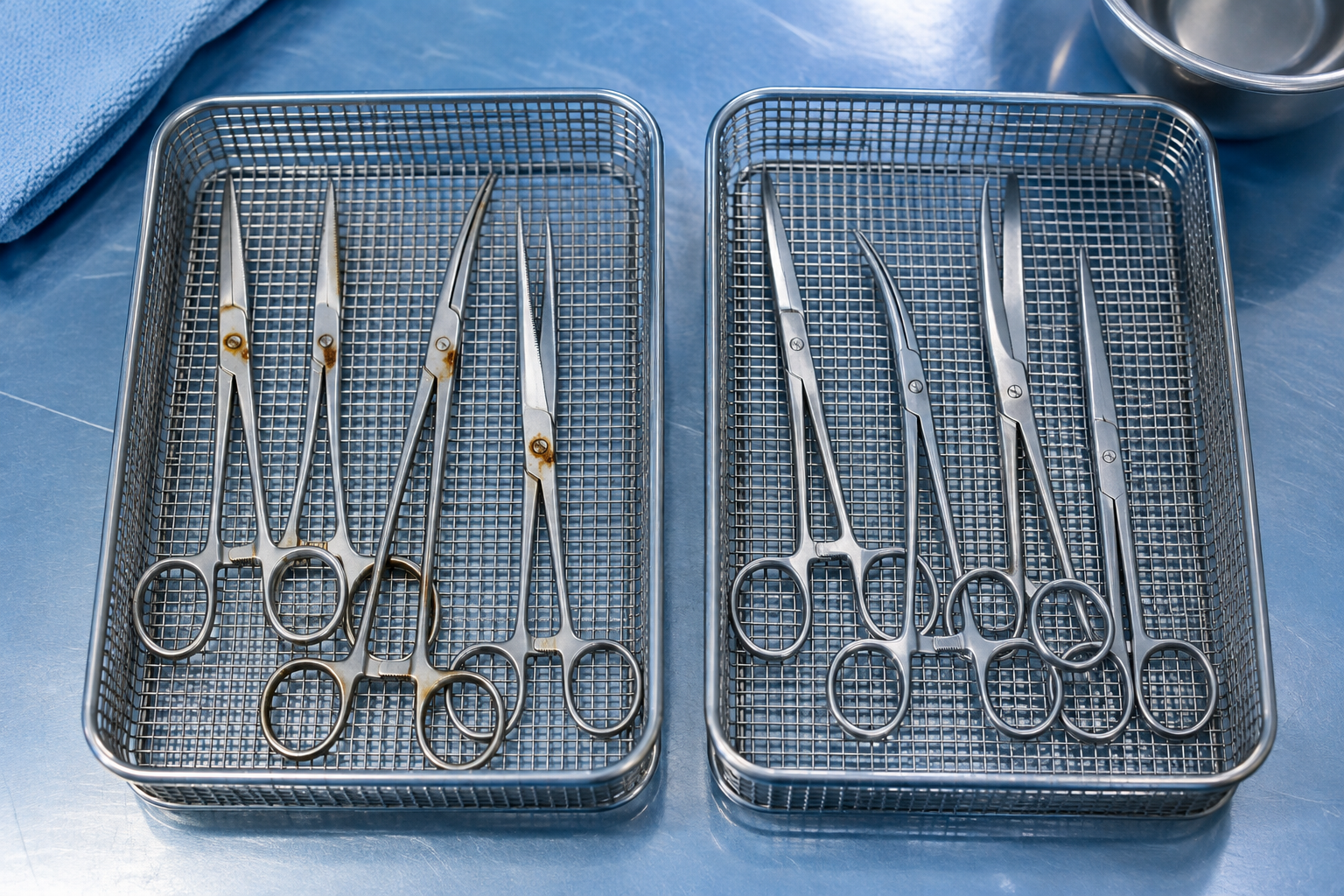
This is the table to work through before anyone opens a catalogue or drafts a complaint. Each row is a question you can answer today from records you already keep.
| What the pattern is | What it points to | How to confirm |
|---|---|---|
| One instrument, repeatedly, load after load | That instrument: damaged passive layer, prior repair or sharpening, a laser mark, or the wrong alloy for its duty | Instrument-level history. Check whether it has been marked, sharpened or repaired, and whether it was repassivated afterwards |
| Several instruments in one basket, others in the same load clean | Dissimilar metals in contact, galvanic plating, or a localised cleaning fault | Look for chrome-plated, aluminium or non-stainless items in that basket. Separate metals and rerun |
| One washer, all its loads, other washers clean | The washer’s final rinse water, detergent dosing, or the alkalinity neutralisation step | Test at that washer’s point of use against critical water limits. Check dosing pumps and detergent concentration |
| One steriliser, all its loads | Steam quality: neutralising amines, chlorides, or rust carried from piping | Test steam condensate. ST108 flags acidic pH causing corrosion of piping and transfer of rust into the load |
| Every washer and steriliser, site-wide, starting at a definable point | The incoming supply, a treatment system failure, or seasonal variation | Compare to the last water results. This is what ST108’s year-long post-commissioning testing exists to catch |
| New instruments only, in their first cycles, rest of the load clean | Manufacturing residues or free iron left on the surface, or inadequate passivation | Process new instruments fully before first clinical use. If they still stain while nothing else in the load does, raise it with the supplier |
| Emergency or rushed sets only | Point-of-use delay. Blood and body fluids dried on, which is a chloride exposure as well as a soil problem | Compare turnaround times. Keep instruments moist and transport promptly |
| Heavy, tightly packed sets more than light ones | Drying failure and condensate retention, not chemistry | Weigh and re-inspect the densest sets first. See our guide to surgical instrument tray optimisation |
Swipe the table sideways to see all columns →
That last row deserves a note, because it is where two problems meet. Dense trays are hard to dry, and water that does not leave the tray dries on the instruments. Reducing tray contents is normally argued on cost and reprocessing labour, but one orthopaedic programme that removed 55% of tray contents also saw trays coming out with holes in the wrapping fall from 13 to 1. Fewer, better-spaced instruments dry better, and instruments that dry do not spot.
Where the passive layer goes, and how it comes back
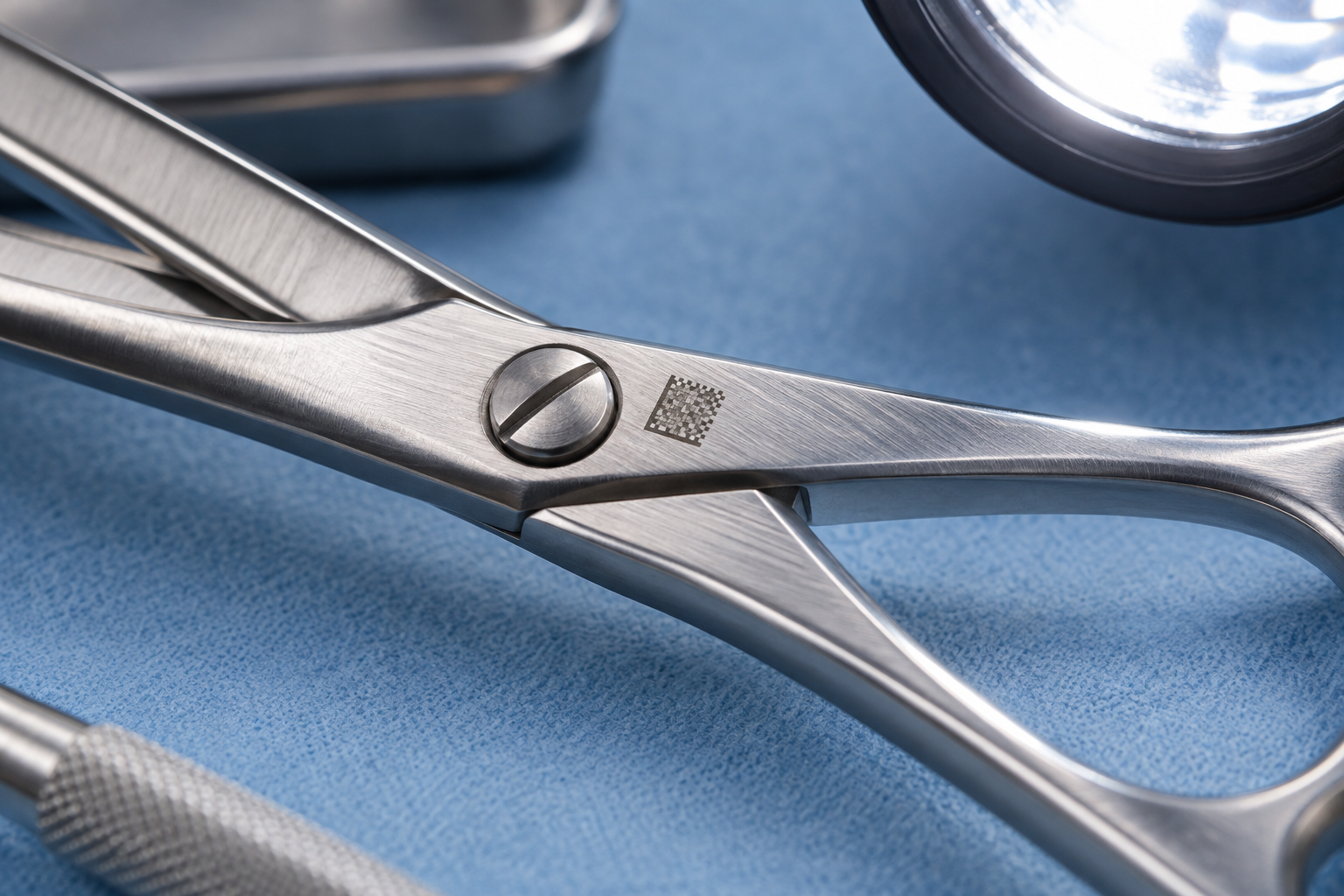
Three things routinely destroy the film that is keeping your instruments intact, and two of them are things your department does deliberately.
Chlorides. Blood, saline, some skin disinfectants. Chloride ions strip chromium from the surface film.
Mechanical damage. Scratches, abrasives, instrument-on-instrument contact in a vibrating ultrasonic basket.
Thermal stress, including laser marking. This is the one worth pausing on. Buhmann and colleagues list laser marking explicitly among the thermal stresses that damage the passive layer. If you are marking instruments for unique device identification, as we recommended in our guide to surgical instrument traceability, then marking is an insult to the passive layer and should be followed by repassivation. The same applies after any repair or sharpening, because grinding removes the film along with the metal.
What passivation actually achieves
The Empa and Borer work is the most useful recent data on this, because it measured rather than asserted. Working with polished coupons of two alloys — 1.4021 (X20Cr13, 12–13% chromium, used for forceps and clamps) and 1.4112 (X90CrMoV18, 17–18% chromium, used for scissors and chisels) — the team compared no passivation, a phosphoric/nitric acid treatment and a citric acid treatment.
- Un-passivated coupons of both alloys showed no corrosion protection in electrochemical testing, and corroded after one hour in 0.9% saline.
- On the higher-chromium 1.4112, both acid treatments produced similar, good results.
- On the lower-chromium 1.4021, phosphoric/nitric acid was significantly better than citric, producing a chromium oxide and chromium phosphate layer around 10 nm thick against roughly 2 nm from citric acid, about five times thicker.
- Freshly passivated surfaces also showed lower water contact angles, which the authors suggest may mean better drying performance in the washer-disinfector. Contact angles rose again after 14 days, so this is a transient effect.
Two practical conclusions. First, passivation is not optional finishing; on a 12% chromium instrument it is the difference between corrosion resistance and none. Second, the lower the chromium content of the alloy, the more the passivation chemistry matters — which is a reason to know your instruments’ material designation rather than their marketing description.
Does staining or corrosion actually harm patients?
This section is where most instrument-care content overclaims, so here is what the evidence supports and what it does not.
What is documented as a risk. ST108 sets out the adverse outcomes that poor water quality can contribute to: device malfunction during a procedure, including a corroded instrument breaking inside a patient when stress is applied; obstructed mechanisms; toxic effects or tissue irritation from residues; infection risk from contaminated devices; and pyrogenic reactions from endotoxin. These are hazards to be controlled, not measured event rates.
The biofilm argument, and why it is weaker than it sounds. The common claim is that corrosion pits shelter biofilm from cleaning. It is a reasonable hypothesis and it has been tested. Rosário and colleagues, publishing in Hygiene in December 2022, fragmented the corrosion points of five heavily corroded instruments in hospital use, deliberately grew biofilm on some of them using Pseudomonas aeruginosa and Enterococcus faecalis in blood and saline, then ran them through a standard sterile processing sequence — ultrasonic with enzymatic detergent, automated washer-disinfector, steam sterilisation — and examined them under scanning electron microscopy.
Biofilm formed reliably on the positive controls that were not cleaned, so the method worked. After the full cleaning and sterilisation sequence, no biofilm was visible at the corrosion points. Corroded instruments taken straight from practice, without deliberate contamination, showed no biofilm either, only residual organic matter without microorganisms.
The honest reading: for these samples, standard reprocessing removed biofilm from corrosion points, and the theoretical concern was not confirmed. The honest caveats: five instruments, a laboratory setting, and SEM imaging rather than clinical outcomes. This does not license running corroded instruments. It does mean that if you are arguing to withdraw a corroded instrument, the stronger arguments are breakage risk, inspectability and instrument life, not infection.
What is well supported. Time matters. The same paper reports earlier work in which Staphylococcus epidermidis load on soiled instruments rose from roughly 101–102 CFU/cm2 after one hour to 104 CFU/cm2 after twelve. That is the evidence behind point-of-use treatment, and it is the same evidence behind not letting blood dry on an instrument: you are controlling both microbial load and chloride exposure with one action.
So the practical case for taking stains seriously is not that they will infect a patient. It is that you cannot inspect through them, that the processes producing them are also producing corrosion, and that corrosion ends instruments early and delays cases.
What it costs, and why it looks like a supplier problem
The best available picture of what damaged instruments look like in practice comes from a pilot study by Munakomi, Shah and Shrestha, published in F1000Research in 2018. They examined 94 instruments sent for repair or replacement within one year of purchase at a tertiary centre in Nepal, 47 from general surgery and 47 from neurosurgery, and recorded what was wrong with each.
| Finding | General surgery (n = 47) | Neurosurgery (n = 47) |
|---|---|---|
| Stains | 97.87% | 38.29% |
| Loosening at joints | 82.97% | 31.91% |
| Rust | 27.65% | — |
| Pits | 25.50% | — |
| Discoloration | — | 23.40% |
| Mal-alignment | 19.00% | 29.78% |
| Fractures | 17.02% | 27.65% |
Swipe the table sideways to see all columns →
Fractures clustered at the tip: 75% of general surgery fractures and 46.1% of neurosurgery fractures. The authors’ own reading is that reprocessing practice, not purchase quality, was doing most of the damage, and that joint care in particular was driving loosening, cracking and early fracture.
Read this table for the pattern, not the rates. The denominator is instruments already sent for repair, at one centre, in a pilot study the authors themselves describe as resource-limited. These are not population prevalence figures, and nobody should quote them as “98% of surgical instruments are stained.” What they do show is that within a population of prematurely failing instruments, staining and joint loosening dominate — both of which are reprocessing outcomes, and both of which are usually invoiced as product faults.
A broader figure worth knowing, with a caveat attached: Rosário and colleagues cite earlier work finding corrosion in 45.8% of surgical instruments in use, attributed in part to unregulated autoclave temperature and maintenance by unqualified staff. We have not read that primary source, so treat it as a secondary citation and a prompt to audit your own instruments rather than a number to put in a business case.
The money is straightforward once you know the two figures that matter. The first is what an instrument costs to reprocess — the range used across the tray-reduction literature is $0.51 to $3.19 per instrument per cycle, which we break down in our reusable versus disposable comparison. The second is the replacement cost of the instruments you withdraw. Between them sits the cost nobody budgets for: a rejected set, a delayed case, and the count-sheet revision that follows every withdrawal. Our note on reducing instrument costs without compromising quality covers the purchasing side of the same arithmetic.
A worked example: tracing a brown bloom
This walks a realistic case so you can copy the sequence. The limits cited are from ST108; the readings are illustrative, chosen to show the arithmetic, and are not from a specific facility.
Day 1, morning. Three general sets come out of washer 2 with a brown bloom at the box locks. Eleven instruments affected.
| Step | Action | Result |
|---|---|---|
| 1 | Wipe test on all 11 | 8 wipe clean, so those are stains. 3 do not |
| 2 | Lighted magnification on the 3 | Pitting visible at the box lock on all 3. Withdraw from service, do not destain further |
| 3 | Pattern check against the day’s records | Washer 2 only. Washers 1 and 3 clean. First noticed about three weeks ago |
| 4 | Test at washer 2’s final rinse point of use | Illustrative reading: 240 µS/cm conductivity, 90 mg CaCO3/L hardness. Critical water limits are under 10 µS/cm and under 1 mg CaCO3/L, so this is utility water, not critical water |
| 5 | Check why | Either the final rinse is plumbed to utility water, or the RO/DI unit serving washer 2 has failed or exhausted. Check detergent dosing and the alkalinity neutralisation step at the same time |
| 6 | Fix, then remediate | Restore a critical-water final rinse. Destain the 8 affected instruments once and re-inspect under magnification. Send the 3 pitted instruments for assessment, repair and repassivation, or replace them |
| 7 | Monitor and record | Return to ST108 minimum frequencies, daily pH and conductivity on critical water, and log the outcome against each instrument so repeat offenders surface. Our traceability guide covers keeping instrument-level records through a change like this |
Swipe the table sideways to see all columns →
Step 3 is the one people skip, and it is the one that saves the week. Without it, this case becomes a procurement dispute about steel quality. With it, it is a failed deioniser on one washer, found in an afternoon.
The supplier conversation: what to ask and what to send
Sometimes the instrument really is the problem. Here is how to tell, and how to make the conversation productive rather than adversarial.
When the instrument is a plausible cause
- New instruments stain in their first cycles while everything else in the same load is clean. Free iron and machining residues left on the surface, or inadequate passivation, will show up exactly this way. Note that new instruments should be fully processed before first clinical use in any case, and that the first cycles legitimately remove manufacturing residues.
- One pattern, one batch, across multiple washers and multiple sterilisers. Plant faults do not respect batch boundaries; material faults do.
- Corrosion appears on a specific instrument type under normal duty, for example scissors corroding while clamps in the same sets do not. Scissors and chisels are normally made from higher-chromium, higher-hardness alloys precisely because of their duty. A mismatch is a specification question.
- The instrument has been repaired, sharpened or laser-marked and was not repassivated afterwards. This is a service failure rather than a manufacturing one, but it belongs in the same conversation.
What to send
Give a supplier enough to actually diagnose it:
- Photographs under raking light, showing the box lock, serrations and hinge, not just the shank.
- The instrument’s own markings and lot or batch reference.
- Which washer and which steriliser, and how many cycles the instrument has had.
- Your most recent water and steam condensate results, against ST108’s limits.
- The detergent, its concentration and its pH, plus whether an alkalinity neutralisation step runs.
- Whether the item was ever exposed to saline, or held soiled for an extended period.
What to ask for
- The material designation, to EN 10088-1 or ISO 7153-1, rather than “surgical grade”.
- Confirmation of passivation and surface finish, and what chemistry was used.
- Guidance on repassivation after laser marking, sharpening or repair.
- Certification documentation. Our guide to surgical instrument certifications sets out what is worth asking for and what is decorative, and our bulk buying guide covers the wider supplier checks.
A supplier who answers the first two questions with a designation and a process is worth keeping. A supplier who answers with an adjective is the reason this article needed writing.
Replace only what needs replacing
NJ Medical Instruments has manufactured surgical, dental and ENT instruments in Sialkot since 1990, as an OEM and direct supplier. Around 1,750 items are listed on this site and over 10,000 are available across the range.
Send your withdrawn instruments list or photographs and you get a line-by-line quote against your own count-sheet numbering, with material designation confirmed per line and certification documentation on request. Useful starting points: general surgery instruments, artery forceps and ligature clamps, scissors, needle holders, dental instruments, complete instrument sets and sterilisation containers.
info@njmedicalinstruments.com · WhatsApp +92 333 8733922 · Contact form · Browse the shop · About the factory
Prevention checklist
Ten things, in rough order of how much difference they make.
- Final-rinse and generate steam with critical water. Under 10 µS/cm, under 1 mg/L chloride, under 1 mg CaCO3/L hardness. This one change addresses most staining.
- Test to ST108’s minimum frequencies and write the results down. Daily pH and conductivity on critical water is the floor, not the target.
- Treat iron, copper, manganese, zinc and aluminium as hard limits in both water categories. They are the staining metals and the standard gives no latitude on them.
- Keep instruments moist and move them promptly. Dried blood is a chloride exposure and a rising microbial load at the same time.
- Never wipe instruments with saline during a case. Sterile water only.
- Never mix metals in the same ultrasonic or autoclave load. Plating and galvanic corrosion both start here.
- Dose detergent to the stated concentration and run the neutralisation step. Both over- and under-neutralised rinses are documented causes of staining.
- Never use steel wool, wire brushes or abrasive powders. Non-metallic brushes only.
- Do not destain daily. If you need to, fix the upstream cause instead; routine destaining thins the passive layer.
- Repassivate after laser marking, sharpening or repair, and process new instruments fully before first clinical use.
One class of instrument this triage does not cover. On an insulated electrosurgical instrument the failure that matters is a break in the insulating coat rather than a mark on the steel, and magnification alone will not reliably find it. Those need their own electrical test: see electrosurgical insulation failure and how to test for it.
Two structural additions worth making once: pack hinged instruments open so box locks do not trap moisture, and audit your heaviest sets first, because they dry worst. Both are covered in more depth in our tray optimisation guide, alongside our instrument maintenance notes and the basics of sterilising medical instruments if you are setting a process up from scratch.
Frequently asked questions
How do I tell a stain from corrosion on a surgical instrument?
Try to remove it. A stain is a deposit on the surface and it usually comes off with an instrument-care wipe, a non-metallic brush or a single destaining cycle. Corrosion is loss of the instrument’s own surface and it does not come off. Once any stain is removed, inspect the surface underneath under lighted magnification, starting at the box lock. If pitting, rust or corrosion is present on the instrument itself, withdraw it from service.
Does a stained instrument mean the sterilisation cycle failed?
No. A surface deposit is not evidence that a cycle failed, and cycle performance is judged by its own monitoring: physical parameters, chemical indicators and biological indicators. The reason a stain still matters is that you cannot inspect a surface you cannot see, and heavy scale can shield residual soil. Remove it, inspect, then find the source.
Why are my instruments rusting if they are stainless steel?
Two different reasons, and they need different fixes. Transferred rust is free iron from your water, your steam piping or another instrument depositing on the surface; ST108 sets the iron limit at under 0.1 mg/L in both utility and critical water. Genuine corrosion is the instrument’s own iron oxidising after its passive layer has been breached, usually by chloride from saline, blood or water, or by mechanical damage. Deposited iron is the more common of the two, and it creates a corrosion site that keeps growing until the instrument is serviced and repassivated.
What water quality should the final rinse be?
Critical water, as defined in ANSI/AAMI ST108:2023: under 10 µS/cm conductivity, under 1 mg/L chloride, under 1 mg CaCO3/L total hardness, pH 5.0 to 7.5, and under 0.1 mg/L each of iron, copper, manganese, zinc and aluminium. Utility water, which allows up to 500 µS/cm, 250 mg/L chloride and 150 mg CaCO3/L hardness, is intended for flushing, washing and intermediate rinsing, not for the final rinse.
What causes black stains on surgical instruments?
The mechanism documented in ST108 is manganese: it oxidises like iron, but the resulting discoloration is black rather than brown. Trade sources also attribute black marks to low-pH or acidic detergent residue and to insufficient alkalinity neutralisation in the washer. Check manganese in your supply first, then detergent pH and the neutralisation step.
What causes a blue or rainbow film on instruments?
Two commonly cited causes. Excess neutralising amines carried over in steam, which is a boiler chemistry question; and reverse plating between dissimilar metals during ultrasonic cleaning or autoclaving, which is a loading question. ST108 documents galvanic corrosion as a mechanism by which metal ions deposit on instruments. The practical test is whether the film appears across a whole load from one steriliser, or only on instruments that shared a basket with plated or non-stainless items.
Can stained or corroded instruments cause infection?
There is no good evidence that corrosion points shelter biofilm from proper reprocessing. The one study that tested this directly, Rosário and colleagues in Hygiene in 2022, deliberately grew biofilm at corrosion points on five corroded instruments and found none remaining after standard manual and automated cleaning followed by sterilisation. It is a small laboratory study, so it settles nothing definitively, but it means infection is the weakest argument for withdrawing a corroded instrument. The strong arguments are breakage risk at stressed joints, inability to inspect the surface, and shortened instrument life.
Should new instruments be processed before first use?
Yes. New instruments should go through a full reprocessing cycle before first clinical use. Expect the first cycles to remove residual manufacturing soils. If new instruments stain while the rest of the load stays clean, that pattern is worth raising with the supplier, because it points to free iron on the surface or inadequate passivation rather than to your water.
Is it safe to use a destainer or acid cleaner routinely?
Acidic chemistries can brighten, destain and help repassivate stainless steel, and they have a place. Used daily they erode the passive layer, leaving it thinner and less protective. If a department needs to destain routinely, the underlying water or chemistry fault should be fixed instead. Never substitute abrasives: steel wool, wire brushes and abrasive powders damage the finish and promote corrosion.
Does laser marking damage instruments?
Laser marking is a thermal stress on the passive layer, and Buhmann and colleagues list it among the causes of passive-layer damage. That is not a reason to avoid marking, since unique device identification is worth having, as we set out in our traceability guide. It is a reason to treat marking like a repair, and arrange repassivation afterwards. The same applies after sharpening or any grinding operation.
Is ANSI/AAMI ST108 a legal requirement?
No. ST108 is a voluntary consensus standard, published in 2023, which revises and replaces AAMI TIR34. What is required in US hospitals is having a water management programme at all: the Joint Commission’s standard EC.02.05.02 took effect on 1 January 2022, complementing a 2017 CMS requirement, and other accrediting bodies have similar expectations. Accreditors and surveyors treat AAMI standards as the benchmark for competent practice, which is why the limits in ST108 are worth meeting whether or not they are law where you are.
What is the European equivalent?
The working reference across much of Europe is the “Red Brochure” published by the Instrument Reprocessing Working Group (Arbeitskreis Instrumenten-Aufbereitung, AKI), first issued in 1979 and updated since, alongside EN ISO 7153-1 for materials and the EN ISO 15883 series for washer-disinfectors. The AKI brochures are available in more than twenty languages from a-k-i.org, and the chemistry researchers cited in this article recommend the Red Brochure directly for corrosion prevention.
Sources
- ANSI/AAMI ST108:2023, Water for the processing of medical devices. Water quality categories and Table 2 limits; the ion-by-ion corrosion and staining mechanisms in Annex A.3.1.1; monitoring frequencies; the supersession of AAMI TIR34; the Joint Commission EC.02.05.02 and CMS references. ANSI Webstore
- Buhmann M, Guseva O, Schmutz P, Ren Q. New insights into chemical passivation of stainless surgical steel: corrosion prevention and beyond. WFHSS, Barcelona, 2022. Passive layer thickness and chromium content; salt-spray and electrochemical results; phosphoric/nitric versus citric passivation on 1.4021 and 1.4112; de-passivation by chlorides, mechanical damage and laser marking. PDF
- Rosário W, Almeida T, Andrade B, et al. Evaluation of the presence of biofilms in corrosive points in surgical instruments after reprocessing. Hygiene, 2022;2(4):243–250. The biofilm-at-corrosion-points experiment and its negative result; corrosion types and the sensitisation mechanism; the secondary 45.8% corrosion figure; the time-dependent microbial load figures. DOI: 10.3390/hygiene2040022
- Munakomi S, Shah R, Shrestha S. A pilot study comparing pattern of damage sustained among instruments from different surgical units in a tertiary care centre in Nepal. F1000Research, 2018;7:102. Damage-category percentages for 94 prematurely failing instruments and the fracture-site distribution. f1000research.com
- ISO 7153-1:2016, Surgical instruments — Materials — Part 1: Metals (Edition 3, confirmed 2022). The materials specification that “surgical grade” is not. iso.org
- Healthcare Sterile Processing Association, Instrument Care and Handling: Preventing Damage and Prolonging Instrument Life. Stain versus corrosion; removing stains to inspect the surface beneath; lighted magnification; removal from service when pitting, corrosion or rust is present. myhspa.org
- Instrument Reprocessing Working Group (AKI), “Red Brochure”, Proper Maintenance of Instruments. The long-standing European reference for instrument reprocessing and corrosion prevention. a-k-i.org
- Kaiser HJ, Schwab P, Tirey JF. Spotting, staining and corrosion of surgical instruments. Infection Control Today, October 2000. The origin of most circulating colour-to-cause charts, and the source for the neutralising-amine and alkalinity-neutralisation attributions. Dated; used here as trade experience rather than as evidence. infectioncontroltoday.com
- Ramos JM. When the shine fades: how OR teams can prevent instrument staining and protect patients. OR Today, May 2025. Point-of-use practice, including wiping with sterile water rather than saline, from a contributor to ST108. ortoday.com
- CMS survey and certification memorandum QSO-17-30 (revised). The 2017 US water management requirement that ST108 references. cms.gov
Research completed 24 September 2026. Standards referenced were current at that date; ST108’s own monitoring guidance assumes water quality varies seasonally, so treat your own results, not this article, as the measurement.

Written by
Akif Javaid
Akif Javaid is the owner of NJ Medical Instruments, a surgical instrument manufacturer established in Sialkot, Pakistan in 1990. The company manufactures reusable surgical, dental, ENT and orthopedic instruments and now stocks them locally through inventory hubs in Pakistan, the UK, the UAE and the USA, supplying hospitals, clinics and distributors worldwide with faster regional fulfilment. It also produces private-label and OEM instrument sets to customer specification.
