


How to Choose the Right Surgical Scissors for Each Procedure

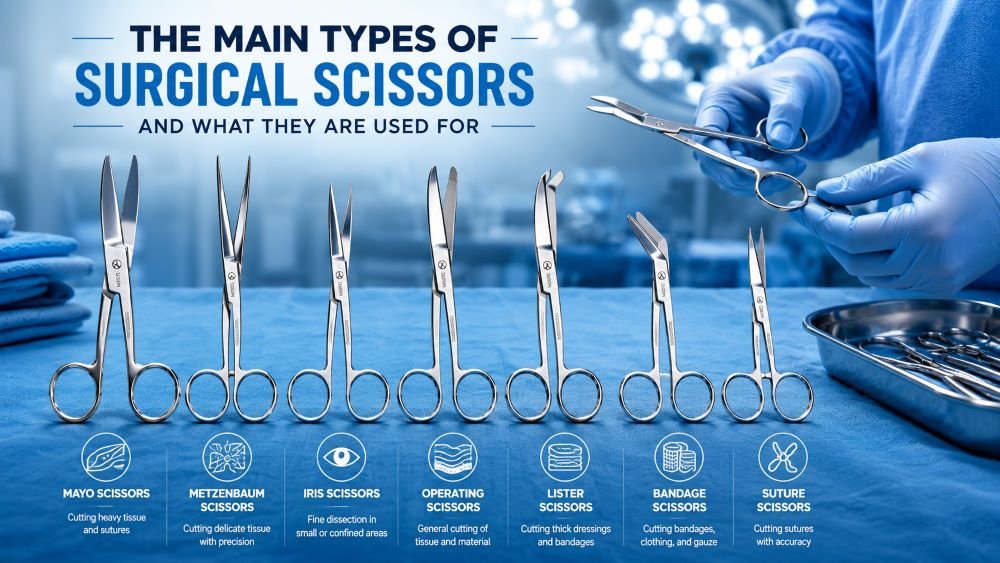
Choosing the wrong scissors in an operating theater is not just inconvenient — it slows the procedure, increases tissue trauma, and puts instrument longevity at risk. Yet with more than a dozen distinct types of surgical scissors on the market, procurement managers and scrub nurses frequently default to ordering general-purpose scissors for procedures that demand something far more specific. Let’s talk more on how to choose the right surgical scissors for each procedure.
This guide covers every major type of surgical scissors, the procedures they are designed for, and the features that separate a clinical-grade instrument from one that will disappoint after a few autoclave cycles.
NJ Medical Instruments has manufactured surgical scissors in Sialkot, Pakistan — the global hub for surgical instrument production — since 1990. Every pair is ISO, CE, and FDA compliant and ships to hospitals and clinics in over 80 countries.
Why the type of scissors matters more than most buyers think
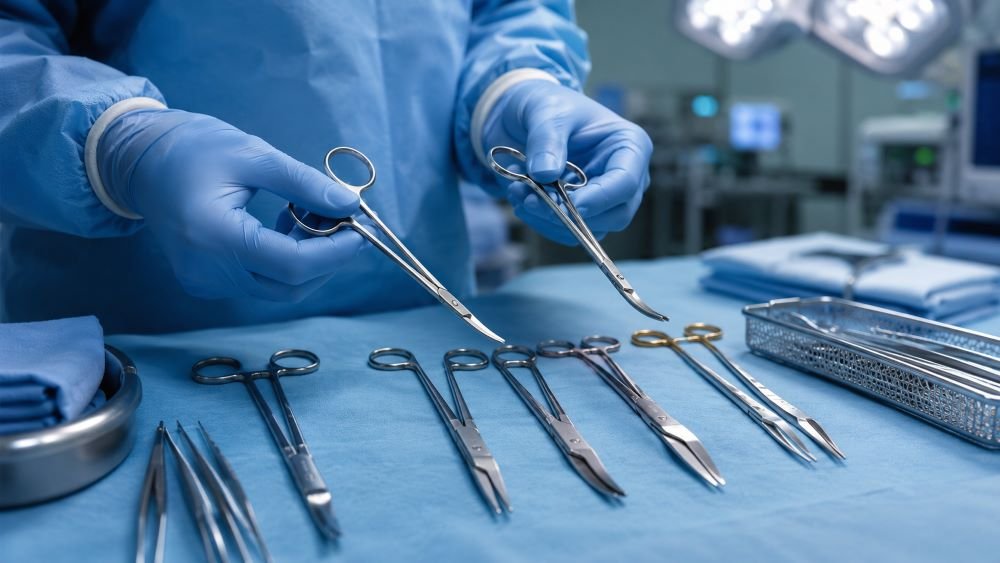
Surgical scissors are not interchangeable. The blade geometry, tip design, blade angle, and jaw material are all optimized for specific tissue types and surgical approaches. Using dissecting scissors for cutting sutures damages the fine blade edge within weeks. Using blunt-tip scissors where sharp-tip access is needed increases drag and tissue damage.
According to the Association of periOperative Registered Nurses (AORN), instrument selection is a critical component of sterile field management and directly influences surgical outcomes. Selecting instruments matched to the procedure is a standard expectation in operating room protocol — not an optional refinement.
The decisions come down to five variables: blade shape, tip type, cutting edge, handle style, and blade material.

The main types of surgical scissors and what they are used for
1. Mayo scissors — the workhorse of general surgery
Mayo scissors are the most widely stocked scissors in any general surgical setting. They have heavy, semi-blunt blades designed to cut through dense, fibrous tissue — fascia, muscle, and sutures. They come in straight and curved configurations.
- Straight Mayo scissors are used primarily for cutting sutures and superficial tissue near the surface of the wound.
- Curved Mayo scissors allow access to deeper anatomical structures and are the go-to for dissecting and cutting connective tissue.
NJ Medical’s Mayo dissecting scissors and Mayo supercut dissecting scissors are stocked in multiple lengths and available with standard or tungsten carbide edges for extended blade life.
Best for: General surgery, gynecology, thoracic procedures, suture removal.
2. Metzenbaum scissors — precision dissection
Metzenbaum scissors are slender, lightweight scissors with a long shank and short blades. They are designed specifically for dissecting delicate tissue and cutting fine structures — not for cutting sutures or heavy fibrous material, which will blunt the blade rapidly.
They are available in straight and curved versions, with standard, supercut, and diamond supercut blade options. The supercut variant has one serrated blade that grips tissue as it cuts, reducing the tendency for tissue to slide.
NJ Medical offers the full Metzenbaum range including Metzenbaum dissecting scissors, Metzenbaum supercut dissecting scissors, and the Metzenbaum diamond supercut dissecting scissors for procedures demanding the finest cutting precision.
Best for: Abdominal surgery, cardiovascular surgery, plastic surgery, any procedure requiring fine tissue dissection.
3. Iris scissors — fine work in tight spaces
Originally designed for ophthalmic surgery, iris scissors have become standard in plastic surgery, microsurgery, and any procedure involving fine, superficial tissue in confined spaces. The blades are short, narrow, and extremely sharp, with either straight or curved configurations.
NJ Medical’s iris scissors tungsten carbide serrated and iris scissors fine tips serrated tungsten carbide are particularly popular in plastic and reconstructive procedures where precision at the millimeter scale matters.
Best for: Ophthalmic surgery, plastic surgery, microsurgery, blepharoplasty, fine skin work.
4. Tenotomy scissors (Stevens scissors) — superficial dissection and eye surgery
Tenotomy scissors have fine, pointed tips and are used for cutting tendons, thin tissue planes, and sutures in ophthalmic and plastic procedures. The Stevens tenotomy pattern is the most commonly requested variant.
Available in NJ Medical’s range: Stevens tenotomy scissors, Stevens supercut tenotomy scissors, and Stevens diamond supercut tenotomy scissors for the sharpest possible cutting performance.
Best for: Ophthalmic surgery, plastic surgery, tendon repair, strabismus correction.
5. Facelift and rhytidectomy scissors — plastic and reconstructive surgery
Facelift scissors are a specialty category designed for subcutaneous dissection in cosmetic and reconstructive procedures. They typically have curved, serrated blades with blunt tips to safely navigate through fat planes without damaging the underlying SMAS layer or nerves.
Key patterns include the Gorney facelift, the Rees facelift, and the Davis facelift. NJ Medical stocks all three patterns in standard and supercut configurations:
- Gorney face lift scissors tungsten carbide serrated
- Gorney Freeman face lift scissors serrated tungsten carbide
- Rees supercut face lift scissors
- Davis supercut face lift scissors
Best for: Rhytidectomy (facelift), neck lift, brow lift, any subcutaneous dissection in cosmetic surgery.
6. Nasal and septum scissors — ENT and rhinoplasty
ENT and rhinoplasty procedures use a specific family of scissors designed to work within the nasal cavity and along cartilage planes. They are typically angled or curved to navigate the anatomy without obscuring the surgeon’s line of sight.
Common patterns include the Joseph nasal scissors, the Cottle septum scissors, and the Fomon nasal scissors. NJ Medical’s ENT and rhinoplasty scissors range includes:
- Joseph nasal scissors
- Joseph supercut nasal scissors
- Cottle septum scissors angled handles serrated
- Fomon dorsal nasal scissors supercut tungsten carbide
Best for: Rhinoplasty, septoplasty, septorhinoplasty, nasal polypectomy, FESS.
7. Blepharoplasty scissors — eyelid surgery
Blepharoplasty scissors are a close relative of iris scissors but are longer and designed specifically for excising excess skin and orbital fat in upper and lower eyelid procedures. The Ragnell pattern is the most widely used.
NJ Medical carries the Ragnell supercut blepharoplasty scissors and Ragnell supercut ergonomic blepharoplasty scissors for oculoplastic surgeons who demand precision and ease of use in a single instrument.
Best for: Blepharoplasty, oculoplastic surgery, ptosis repair.
8. Dissecting scissors — deeper anatomical access
Beyond the Metzenbaum, a broad category of dissecting scissors covers deeper tissue work. These include the Ragnell dissecting scissors, the Jabaley pattern, the Kaye pattern, and body contouring variants used in abdominoplasty and body lift procedures.
From NJ Medical’s range:
- Ragnell dissecting scissors
- Ragnell supercut dissecting scissors
- Body contouring supercut serrated scissors
- Jabaley supercut dissecting scissors
Best for: Body contouring, abdominoplasty, breast surgery, general dissection.
Standard vs Supercut vs Diamond Supercut: which blade should you order?
This is one of the most common questions from procurement managers, and the answer depends on procedure volume and tissue type.
| Blade type | Description | Best for |
|---|---|---|
| Standard | Both blades plain | Light tissue, low procedure volume |
| Supercut | One serrated blade grips tissue | General surgery, moderate volume |
| Diamond Supercut | Diamond-coated blade, superior edge retention | High-volume settings, delicate tissue |
| Tungsten Carbide insert | TC inserts on cutting edge | Extended lifespan, frequent sterilization |
For operating theaters running high volumes, the supercut and tungsten carbide options are significantly more cost-effective over a 12-month period despite a higher upfront cost.
What to check before buying surgical scissors
1. Blade material and finish. All clinical-grade scissors should be made from surgical-grade stainless steel (typically 420 or 440 series). NJ Medical instruments are manufactured from premium German-grade stainless steel in Sialkot.
2. Hinge tension. The blades should close smoothly with no wobble at the pivot point and no over-tension that forces the surgeon to squeeze harder than necessary.
3. Certifications. Only purchase from suppliers with ISO 13485, CE, and FDA registration. These are not marketing claims — they are auditable quality management standards. NJ Medical holds all three.
4. Sterilization compatibility. All NJ Medical scissors are fully autoclave-compatible and designed for repeated sterilization cycles without blade degradation or handle corrosion.
5. Size and weight. Scissors that are too heavy cause hand fatigue during long procedures. The ergonomic handle variants available from NJ Medical are specifically designed to reduce grip fatigue in high-volume settings.

How to order surgical scissors from NJ Medical Instruments
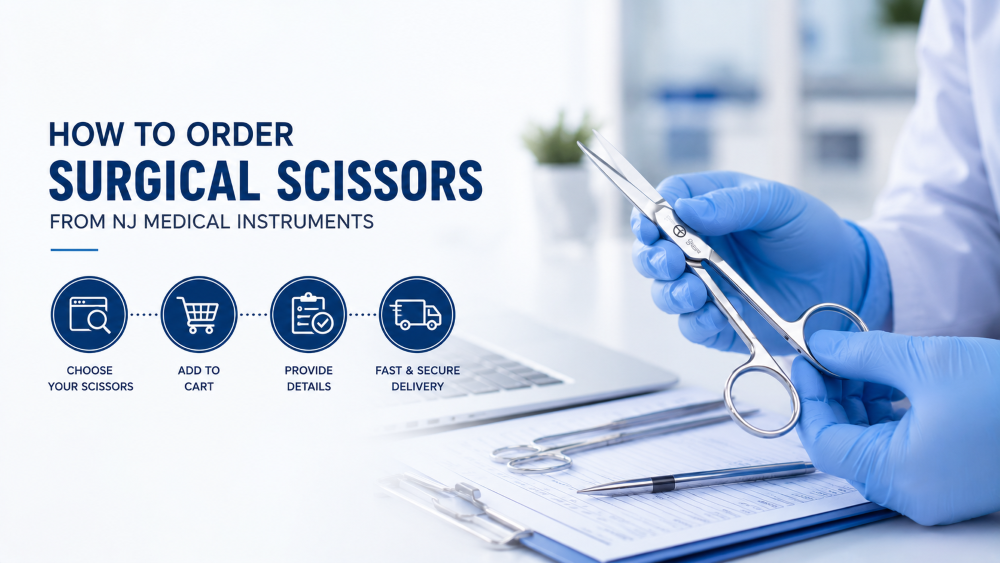
NJ Medical supplies hospitals, surgical centers, distributors, and individual practitioners directly through the online shop. All orders are fulfilled from Sialkot with global shipping to 80+ countries. Bulk pricing is available for hospitals and distributors — contact the team directly via WhatsApp (+92-333-8733922) or through the website for a custom quote.
Browse the full surgical scissors range and place your order directly: 👉 View all surgical scissors at NJ Medical Instruments
Frequently asked questions
What is the difference between Mayo and Metzenbaum scissors? Mayo scissors have heavier blades for cutting dense tissue and sutures. Metzenbaum scissors have finer blades designed exclusively for dissecting delicate tissue. Using Metzenbaum scissors to cut sutures will blunt them quickly.
Can surgical scissors be resharpened? Yes, most stainless steel surgical scissors can be resharpened by a qualified instrument technician. However, supercut and tungsten carbide variants should be returned to the manufacturer or a specialist for resharpening as standard sharpening techniques alter the geometry of the cutting edge.
What does supercut mean on surgical scissors? Supercut scissors have one micro-serrated blade. The serrations grip the tissue as the blades close, preventing slippage and producing a cleaner cut with less force. They are the standard specification for most dissecting applications.
How do I know if surgical scissors are ISO certified? Ask the supplier for their ISO 13485 certificate number and verify it. NJ Medical Instruments is ISO 13485 certified, CE marked, and FDA registered — certificates are available on request.
What is the minimum order for surgical scissors from NJ Medical? NJ Medical supplies single units through the online shop and bulk orders direct. There is no minimum order quantity for standard products. Contact the team for wholesale and distributor pricing on larger volumes.

Scissors are among the instruments where reusable quality pays back fastest. Our comparison covers when single-use instruments make more sense instead.
Scissors are rarely ordered on their own — they arrive as part of a tray. If you are specifying a whole set rather than a single pair, see what is inside twelve standard surgical trays and how to write each line so it cannot be misread.
2 thoughts on “How to Choose the Right Surgical Scissors for Each Procedure”