


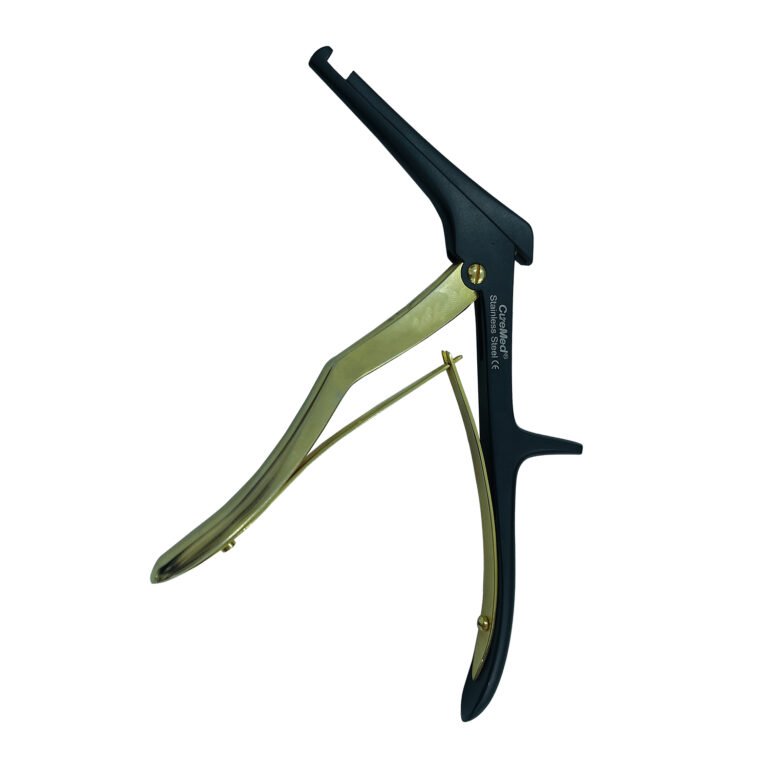
Kerrison Rongeur | NJ Medical Instruments
In stock
Kerrison Rongeurs: A Sliding Punch That Bites Rather Than Squeezes
A Kerrison rongeur removes bone by driving an upper cutting element along a fixed lower footplate, so the bite is a shearing action between two surfaces rather than a squeeze between two jaws. That sliding mechanism is what allows a clean, defined bite to be taken in a confined space — and it is also what makes this instrument mechanically more demanding than a simple pivoted rongeur, because the two elements must stay in exact register through every stroke and through years of reprocessing.
The sliding action and why register matters
The cutting element travels along a track. If the fit in that track loosens, the cutter arrives at the footplate slightly out of line and the bite stops being clean — bone is torn or compressed instead of sheared. Play in the slide is the characteristic wear mode of this design, and it shows up as a bite that requires more force and leaves a ragged margin long before the cutting edge itself is worn out. Track fit, not edge sharpness, is what to inspect first on a tired instrument.
Bite size, force and the stroke you can actually complete
The width of the cutting element sets how much bone comes away per stroke, and it also sets how much force the stroke needs. A wide bite in dense bone can require more force than can be applied smoothly at the handle, and a stroke that stalls halfway is worse than a smaller bite completed cleanly. Choosing the bite size is really choosing the largest stroke you can finish in one controlled movement in the bone you are actually working on.
Angles and the surfaces they reach
Patterns are supplied at several angles — commonly 40, 90 and 130 degrees — because the direction the cutting element faces determines which surfaces can be addressed from a given approach. A set spanning angles allows a removal to be completed without changing the exposure, which is the main practical reason these are bought in groups rather than singly.
Ejector mechanisms and take-apart construction
Each bite leaves a fragment in the mechanism. Ejector designs clear that fragment on the return stroke so the instrument stays working and the debris does not accumulate in the track. Take-apart construction goes further, separating the components so every internal surface of the slide can be reached during reprocessing — which matters especially on this design, since the track is both the part that must stay clean and the part whose fit determines cut quality.
Which Kerrison rongeur do you need?
| Requirement | Configuration | Typical specification | Chosen for |
|---|---|---|---|
| Fine margin work | Narrow bite | 1–2 mm | Control where each bite is least reversible |
| Bulk removal | Wider bite | 3–5 mm | Progress, where force allows a clean full stroke |
| Reaching around structures | Angled 40°, 90°, 130° | Matched to the approach | Completing a removal without changing exposure |
| Continuous working | Ejector mechanism | Clears on return stroke | Debris not accumulating in the track |
| Thorough reprocessing | Take-apart | Separates fully | Access to every surface of the slide |
Related instruments in this range
- General Surgery — the full range this category sits within
- Laminectomy Punches — punch removal in confined access
- Rongeurs — pivoted piecemeal bone removal
- Bone Cutters & Rongeurs — cutting and removing bone
- Surgical Instruments — the wider instrument catalogue
Wholesale, OEM and private-label supply
NJ Medical Instruments manufactures Kerrison rongeurs in Sialkot, Pakistan, supplying single instruments through this shop and graded sets in bulk to hospitals, neurosurgical and spinal units, and distributors. As the manufacturer we produce to specification — bite width, cutting angle, footplate thickness, shaft length, ejector and take-apart construction, marking and private-label packaging. Because this category is used as a graded family spanning widths and angles, we can quote for a complete set. Email info@njmedicalinstruments.com or message +92-333-8733922.
Frequently asked questions
How is a Kerrison different from a standard rongeur?
A standard rongeur pivots, squeezing bone between two jaws. A Kerrison slides — an upper cutting element travels along a fixed lower footplate, shearing the bone between them. The sliding action gives a cleaner, more defined bite in confined spaces, at the cost of a mechanism whose fit has to stay precise.
Why has my Kerrison started tearing instead of cutting?
Almost always play in the slide. Once the track loosens, the cutter reaches the footplate slightly out of register and shears less cleanly, so the bite needs more force and leaves a ragged margin. This appears well before the cutting edge itself is worn, so check track fit before assuming the instrument needs sharpening.
What bite width should I choose?
The largest you can drive through in one smooth, completed stroke in the bone you are actually working on. A wide bite that stalls mid-stroke is worse than a narrower one taken cleanly, so dense bone often calls for a smaller bite than the same surgeon would use elsewhere. Most sets carry several widths.
Do I need an ejector mechanism?
It helps considerably in sustained use. Each bite leaves a fragment in the mechanism, and an ejector clears it on the return stroke so debris does not build up in the track — the same track whose fit determines cut quality.
What are your Kerrison rongeurs made from?
They are manufactured from surgical-grade stainless steel, with the cutting element ground and the slide fitted and inspected before dispatch. Both reusable and single-use options exist across our range — specify which you need, or ask for the material specification of a particular pattern.
Can I order a graded set or custom specification?
Yes. As an OEM manufacturer we supply retail quantities through this shop and bulk orders direct from the factory, including graded sets spanning bite widths and angles. Custom bite widths, angles, footplate thicknesses, shaft lengths, ejector and take-apart construction, laser marking and private-label packaging are available. Send your specification and quantity for a quotation.