


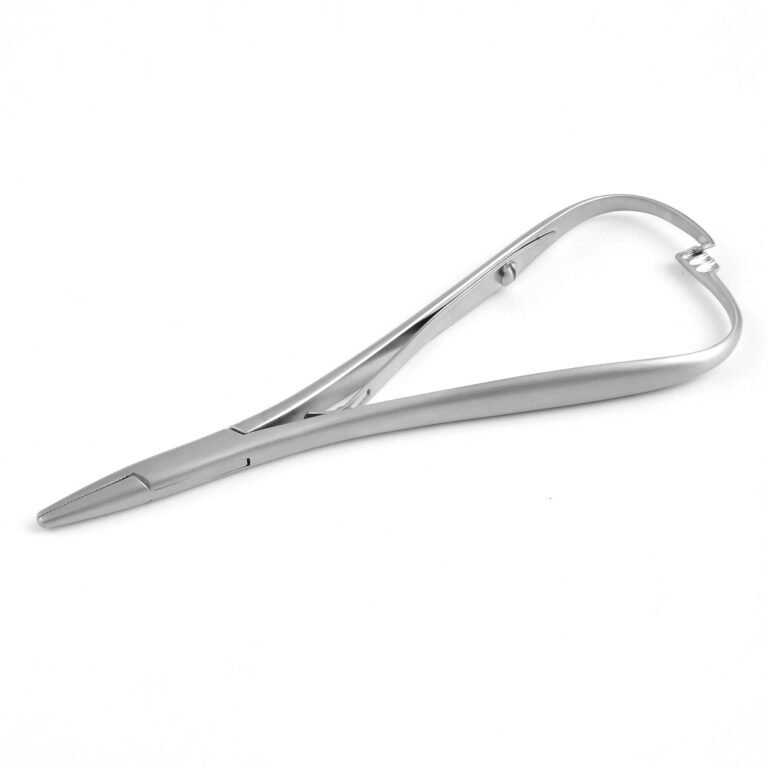
Mathieu Needle Holders | NJ Medical Instruments
In stock
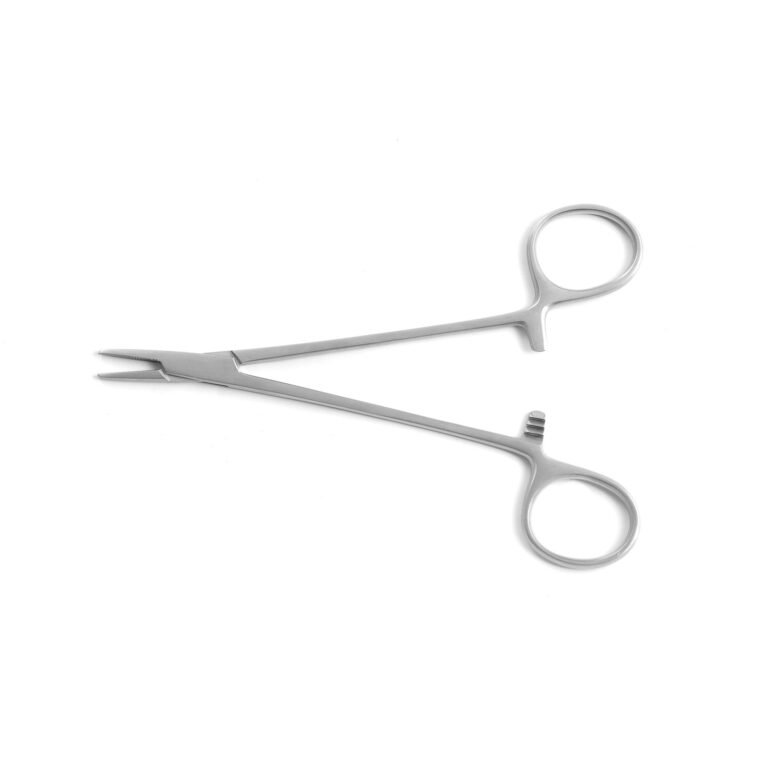
Mayo-Hegar Needle Holder | NJ Medical Instruments
In stock
Needle Holders: Holding a Curved Needle at a Fixed Angle
A needle holder has to grip a small, hard, curved object firmly enough that it does not rotate under load, without gripping so hard that it damages the needle or the jaw. The needle is driven by rotating the wrist, so any movement of the needle within the jaws goes straight into the accuracy of the bite. This is why the jaw insert — the small surface that actually contacts the needle — matters more than the size, weight or finish of the rest of the instrument.
Jaw inserts and why they wear out first
The gripping surfaces take the entire load of every needle pass, concentrated onto a contact area of a few square millimetres. Cross-hatched or diamond-pattern inserts hold the needle from rotating in any direction, and their pattern is what does the work — smooth or worn faces let the needle roll no matter how tightly the ratchet is closed. Because these faces wear before anything else on the instrument, jaw condition is the practical measure of a needle holder's remaining life.
Matching jaw size to needle size
An oversized jaw on a fine needle contacts at the tip only, concentrating force onto one point and bending or scoring the needle. An undersized jaw on a heavy needle cannot generate enough grip across the contact area, so the needle rotates on the first pass through dense tissue. This is the most common mismatch in the category, and it is why needle holders are stocked across a size range rather than bought as a single general-purpose instrument.
Ratchet behaviour: holding, and letting go at the right moment
The ratchet has to lock positively at a setting that grips the needle, and it has to release cleanly when the surgeon decides — not a moment before, and not with a jolt that displaces the needle just as it enters tissue. A ratchet that releases suddenly moves the needle tip at exactly the wrong instant. Smooth, progressive release is a genuine quality difference between patterns and it is felt immediately in use.
Straight, curved and self-releasing patterns
Straight jaws are the general-purpose choice and give the most direct relationship between wrist rotation and needle path. Curved jaws let the needle be presented at an angle in confined or deep spaces where the hand cannot be positioned behind it. Self-releasing and spring-handled patterns dispense with the ring handles for fine work, where the ratchet action itself would disturb the delicacy of the placement.
Which needle holder do you need?
| Work | Jaw and handle | Typical length | Chosen for |
|---|---|---|---|
| General suturing | Straight jaws, ring handle, ratchet | 14–18 cm | Direct control across common needle sizes |
| Heavy tissue | Wide jaws, robust ratchet | 18–24 cm | Grip across a larger contact area |
| Fine and delicate work | Fine jaws, spring handle | 12–16 cm | Placement undisturbed by ratchet action |
| Deep or confined field | Curved jaws, long shanks | 20–26 cm | Presenting the needle where the hand cannot go |
| Combined cutting | Jaws with integral scissor | 14–18 cm | Fewer instrument exchanges during closure |
Related instruments in this range
- General Surgery — the full range this category sits within
- Forceps — tissue handling during suturing
- Suture & Suture Carrying Scissors — cutting suture material
- Artery Forceps and Ligature Clamps — haemostatic control
- Surgical Instruments — the wider instrument catalogue
Wholesale, OEM and private-label supply
NJ Medical Instruments manufactures needle holders in Sialkot, Pakistan, supplying single instruments through this shop and bulk quantities direct to hospitals, surgical centres, dental practices and distributors. As the manufacturer we build to specification — jaw size and insert pattern, jaw form, ratchet graduation and release characteristics, handle type, length, marking and private-label packaging. For volume pricing or an OEM quotation, email info@njmedicalinstruments.com or message +92-333-8733922.
Frequently asked questions
Why does the needle keep rotating in the jaws?
Either the jaw pattern has worn smooth, or the jaw is the wrong size for the needle. A worn insert cannot hold regardless of ratchet setting, and an undersized jaw on a heavy needle cannot generate enough grip across the contact area. Closing the ratchet harder is not the fix for either.
How do I match jaw size to needle size?
Choose a jaw whose gripping face is proportionate to the needle, so contact is spread across the face rather than concentrated at the tip. An oversized jaw on a fine needle scores or bends it; an undersized jaw on a heavy needle lets it turn. This is why needle holders are stocked as a size range.
What makes one ratchet better than another?
Positive locking at a usable setting and a clean, progressive release. A ratchet that releases suddenly jolts the needle tip at the moment of placement, which is exactly when accuracy matters most. The difference is felt immediately in use even though it is hard to see on the bench.
When should I use a spring-handled needle holder?
For fine and delicate work, where the mechanical action of a ring-handled ratchet would itself disturb the placement. Spring and self-releasing patterns trade the positive lock for a lighter, more continuous feel that suits small needles and precise suturing.
What are your needle holders made from?
They are manufactured from surgical-grade stainless steel, with jaw faces patterned and ratchets fitted and inspected before dispatch. Both reusable and single-use options are available across our range — specify which you need when ordering, or ask for the material specification of a particular pattern.
Can I order in bulk or to our own specification?
Yes. As an OEM manufacturer we supply retail quantities through this shop and bulk orders direct from the factory. Custom jaw sizes and insert patterns, ratchet characteristics, handle types, lengths, laser marking and private-label packaging are available. Send your specification and quantity for a quotation.