


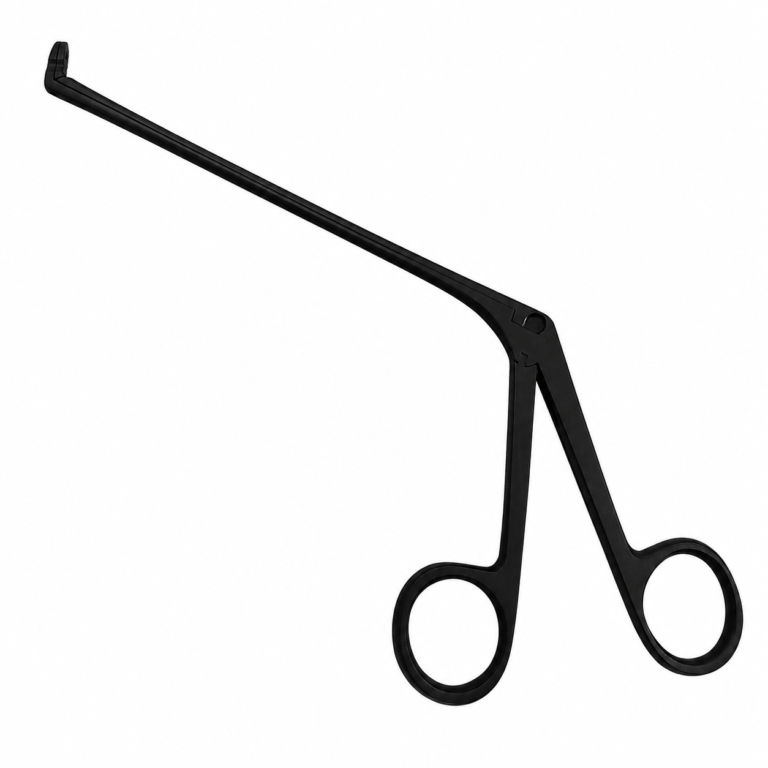
Micro Alligator Ear Forceps | NJ Medical Instruments
In stock
Ear Instruments: Working Down a Narrow Canal That Bends
Almost every constraint in ear instrumentation comes from one fact: the working space is a short, narrow, curved tube whose walls are sensitive and whose far end must not be touched carelessly. There is no room to approach from a second angle, no space for a hand to enter, and the instrument itself blocks the view of whatever is beyond it. Ear instruments are therefore built around a compromise every design has to solve — being slim enough to leave a line of sight past the shaft, while still doing useful work at the tip.
The instrument must not block its own view
Illumination and vision travel down the same canal the instrument occupies. A shaft that is thicker than necessary casts a shadow over the very area being worked on. This is why ear instruments have disproportionately fine shafts relative to their working ends, and why bayonet and offset forms recur throughout the category — stepping the shaft sideways preserves the sightline past it. Slimness here is not delicacy for its own sake; it is what makes the tip usable at all.
Angled tips for a canal that is not straight
The canal curves, so a tip that points directly along the shaft cannot address surfaces at its far end. Working ends are angled, hooked or bent so they can reach around that curve and present their working face to a surface the shaft approaches obliquely. The angle also lets a tip pass beyond a structure and work back toward the operator, which is a movement that cannot be performed with a straight instrument in a confined tube.
Hooks, loops, curettes and forceps — four different actions
Hooks engage an edge and pull toward the operator. Loops encircle and draw material out without gripping it. Curettes scrape along a surface with a defined edge. Fine alligator and cup forceps grasp and hold, with jaws that open in the plane of the canal so they can be opened at all in the available space. Choosing between them is choosing an action, not a size — and the wrong action in this space usually means the instrument simply cannot be applied.
Why small does not mean fragile
These instruments are fine, but they are worked against tissue and sometimes against firm material, and a tip that flexes under load is unusable because it stops going where it is pointed. Temper and shaft rigidity matter more at this scale than at any other, since a small amount of flex at a fine tip is a large proportional error. Rigidity is also what transmits feel back to the hand — and in a space this confined, feel is a substantial part of the information available.
Which ear instrument do you need?
| Action required | Instrument | Working end | Notes |
|---|---|---|---|
| Engage and draw an edge | Ear hook | Angled or right-angle hook | Reaches past and works back toward the operator |
| Encircle and withdraw | Ear loop | Closed wire | Removes without gripping or compressing |
| Scrape a surface | Ear curette | Cup with sharpened rim | Defined removal with tactile feedback |
| Grasp and hold | Alligator or cup forceps | Jaws opening in the canal plane | Only jaw geometry that can open in the space |
| Preserve the sightline | Any, in bayonet form | Offset shaft | Keeps shaft and hand out of the view |
Related instruments in this range
- ENT Diagnostic — the full range this category sits within
- Surgical Loops — closed-wire retrieval
- Bone Curettes — scraping with tactile feedback
- Forceps — tissue handling
- Surgical Instruments — the wider instrument catalogue
Wholesale, OEM and private-label supply
NJ Medical Instruments manufactures ear and otology instruments in Sialkot, Pakistan, supplying single instruments through this shop and complete ENT sets in bulk to hospitals, ENT departments, clinics and distributors. As the manufacturer we produce to specification — working-end form and angle, shaft diameter and rigidity, bayonet and offset geometry, overall length, handle form, marking and private-label packaging. ENT departments usually order across the range of actions rather than singly; we can quote for a complete set. Email info@njmedicalinstruments.com or message +92-333-8733922.
Frequently asked questions
Why are ear instruments so slim?
Because light and vision travel down the same narrow canal the instrument occupies, so a thicker shaft shadows the area being worked on. The fineness is functional rather than delicate — it is what leaves a usable line of sight past the instrument to the tip.
What is a bayonet form for?
It steps the shaft sideways so the hand and shaft sit out of the direct line of view while the tip stays on axis. In a space where the operator looks straight down a tube, that offset is often the difference between being able to see the working end and not.
Why are the tips angled?
Because the canal curves, so a tip pointing straight along the shaft cannot present its working face to surfaces at the far end. Angling also lets the tip pass beyond a structure and work back toward the operator — a movement a straight instrument cannot perform in a confined tube.
How do I choose between a hook, a loop, a curette and forceps?
By the action needed, not by size. Hooks engage an edge and pull; loops encircle and withdraw without gripping; curettes scrape with a defined edge; fine forceps grasp and hold. In a space this restricted, the wrong action usually means the instrument cannot be applied at all.
Are these instruments fragile?
They are fine but should not flex. A tip that bends under load stops going where it is pointed, and at this scale a small deflection is a large proportional error. Shaft rigidity and temper also carry feel back to the hand, which is a significant part of the information available in a confined field.
Can I order a complete ENT set or custom specification?
Yes. As an OEM manufacturer we supply retail quantities through this shop and bulk orders direct from the factory, including full sets spanning hooks, loops, curettes and forceps. Custom working ends, angles, shaft diameters, lengths, handle forms, laser marking and private-label packaging are available. Send your specification and quantity for a quotation.