


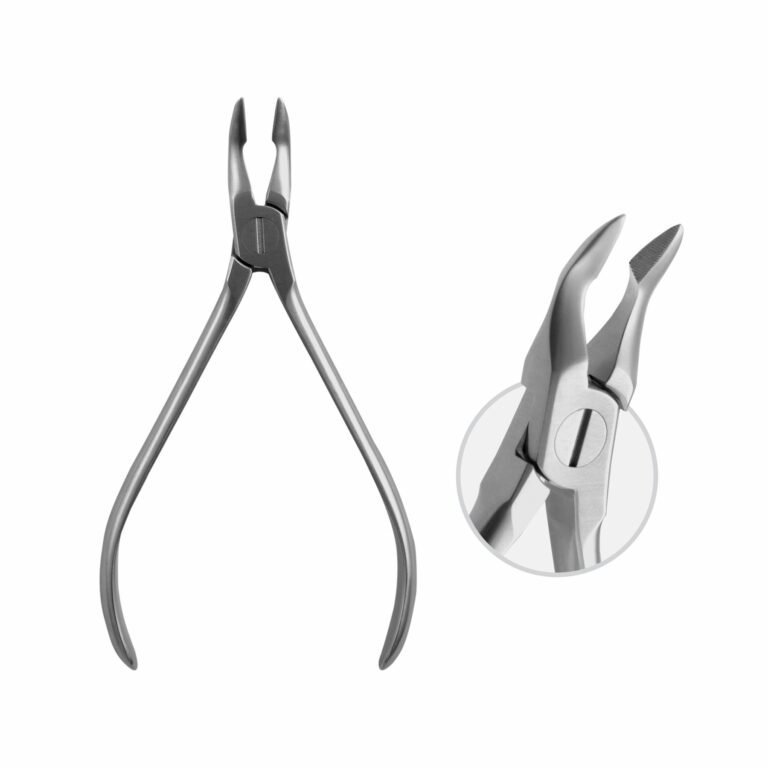
Weingart Universal Pliers | NJ Medical Instruments
In stock
Orthodontic Pliers: Bending, Cutting and Placing Appliances
Orthodontic pliers are named for what their beaks do to wire, and once you understand that, the whole range becomes readable. Orthodontics is largely the controlled application of force through wire, so the instruments exist to shape that wire precisely, cut it cleanly in the mouth, and place or remove the attachments that transmit force to the teeth. A plier that puts the wrong bend in an archwire does not simply look untidy — it changes the force system acting on the dentition. NJ Medical Instruments manufactures the full range in surgical-grade stainless steel, including tungsten-carbide-inserted cutters, supplied worldwide direct from the factory for individual purchase and for bulk, wholesale, and OEM/private-label supply.
Reading the beaks
The beak geometry tells you the bend it makes. Bird-beak pliers pair a cone with a pyramid, so the wire can be formed into loops and curves of graded radius depending where along the cone it sits. Tweed loop-forming pliers have stepped or graduated beaks that produce loops of consistent, repeatable size — consistency matters because a loop determines the force delivered. Three-jaw pliers grip the wire between two beaks on one side and one on the other, allowing sharp, controlled angular bends in heavier wire.
Cutters and why insert quality matters
Cutting hardened orthodontic wire is what destroys pliers. Distal end cutters trim the wire flush behind the last molar tube and, critically, hold the cut segment so it is not released into the patient's mouth — that retention feature is the reason a general wire cutter is not an acceptable substitute. Pin and ligature cutters handle fine ligature wire. Hard wire cutters are built for stainless and nickel-titanium archwire. Tungsten carbide inserts hold their cutting edge far longer against these materials, which is why they are worth the difference on any cutter in daily use.
Placement and removal
Bracket placement pliers hold a bracket by its base or wings for accurate positioning during bonding. Band seaters and removers, and bracket removal pliers, take appliances off with force directed to break the adhesive bond rather than stress the enamel.
Which orthodontic plier do you need?
| Plier | Beak / action | Used for |
|---|---|---|
| Bird-beak plier | Cone and pyramid beaks | Forming loops and curves in wire |
| Tweed loop-forming plier | Stepped graduated beaks | Loops of consistent, repeatable size |
| Three-jaw plier | Two beaks against one | Sharp angular bends in heavy wire |
| Distal end cutter | Cuts and retains the offcut | Trimming flush behind the molar tube |
| Pin and ligature cutter | Fine cutting edges | Cutting ligature wire |
| Hard wire cutter | TC inserts | Stainless and NiTi archwire |
| Bracket placement plier | Holds bracket base or wings | Positioning during bonding |
| Band remover | Cushioned lifting tip | Removing bands without enamel stress |
Explore related dental instruments
- All Dental Instruments
- Extracting Forceps and Dental Elevators
- Mouth Mirrors, Scalers, Explorers & Probes
- Amalgam Pluggers, Condensers & Burnishers
All manufactured in surgical-grade stainless steel to international standards, reusable and autoclavable, with worldwide shipping.
Bulk, wholesale & OEM supply
As a direct manufacturer, NJ Medical Instruments supplies orthodontic pliers in bulk and wholesale quantities to orthodontic practices, dental clinics, dental schools, and distributors, and produces OEM / private-label instruments to custom specifications and laser marking. Contact us by email at info@njmedicalinstruments.com or by WhatsApp for volume pricing — no minimum-order barriers, no middlemen.
Frequently asked questions
What are bird-beak pliers used for?
Bird-beak pliers have a cone on one beak and a pyramid on the other, letting the operator form loops and curves in orthodontic wire. The radius of the bend depends on where along the cone the wire is positioned.
What is a distal end cutter used for?
A distal end cutter trims archwire flush behind the last molar tube. Critically, it also holds the cut segment rather than releasing it, which is why an ordinary wire cutter is not a safe substitute in the mouth.
Why do orthodontic cutters have tungsten carbide inserts?
Hardened stainless and nickel-titanium archwire blunts plain steel edges quickly. Tungsten carbide inserts hold their cutting edge far longer against these materials, which makes them worthwhile on any cutter in daily use.
What is the difference between a ligature cutter and a hard wire cutter?
A ligature cutter has fine edges for thin ligature wire. A hard wire cutter is built more heavily for stainless steel and nickel-titanium archwire. Using a ligature cutter on hard archwire will damage its edges.
What are three-jaw pliers used for?
Three-jaw pliers grip wire between two beaks on one side and a single beak on the other, giving the control needed for sharp angular bends in heavier gauge wire.
Do you supply orthodontic pliers in bulk or for OEM / private label?
Yes. As a direct manufacturer we supply orthodontic pliers in bulk and wholesale quantities and offer OEM / private-label production to custom specifications. Contact us by email or WhatsApp for volume pricing.