


Top 10 Must-Have Surgical Instrument Sets for Operating Theaters

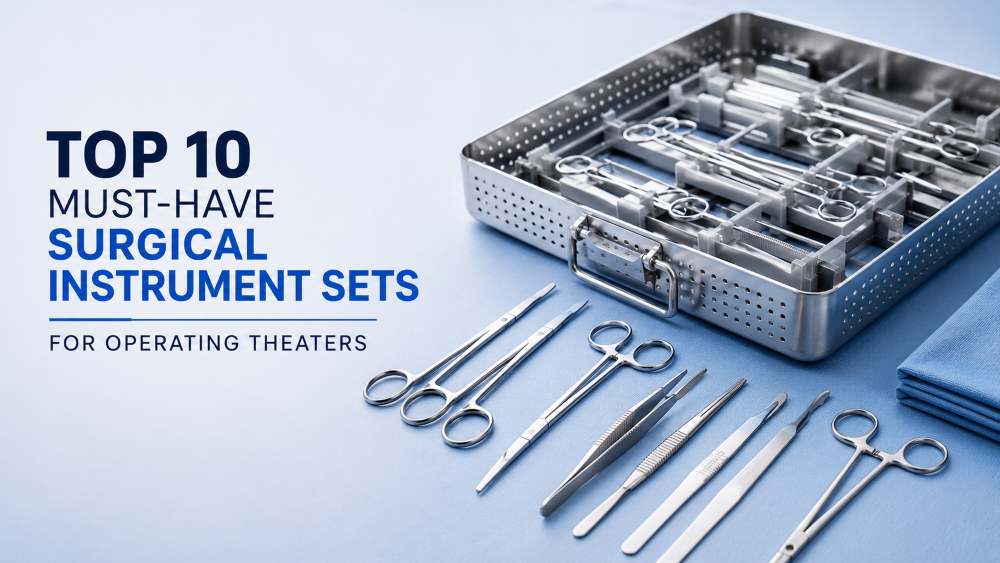
Equipping an operating theater is one of the most consequential purchasing decisions a hospital procurement manager or clinic director makes. Choose the wrong sets — or miss a critical instrument category — and you create delays, workarounds, and unnecessary pressure on scrub nurses who end up improvising with whatever is available on the tray.
This guide covers the 10 surgical instrument sets every operating theater should have, what each set must contain, the clinical scenarios that demand them, and how to source them at the right specification and price point.
NJ Medical Instruments has manufactured and supplied complete surgical instrument sets from Sialkot, Pakistan since 1990. All sets are ISO 13485 certified, CE marked, and FDA registered. They supply hospitals, surgical centers, and distributors across 80+ countries — directly, with no distribution layer between the factory and your theater.
How to use this guide
This list covers the 10 essential set categories any well-equipped theater needs. Within each, we list what the set must contain, what to check before buying, and where to source it. For specialty centers — cardiac, neurosurgical, or ophthalmic — additional sets are required beyond this core list and are noted where relevant.
Set 1 — General Surgery / Laparotomy Set
The most important set in any surgical facility.
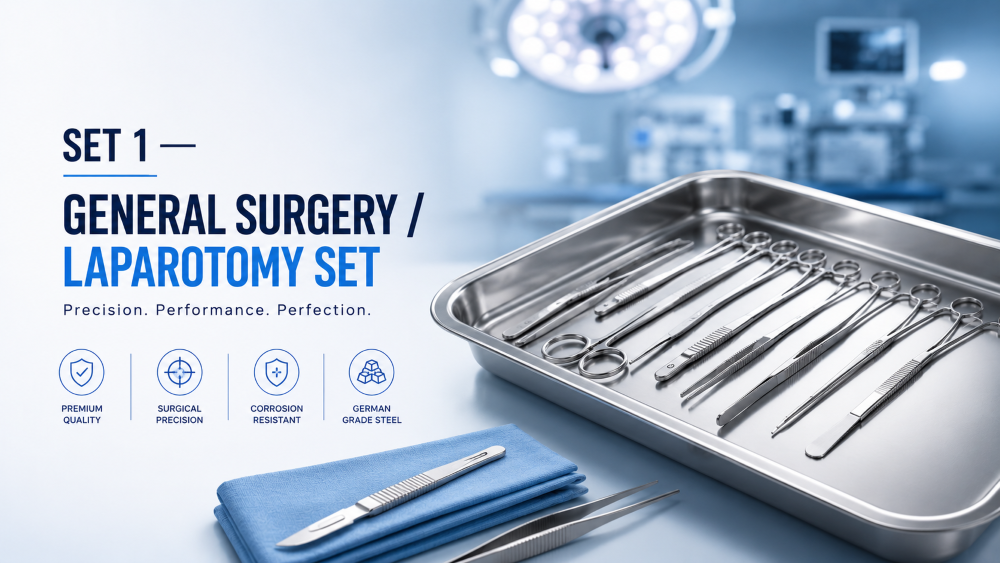
No operating theater is complete without a fully stocked general surgery instrument set. This is the foundation set used in abdominal procedures, exploratory laparotomy, hernia repair, appendectomy, and general soft-tissue surgery. It is also the set from which scrub nurses pull supplementary instruments when other specialty trays run short.
A complete general surgery set must include:
- Scalpel handles — scalpel handle No. 3 and scalpel handle No. 4 for different blade sizes
- Dissecting scissors — Mayo dissecting scissors (straight and curved) and Metzenbaum dissecting scissors
- Hemostatic forceps — Halsted Mosquito artery forceps, Kelly artery forceps, Kocher artery forceps
- Tissue forceps — Adson thumb forceps cross serrated, DeBakey vascular tissue forceps
- Needle holders — Mayo Hegar needle holder and needle holder tungsten carbide serrated jaw
- Grasping forceps — Babcock intestinal grasping forceps, Allis tissue forceps standard pattern
- Retractors — Langenbeck Green retractor 17 cm
- Towel clamps — Backhaus towel clamp
- Sponge holders — Foerster sponge holding forceps
- Solution bowl — round bowl for solutions stainless steel
NJ Medical supplies the general surgery HCIV instrument set — a complete, pre-configured theater-ready set suitable for district hospitals and surgical centers performing a full range of general procedures.
Minimum sets per theater: 3 (to allow for sterilization cycling). For high-volume theaters running multiple procedures per day, 4–5 sets are recommended.
Set 2 — Suturing and Wound Closure Set
The most frequently used set across every specialty.
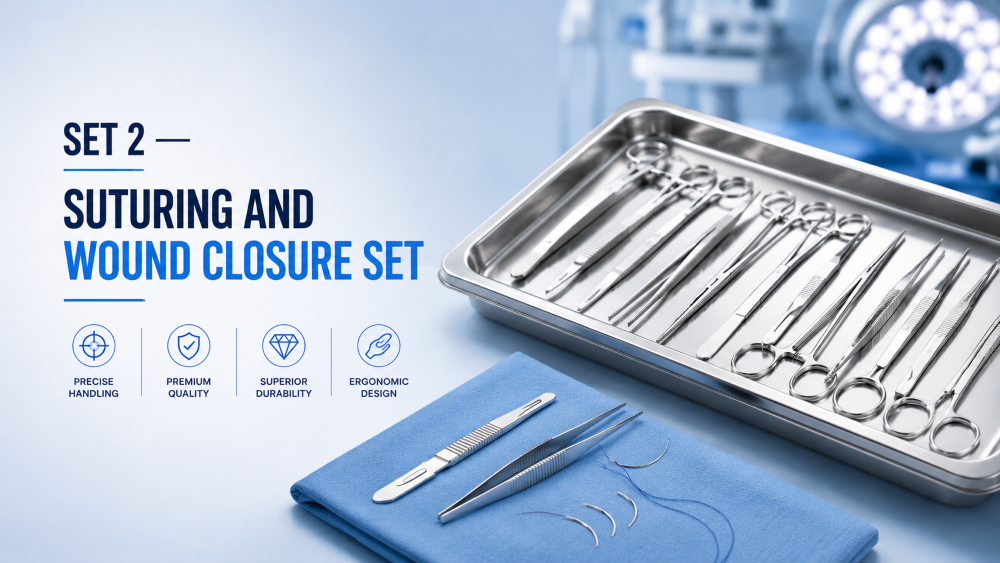
Every procedure ends with closure. A dedicated suture and wound closure set keeps the final stage of surgery efficient and reduces the risk of running out of critical instruments mid-closure on complex cases.
Must contain:
- Multiple needle holders — Mayo Hegar needle holder, Mathieu needle holders, Gillies needle holder tungsten carbide serrated jaw
- Fine tissue forceps — Adson thumb forceps lightweight fenestrated handle, Adson tissue forceps tungsten carbide 1×2 teeth
- Suture scissors — Littauer stitch scissors, Spencer stitch scissors angled delicate
- Bandage and dressing scissors — Lister bandage scissors
Procurement note: Needle holders are the highest-wear instruments in any set. Specify tungsten carbide jaw inserts for all needle holders in high-volume theaters — the TC jaw maintains grip on suture needles far longer than plain stainless steel, significantly reducing the cost-per-use over a 12-month period.
Set 3 — Gynecology and Obstetrics Set
Essential for any facility delivering maternity or women’s health services.
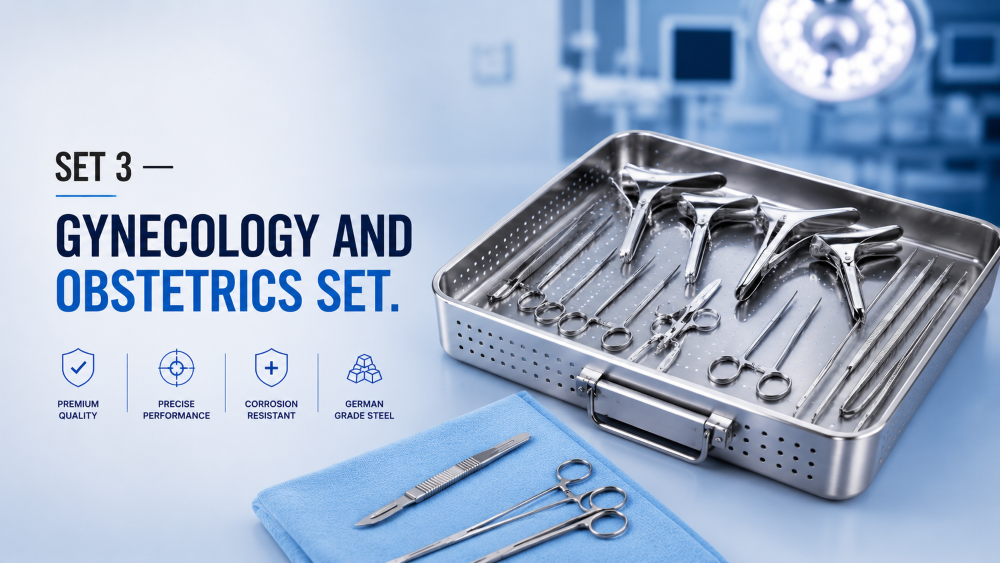
Gynecological procedures — from diagnostic colposcopy to hysterectomy — require a specific instrument complement that does not overlap significantly with general surgery. A poorly equipped gynecology tray is one of the most common procurement gaps in district and regional hospitals.
Must contain:
- Vaginal specula — Graves vaginal speculum, Graves speculum, Cusco speculum, Collin speculum
- Endocervical speculum — Kogan endocervical speculum
- Hysterectomy forceps — Heaney hysterectomy forceps
- Gynecology needle holder — Heaney needle holder tungsten carbide curved serrated jaw
- Heavy hemostatic clamps — Rochester-Ochsner artery forceps, Rochester-Pean artery forceps
Why this matters: The WHO lists gynecological instrument sets as a core component of essential surgical care packages for district hospitals — hospitals that lack dedicated gynecology sets routinely substitute general surgical instruments, which increases procedure times and complication risk in pelvic surgery.
Minimum sets per gynecology theater: 3 full sets to maintain sterilization cycling.
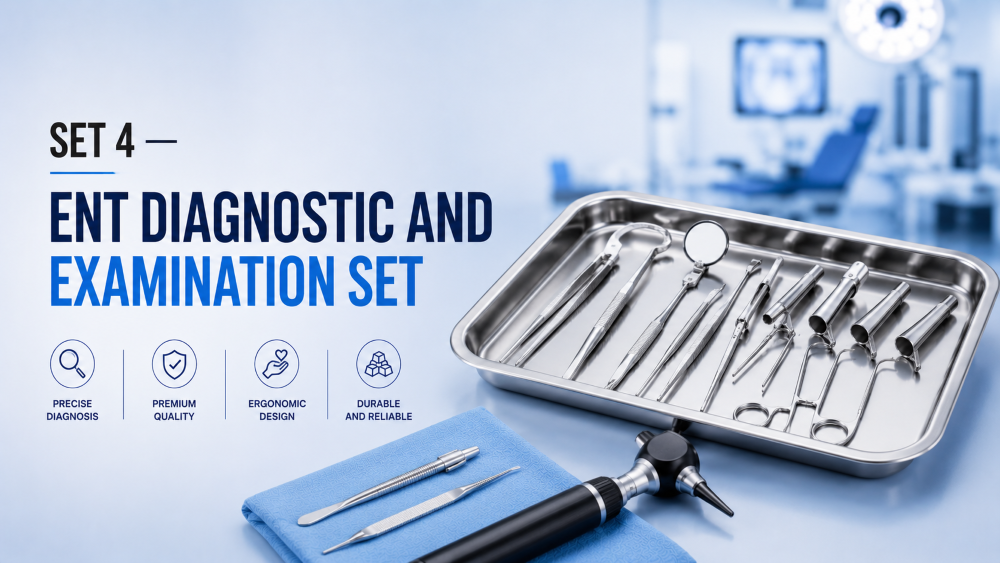
Set 4 — ENT Diagnostic and Examination Set
Required for every ENT clinic, emergency department, and outpatient surgical facility.
ENT diagnosis and minor procedures need a compact but comprehensive instrument set covering the ear, nose, and throat. Many hospitals understock ENT instruments because ENT is perceived as a low-acuity specialty — but a poorly equipped ENT tray delays diagnosis of airway emergencies, missed foreign bodies, and undertreated otitis.
Must contain:
- Complete otoscope, ophthalmoscope, and examination instruments — ENT diagnostic complete set covers all standard diagnostic tools in a single ready-to-use kit
- Fiber optic upgrade option — ENT diagnostic fiber optic otoscope set for facilities requiring higher diagnostic precision
- Combined otoscope and ophthalmoscope set — fiber optic otoscope ophthalmoscope set LED ear eye examination kit
For ENT surgical theaters, the diagnostic set must be supplemented with nasal specula, ear forceps, tonsil instruments, and nasal cutting instruments. The FESS instruments complete set covers endoscopic sinus surgery requirements.
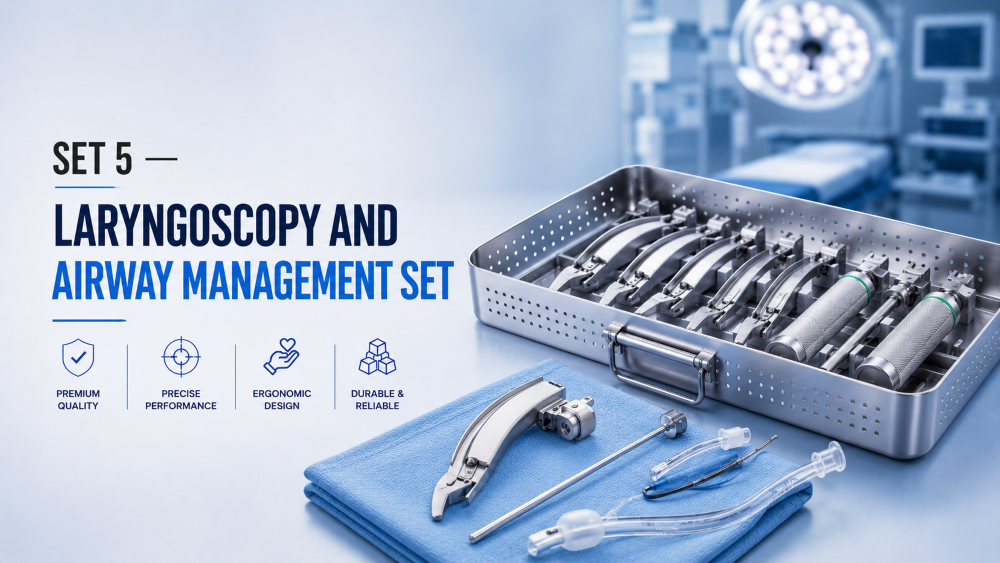
Set 5 — Laryngoscopy and Airway Management Set
Critical for every anesthetic department, ICU, and emergency theater.
Airway management instruments are life-critical. A laryngoscope failure during a rapid sequence induction is one of the most dangerous situations in clinical medicine — and it is entirely preventable with a properly maintained set of backup instruments.
Must contain:
- Standard curved blade laryngoscope — conventional curved laryngoscope set with multiple blade sizes (1, 2, 3, 4)
- Fiber optic upgrade — fiber optic laryngoscope set for difficult airway management and video-assisted intubation protocols
Procurement critical point: Every anesthetic bay and every resuscitation trolley should have at minimum two fully functional laryngoscopes. Blade handles are the most common failure point — always stock spare handles alongside blade sets.
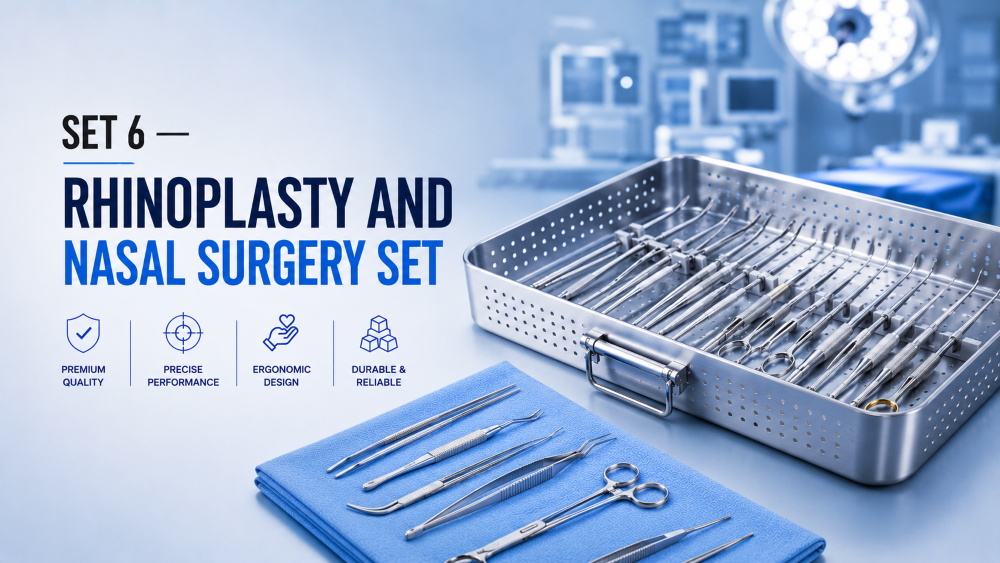
Set 6 — Rhinoplasty and Nasal Surgery Set
Essential for any plastic surgery, ENT, or craniofacial surgical unit.
Rhinoplasty and septorhinoplasty procedures require highly specific instruments that are not interchangeable with general surgical tools. Using general forceps and scissors on nasal cartilage causes unnecessary structural trauma and compromises surgical outcomes.
Must contain:
- Complete nasal surgery instrument set — complete rhinoplasty instruments set of 69 pieces covers the full range of osteotomes, rasps, scissors, elevators, and retractors for a comprehensive nose surgery program
- Alternative complete sets — Gubisch complete rhinoplasty instruments set and Gunter rhinoplasty instruments set for surgeons using specific technique-matched instrument configurations
- Compact option — rhinoplasty instruments set of 50 pieces for lower-volume centers
Procurement note: Rhinoplasty instrument sets are among the highest-value sets in plastic surgery. Request full instrument lists from the supplier and cross-reference against your surgical team’s preferred instrument specifications before ordering. NJ Medical provides full instrument lists for all sets on request.
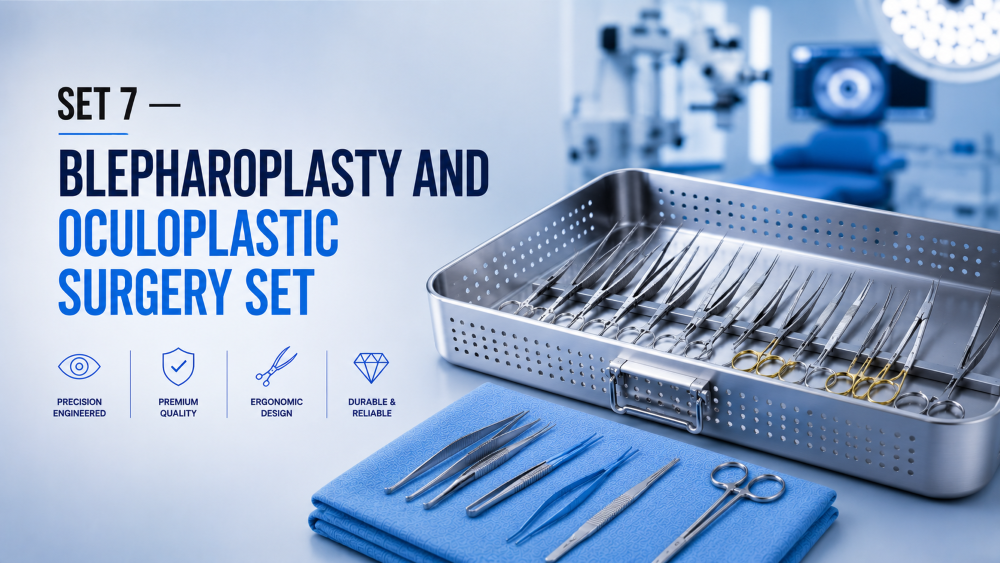
Set 7 — Blepharoplasty and Oculoplastic Surgery Set
Required for any plastic surgery unit performing eyelid procedures.
Blepharoplasty — upper and lower eyelid surgery — is one of the most commonly performed aesthetic procedures globally. The instruments required are fine, precise, and entirely different from general surgical instruments. Using the wrong scissors or forceps on eyelid tissue causes avoidable scarring and poor outcomes.
Must contain:
- Complete blepharoplasty set — blepharoplasty instruments set of 30 pieces micro eye surgery set — covers all instruments required for upper and lower lid surgery including scissors, forceps, needle holders, and retractors
- Specialized forceps — Adson blepharoplasty forceps tungsten carbide inserts
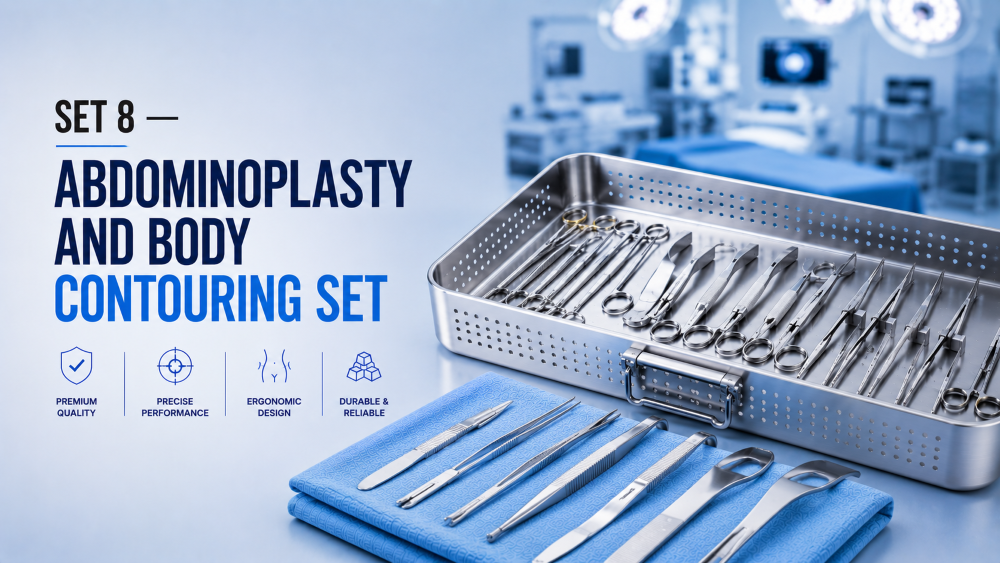
Set 8 — Abdominoplasty and Body Contouring Set
For plastic surgery units performing tummy tuck, body lift, and contouring procedures.
Body contouring procedures involve large-field dissection, complex tissue handling, and precise closure. The instrument requirements span from heavy dissectors and retractors to fine suture-specific needle holders and scissors.
Must contain:
- Complete abdominoplasty set — abdominoplasty surgery instruments set
- Breast augmentation set — breast augmentation instrument set for units performing combined procedures
Procurement consideration: Body contouring sets are high-value purchases that are often delayed or deprioritized in hospital procurement. In plastic surgery units where these procedures generate significant revenue, the ROI on a complete body contouring instrument set is recovered within the first two to three procedures.
Set 9 — Orthopedic and Spinal Instrument Sets
Required for any surgical facility performing bone, joint, or spinal procedures.
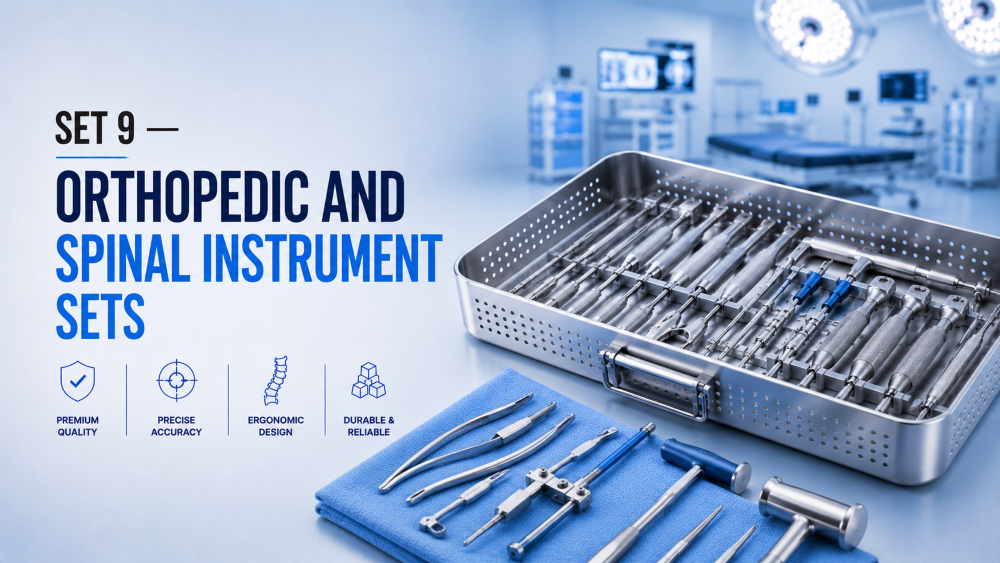
Orthopedic and spinal surgery requires heavy-duty, precision-engineered instruments that are purpose-built for bone work. General surgical instruments are not appropriate substitutes for bone rongeurs, chisels, or pedicle screw instrumentation.
Must contain by sub-specialty:
- Spinal surgery — spinal pedicle screw instrument set, spine surgery set 5.5 mm titanium pedicle screw, major spinal surgical instrument set, spinal retractor instrument set anterior cervical retractor kit
- Cervical spine — anterior cervical plate instrument set, cervical cage surgical set
- General orthopedic — bone curette, bone curette long model, bone rongeur
- Hardware removal — broken screw removal set
Set 10 — Ophthalmic Surgery Set
Essential for any eye surgery unit.
Ophthalmic surgery requires the finest, most precise instruments in clinical use. The margins for error in cataract, corneal, and strabismus surgery are measured in fractions of a millimeter — instrument quality, surface finish, and jaw precision directly affect patient outcomes.
Must contain:
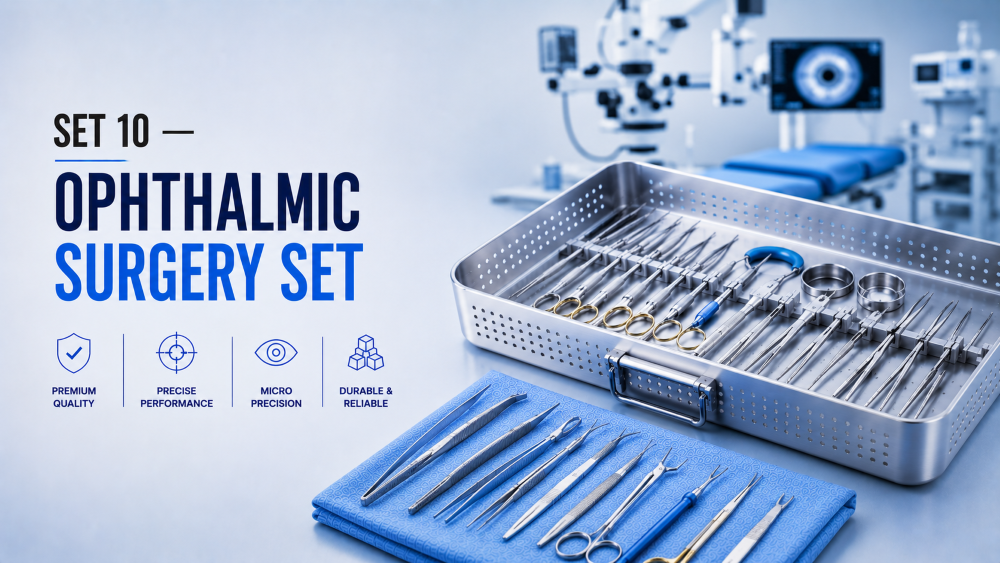
- Complete ophthalmic set — ophthalmic surgery set
- Precision forceps — Castroviejo suturing forceps delicate tungsten carbide 1×2 teeth, Castroviejo tying forceps
- Calipers — Castroviejo caliper 9 cm 40 mm measuring range
Procurement note: Ophthalmic instruments have the narrowest tolerance requirements of any instrument category. Always request sample inspection before bulk ordering and confirm that TC insert instruments have been tested for jaw-tip alignment accuracy.
The one thing every set needs: a proper sterilization tray
oper sterilization tray
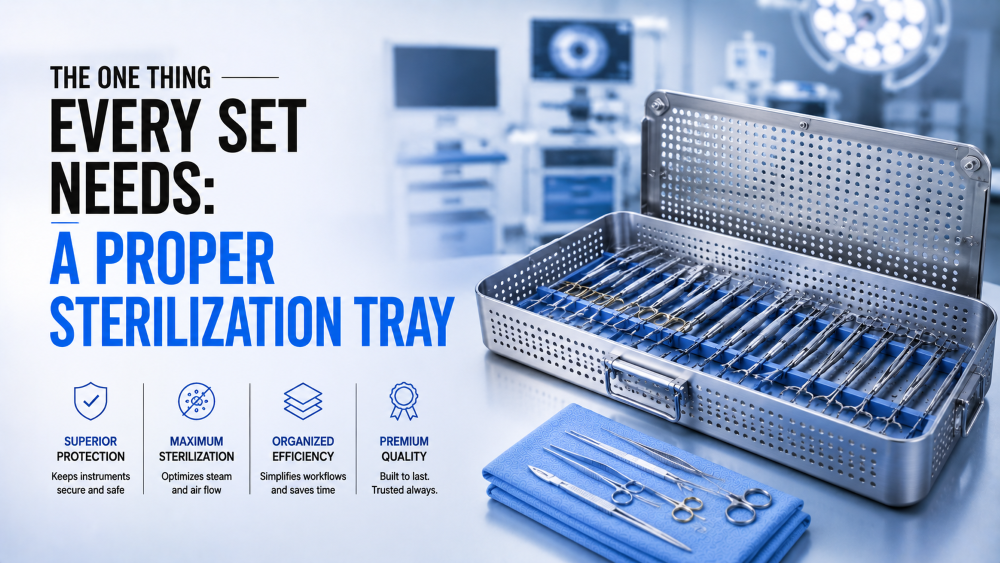
A surgical instrument set is only as good as the sterilization system that supports it. Instruments stored loose or in inappropriate containers suffer accelerated wear, cross-contamination risk, and increased maintenance costs.
Every set at NJ Medical can be paired with purpose-built sterilization trays:
- Stainless steel mesh sterilization tray — mesh base for optimal steam penetration in autoclave cycles
- Stainless steel sterilizing tray for surgical instruments — solid-base tray for standard instrument storage and sterilization
- Silicone mat for stainless steel sterilization tray box — silicone insert to protect delicate instrument tips from contact damage during sterilization
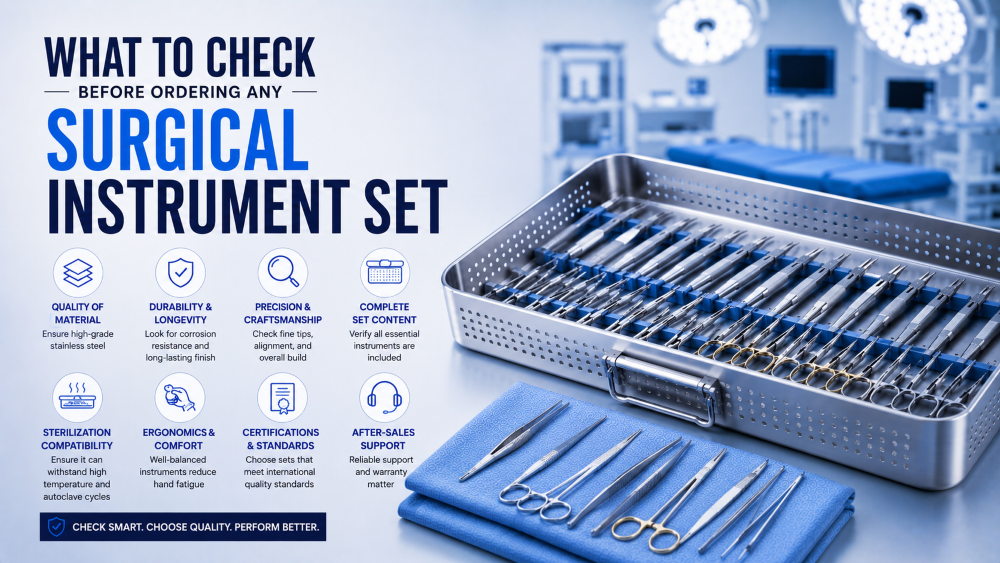
What to check before ordering any surgical instrument set
Before committing to a bulk set order — from any supplier — verify:
1. Full instrument list. Every set should come with a complete itemized list of instruments included. Vague descriptions like “general surgery set, approximately 30 pieces” are insufficient for procurement compliance. Request the full list.
2. Individual instrument specifications. For scissors: confirm blade type (standard, supercut, or diamond supercut). For forceps: confirm jaw pattern, serration type, and TC insert status. For needle holders: confirm jaw size and TC status.
3. Certification documents. ISO 13485 certificate, CE Declaration of Conformity, and FDA establishment registration should be available on request. NJ Medical provides all three.
4. Sterilization compatibility confirmation. All instruments in the set should be validated for steam sterilization (autoclave) at 134°C for standard cycle parameters.
5. Replacement instrument availability. Individual instruments from the set should be available for replacement purchase when items are lost or damaged. A set supplier who only sells complete sets makes long-term theater management more expensive.
NJ Medical supplies both complete sets and individual instruments — every item in every set is available for individual reorder at the same specification.
Bundle pricing and custom theater configurations
For hospitals and surgical centers equipping multiple theaters, or distributors configuring sets for resale, NJ Medical offers bundle pricing on sets and custom theater configurations. Specify your procedure mix, theater type, and required quantities — the sales team will provide a configured quote with full instrument lists.
Browse all surgical instrument sets and place your order directly: 👉 Shop surgical instrument sets at NJ Medical Instruments 📲 WhatsApp: +92-333-8733922 — bulk orders, custom sets, and OEM configurations welcome
Also in this series:
- How to choose the right surgical scissors for each procedure — Mayo, Metzenbaum, iris, facelift, blepharoplasty, and nasal scissors for every specialty
- Surgical forceps: a complete buyer’s guide for hospitals and clinics — artery, tissue, sponge holding, and specialty forceps
- German steel vs Sialkot surgical instruments: what surgeons actually need to know — material grades, certifications, and what the quality difference really is
Frequently asked questions
How many surgical instrument sets does an operating theater need? Each theater should have a minimum of 3 complete sets per procedure type to allow for sterilization cycling — while one set is in use, one is being sterilized, and one is on standby. High-volume theaters running continuous lists may need 4–5 sets to maintain throughput without delays.
What is included in a general surgery instrument set? A complete general surgery set includes scalpel handles, dissecting scissors (Mayo and Metzenbaum), hemostatic forceps (Mosquito, Kelly, Kocher, Rochester-Pean), tissue forceps (Adson, DeBakey), needle holders (Mayo-Hegar, TC-insert), grasping forceps (Babcock, Allis), retractors (Langenbeck), towel clamps (Backhaus), sponge holders (Foerster), and a solution bowl. NJ Medical’s general surgery HCIV set is pre-configured to cover all these requirements.
Can I order a custom surgical instrument set for my hospital? Yes. NJ Medical configures custom sets for hospitals, surgical centers, and distributors. Provide your procedure list, preferred instrument patterns, and quantity requirements. The team will build a configured set with a full itemized instrument list and pricing.
Are NJ Medical instrument sets ISO certified? Yes. All NJ Medical instruments and sets are manufactured to ISO 13485 quality management standards. The facility holds ISO 13485 certification, CE marking, and FDA registration — full documentation available on request.
What is the delivery time for surgical instrument sets? Standard sets in stock ship within 2–5 business days. Custom configurations and large bulk orders are typically fulfilled within 2–4 weeks from order confirmation. NJ Medical ships globally with full export documentation.
Can I get replacement instruments for a set I already purchased? Yes. Every instrument in every NJ Medical set is available for individual reorder. Contact the sales team with the instrument name or SKU and they will confirm availability and pricing for replacements.
Knowing which sets to stock is one half of the job. Knowing what is inside each one, and what every piece is called on a purchase order, is the other — see what is actually in twelve standard surgical trays, with a printable count sheet for each.