


German Steel vs Sialkot Surgical Instruments: What Surgeons Actually Need to Know

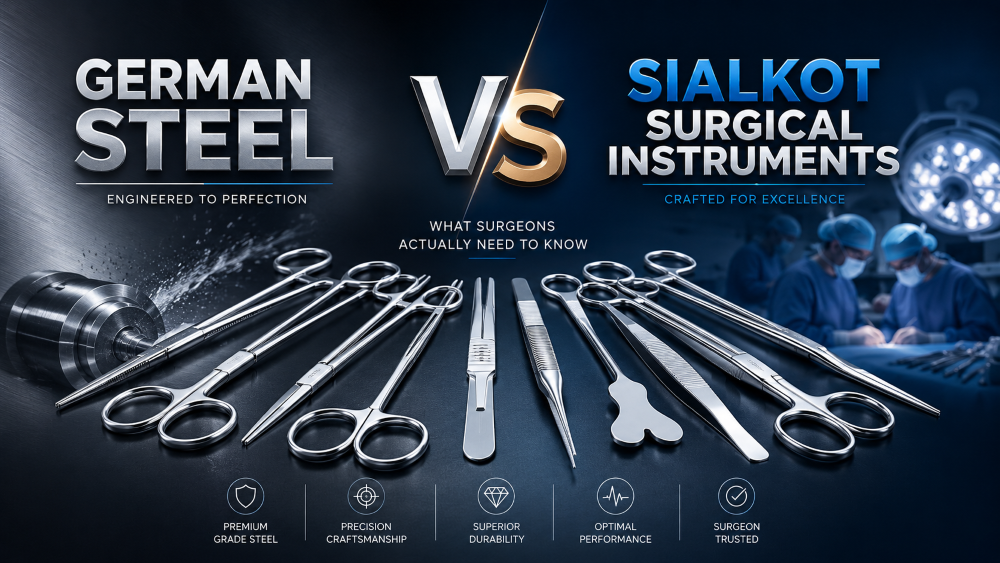
There is a question that comes up in almost every procurement conversation about surgical instruments from South Asia: “But are they as good as German ones?”
It is a fair question — and one that deserves a direct, factual answer rather than marketing language. The reality is that the Sialkot vs Germany debate is largely a myth built on decades-old assumptions, and it costs hospitals and distributors significantly more than it should every time they default to European suppliers without scrutinizing the actual specifications they are receiving.
This article breaks down the facts: what “German steel” actually means, how Sialkot instruments are manufactured and certified, where the genuine differences lie (there are some), and how to make an informed sourcing decision based on specifications rather than geography.
NJ Medical Instruments has manufactured surgical instruments in Sialkot since 1990 and supplies hospitals, clinics, and distributors in over 80 countries. All instruments are ISO 13485 certified, CE marked, and FDA registered.
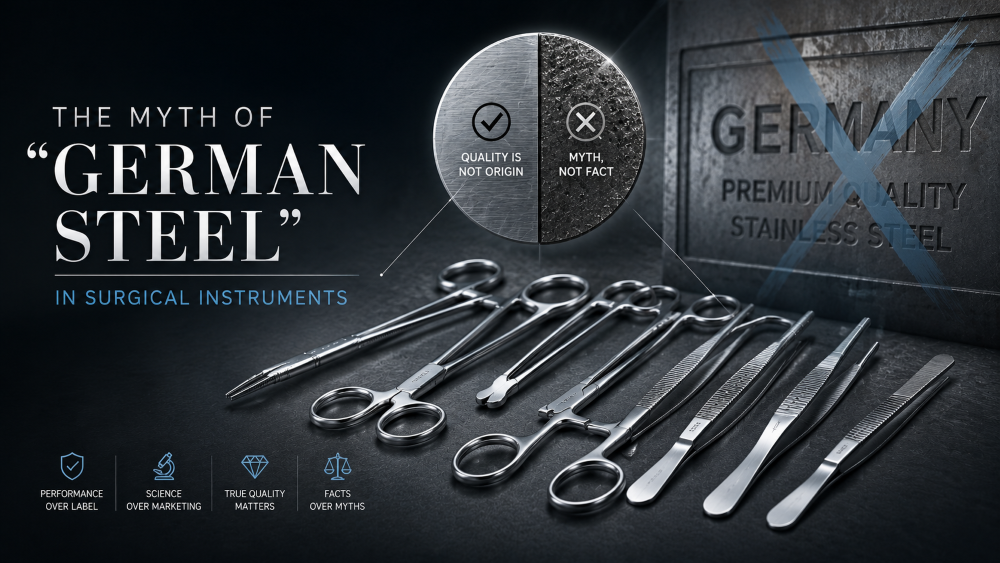
The myth of “German steel” in surgical instruments
When buyers ask for “German steel” instruments, they almost always mean one of two things: instruments manufactured in Germany, or instruments made from high-grade stainless steel originally associated with German steel mills.
Here is the important distinction: virtually no surgical scissors, forceps, or clamps sold today — including those from major European brands — are made in Germany. The vast majority of surgical instruments sold under European or American brands are manufactured in Sialkot, Pakistan, or Tuttlingen, Germany, with Sialkot producing the overwhelming share of global volume.
Tuttlingen, a small town in Baden-Württemberg, is the other global center for surgical instrument manufacturing and has been since the early 20th century. At its peak, it housed hundreds of instrument workshops. Today, most of those companies have shifted significant manufacturing to lower-cost regions — including Sialkot — while maintaining their European head offices, branding, and quality control systems.
The phrase “German steel” in a supplier’s catalog typically refers to the grade of stainless steel used in production, not the country of manufacture. It is a material specification claim, not a geographic one — and the same material grades are available to every manufacturer in the world, including every established factory in Sialkot.
What “surgical grade” stainless steel actually means
Surgical instruments are manufactured from martensitic stainless steel, primarily in the 400 series. The two most common grades are 420 and 440, with the choice depending on the balance required between hardness, corrosion resistance, and workability.
According to the International Organization for Standardization’s ISO 7153-1 standard — the globally recognized specification for surgical instrument materials — instruments must meet defined criteria for corrosion resistance, hardness, surface finish, and biocompatibility. This standard does not specify a country of origin. It specifies a measurable performance threshold.
NJ Medical Instruments manufactures to ISO 7153-1 using surgical-grade stainless steel that meets the same material specifications as instruments produced in Tuttlingen. The steel supply chains for both regions draw from global certified mills — the raw material is not geographically exclusive.
The key performance grades are:
| Steel grade | Hardness (Rockwell C) | Corrosion resistance | Primary use in instruments |
|---|---|---|---|
| 410 stainless | 28–34 HRC | Moderate | Economy instruments, handles |
| 420 stainless | 46–52 HRC | Good | Scissors, dissectors, general instruments |
| 440A/B/C stainless | 55–60 HRC | Good–excellent | Fine blades, ophthalmic instruments |
| Tungsten carbide inserts | 85–90 HRC | Excellent | Jaw inserts, blade edges on premium instruments |
What differentiates manufacturers is not access to the material — it is the heat treatment process, tempering, hand finishing, and quality control inspection that determine the final performance of an instrument made from the same steel grade.
How Sialkot became the world’s surgical instrument capital
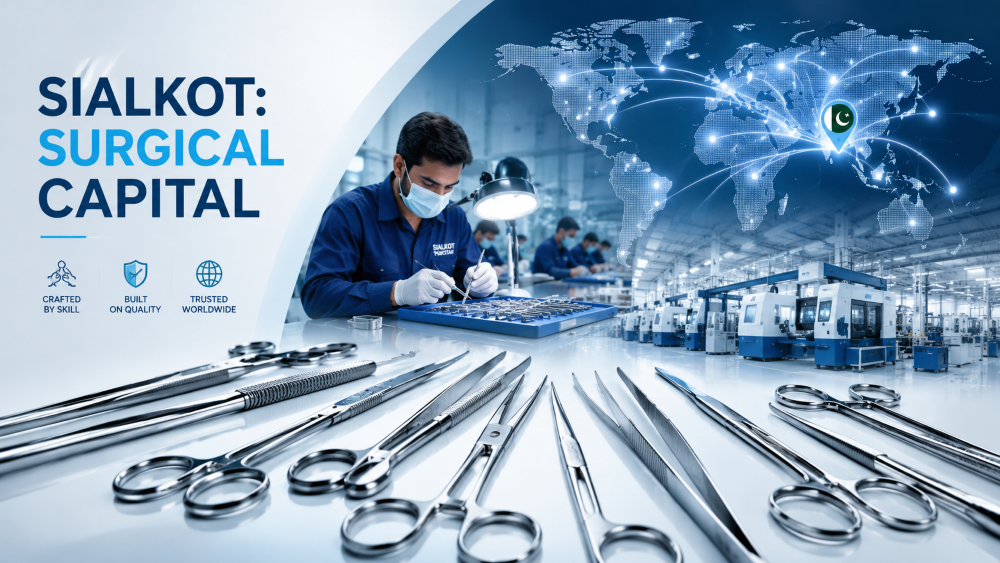
Sialkot’s surgical instrument industry has its roots in British-era colonial workshops that supplied the Indian subcontinent and East Africa from the early 1900s. After Partition in 1947, the cluster concentrated in what became Pakistan, grew rapidly through the 1960s and 70s supplying European buyers seeking lower-cost production, and by the 1980s had developed a fully integrated supply chain — steel forging, heat treatment, grinding, polishing, assembly, and quality inspection — all concentrated within a 30-kilometer radius.
Today, Sialkot manufactures an estimated 95% of the world’s reusable surgical instruments by volume, supplying manufacturers and distributors across Europe, North America, the Middle East, Africa, and Asia. The cluster includes over 2,000 registered manufacturers ranging from small artisanal workshops to large ISO-certified export factories.
The global instrument brands most surgeons recognize — whether European, American, or otherwise — source the majority of their production from Sialkot. The instruments that reach European operating theaters branded under German or Swiss names are, in most cases, manufactured in Sialkot and redistributed through European distribution channels with European pricing and European branding.
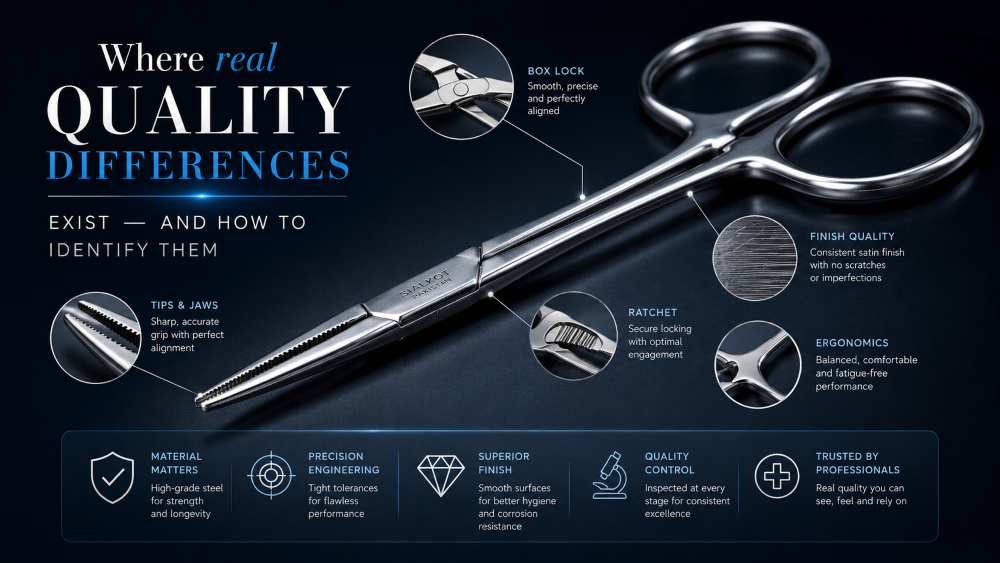
Where real quality differences exist — and how to identify them
Saying “Sialkot and Germany are the same” is as much an oversimplification as saying “Sialkot instruments are inferior.” Quality in surgical instruments is not determined by geography — it is determined by:
1. Manufacturing process and hand finishing
Sialkot has a wide quality spectrum. At one end are small unregistered workshops producing instruments for the low-cost disposable market. At the other are large certified factories with full ISO 13485 quality management systems, in-house metallurgy labs, and 100% inspection before export. The difference between a $4 artery forceps and a $40 one from Sialkot is not the steel — it is the manufacturing process, finishing, and QC.
Instruments manufactured to ISO 13485 at a certified facility go through:
- Forging from certified bar stock
- Initial grinding and shaping
- Heat treatment to the specified hardness
- Fine grinding and surface finishing
- Assembly and ratchet/hinge fitting
- Dimensional inspection against technical drawings
- Functional testing (jaw alignment, ratchet engagement, cutting test for scissors)
- Surface passivation (corrosion resistance treatment)
- Ultrasonic cleaning and packaging
A factory skipping or compressing any of these steps produces a cheaper instrument — regardless of what steel grade it claims to use.
2. Certification status
ISO 13485 is the Quality Management System standard for medical device manufacturers. CE marking is the European conformity mark required for instruments sold in the EU. FDA registration is required for instruments imported into the United States. These are not optional labels — they require third-party audits, documented procedures, and ongoing compliance.
NJ Medical Instruments holds ISO 13485 certification, CE marking, and FDA registration. Instruments supplied by NJ Medical to buyers in Europe, North America, and regulated markets meet the legal requirements for those markets — the same requirements that European-branded instruments must meet.
When buying from any supplier — Sialkot or Tuttlingen — ask for the certification documents. If a supplier cannot produce them, the instruments are not certified, regardless of what the catalog says.
3. Tungsten carbide and specialty materials
One area where genuine specification differences arise is in tungsten carbide insert instruments. TC jaw inserts — used on needle holders, tissue forceps, and scissors — are sintered carbide components that must be bonded precisely and inspected for bond integrity. Low-quality TC instruments can have inserts that debond after autoclave cycles or have inferior grip patterns that wear quickly.
NJ Medical’s tungsten carbide range — including the needle holder tungsten carbide, Gillies needle holder tungsten carbide serrated jaw, needle holder tungsten carbide heavy box lock, and needle holder tungsten carbide angled jaws — uses precision-bonded TC inserts with the same jaw pattern geometry used in high-end European instruments.
4. Instrument longevity through autoclave cycles
A well-manufactured surgical instrument from Sialkot, produced from 420-grade stainless with correct heat treatment, proper passivation, and solid assembly, will withstand the same number of steam sterilization cycles as a comparable European-branded instrument — typically 1,000+ cycles for standard instruments.
The variable is not origin. It is whether the passivation was correctly performed, whether the joint has appropriate metal-to-metal contact, and whether the surface finish is smooth enough to resist pitting from repeated autoclaving. These are process discipline questions, not geography questions.
A practical comparison: what you actually get from Sialkot vs German-branded instruments
| Factor | German-branded instruments | Certified Sialkot manufacturer |
|---|---|---|
| Manufacturing location | Mostly Sialkot or low-cost regions | Sialkot |
| Steel grade | ISO 7153-1 compliant | ISO 7153-1 compliant |
| Certifications available | ISO, CE, FDA | ISO, CE, FDA (from certified factories) |
| Price premium | 3×–8× higher | Baseline |
| Lead time | 4–12 weeks (distribution chain) | 2–6 weeks (direct) |
| Custom configurations | Limited | Available from most factories |
| OEM/private label | Not available | Available |
The price premium for European-branded instruments reflects the European distribution and branding layer — not superior manufacturing. Hospitals and distributors that buy directly from ISO-certified Sialkot manufacturers receive equivalent instruments at a fraction of the price, with the same certifications and significantly faster lead times.
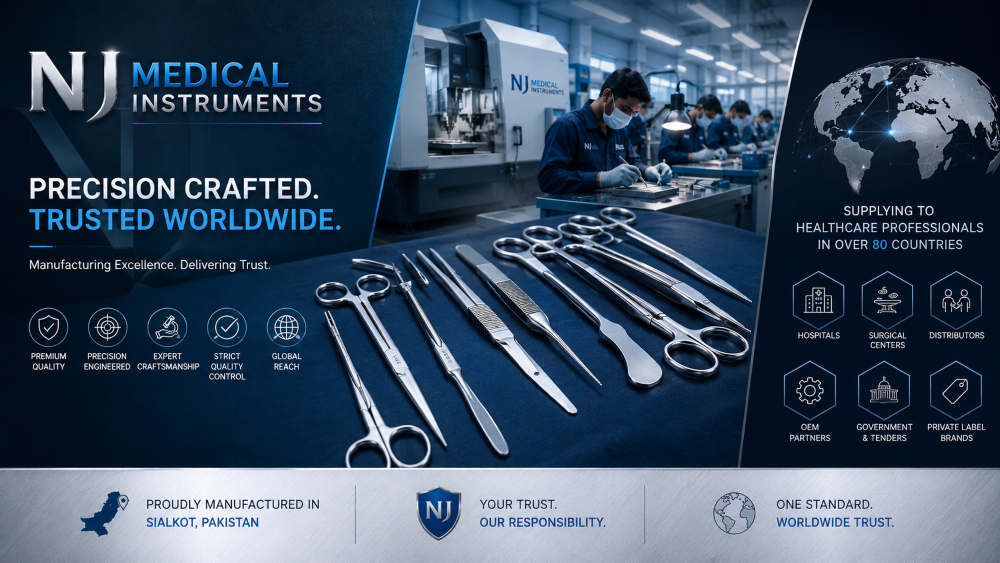
What NJ Medical Instruments manufactures — and who it supplies
NJ Medical Instruments manufactures over 10,000 products across every major surgical specialty. The full catalog spans:
General surgery: Mayo dissecting scissors, Metzenbaum dissecting scissors, Kelly artery forceps, Kocher artery forceps, Halsted Mosquito artery forceps, Babcock intestinal grasping forceps, Foerster sponge holding forceps, Allis tissue forceps standard pattern, Mayo Hegar needle holder, Mathieu needle holders
Plastic and reconstructive surgery: Complete rhinoplasty instruments set 69 pcs, Gubisch complete rhinoplasty instruments set, abdominoplasty surgery instruments set, breast augmentation instrument set, Adson blepharoplasty forceps tungsten carbide
ENT and diagnostic: Conventional curved laryngoscope set, fiber optic laryngoscope set, ENT diagnostic complete set, ENT diagnostic fiber optic otoscope set
Cardiovascular and vascular: DeBakey vascular tissue forceps, DeBakey vascular tissue forceps angled, DeBakey aortic aneurysm clamp
Orthopedic: bone curette, bone rongeur, anterior cervical plate instrument set
Ophthalmic: Castroviejo suturing forceps tungsten carbide, Castroviejo tying forceps, Castroviejo caliper 9 cm
Dental: dental elevator minimally invasive 12 pcs pack, 151 lower incisors cuspids bicuspids, 53R upper molar right
Electrosurgical: Adson European bipolar forceps, Adson non-stick bipolar forceps
General surgery sets: general surgery HCIV instrument set
Every instrument listed above is available for direct order through the NJ Medical online shop with global shipping, or via the sales team for bulk and custom configurations.
How to verify instrument quality before you buy — a checklist for procurement managers
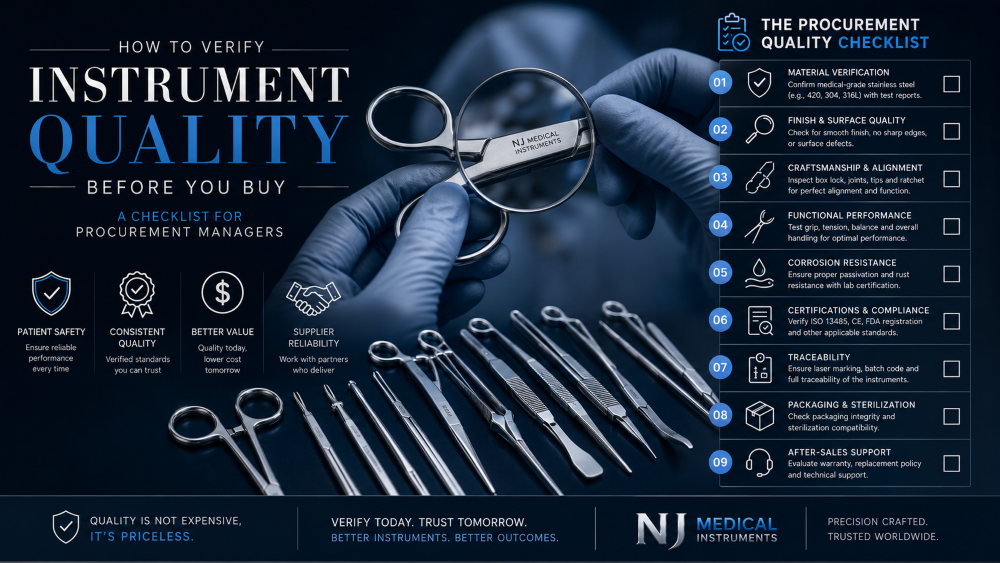
Before placing any surgical instrument order — from any supplier — verify the following:
✓ Request the ISO 13485 certificate with the certificate number. A genuine certificate is auditable. Ask for the name of the certifying body and verify independently.
✓ Ask for CE Declaration of Conformity for any instruments being imported into the EU or supplied to EU-regulated facilities.
✓ Request FDA establishment registration details for instruments imported into the United States.
✓ Ask for material certificates confirming the steel grade used in production. The certificate should reference the heat batch and the mill that supplied the steel.
✓ Request a sample order before bulk purchasing. Inspect for jaw alignment, ratchet engagement quality, surface finish consistency, and instrument weight relative to the specification.
✓ Ask about sterilization validation. The manufacturer should be able to confirm that instruments are validated for steam sterilization (autoclave) to the cycle parameters used in your facility.
✓ Confirm warranty and returns policy. A manufacturer confident in their quality provides a clear warranty on manufacturing defects.
NJ Medical Instruments provides full documentation on all of the above. Certificates are available on request and samples can be requested before bulk orders are placed.
The bottom line: buy on specifications, not on geography
Surgical instruments should be specified and procured the same way any clinical equipment is — on the basis of material grade, manufacturing certification, functional performance, and verified quality documentation. A CE-marked, ISO 13485 certified instrument from a Sialkot manufacturer operating to the same standards as a Tuttlingen facility is, by every measurable criterion, the equivalent of a European-branded instrument — at a fraction of the cost and with faster, more direct supply chain access.
The surgeons and procurement managers who have moved to direct Sialkot sourcing from certified manufacturers report the same clinical performance, significantly lower per-unit costs, and faster replenishment cycles. The ones still paying European distributor margins for instruments manufactured in the same factories are, in most cases, simply paying for the brand.
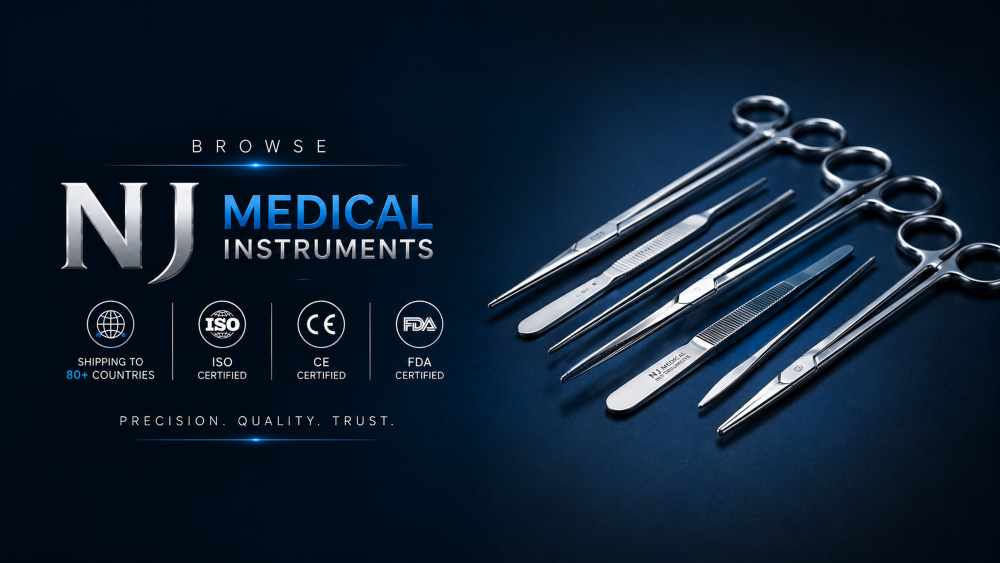
Browse NJ Medical Instruments — ISO, CE & FDA certified, shipping to 80+ countries
Ready to source directly from the manufacturer? 👉 Browse the full surgical instruments catalog at NJ Medical 📲 WhatsApp: +92-333-8733922 — bulk orders, OEM, and custom configurations welcome
Preiously in this series:
- How to choose the right surgical scissors for each procedure — covering Mayo, Metzenbaum, iris, facelift, nasal, and specialty scissors
- Surgical forceps: a complete buyer’s guide for hospitals and clinics — covering artery, tissue, sponge holding, and specialty forceps
Frequently asked questions
Are Sialkot surgical instruments ISO certified? Not automatically — ISO 13485 certification must be obtained by each individual manufacturer through third-party audit. NJ Medical Instruments holds ISO 13485 certification, CE marking, and FDA registration. Always request the certificate number from any supplier and verify it independently with the certifying body.
Is Sialkot steel the same as German steel? The phrase “German steel” in instrument catalogs typically refers to the grade of stainless steel used, not the country of origin of the steel itself. Certified Sialkot manufacturers, including NJ Medical, use surgical-grade stainless steel that meets the same ISO 7153-1 material standard as instruments produced in Germany. The steel supply chains are global — the same certified mills supply manufacturers in both regions.
Why are Sialkot instruments cheaper than European-branded ones? European-branded instruments carry the cost of a European distribution layer — importer margins, warehousing, rebranding, and marketing — on top of the manufacturing cost. Direct-from-Sialkot purchasing eliminates that distribution layer entirely. The manufacturing cost difference is modest; the distribution cost difference is significant.
How do I know if my current European supplier is actually manufacturing in Sialkot? Ask them directly where the instruments are manufactured. Many European and American brands will confirm Sialkot or “South Asia” manufacturing. If they decline to answer, that itself is informative. The alternative is to request a factory audit or third-party inspection report.
Can NJ Medical supply instruments for resale under my own brand? Yes. NJ Medical provides OEM and private label manufacturing services for distributors who wish to market instruments under their own brand. Contact the team via WhatsApp or the website for OEM enquiries and minimum order requirements.
What is the minimum order from NJ Medical? Standard instruments are available for individual purchase through the online shop with no minimum order. Bulk and wholesale pricing is available for larger orders. Contact the sales team for distributor pricing and OEM minimum quantities.