


Complete Guide to Dental Extraction Forceps: Which One for Which Tooth

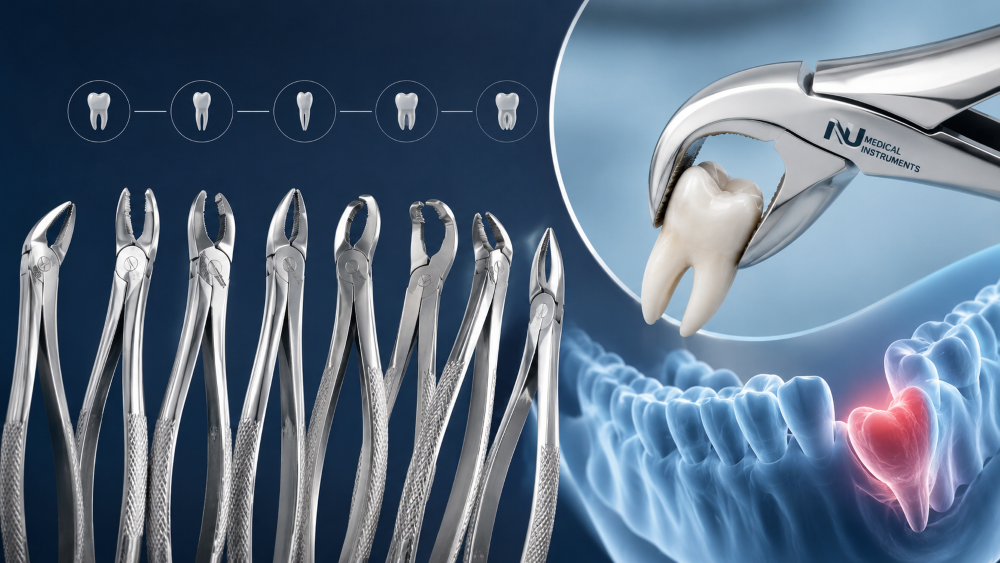
Picking the wrong pair of extraction forceps doesn’t just slow a procedure down — it makes a routine extraction harder than it needs to be, increases the risk of root fracture, and adds unnecessary chair time. Every tooth in the mouth has a different root shape, angulation, and crown anatomy, which is exactly why dental extraction forceps come in dozens of tooth-specific designs instead of one “universal” tool.
This guide breaks down every major type of dental extraction forceps, matches each one to the tooth it’s designed for, and explains the practical differences between English and American pattern instruments — so whether you’re a practicing dentist, a clinic procurement manager, or a dental student building your first kit, you’ll know exactly which forceps to reach for and why.
1. What Are Dental Extraction Forceps?
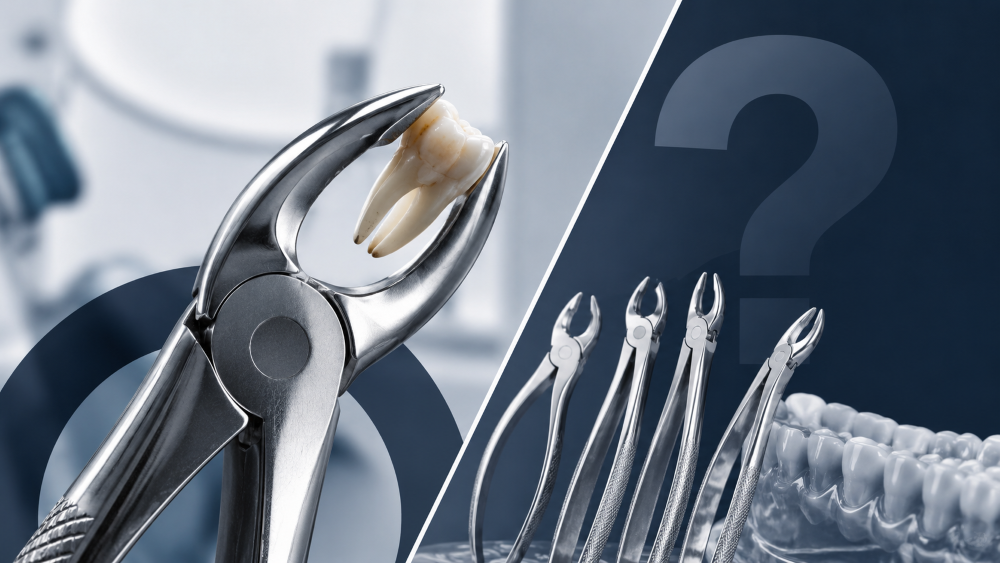
Extraction forceps are hinged, plier-like instruments designed to grip a tooth at the cervical line (near the gumline) and apply controlled rotational, luxating, or lever force to separate the root from the periodontal ligament and alveolar bone. Unlike a general-purpose plier, each forceps design has beaks shaped to match the crown contour and root number of a specific tooth or tooth group — upper vs lower, single-rooted vs multi-rooted, left side vs right side.
For restorative work, see our full range of amalgam burnishers, condensers and pluggers.
Using the correctly matched forceps reduces the force needed for extraction, protects adjacent teeth, and significantly lowers the chance of root tip fracture — which is the single most common complication in forceps extractions.
2. Anatomy of an Extraction Forceps
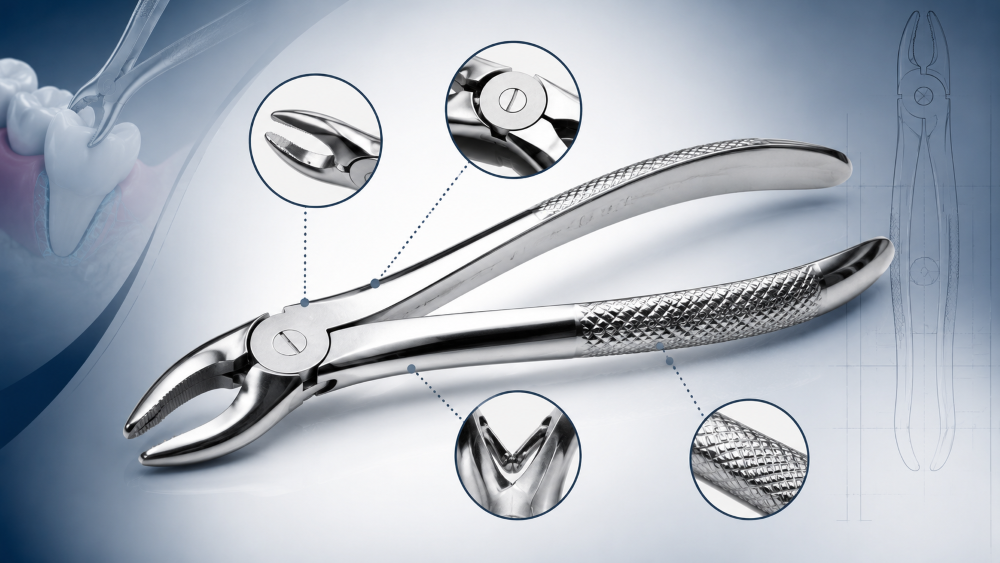
Every extraction forceps has three parts:
- Handles – Where the clinician grips; longer handles give more leverage for posterior teeth.
- Hinge (joint) – The pivot point; quality forceps use a precision-machined hinge that stays tight through hundreds of sterilization cycles.
- Beaks – The working tips that grip the tooth. Beak shape, angle, and width are what differentiate one forceps design from another.
The angle between the handle and the beak is what makes upper forceps and lower forceps look so different — upper forceps are nearly straight (in line with the handle) since the maxilla is accessed from above, while lower forceps have a sharp downward bend so the beaks can reach the mandibular arch at the correct angle.
3. Upper Jaw (Maxillary) Extraction Forceps by Tooth
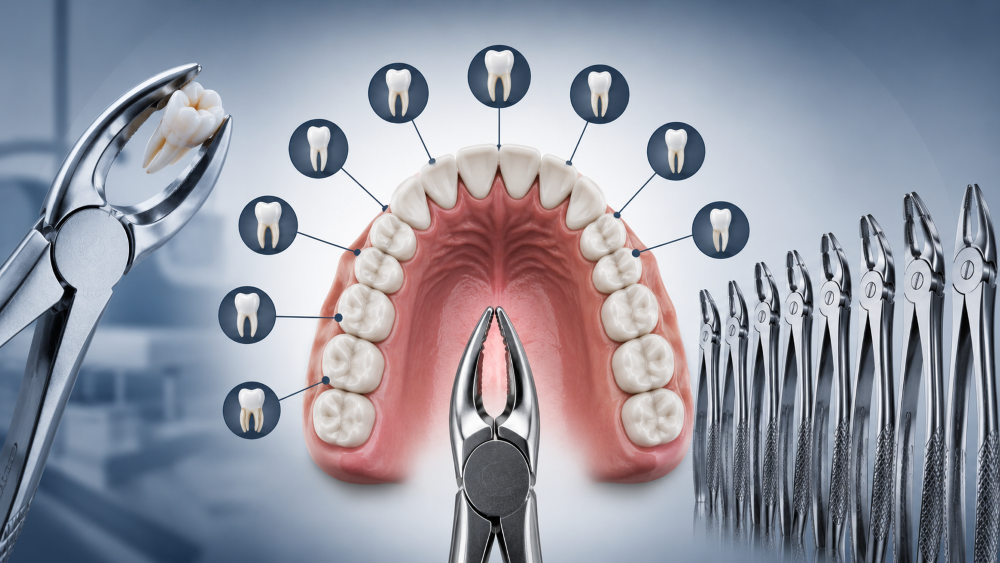
| Tooth | Forceps Type | Beak Design |
|---|---|---|
| Upper central & lateral incisors | Straight upper forceps (No. 1) | Narrow, straight beaks for single conical roots |
| Upper canines | Straight upper forceps (No. 1 or 1A) | Slightly wider beak for the longer canine root |
| Upper premolars | Upper premolar forceps (No. 4 series) | Slightly curved beaks to grip a single or bifid root |
| Upper first & second molars (right/left specific) | Upper molar forceps with a beak spur | One beak is pointed to fit between the two buccal roots, the other is flat for the palatal root |
| Upper third molars (wisdom teeth) | Upper wisdom tooth forceps (No. 210 series) | Shorter, angled beaks for restricted posterior access |
Because upper molars have three roots (two buccal, one palatal), the left and right upper molar forceps are not interchangeable — each has a beak spur oriented to fit the specific buccal groove on that side. A Harris upper molar (American pattern) forceps is a good example of this side-specific design.
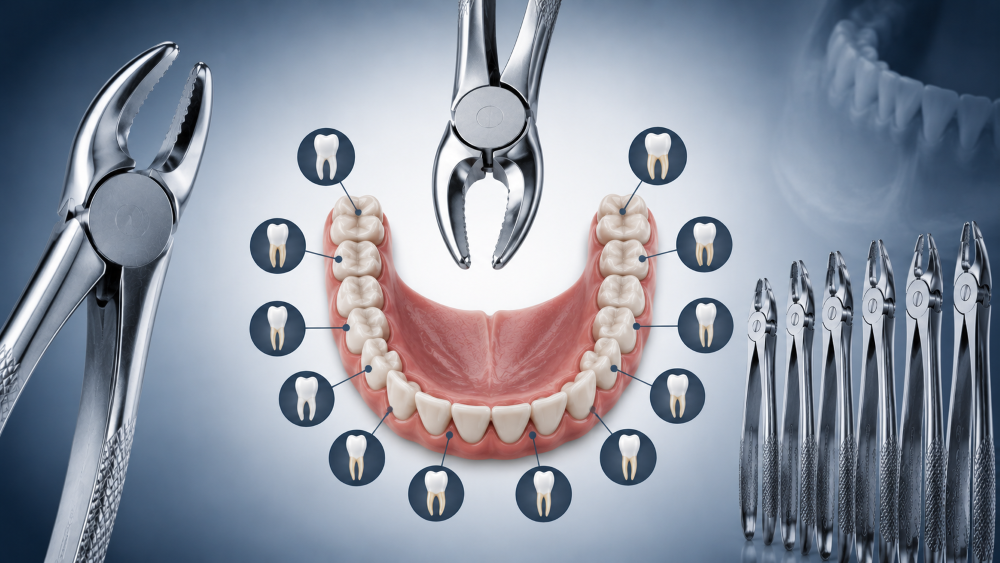
4. Lower Jaw (Mandibular) Extraction Forceps by Tooth
| Tooth | Forceps Type | Beak Design |
|---|---|---|
| Lower incisors & canines | Lower anterior forceps (No. 74N/151) | Narrow beaks, sharply angled shank for anterior access |
| Lower premolars | Lower premolar forceps (No. 74N series) | Similar to anteriors but slightly wider for premolar crown width |
| Lower first & second molars | Lower molar (cow horn) forceps | Two pointed beaks that engage the bifurcation between mesial and distal roots for a squeezing, lever-out extraction |
| Lower third molars (wisdom teeth) | Lower wisdom tooth forceps (No. 222/molar 79) | Compact head, steep angle for restricted posterior mandibular access |
The cow horn design is worth calling out specifically: instead of gripping the crown, the beaks are driven into the furcation (the split between the two roots) and then squeezed, which levers the tooth out rather than pulling it — ideal for lower molars with divergent or curved roots. A universal cow horn forceps (No. 23) is a staple in most extraction kits for exactly this reason.
For general lower molar work, an English pattern lower molars extracting forceps is another widely stocked option, particularly for clinics trained on the English instrument system.
5. English Pattern vs American Pattern Forceps
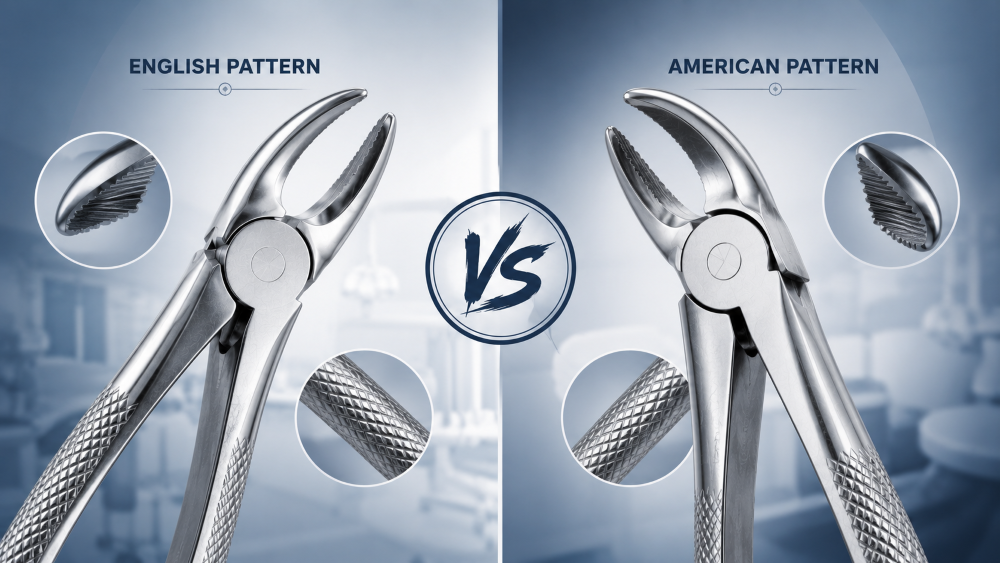
This is one of the most common points of confusion for new buyers, so here’s the practical difference:
- English Pattern – Handles are usually straighter and more slender, hinge sits closer to the beak, and the grip style favors a more traditional rotational technique. Popular across the UK, Commonwealth countries, and much of Asia.
- American Pattern – Handles tend to be broader with a more ergonomic curve, and beak geometry is often slightly more aggressive for a firmer initial purchase on the tooth. Common across North America.
Neither pattern is objectively “better” — the right choice depends on what technique a clinician was trained in and what the rest of their kit is built around. Because of that, it’s worth stocking both patterns if you supply multiple markets, which is why we manufacture extraction forceps in both English pattern and American pattern configurations.
6. Universal Forceps vs Tooth-Specific Forceps
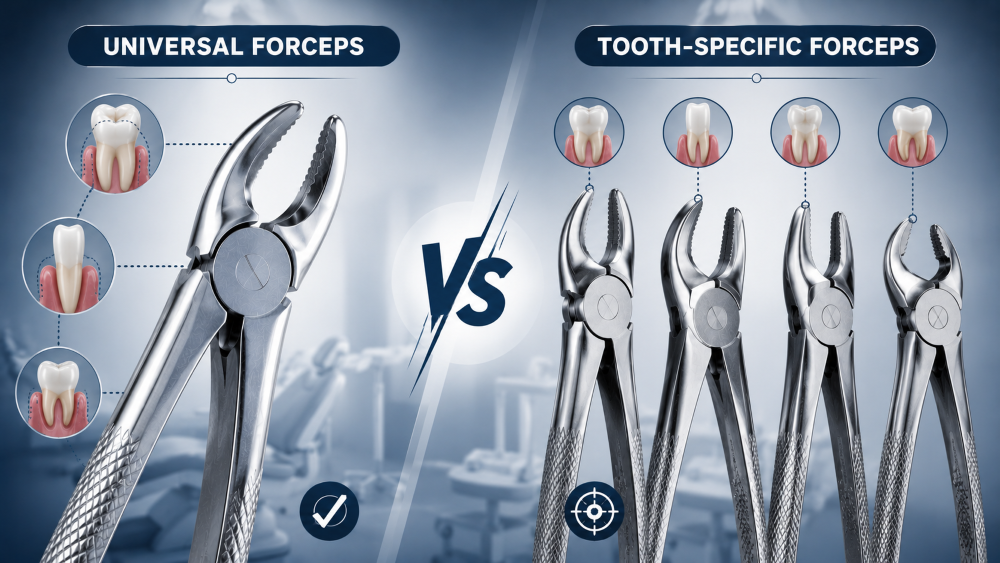
Some clinics try to minimize their kit size with “universal” upper or lower forceps that can technically grip several tooth types. These trade some precision for convenience and are reasonable for high-volume general extractions, but tooth-specific forceps remain the standard of care for:
- Molars (due to multi-root anatomy)
- Impacted or partially erupted teeth
- Any extraction where root fracture risk is elevated (curved roots, prior endodontic treatment, elderly patients with brittle dentin)
A well-stocked clinic typically keeps a full extracting forceps range rather than relying on one or two universal designs, particularly if the practice handles any oral surgery referrals.
7. Pediatric Extraction Forceps
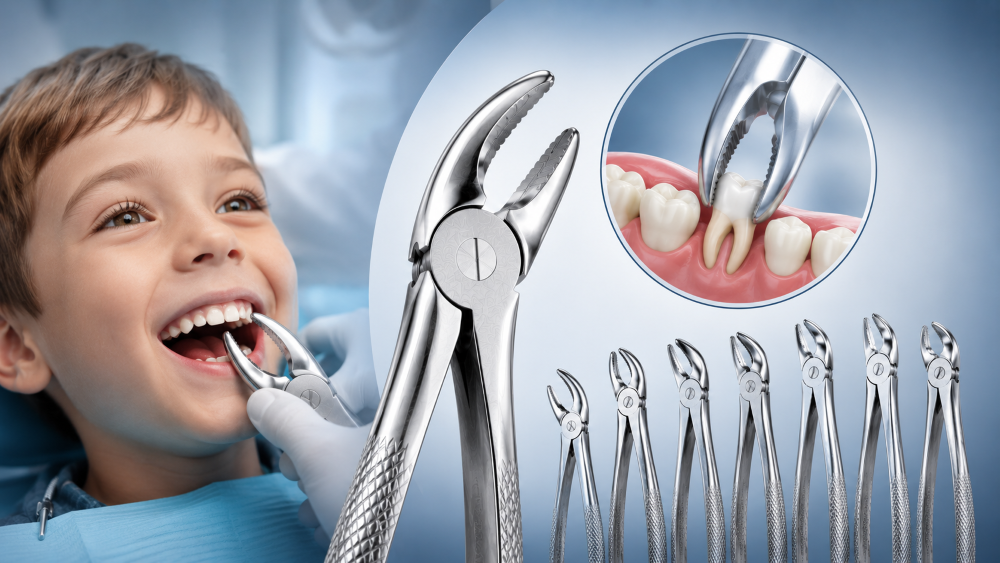
Primary (baby) teeth have shorter, more delicate roots that resorb naturally as the permanent tooth erupts, so pediatric forceps are scaled down significantly from adult designs — smaller beaks, lighter handle weight, and a gentler bite to avoid damaging the underlying permanent tooth bud. Pedodontic extraction forceps are sized specifically for this, and no pediatric dental kit should substitute adult forceps for children’s extractions — the fit and force profile are simply wrong.
8. Instrument Material & Build Quality
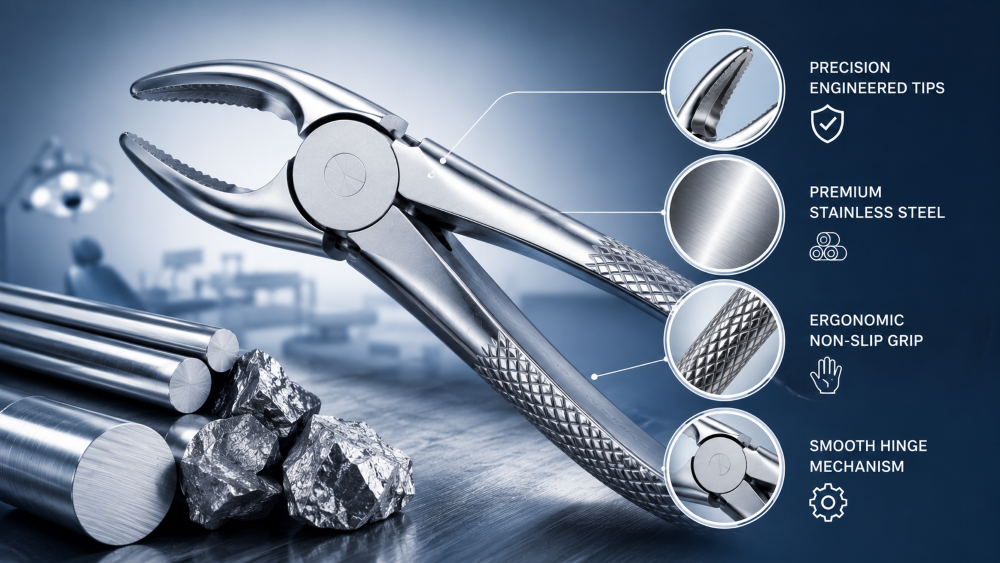
Extraction forceps undergo real mechanical stress — squeezing, rotating, and levering against dense bone and root structure — so material quality directly affects both patient safety and instrument lifespan. Look for:
- Surgical-grade stainless steel (typically 410 or 420 grade) for corrosion resistance through repeated autoclaving
- A precision-fitted hinge with no lateral play, which keeps the beaks aligned under load
- A consistent, rust-free finish after multiple sterilization cycles — a clear sign of proper heat-treatment during manufacturing
This is also where sourcing matters. Instruments forged and finished under ISO 13485 and CE-certified quality control hold their hinge tolerance far longer than mass-produced, unregulated stock — which is a major reason clinics standardize on a single trusted manufacturer rather than mixing suppliers.
9. Care, Sterilization & Lifespan
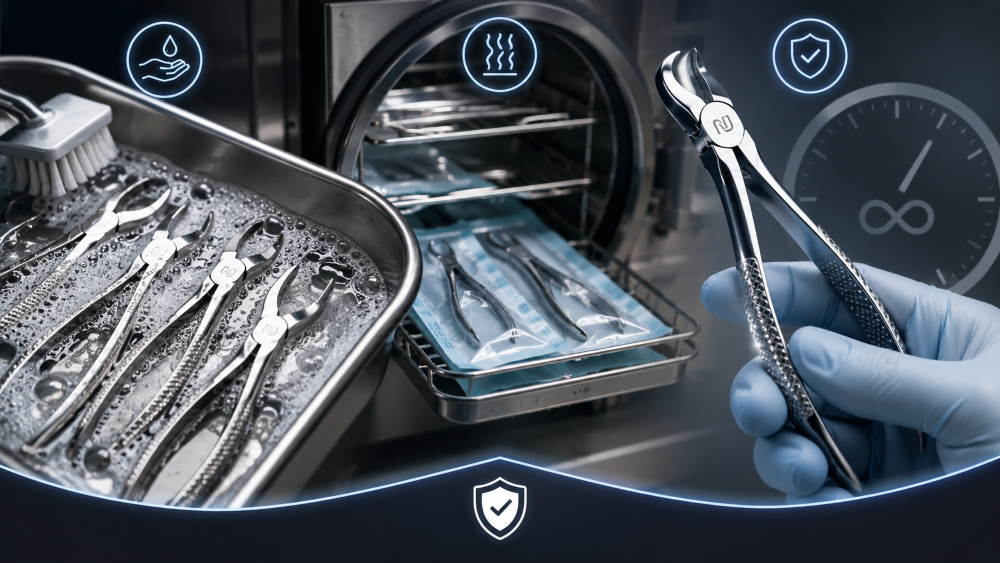
Even the best forceps will fail early with poor maintenance. A few practical rules:
- Rinse instruments immediately after use to prevent blood and debris from drying into the hinge.
- Autoclave according to the beak material’s rated temperature — most stainless steel forceps handle standard 134°C cycles without issue.
- Inspect the hinge periodically for looseness or grinding — a loose hinge is the earliest sign a forceps needs replacing.
- Store in a dedicated tray or sterilization container rather than loose in a drawer, to protect the beak tips from nicks that can tear soft tissue.
10. How to Choose a Dental Instruments Supplier

When you’re stocking or replacing an extraction forceps set, the supplier matters almost as much as the design. Look for:
- Full tooth-specific range — a supplier who only stocks 3–4 “universal” designs can’t cover a complete clinic
- Both English and American patterns available, so you’re not locked into one system
- Certifications (ISO 13485, CE) confirmed on the product page, not just claimed on the homepage
- Complementary instruments in stock — elevators, syringes, and extraction pliers so you can build a complete extraction kit in one order
NJ Medical Instruments manufactures and supplies the full range of dental extraction forceps — upper and lower, English and American pattern, adult and pediatric — alongside dental elevators, dental syringes, and orthodontic pliers, so clinics and distributors can source a complete extraction and dental kit from one manufacturer. Browse the complete dental instruments catalog or the full shop for bulk and clinic pricing.
11. FAQs

Q: Which forceps should I use for an upper molar extraction? A: A side-specific upper molar forceps with a beak spur — one pointed beak seats between the two buccal roots, the other flat beak sits against the palatal root. Left and right upper molars require different forceps.
Q: What’s the difference between English pattern and American pattern extraction forceps? A: English pattern forceps have slimmer handles and a hinge closer to the beak, favoring a rotational extraction technique. American pattern forceps have broader, more ergonomic handles and slightly more aggressive beak geometry for a firmer initial grip. The choice usually comes down to training and regional convention rather than one being objectively superior.
Q: What forceps are used for a lower wisdom tooth extraction? A: A lower third molar forceps (often labeled No. 222 or similar), which has a compact head and steep handle angle to reach the restricted posterior mandibular space.
Q: Can I use adult forceps on a child’s tooth? A: No. Pediatric (pedodontic) extraction forceps are scaled down specifically for primary tooth root anatomy and the force profile needed to avoid damaging the underlying permanent tooth bud.
Q: What are “cow horn” forceps used for? A: Cow horn forceps are used for lower molar extractions. The two pointed beaks are driven into the furcation between the mesial and distal roots, then squeezed to lever the tooth out — effective for molars with divergent or curved roots.
Q: How do I know when to replace extraction forceps? A: Watch the hinge. Any lateral play, grinding, or looseness under pressure means the beaks are no longer staying precisely aligned, which increases the risk of slippage during extraction — replace at that point rather than waiting for visible damage.
Choosing the right dental extraction forceps for every tooth reduces chair time, protects your patients, and protects your instruments. Explore the full range of extraction forceps, elevators, and dental instrument sets from NJ Medical Instruments, or get in touch for bulk clinic and distributor pricing.

Written by
Akif Javaid
Akif Javaid is the owner of NJ Medical Instruments, a surgical instrument manufacturer based in Sialkot, Pakistan and established in 1990. The company manufactures and supplies reusable surgical, dental, ENT and orthopedic instruments direct to hospitals, clinics and distributors worldwide, and produces private-label and OEM instrument sets to customer specification.
