



Surgical Forceps: A Complete Buyer’s Guide for Hospitals & Clinics | NJ Medical Instruments

Every surgical procedure uses forceps. From the first skin incision to the final suture tie, a surgeon’s hands rely on them to grasp, clamp, dissect, and hold tissue with a precision that fingers alone cannot deliver. Yet forceps are among the most under-specified items in procurement — hospitals routinely order “artery forceps” without specifying jaw pattern, length, serration type, or material grade, and end up with instruments that technically work but slow the scrub nurse and frustrate the operating surgeon.
This guide covers every major category of surgical forceps, the procedures they serve, the features that separate clinical-grade from substandard instruments, and what to look for when sourcing for a hospital, surgical center, or distribution business.
NJ Medical Instruments has manufactured surgical forceps in Sialkot, Pakistan — the world’s leading surgical instrument manufacturing hub — since 1990. All products are ISO 13485 certified, CE marked, and FDA registered, and are supplied to hospitals, clinics, and distributors across 80+ countries.
What are surgical forceps?
Surgical forceps are hinged, tweezer-like instruments used to grip, clamp, hold, and manipulate tissue, vessels, needles, or surgical materials during a procedure. They are broadly divided into two mechanical families:
- Thumb forceps (tissue/dressing forceps): Non-locking, spring-tension instruments operated by squeezing between thumb and fingers. Used for grasping and manipulating tissue.
- Ratchet/locking forceps (hemostatic/artery forceps): Instruments with a box lock hinge and ratchet mechanism that locks the jaws closed. Used for clamping vessels, controlling bleeding, and holding structures.
Within these two families are dozens of named patterns, each optimized for a specific surgical context.
Category 1 — Hemostatic and artery forceps
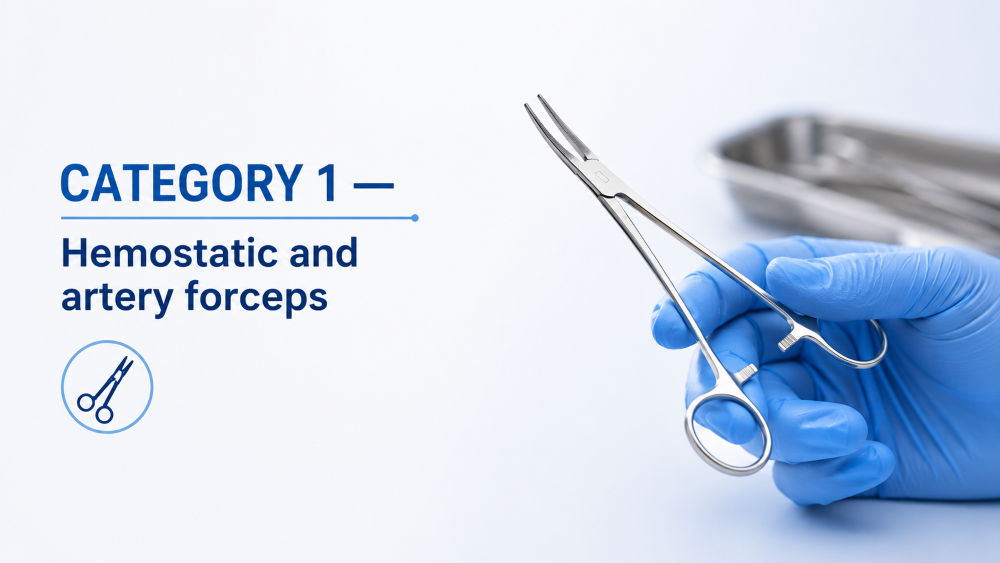
Hemostatic forceps are the most commonly ordered forceps in general surgery. Their primary function is to clamp blood vessels to control bleeding, though they are also used as dissectors, needle holders, and tissue holders in many procedures.
Halsted Mosquito forceps
The Mosquito is the smallest and most delicate of the hemostatic forceps family. It is used for clamping very fine vessels, securing small bleeders, and handling delicate tissue in pediatric, plastic, and ophthalmic procedures where larger instruments would cause unnecessary trauma.
NJ Medical supplies the Halsted Mosquito artery forceps, Halsted Mosquito forceps standard pattern serrated jaw, and the Halsted Micro Mosquito forceps extra delicate for microsurgical applications. The Hartmann Micro Mosquito forceps and Jacobson Micro Mosquito forceps are available for the finest microsurgical work.
Available in: Straight and curved. Lengths: 12.5 cm standard.
Kelly forceps
Kelly forceps are heavier than Mosquito forceps and are used for clamping larger vessels and tissue bundles. They are serrated only on the distal half of the jaw, which reduces tissue trauma at the tip while still providing a secure grip. This partial serration makes them a preferred choice in gynecological and general abdominal surgery.
From NJ Medical: Kelly artery forceps, Kelly forceps, Kelly hemostat forceps straight, and the Kelly Rankin artery forceps.
Available in: Straight and curved. Lengths: 14 cm–16 cm.
Crile forceps
Crile forceps are similar to Kelly forceps but have full-length transverse serrations along the entire jaw — not just the distal half. They provide a more secure grip on larger vessels and tissue pedicles. Standard in general surgery, thoracic, and abdominal procedures.
NJ Medical stocks Crile artery forceps, Crile artery forceps with teeth, and the Crile NJ Medical artery forceps in multiple lengths.
Available in: Straight and curved. Lengths: 14 cm–18 cm.
Rochester-Pean forceps
The Rochester-Pean is a large, heavy hemostatic clamp used for clamping thick tissue pedicles, large vessels, and in hysterectomy and other major abdominal procedures. The jaws run full-length serrations. They are among the strongest general-purpose hemostatic forceps and are frequently included in major laparotomy sets.
Available from NJ Medical: Rochester-Pean artery forceps, Rochester-Pean delicate artery forceps, and Rochester-Pean forceps.
Rochester-Ochsner (Kocher) forceps
The Kocher/Ochsner pattern adds 1×2 teeth at the tip of a heavy hemostatic clamp, combining crushing grip with a positive engagement for ligating large tissue bundles. They should not be used on delicate structures as the teeth cause intentional trauma. They are indispensable in thyroid surgery, mastectomy, and large vessel ligation.
NJ Medical stocks: Kocher artery forceps, Kocher forceps 1×2 teeth, Rochester-Ochsner artery forceps, Rochester-Ochsner delicate artery forceps, and Rochester-Ochsner forceps 1×2 teeth.
Pean forceps
The Pean is a straight or curved hemostatic clamp with full serrations and no teeth — a lighter general-purpose clamp commonly used in European operating rooms as a standard artery forceps. The Pean artery forceps from NJ Medical is available in multiple lengths.
Rochester-Carmalt forceps
The Carmalt pattern has longitudinal serrations running the length of the jaw with cross serrations only at the tips. This design is engineered to prevent the instrument slipping off a large vessel or pedicle under traction. Standard in hysterectomy and urological surgery. Available from NJ Medical as the Rochester-Carmalt forceps longitudinal serrated jaw.
Category 2 — Tissue forceps (thumb forceps)
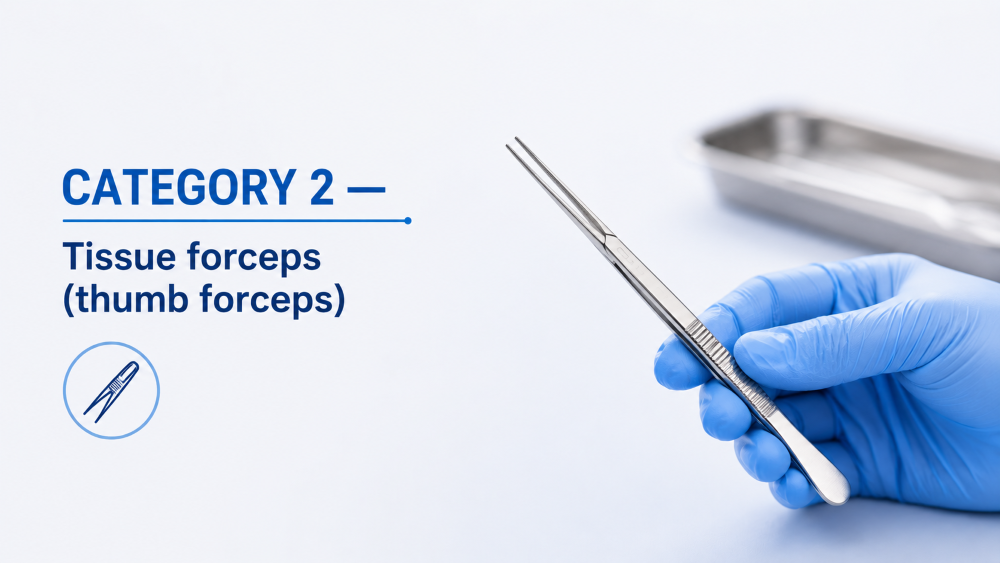
Tissue forceps are non-locking spring instruments that grip tissue for the duration of the hold and release on demand. They are the most used instrument in any scrub nurse’s hand during a procedure.
Adson forceps
The Adson is the standard tissue forceps of plastic surgery, skin closure, and wound repair. The fine, serrated or toothed tips produce minimal tissue trauma. The handle is lightweight and allows fine tactile feedback — essential when working on skin flaps and delicate wounds.
NJ Medical’s Adson range includes: Adson thumb forceps cross serrated tips, Adson thumb forceps angled tips, Adson tissue forceps 2×3 teeth, Adson dressing forceps tungsten carbide serrated, and the Adson tissue forceps tungsten carbide serrated 1×2 teeth.
For plastic surgeons, the Adson Brown tissue forceps and Adson Brown tissue forceps tungsten carbide serrated 7×7 teeth are particularly popular for precise skin edge handling.
DeBakey vascular forceps
The DeBakey is the gold standard for vascular and cardiovascular surgery. The jaw features a distinctive double row of fine, longitudinal serrations that grip the vessel wall without crushing — a critical feature when working on aortic grafts, coronary vessels, and delicate anastomoses. Using a toothed or heavily serrated forceps on a vessel causes intimal damage that can lead to thrombosis or aneurysm.
Available from NJ Medical: DeBakey vascular tissue forceps, DeBakey vascular tissue forceps angled, and the Adson DeBakey dressing forceps atraumatic 1.5 mm tips for finer vascular work.
Russian tissue forceps
Russian forceps have a distinctive round, multi-fenestrated cup at the tip that provides a broad, atraumatic grip on tissue without piercing it. They are used extensively in gynecological, abdominal, and colorectal procedures for grasping bowel, uterine tissue, and peritoneum.
NJ Medical stocks: Russian tissue forceps and Russian model tissue forceps.
Allis tissue forceps
Allis forceps have multiple fine, interlocking teeth along the jaw edges and are used for gripping and retracting tissue firmly — particularly fascia, bowel serosa, and skin edges during wound closure. They produce some tissue trauma intentionally and should not be used on structures that must remain undamaged.
NJ Medical’s range covers: Allis tissue forceps standard pattern, Allis intestinal grasping forceps, Allis atraumatic intestinal grasping forceps, and the Allis Babcock tissue forceps angled.
Babcock forceps
Babcock forceps are atraumatic grasping instruments with a smooth, fenestrated oval jaw. They are the standard forceps for handling bowel, fallopian tubes, appendix, and any hollow structure that must not be crushed. They are essential in bowel surgery, appendectomy, and gynecological laparoscopic procedures.
Available from NJ Medical: Babcock intestinal grasping forceps, Babcock tissue forceps tungsten carbide jaws, Babcock baby tissue forceps extra delicate jaws, and Beasley-Babcock tissue forceps.
Sponge-holding forceps (ring forceps)
Sponge-holding forceps have ring-shaped or oval jaws on long handles. Their primary use is holding sponges and swabs for wound cleaning, applying antiseptic, and packing cavities. They are also used for holding delicate tissue structures in gynecology and general surgery.
NJ Medical stocks: Foerster sponge holding forceps, Foerster Ballenger sponge forceps, Rampley sponge holding forceps, Maier sponge holding forceps, Fletcher-Javerts sponge forceps, and sponge holding forceps 9.5″ straight smooth jaws.
Category 3 — Specialty and procedure-specific forceps
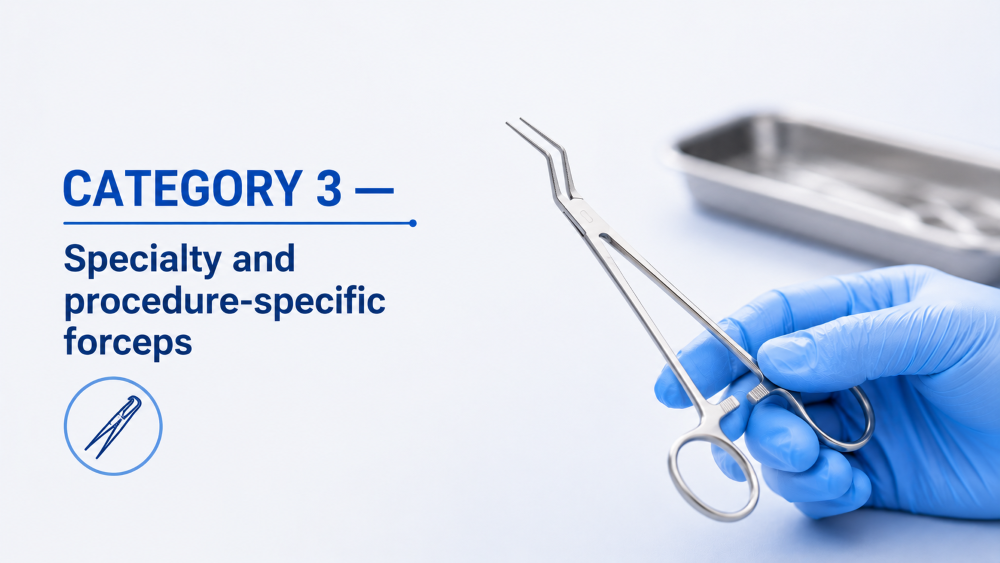
Heaney hysterectomy forceps
A heavy-duty tissue clamp designed specifically for clamping the uterine broad ligament, cervical tissue, and uterosacral ligaments during hysterectomy. The angled jaw enables access in the deep pelvis. NJ Medical’s Heaney hysterectomy forceps and Heaney tissue forceps cross serrated 2×3 teeth are standard specifications for gynecological theaters.
Duval lung and intestinal forceps
Duval forceps have a triangular fenestrated jaw designed for atraumatic grasping of the lung, bowel, and other visceral structures. The Duval intestinal grasping forceps and Duval-Collins tissue grasping forceps are both stocked by NJ Medical.
Lovelace lung grasping forceps
Used for grasping and retracting lung tissue during thoracic surgery. The Lovelace lung grasping forceps from NJ Medical features the standard multi-fenestrated jaw designed to minimize trauma to fragile parenchymal tissue.
Pennington tissue grasping forceps
The Pennington pattern has a triangular, serrated jaw commonly used in rectal surgery and colorectal procedures. The Pennington tissue grasping forceps 12 mm wide jaws provides a firm, controlled grip on rectal tissue with minimal trauma.
Jaw design quick-reference table
| Jaw type | Grip mechanism | Best use | Risk if misused |
|---|---|---|---|
| Plain serrated | Transverse serrations | General vessel clamping | Slippage on large pedicles |
| 1×2 teeth (Kocher) | Teeth + serrations | Heavy tissue ligation | Tissue damage if used delicately |
| Longitudinal (DeBakey) | Fine longitudinal ridges | Vascular — aorta, vessels | None — atraumatic by design |
| Atraumatic ring (Babcock) | Smooth oval cup | Bowel, hollow organs | Inadequate hold if over-stretched |
| Multi-fenestrated (Russian) | Round cup | Peritoneum, uterus | Bulky in tight spaces |
| Fine serrated (Adson) | Light cross serration | Skin, fine tissue | Slippage on wet heavy tissue |
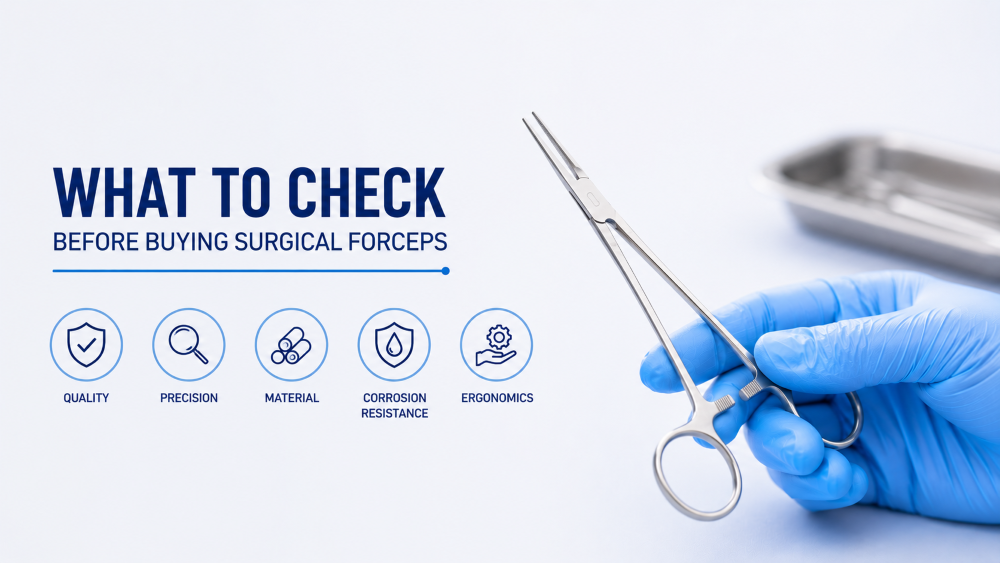
What to check before buying surgical forceps
1. ISO 13485 and CE certification. These are non-negotiable for any hospital or clinic purchasing for patient use. NJ Medical Instruments holds both, along with FDA registration. These certifications are auditable and available on request — not marketing claims.
2. Material grade. According to the World Health Organization’s guide to surgical instrument specifications, surgical instruments must be manufactured from appropriate grade stainless steel with sufficient corrosion resistance for repeated autoclaving. NJ Medical uses surgical-grade stainless steel manufactured to ISO 7153-1 standards.
3. Jaw alignment. Hold the forceps to the light when closed — the jaws must meet evenly along their full length with no lateral deviation or gaps. Misaligned jaws indicate poor manufacturing tolerances and will fail to hold tissue securely.
4. Ratchet tension. The ratchet on locking forceps must engage cleanly at each position and hold without slipping under load. Test by applying firm lateral pressure — the ratchet should not release.
5. Tungsten carbide inserts. For high-volume operating theaters, TC insert forceps last significantly longer and maintain jaw grip quality through many more autoclave cycles than plain stainless steel. NJ Medical supplies TC insert variants across all major forceps patterns.
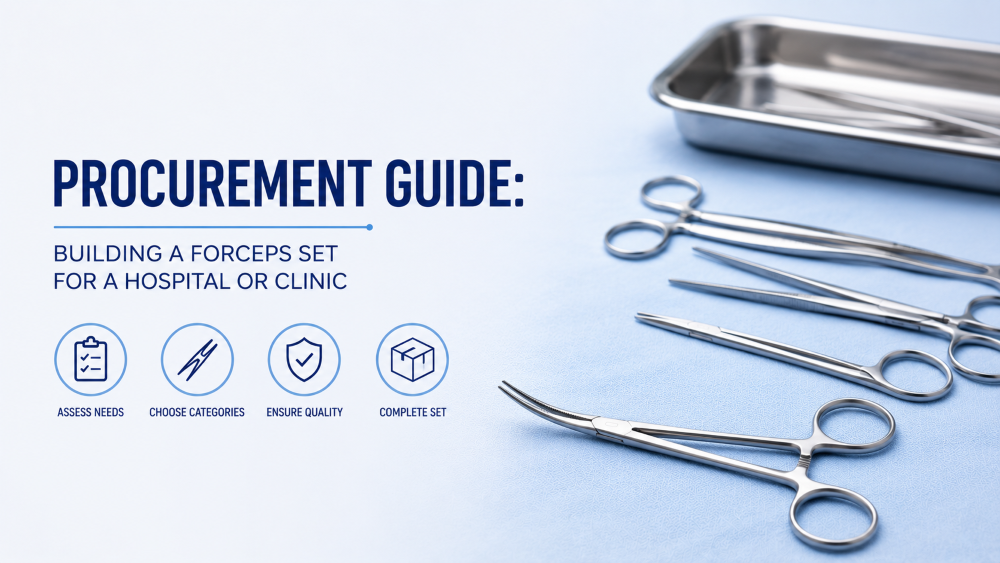
Procurement guide: building a forceps set for a hospital or clinic
A typical general surgery theater should be stocked with at minimum:
- 4–6 pairs Halsted Mosquito (straight and curved)
- 4–6 pairs Kelly (straight and curved)
- 4–6 pairs Crile (curved)
- 2–4 pairs Rochester-Pean (for major procedures)
- 2 pairs Rochester-Carmalt (for hysterectomy and major pelvic work)
- 2–4 pairs Kocher/Ochsner (for vessel ligation)
- 2–4 pairs Adson thumb forceps (skin closure)
- 2 pairs DeBakey vascular (cardiovascular or vascular procedures)
- 2–4 pairs Babcock (bowel and visceral procedures)
- 2–4 pairs Allis (tissue retraction and grasping)
- 2 pairs Foerster sponge holders (wound preparation)
For specialty theaters — gynecology, thoracic, plastic surgery — additional procedure-specific patterns should be added based on the surgical repertoire of the department.
NJ Medical supplies complete instrument sets and custom trays in addition to individual instruments. Contact the team via WhatsApp or the website for a configured set quote for your theater type.
How to order surgical forceps from NJ Medical Instruments
NJ Medical supplies individual instruments, complete sets, and wholesale bulk orders directly from Sialkot. All products are in stock for immediate dispatch and ship globally with full documentation for customs and hospital procurement compliance.
Ready to equip your theater? 👉 Browse the full forceps range at NJ Medical Instruments 📲 WhatsApp: +92-333-8733922 📧 Contact via website for bulk and distributor pricing
For related instruments used alongside forceps in general surgery, read our guide to surgical scissors types and uses — covering Mayo, Metzenbaum, iris, facelift, and nasal scissors for every surgical specialty.

Frequently asked questions
What is the difference between artery forceps and tissue forceps? Artery forceps (hemostatic forceps) are locking instruments with a ratchet mechanism, designed to clamp and hold vessels or tissue pedicles under sustained pressure. Tissue forceps are non-locking spring instruments used to grip and manipulate tissue momentarily during a procedure. Both are used in virtually every operation — they serve different purposes and cannot substitute for each other.
Which forceps are used in gynecological surgery? Gynecological surgery typically uses Heaney forceps for hysterectomy, Rochester-Carmalt and Kocher forceps for pedicle clamping, Babcock forceps for bowel and fallopian tube handling, Russian forceps for peritoneum and uterus, and Foerster sponge holders for wound preparation. NJ Medical supplies all of these with ISO and CE certification.
What does tungsten carbide mean in forceps? Tungsten carbide (TC) inserts are extremely hard jaw inserts that replace the standard stainless steel jaw surface. They maintain their grip and edge quality significantly longer than plain steel — important in high-volume settings where instruments are autoclaved daily. TC forceps are identified by gold-colored ring handles on most NJ Medical instruments.
What jaw pattern should I choose for bowel surgery? For bowel and visceral surgery, the primary forceps are Babcock (atraumatic, fenestrated oval jaw), Duval (triangular fenestrated jaw), and Russian (round cup jaw). All three are available from NJ Medical in standard and delicate sizes.
Can I order a custom forceps set for my hospital’s theater? Yes. NJ Medical configures custom instrument sets for operating theaters, clinics, and distributors. Contact the sales team via WhatsApp (+92-333-8733922) or through the website with your procedure list and quantity requirements.
How many artery forceps does a general surgery theater need? A fully equipped general surgery theater typically requires 20–30 hemostatic forceps across all patterns per set, with 2–3 sets per theater to allow for sterilization cycles. NJ Medical supplies bulk theater sets with quantity pricing for hospital procurement teams.